Wednesday, February 29, 2012
Updated: Cline Removed from Office
Monday, February 27, 2012
Judge Marcia Morey, Roving Character Witness for Wayward Prosecutors
Morey's record as an evaluator of DA's, however, is a bit on the shaky side. This is the same Judge Morey who appeared as a character witness on behalf of Mike Nifong during his ethics proceedings. At the time--and after months of reports showing that Nifong had issued at best misleading statements and at worst outright lies about the lacrosse case, including to Judge Smith--Judge Morey testified, "I have never doubted his truthfulness."
And then, to close her cross-examination in the ethics hearing, the judge gave this extraordinary response:
Q: Is it your testimony that Mike Nifong currently [as of June 2007] enjoys a reputation for truthfulness?
Morey: I think he does.
Courtesy of WRAL, here's a video of Judge Morey at Nifong's 2007 criminal contempt trial, at which she advanced the extraordinary argument that in evaluating the candor of a prosecutor, it "makes a difference" whether a case is at the trial stage or in pre-trial motions.
Given her own willingness to stand up on behalf of not one but two ethically challenged chief prosecutors, it's a wonder that Judge Morey considers herself qualified to opine about the "administration of justice," at least as the term is commonly understood.
Thursday, February 23, 2012
Cline Hearing
And she also had this exchange:
Q: Is it your testimony that Mike Nifong currently enjoys a reputation for truthfulness?I'd say that Judge Morey was a particularly appropriate witness on behalf of DA Cline.
A: I think he does.
Update, 3.22pm: Cline might have just lost any chance to get hired by a Group of 88-dominated department if she's removed from her position: she suggested that people can claim racism when it's not there, and in so doing can disturb efforts to combat real racism.
That answer, alas, came as part of a give & take in which Cline refused to back down on any of the specific words she used in her anti-Hudson motions.
Update, 3.14pm: Cline continues to insist that everything in all of her filings is true, and says that she has no regrets about her decision to file complaints against Hudson.
The hearing continues:
Cline insisted this morning that she was unfairly criticized by the News & Observer, repeating complaints she has lodged for months despite evidence that she is wrong in her assertions.
"I’m not saying I disagree with them. I’m saying they were false," Cline said. The N&O stands by its reports.
Editors at the N&O refuted Cline's assertions that it failed to report the district attorney's office provided rough notes from the SBI in a case that has since been dismissed. Last summer, Cline backed down from that after being shown the exact passage in the article that details that information. Use the controls on the right side of this page to listen to audio of that interview.
This morning, Cline again asserts that the N&O left out that piece of information.
Cline also refused to back down from assertions that N&O reporter J. Andrew Curliss was held in contempt of court in the Allen matter, even though an assistant clerk testified last week that there's no evidence of that anywhere in the court file or in the database of criminal charges.
Cline admitted she never checked the file to look for any contempt filings for Curliss. Still, she insists he was charged.
Saturday, February 18, 2012
Legal Updates
A few legal updates:
Both the Carrington and McFadyen attorneys had additional recent filings. Though they contained nothing as explosive as Brodhead’s implicit comparison of the falsely accused lacrosse players to a sociopath who murdered a corrupt cleric, they offered more reasons why Duke shouldn’t want this case to go to trial.
The Carrington filing, which blasts “Duke’s hyper-compartmentalized approach to relevance,” offers a glimpse into the unindicted players’ litigation strategy. (Duke is trying to prevent virtually all discovery related to the university’s p.r. strategy.) The attorneys want to “establish what (and when) President Brodhead knew about the credibility of the rape allegations,” expecting “information about Duke’s public relations strategy to reveal a fixation on the institution’s public image that eclipsed any interest the university may otherwise have had in vindicating the reputations of its wrongly accused students.”
In particular, Duke has sought to block all inquiries into whether and when senior administrators were informed about the (lack of) evidence relating to false accuser Crystal Mangum’s claims. Why is this relevant? “If Duke continued to undermine Plaintiffs after learning the negative results of Mangum’s rape kit, that information would suggest that Duke’s efforts to bolster Mangum’s allegations were driven by its desire to salvage its own reputation.”
If I were a Duke attorney, I too would do whatever I could to avoid scrutiny as to who came up with the idea for Brodhead to address the Durham Chamber of Commerce shortly after the Seligmann and Finnerty arrests and deliver his infamous “whatever they did was bad enough” line.
The McFadyen filing, meanwhile, offers interesting nuggets regarding the most vulnerable area for Duke: the university’s almost unfathomable decision to turn over FERPA-protected keycard data to the police, and then the school’s decision not to come clean for months about what it had done.
Duke’s approach to defending this claim, at least to date, appears to have been the see-no-evil, hear-no-evil strategy. From the filing: “With respect to the topics relating to Plaintiffs’ fraud claim, Ms. Wasiolek had no personal knowledge of any of the material facts, reviewed a handful of documents, and spoke with only 4 people. Ms. Wasiolek had no clear recollection of the documents she reviewed, and she did not interview any of the individuals named or identified in connection with Plaintiffs’ fraud claim.” This list of four people, incredibly, did not include the Duke police officer who, in violation of FERPA, handed over the keycard data. “And yet, Ms. Wasiolek swore under oath that no one else was more knowledgeable or better able than she to testify about the noticed topics on behalf of Duke University.”
Has Duke elected to pursue willful ignorance as a defense strategy?
----------------
The Tracey Cline hearing remains scheduled for Monday, yet her newly-hired attorney, Jim Van Camp, demanded a delay. This course of action was necessary, wrote he, “because this case is both unique and special, and because of the dramatic, personal tensions inherent to allegations set forth in the Affidavit, an unnecessary and expedient hearing can only risk Ms. Cline being merely prepared to offer a mercurial defense based on emotional rather than a calm, rational defense based on facts."
That her attorneys didn’t have much time to prepare, however, was solely the fault of Cline—her delay in hiring counsel caused the problem. Kerry Sutton opposed the request, terming it “disingenuous,” and yesterday, Judge Hobgood appropriately denied it.
In addition, Sunday's N&O contained a lengthy feature on Cline and her background. Two items jumped out: (1) Cline twice had her law license suspended, because she didn't pay her State Bar fees; (2) An alleged incident in Elizabeth City. Here's how N&O reporter Mandy Locke described it:
In July 1993, she headed to the state's northeast corner to work as a prosecutor in a cluster of counties near Elizabeth City. Her stint there was short-lived, just six months, and unremarkable, according to supervisors.
But years later, when she filled out a questionnaire in 2008 when running for district attorney, Cline said that at work in Elizabeth City, she was "confronted with what I felt was a disparity in justice based solely on race. I refused to be a part of that injustice." She said in an interview last summer that she didn't recall the exact issue.
Both her bosses, former district attorney H.P. Williams and current district attorney Frank Parrish, say they have no idea what Cline is recalling. Both are mystified by her feelings about her time in Elizabeth City, saying it seemed cordial.
"I hated to see her leave," Williams said. "I'm surprised to hear she remembered that time as difficult. I would have given her a good recommendation."
Detecting racial grievances for imagined or non-existent slights? If she is removed from office, perhaps Cline can join the Duke faculty. The Group of 88 doubtless would welcome such an ideological soulmate.
--------------
Friday’s H-S referenced a long-forgotten figure, “Spoiler Steve” Monks, In an article about a petition candidate for county commissioner, reporter Ray Gronberg recalled the last time the petition tactic was used in a high-profile Durham County race—the Lewis Cheek (Recall Nifong) effort.
In that campaign, Gronberg remembered, “Write-in candidate Steve Monks in that race bypassed both the primary and petition routes and wound up getting 11 percent of the vote. That earned him a reputation as a spoiler whose involvement wound up swinging the election to the since-disbarred Nifong.”
Given how the case ended—with Nifong forced by ethics charges to turn matters over to the AG for a fair investigation—it’s easy to assume that this ending was inevitable. Yet the State Bar committee’s vote for immediate ethics charges was 9-8; without that vote, Nifong could have plowed ahead on his unethical course.
If that vote hadn’t occurred, the impact of “Spoiler Steve” would have been considerable indeed.
----
Finally, Sunday's ESPN Outside the Lines had an excellent feature on former FIU baseball player Garrett Wittels, who almost certainly was the target of a false rape accusation (the charges were ultimately dropped; video evidence contradicted the unidentified accusers' tales; the father of one of the accusers was sued by NASCAR for allegedly trying to construct a rape frame against a NASCAR employee). The allegations alone, however, were enough to prevent him from being selected in the MLB draft.
Unlike Duke's handling of the falsely accused lacrosse players, FIU didn't suspend Wittels (nor, obviously, did it cancel the baseball team's season), even though Wittels admitted all along that "something" (sex with one of the accusers) happened. There was no FIU equivalent of the Group of 88. It's worth wondering, however, whether the FIU administration would have been so respectful of due process if Wittels' accusers hadn't been rural Arkansans.
You can see the report here.
Friday, February 10, 2012
Cline Requests (And Receives) Delay
And, as Andy Curliss points out, she claims that Judge Hobgood found probable cause regarding one element of Sutton's complaint on which, in fact, he did not find probable cause.
Again, this is a filing in a case that could bring about Cline's removal. And, as is her usual pattern, she couldn't be bothered to run a spell-check, and ensure that her facts were accurate?]
It seems likely that Cline's request will be granted. But the motion itself doesn't inspire confidence in the likelihood of her ultimate success.
Tuesday, February 07, 2012
Poynter & The Serial Fabricator
I recently did a post at Minding the Campus examining how the media responded to the Times’ Patrick Witt article—a piece of “journalism” that’s looking worse by the day, and which the Times public editor has now repudiated.
The most extraordinary (and counterintuitive) critique came from Poynter’s Kelly McBride—who faulted the Times, which had bent over backwards to frame the case against Witt as negatively as possible, for not doing enough to ensure that Witt’s accuser’s story was represented. To bolster her line of argument, McBride turned to adjunct law professor Wendy Murphy, who had distinguished herself in the lacrosse case for her willingness to fabricate, fabricate again, and fabricate some more.
Poynter describes its mission as promoting “excellence and integrity in the practice of craft.” The organization claims that “we teach . . . ethical decision-making,” with teaching “focused on the highest standards of journalistic value.” How could this type of organization turn to a serial fabricator such as Murphy?
In an e-mail, I provided McBride with a list of many (but not all) of Murphy’s public, factual inaccuracies (as well as her various unsubstantiated opinions and denigrations of due process). McBride replied that she saw no problem at all in her use of Murphy as either a source or a seminar instructor. She even seemed willing to rationalize Murphy’s difficulties with the truth, describing the list in the following manner: “Some of those statements are her opinions. Some of them are statements she made based on her expertise in the subject area. Some of them are taken out of context.” I invited McBride to identify any of the factual errors as items “taken out of context”; she did not reply.
No one would expect McBride to be an expert on Murphy’s record in the lacrosse case (although the media’s failures, and Murphy’s role in them, was explored at great length in the American Journalism Review, which presumably is on every Poynter faculty member’s regular reading list). But it seems as if Murphy’s serial fabrications mattered not to McBride, who affirmed that even after hearing of them, she’d eagerly invite Murphy back to teach at Poynter.
McBride’s response confirms observations from Alex Pareene, who described Murphy’s career as showing that “there are, in the mass media, absolutely no consequences for blatant, constant lying,” and Radley Balko, who came away from his own experience of Murphy inventing facts to ask, “At some point you have to wonder, is it even possible to be too shameless for cable news?” It seems that as long as Murphy still gets quoted by the media and retains the backing of like-minded figures within the “victims’ rights” movement, two alleged Murphy qualifications mentioned by McBride, she’ll receive Poynter’s seal of approval—factual inaccuracies and wildly intemperate, unsubstantiated opinions be damned. Would Poynter be as cavalier if women or minority groups had been the targets of Murphy’s bile?
-------------------
Between April 5, 2006 and December 31, 2006, Murphy made no fewer than 18 factually inaccurate statements in her TV commentary about the lacrosse case. She made at least eight more factually inaccurate statements about the case in December 21, 2006 and January 9, 2007 “talking points” forwarded by “victims’ rights” groups, plus at least one factual error in a late 2006 USA Today op-ed. Twenty-seven outright errors of fact on a single case is quite a tally. And that list, of course, doesn’t include Murphy’s misleading statements that were phrased in the form of questions or speculation, or her use of unsubstantiated rumors.
Facts are facts, and McBride’s insinuation that “context” could somehow transform Murphy’s factual errors into “facts” is absurd. But context does matter in interpreting factual errors. That Murphy’s factual errors weren’t random but almost always tilted against the lacrosse players suggests she wasn’t simply amazingly sloppy (a problem that in and of itself would seem to disqualify someone as a Poynter source or seminar instructor). Instead, Murphy’s fabrications bolstered her preconceived views, suggesting deliberateness to her fabrications.
In this respect, and despite McBride’s implication, the broader context of Murphy’s remarks was even more damning than the myriad factual inaccuracies taken alone. Beyond factually inaccurate descriptions of North Carolina legal procedures or some defense motions, each time in such a way to reinforce the ultimately-disbarred Mike Nifong’s position, Murphy’s serial fabrications tended to fall into one of three general categories:
(1) The April 4, 2006 photo array, which provided the only specific evidence used to indict the three falsely accused players and which Nifong had ordered the DPD to confine to members of the lacrosse team, did not violate DPD procedures, because many lacrosse players didn’t attend the party, and therefore these non-attendees could be deemed fillers. Confirmation for this “fact” came from a neutral source on the criminal case, Duke president Richard Brodhead.
Here was the Poynter source/seminar instructor on May 2, 2006: “According to Durham president, the president of the university, he said March 22 in a press release, many players weren’t there that night. Well, what does that tell us? It tells us the defense motion [on the lineup] is a bunch of nonsense, because if many players weren’t there, it’s a darned good chance if this was a hoax that she could have gotten it wrong.” Murphy returned to the theme in a December 21 e-mail: “The line-ups were not unlawful. According to the president of Duke, ‘many’ players were not at the party—and many NON-players WERE.” [Emphasis added in both instances; capitalization in original.]
Murphy’s description of Durham’s lineup procedures was wrong: Nifong had publicly identified as suspects all 46 white lacrosse players, the only people included in the April 4 photo array, and the Durham Police Department procedures required photos of five non-suspects for each photo of a suspect. Wouldn’t a lawyer understand the definition of a non-suspect?
In the event, the most extraordinary element of these two statements came in Murphy’s invention of a Brodhead statement regarding the party’s composition. John Burness, Duke’s then-P.R. head, confirmed that Brodhead made no statement, of any kind, about the case on March 22, 2006; and that Brodhead never claimed, one way or the other, to possess knowledge on who did or did not attend the party. Murphy simply made up a statement to corroborate her preconceived viewpoint.
(2) Considerable evidence actually bolstered the prosecution’s version of events, although defense attorneys or the media concealed some of this evidence.
Murphy looked to bolster false accuser Crystal Mangum’s credibility to pointing out that “Brett and Matt happen to be the real names of two of the captains who lived in that home.” (At least in some of her myriad stories, Mangum had claimed that her attackers were named Adam, Matt, and Brett.) But Murphy’s statement was factually inaccurate: the first names of the captains who lived at the house were Matt, Dave, and Dan, and their names had been widely reported.
In a May 2, 2006 interview, Murphy pointed to hidden evidence (that, in fact, didn’t exist and that the police and Nifong had never claimed existed). Dismissing test results that indicated no DNA matches to any of the lacrosse players, Murphy asserted that “the broomstick DNA has not yet been revealed.” The only problem: there was no “broomstick DNA,” since even the mentally imbalanced Mangum had never claimed an assault by broomstick.
Turning her concealment argument to the lawyers, Murphy suggested that the defense attorneys had “withheld” 1000 pages of documents (sometimes she said the figure was 1200). In fact, Judge Osborn Smith had ordered the pages to be sealed, because they contained Mangum’s psychological records. That ruling had been made in open court, and was widely reported; defense attorneys releasing the records would have placed them in contempt.
When all else failed, Murphy accused the lacrosse players and their attorneys of criminal obstruction, as in her assertion that “all the photographs showing how really fine [Mangum] was when she left scene [photos frequently cited in various defense motions] were doctored, where the date stamp was actually fraudulent.” [Emphasis added in both instances.] Even the utterly corrupt Mike Nifong never challenged the photos’ veracity, and the subsequent AG’s investigation confirmed the photos’ accuracy by cross-checking various other forms of electronic data.
(3) The lacrosse players behaved as if they were guilty; or had profiles that would lead a fair-minded observer to believe they might be guilty.
In one of her first appearances on the case, on April 19, 2006, Murphy reported some basic, and seemingly troublesome, “facts”: “All of them [the lacrosse players] took the Fifth. All of them refused to cooperate. All of them refused to give a DNA sample, until the court produced an order compelling them to do so.”
Each of these three statements was a lie. No player ever invoked the Fifth Amendment, at any point in the case. The three captains who lived in the house where the party occurred cooperated (foolishly, in retrospect) wholly with police, including voluntarily giving DNA samples and offering to take lie-detector tests. A few days before this parade of falsehoods, the Poynter source/seminar instructor had invented a statement by an unidentified neighbor asserting that members of the 2006 lacrosse team had committed “other sexual offenses.” No such statement existed, and no members of the team had committed “other sexual offenses.”
The pattern of Murphy making up “facts” to portray the lacrosse players as behaving suspiciously continued throughout the case. One of the people picked by Mangum, Reade Seligmann, had an unimpeachable electronic alibi (he had called a cab with his cell phone, and then was shown on a time-stamped ATM video more than a mile away from the captains’ house) for the time of the alleged attack. This was a major problem for Nifong, but not for Murphy; in a December 21, 2006 e-mail, she simply altered “facts” to make Seligmann look guilty. She wrote, “In fact, the guy Seligman [sic] who claims his cell phone calls ‘prove’ his innocence actually lends support to the theory that he was the first guy to assault her—which is what she claims—and that it was oral—because he could have assaulted her for the first few minutes—then thought to himself ‘I’ve got to get out of here’—which explains why he frantically and repeatedly called a cab. who frantically calls a cab to see if they’re coming—in a space of five minutes—especially considering that the guy went to an ATM and a pizza place when he left—no real emergency there. Isn’t it convenient that he just happens to be one of the guys she accused?”
This statement had no relationship with the truth. Though Mangum never told the same story twice, she never claimed that one of her attackers left during the attack, nor that any of her attackers had used a telephone, nor did she ever make any clear claim that Seligmann could be identified as “the first guy to assault her.” Seligmann, whose cell-phone records were posted on the web for Murphy to see, didn’t “frantically and repeatedly call[] a cab”; he called the cab once, and the cab came a few minutes later. And before Murphy’s statement, no one had ever claimed that Seligmann went to “a pizza place when he left.”
--------------
Perhaps the most outrageous thing that Murphy said during the lacrosse case was not, because of the way she framed her remark, a demonstrably untrue statement. On May 3, 2006, in an appearance on “CNN Live,” the Poynter source/seminar instructor mused, “I bet one or more of the players was, you know, molested or something as a child.”
An unsubstantiated insinuation, on national TV, that a college student was sexually molested? That’s a disgusting statement—indicative of a coarse mind and a bullying temperament, not “dynamic and thought-provoking,” which is how McBride describes Murphy. Yet McBride, by her own admission, wasn’t surprised to see the Poynter source/seminar instructor make such an assertion. If insinuating child abuse against people* about whom she knew nothing isn’t enough for disqualify Murphy in McBride’s eyes, what would constitute going too far? And how, possibly, could a figure who made such a remark provide instruction “focused on the highest standards of journalistic value” that would promote “excellence and integrity in the practice of craft”?
In recent months, the departure of Jim Romenesko somewhat tarnished Poynter’s reputation, as has the organization’s uneven (or worse, as SI’s Richard Deitsch might suggest) performance as ESPN ombudsman. But I always had believed that Poynter was committed to journalistic integrity, and never considered that it might be an organization that would use a serial fabricator as both a source and a seminar instructor for guiding journalists’ behavior.
It appears that I was wrong in these beliefs. And unlike Wendy Murphy, I’m willing to admit when I make a mistake.
*--modified for clarity
Saturday, February 04, 2012
Two E-Mail Chains; Or R. Brodhead, Movie Critic
The closing scene of Primal Fear, the movie referenced by Richard Brodhead as, it seems, an avenue through which to interpret the lacrosse case. Brodhead's private comment came a few days after the arrests of Reade Seligmann and Collin Finnerty. Could this chilling portrayal by Ed Norton really be how the Duke president perceived his institution's own students?
Courtesy of a Bob Ekstrand filing, two e-mail chains, including five April 2006 e-mails, from senior Duke administrators.
Martin Vail is a prominent defense attorney in Chicago who jumps at the chance to represent Aaron Stampler, a young, stuttering altar boy accused of murdering the Archbishop. At first interested primarily in the publicity that the case will bring, Vail comes to believe that his client is truly innocent, much to the chagrin of the prosecutor (and Vail's former lover), Janet Venable.
Vail discovers that powerful civic leaders, including the District Attorney, have lost millions in real estate investments due to a decision by the Archbishop not to develop certain church lands. The archbishop received numerous death threats as a result. He also learns that the archbishop had been sexually abusing altar boys, including Stampler.
Introducing this evidence, while it would make Stampler more sympathetic to the jury, would also give his client a motive for murder, something the prosecution otherwise has lacked.
The trial does not proceed well for the defense, as there is considerable evidence against Stampler and public opinion holds him almost certainly guilty. When Vail confronts his client and accuses him of having lied, Aaron breaks down and transforms into a new persona, a violent sociopath who calls himself "Roy." He confesses to the murder of the archbishop and throws Vail against the wall, injuring him.
When this incident is over, Aaron appears to have no recollection of it. Molly Arrington, the psychiatrist examining Aaron, is convinced he suffers from multiple personality disorder due to childhood abuse by his own father. However, Vail cannot enter an insanity plea during an ongoing trial.
Vail sets up a confrontation in court. After Venable questions him harshly, Aaron turns into Roy and charges at her, threatening to snap her neck if anyone comes near him. Aaron is subdued by courthouse marshals and is rushed back to his cell. In light of Aaron's apparent insanity, the judge dismisses the jury in favor of a bench trial and then finds Aaron not guilty by reason of mental insanity, and remands him to a mental hospital
Vail visits to tell him this news. Aaron says he recalls nothing of what happened in the courtroom, having again "lost time." However, just as Vail is leaving, Aaron asks him to "tell Ms. Venable I hope her neck is okay," which is not something that Aaron should have been able to remember if he had "lost time." Vail points this out, whereupon Stampler grins slyly and reveals that he has been pretending to be insane the whole time. But he didn't make up the identity of Roy, he made up Aaron.
Stampler now admits to having murdered the archbishop, as well as his girlfriend, Linda, whom the cleric also had molested. Stunned and disillusioned, Vail walks away, with Roy taunting him from the cell.
Did Brodhead see the lacrosse players as sociopaths? This cultural reference suggests an astonishingly negative view of the two students who had just been indicted. Or perhaps the president was merely asking his colleagues about the previous night's schedule on HBO.
Tuesday, January 31, 2012
Yale & Witt
Friday, January 27, 2012
Cline Suspended
Sunday, January 22, 2012
Politics of Grievance at Duke [Updated: The Group, and Tim Tyson, Strike Back]
[Updated, Friday, 1.07pm: In the race-to-the-bottom among critics of the paper, none other than Tim Tyson--yes, that Tim Tyson--has weighed in on the matter. In virtually any other environment, Tyson would have no credibility to comment on public matters. This was, after all, a figure who so badly misjudged the lacrosse case that he participated, as a "teacher," in a candlelight vigil on behalf of false accuser Crystal Mangum (who he described as somebody's "sweetheart") a couple of hours before Mangum took the stage, in a highly . . . limber . . . fashion, in a local strip club.
But in the race/class/gender-dominated academy, a race-baiter like Tyson speaks pearls of wisdom. And so in yesterday's Chronicle, Tyson goes after Peter Arcidiacono, fuming, "Who appointed [Arcidiacono] to weigh the merits of black folks being allowed into the room?" I was unaware that tenured faculty members like Arcidiacono had to be "appointed" before they could engage in scholarly inquiry.
As with virtually all of Arcidiacono's critics, Tyson does not challenge the data that the paper of Arcidiacono, et al., uncovered. Instead, he resorts to the race-baiting attack lines: after disingenuously suggesting that he's not challenging the academic freedom of people who don't share his world-view, he does just that: "Duke’s treasure, the late Dr. John Hope Franklin, whose legacy Arcidiacono treads upon, provided research for Thurgood Marshall in the Brown v. Board of Education case. But there is no constitutional right to R-E-S-P-E-C-T, as Aretha might put it. BSA members who question 'the research’s intent, methodology, analysis and conclusion, in addition to its validity,' display a generosity and deliberation far exceeding those of this study."
Once again: Tyson does not challenge in any way the data that Arcidiacono, et al., presented, that black students at Duke disproportionately migrate away from more difficult (science and engineering) to easier (liberal arts) majors.
[Updated, Wed., 8.14pm: In what could be deemed the least surprising development of this entire affair, prominent members of the Group of 88 have sharpened their race-baiting credentials to attack the paper.
Karla Holloway, notorious for her decision to pass along fifth-hand, slanderous gossip against Duke students, at least when doing so furthered her on-campus agenda, tweeted that "Duke authors' unpublished study of race + Affirmative Action lacks academic rigor." Nowhere in her twitter feed has Holloway provided any specific criticism of the study's data; indeed, in another tweet, she even elected to use scare quotes when describing the paper as a study.
The existence of the paper, the Group of 88'er wildly implied, indicated that "Duke still struggles w/issues of diversity," as she appeared to demand that Duke administrators publicly speak out about a research study from Duke professors. (This position was particularly rich coming from Holloway, who during the lacrosse case had issued the bizarre demand that Duke administrators had to publicly support her, as a Duke professor, from criticism.) In what could qualify as a textbook case of the politics of grievance in action, Holloway leveled the inflammatory allegation that the paper--a paper, again, whose data she does not appear to have publicly challenged--"re-opens old racial wounds."
The message here was clear: professors willing to provide data--even if that data is accurate--that challenges Holloway's worldview will face ill-concealed accusations of racism.
Holloway also tweeted a link to the blog run by Mark Anthony ("Thugniggaintellectual") Neal, who ran a post by David Leonard criticizing the paper. Imitating Holloway's race-baiting tactics, Leonard asserted that the paper (whose data he, too, did not challenge) "has dangerous implications."
Meanwhile the Black Student Association has upped its pressure, delivering what the Chronicle terms a "list of demands" to the administration. The list includes--of course--hiring more black professors. The almost laughable inference here is that Duke's arts and sciences faculty--a faculty where many departments are dominated by Group of 88 members, and others have strong Group influence--somehow are insufficiently attentive to hiring African-American faculty. Anyone who believes such a claim would have to reside in some sort of fantasy-land.]
Watching the returns from Saturday night’s South Carolina primary, I was struck by a focus group of Florida GOP voters, who had response dials as they listened to Newt Gingrich’s victory speech. Their dials skyrocketed into positive territory when Gingrich spoke of his willingness to stand up to ill-defined anti-Christian bigotry—this in a majority-Christian country where more than six in ten voters say they’d be less likely to support a presidential candidate who was an atheist.
But Gingrich did not need data or factual evidence to bolster his claims. Rather, as the (basically sympathetic) Sheldon Alberts correctly analyzed, the speech was part of a “broader ‘politics of grievance’ strategy that Gingrich is executing — at the moment — better than his rivals.”
As expert as Gingrich might be at practicing the politics of grievance—and he’s a master—the former Speaker can’t hold a candle to campus “diversity” advocates, who all but originated the tactic. An excellent example came last week at Duke.
The affair started with an unpublished paper penned by Peter Arcidiacono, Kenneth Spenner, and Esteban Aucejo. (Arcidiacono and Spenner are professors at Duke.) The paper used Duke’s own data to show that groups of students who receive preferential treatment in the admissions process (African-Americans and “legacy” admittees) disproportionately migrate from more difficult (science and engineering) to easier (liberal arts) majors.
The paper was cited in an amicus brief in the Fisher case. In briefs filed with the Supreme Court, a key, and persuasive, argument of opponents of on-campus preferences—including, as I wrote about at MTC, my UPI co-author Stuart Taylor—is that not only do these preferences violate the 14th amendment’s promise of all people receiving equal treatment under the law regardless of their race, but preferences don’t even benefit the people (minorities, in this instance) they allegedly were designed to serve. In this instance, the paper’s authors concluded that “attempts to increase representation [of minorities] at elite universities through the use of affirmative action may come at a cost of perpetuating underrepresentation of blacks in the natural sciences and engineering.”
As far as I can tell, no one has presented evidence that challenges the accuracy of the data that the trio presented. To reiterate: as far as I can tell, no one has presented evidence that challenges the accuracy of the data that the trio presented.
The paper first generated outrage from Duke’s Black Student Alliance. The H-S revealed that the organization e-mailed the state NAACP to complain that “the implications and intentions of this research at the hands of our very own prestigious faculty, seemingly without a genuine concern for proactively furthering the well-being of the black community is hurtful and alienating.” Newt couldn’t have handled the faux grievance angle better!
The e-mail further noted that the BSA had demanded “a dialogue” with the paper’s authors “that addresses our concerns about research’s intent, methodology, analysis and conclusion, in addition to its validity.” Yet as far as I could tell, the BSA did not challenge the accuracy of the data that the paper presented. I e-mailed BSA president Nana Asante to ask her if, in fact, she had any complaints about the accuracy of the paper’s data. She did not reply.
Even more boldly, the BSA suggested that some type of “acknowledgement or intervention took place, in the best interests of black students” by the Duke administration. I also asked Asante what type of administration “intervention” she and her colleagues envisioned. She did not reply.
To reiterate: as far as I can tell, the BSA did not challenge the accuracy of the data that the paper presented.
According to the H-S, the grievance crusade then moved on from the BSA to a group of black Duke alums. Seventeen alums wrote to the H-S to say that “we are deeply troubled and offended by the recent study emanating from faculty members at our alma mater.” The letter accused Arcidiacono, Spenner, and Aucejo of “slander” and having produced “both flawed and incorrect” research.
Yet, at least according to what was revealed in the H-S article, the letter didn’t actually identify any specific areas in which the paper was “both flawed and incorrect,” much less slanderous. It’s not even clear to me who the paper could have slandered.
To reiterate: as far as I can tell, despite their overheated rhetoric, the alums did not challenge the accuracy of the data that the paper presented.
The grievance demands triggered a joint letter from Duke provost Peter Lange and other Duke administrators (including Group of 88’er Lee Baker, now a Duke dean). The letter gave a generic defense of academic freedom. But it also included this extraordinary sentence: “We understand how the conclusions of the research paper can be interpreted in ways that reinforce negative stereotypes.”
The administrators did not identify which “negative stereotypes” they had detected, nor did they explain how “the conclusions of the research paper” could be “interpreted in ways that reinforce” these unidentified “negative stereotypes.” The administrators’ letter did not challenge, in any way, the accuracy of the data that the paper presented.
Apart from instances of academic fraud or outright racist/sexist/anti-semitic “research” claims by professors (the “work” of Northwestern’s Arthur Butz comes to mind), I can’t recall a single instance of a university’s administrators—much less a leading research university’s administrators—accusing professors at their school of producing scholarship that could “be interpreted in ways that reinforce negative stereotypes."
This administrative outrage, of course, is highly selective. Imagine the following counter-example. A couple of Duke professors pen a research paper noting (correctly) that opposition to marriage equality skews toward under-educated segments of the population. Duke’s Christian student organization, whose members oppose marriage equality but who see an association with poorly educated people as personally offensive to their religious beliefs, pen a letter wailing that “the implications and intentions of this research at the hands of our very own prestigious faculty, seemingly without a genuine concern for proactively furthering the well-being of the Christian community is hurtful and alienating.” The Christian students demand “a dialogue” with the paper’s authors “that addresses our concerns about research’s intent, methodology, analysis and conclusion, in addition to its validity.”
Does anyone believe that Duke administrators would respond to the Christian students with an open letter seeming to validate their complaints about the (accurate) scholarship, or that “we understand how the conclusions of the research paper can be interpreted in ways that reinforce negative stereotypes”? And if such a public letter were penned, does anyone believe that Duke administrators would not be facing a revolt from the Group of 88 and their allies?
To reiterate: as far as I can tell, no no one has presented evidence that challenges the accuracy of the data that Aucejo, Arcidiacono, and Spenner presented. But in the contemporary academy, which worships before the altar of “diversity,” accurate scholarship can be insufficient—and can even, as in this case, generate an implicit rebuke from a university leadership.
Hat tip--O.S.
Sunday, January 15, 2012
Yet Another Cline Embarrassment (Updated)
[Updated, Thurs., 5.56pm: "Ahab" Cline will continue her quixotic quest against Judge Hudson, the N&O reveals. Cline--the person who, it's worth noting, wouldn't recognize the truth if it bopped her in the head--wrote that "it is truth telling time" for Durham County.]
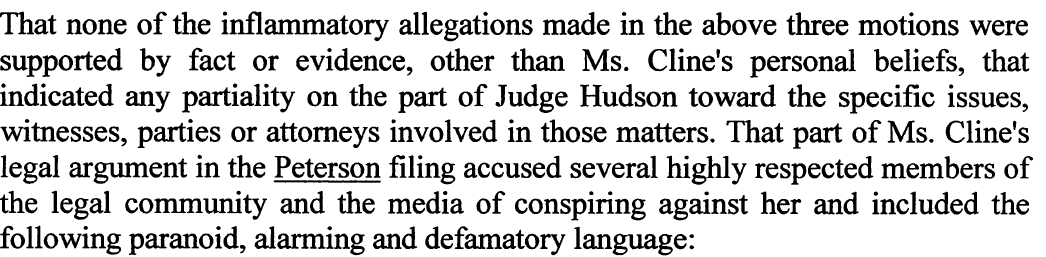
[Updated, Wed., 4.22pm: Durham attorney Kerry Sutton (who played a minor role in the lacrosse case) has filed an affidavit urging the removal of Tracey Cline as Durham DA. In the affidavit, Sutton accuses Cline of "habitual intemperance" and conduct "prejudicial to the administration of justice." Sutton, not unreasonably, characterized Cline's "inflammatory" filings against Judge Orlando Hudson as filled with "venom" and "paranoid" language, lacking in "fact or evidence, other than Ms. Cline's personal beliefs." Sutton goes into considerable length about how Cline's obsession with Hudson has both harmed the Durham DA office's reputation and consumed the Durham legal community's resources. (She also points out that the grammatically-challenged Cline also has a tendency to misspell "affidavit" in her legal filings.)
The N&O's Andrew Curliss reports that the gambit employed by Sutton is rarely used, and is believed to have resulted in the removal of only one DA in North Carolina history.]
Durham County’s minister of justice was last heard from penning a bizarre e-mail to the Herald-Sun in which she misspelled a judge’s name and asserted that “truth should be intimidated by the pressure of the powerful or the fear of failure.” This morning’s N&O exposes as false a central claim made by Tracey Cline in her quixotic crusade against Judge Orlando Hudson—that Hudson had demonstrated his anti-Cline bias by entering an August order before the prosecution even had the chance even to present all of its witnesses.
Reporter Andrew Curliss did what Cline failed to do—he actually investigated the seeming anomaly. And he discovered a benign explanation: “The clock at the courthouse that stamped the document was more than two hours slow that day.” In a situation that would seem more likely in a small town courthouse than in North Carolina’s fifth-largest city, the clock in the county clerk’s office seems to malfunction with some regularity. Curliss spoke to assistant county clerk Angela Kelly, who commented about the clock, “It is a machine that's plugged up in the wall that runs constantly. When things are filed, we stick it in there, and we always hope and pray it's correct. But there have been times when we notice that it's not correct."
Curliss confirmed Kelly’s recollection by checking into legal documents filed the next morning—which the clock erroneously stamped at 7.18am, rather than after 9.00am, when the clerk’s office actually opened. (Times public editor Arthur Brisbane might just call Curliss a “truth vigilante.”) The N&O website has a photo of the relevant filings.
Rather than assuming the worst and thereby leveling wild, unsubstantiated allegations against a sitting judge, Cline might have checked to see if there were problems with the clock in the clerk’s office, something that would have taken her only a few minutes to do. The N&O presented Cline with the information, but she declined comment, and thus did not take the opportunity to say that she would withdraw her charges against Hudson. Jim Coleman summarized the problem to Curliss: "She has made a serious allegation, and it warranted serious review by her before this filing. It is now just more evidence of a lawyer who is barreling down a hill totally oblivious to the damage she is causing to the judicial system. She is undermining confidence in the system. It's disgraceful."
Such cavalier disregard for the truth and professional behavior from his county’s “minister of justice” might be enough to cause “shame” and “anger” even from the likes of Duke professor William Reichert. But I suspect not.
Friday, January 13, 2012
The Reichert Rules
Though Duke’s race/class/gender-dominated humanities faculty members embarrassed themselves in their response to the lacrosse case, faculty in the hard sciences and engineering behaved very differently. Indeed, only one member of the Group of 88, Ronen Plessler, came from any of the sciences or engineering departments.
That said, on the one occasion in which a science professor did try to imitate his “activist” colleagues—when “Counselor” Thomas Crowley hung his shingle for readers of the Herald-Sun—the result was humiliation and a quick backtrack.
Biomedical Engineering professor William Reichert should have learned Crowley’s lesson. In what’s described as a guest “commentary” in today’s Chronicle, Reichert begins by complaining about SportsCenter devoting excessive coverage to the Jerry Sandusky case, thereby disturbing his workout. This situation—not, it seems, Sandusky’s alleged crime, but ESPN’s coverage, from which for unknown reasons he could not avert his eyes—left him “stewing . . . for weeks and weeks,” until, finally, he elected to turn to the pages of the Chronicle. (Did Deadspin, known for its biting ESPN commentary, reject his submission?)
From the Sandusky affair, Reichert moved on to a . . . curious . . . recapitulation of the lacrosse case. He confessed that “senseless behavior,” which he did not specifically define, left him with feelings of “anger” and “shame.” Of what senseless behavior, then, did he speak? His colleagues’ rush to judgment and their abandoning the basic requirements of the Faculty Handbook? The local prosecutor’s violating myriad ethical standards? The Durham newspaper’s decision to turn a blind eye to the abuses?
None of these developments appeared to produce either “shame” or “anger” for Dr. Reichert—in itself a revealing insight into his character. His “shame” or “anger” came from the “behavior of students”—presumably the lacrosse players, rather than the potbangers, though Reichert is careful not to say so (perhaps for legal reasons?). Fortunately, however, there was a hero of the affair: Richard Brodhead, who showed “courage” in prematurely terminating the 2006 lacrosse season, fully aware of “the blow back [sic] that was sure to come.”
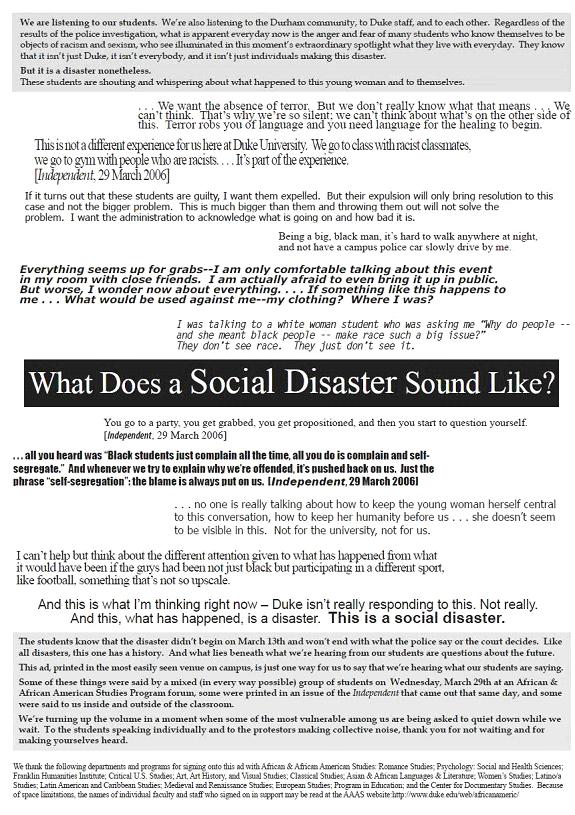
This claim is a little bit like Cathy Davidson’s reinvention of spring 2006 as a time of terror for black students on the Duke campus. Brodhead’s canceling the lacrosse season required no courage at all. Faculty “activists” were demanding it, the team itself had virtually no supporters on campus at the time, and then-BOT chairman Bob Steel considered it a necessary sacrifice for public relations purposes.
Brodhead, in short, received virtually no “blow back” for the decision, at least at the time. Indeed, the only way in which Reichert’s “blow back” claim makes any sense would be if he’s suggesting that Brodhead fully believed that the accused students were innocent but cancelled the season anyway, thereby anticipating a “blow back” once outsiders (even the biased New York Times) came to criticize the university for its guilt-presuming action.
A question: could it be that Reichert’s other title—“Associate Dean for Diversity”—accounted for his Group of 88-like interpretation of the lacrosse case?