Showing posts with label depositions. Show all posts

Friday, March 11, 2011

The DNA Security File

Brian Meehan, the former lab director of DNA Security (DSI) who was fired after the nature of his . . . incomplete . . . report in the lacrosse case came to light, has filed a quixotic appeal to his quixotic wrongful termination suit. (His suit failed to survive summary judgment.) Meehan’s chances of appeal aren’t exactly high, but his appeal has produced a document dump. (The post below contains the choicest excerpts from several hundred pages of depositions, exhibits, and internal DSI documents.)

Two items spring out from the lawsuit documents: (1) the lacrosse case represented a potential windfall for DSI, which had otherwise struggled since its inception financially; and (2) DSI head Richard Clark offered self-contradictory statements regarding whether or how he pressured Meehan to discuss the lacrosse case during the ex-lab director’s infamous 60 Minutes interview.

The documents bring into relief DNA Security’s precarious financial state. Meehan co-founded DSI with two friends from Michigan; he bought the duo out in the early 2000s for a measly $3000 apiece. The company struggled so much financially—Meehan admitted that he did everything, ranging from lab director and “janitor”—that he had to look for a second job in 2004. Ironically, he applied for a position at Richard Clark’s other company (a business whose profit margins peaked in mid-1990s). After some discussion, Clark agreed to purchase DSI for $80,000, with an agreement to keep Meehan on staff for seven years. At the time of the purchase, DNA Security had less than $2000 cash-on-hand.

Over the next two years, DSI lost money every month—until Mike Nifong gave it business in the lacrosse case. (April-May 2006 was the only stretch in which DSI ran a profit between 2004 and 2007.) Meehan himself said that he had followed the early reports of the lacrosse case, and was “excited” to get an opportunity for involvement. Clark seems to have shared his lab director’s sentiments, given that the lacrosse case was the biggest of the company's career.

Both Meehan personally and DSI collectively, therefore, had considerable incentive to do what they could to appease their “client,” the term that they used to describe Nifong. If the client wanted an incomplete report that violated DSI company protocol by failing to provide all test results, such a report he would receive.

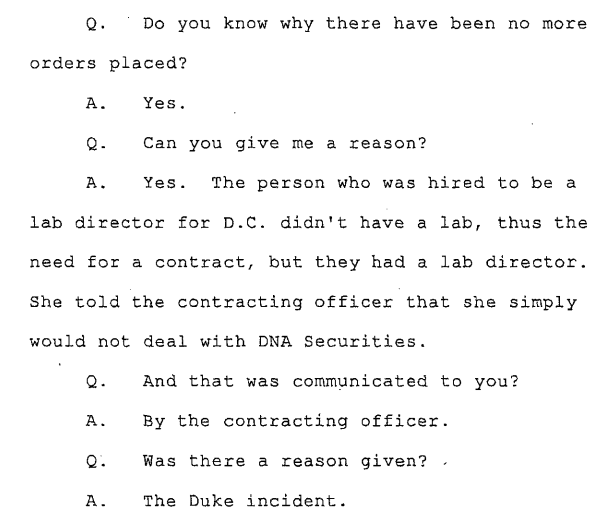
Ironically, of course, Meehan’s dubious conduct, first exposed by Brad Bannon and Jim Cooney in the December 15, 2006 hearing, wound up harming DNA Security’s bottom line. E-mails and depositions from other DSI executives recall how law enforcement agencies from Florida to Wyoming ended involvement with DSI after Meehan’s Dec. 15, 2006 performance—if only because they recognized that having DSI do their testing would provide defense attorneys with an easy opening for impeachment.

Meehan’s 60 Minutes interview was a defining moment for the company. DSI brought in an outside attorney, Fred Antoun, to offer both legal and public-relations guidance, and Antoun believed (not unreasonably) that Meehan had to go on 60 Minutes to respond to repair the p.r. damage from his disastrous performance at the December hearing. Clark, who comes across in the documents as even more defensive and arrogant than Meehan (which is saying something), strongly supported the appearance, stating—according to Meehan, anyway—that “any publicity is good publicity.” A few other DSI officials worried about this approach, and Meehan initially didn’t want to submit to questions. The ex-lab director said he changed his mind when reflecting on how his son would think of him otherwise.

Meehan spent three days preparing for the interview, only to flub his lines, and affirm that he committed a “big error” in his handling of the case. Antoun wanted Meehan to confess only to a minor error in judgment and to avoid questions about the December hearing, with the following line: “In retrospect, I didn't put all the stuff in the report, blah, blah, blah.”

The documents offer three tantalizing, though very incomplete, revelations regarding DSI and the lacrosse case. First, Meehan’s deposition features the clearest indication to date that the April and May 2006 conversations between the lab director, Mike Nifong, and Sgt. Gottlieb involved specifics of the case, most significantly how non-lacrosse player DNA could have been transferred to false accuser Crystal Mangum. Nifong, of course, always maintained that his discussions with Meehan never involved anything that could involve theories of the case. Second, DSI admitted that it kept what it called a “Duke Lacrosse case file”—which, unfortunately, is not reproduced in any of the court filings. Finally, Richard Clark, seemingly inadvertently, admitted that the lab remained in contact with its future co-defendant Nifong even after Nifong recused himself from the lacrosse case. There would seem to have been no professional reason for continued DSI-Nifong exchanges after January 12, 2007.

Meehan’s deposition exhibits familiar characteristics for anyone who followed the lacrosse case. There’s “Mr. Obfuscation,” with Meehan trying to compare his having amended his lacrosse report to include all rather than just some of the test results to his having previously amended reports to correct typographical errors. There’s the clueless scientist, who penned emails to his superiors demanding a raise--a few weeks after his disastrous performance in the December 2006 hearing. There’s the defiant Meehan, alternatively blaming Nifong for his problems, affirming that Mangum was “the victim,” and misrepresenting his May 2006 report (which went out of its way to falsely insinuate that Dave Evans’ DNA might be present) as everything the lacrosse players could have wanted.

(Meehan also got a friend, Mississippi lab director R.W. “Bo” Scales, head of Scales Biological Laboratory, to say what a good job he did, and that his May 12, 2006 report was acceptable and even appropriate. Scales added that he charges $250/hr. and $1800/day to testify.)

But perhaps the most remarkable Meehan Moment came in his discussion of the December 15, 2006 hearing. Meehan simultaneously affirmed that he always told the truth at the hearing and that he did nothing wrong in the case. How, then, to explain the following passage, the Perry Mason moment of the case?

In his deposition, Meehan claimed that his words were “taken out of context.” How, exactly, his straightforward response to a straightforward question from Cooney could be taken out of context Meehan did not reveal.

Finally: one of the odder moments of the case for me came when I heard (from two sources) that Nifong was a regular DIW reader. It turns out that the people at DNA Security also checked in on the blog. One DSI worker worried that “blogs were out there” criticizing the company. Clark himself took issue with this DIW post, which portrayed DNA Security as a “fly-by-night” operation that had started in a garage. (Nothing in the document dump has led me to revise my opinion of the company.) And DSI’s Michael Burrows remembered that “one of the web publications had attacked us early on, and rather doggedly.” He said he questioned the wisdom of Meehan going on 60 Minutes lest the DIW criticisms of DSI get a national audience.

These documents reveal a company that was at best over its head in the lacrosse case and at worst either wholly incompetent or blatantly unethical.

hat tip: Ml.

Document Excerpts: DSI File

Here is Meehan's complaint misrepresenting his May 2006 report, which actually did everything it could, short of simply lying about the results, to prop up "client" Nifong's case.
Given the reality of his report, Meehan really didn't want to appear in court on Dec. 15, 2006, as this deposition excerpt from a Meehan co-worker suggests. Not too hard to figure out why. Meehan's 2006 W-2, showing how he earned $125,000 even as his unprofessional behavior helped prop up a case against innocent people.
From his complaint, Meehan affirms that he testified truthfully in the Dec. 2006 hearing. Leaving aside the absurdity of this claim (since he initially tried to parry Brad Bannon's questioning until he figured out that Bannon knew what he was talking about), this admission seems to confirm that he told the truth to Jim Cooney.

From his complaint, Meehan blames Nifong for his problems.
From his deposition, Mr. Obfuscation suggests that he can't remember who Lane Williamson was.
From Meehan's deposition, a potentially significant revelation: he and Nifong, in spring 2006, appear to have discussed the non-lacrosse player DNA found in Mangum's rape kit.

Meehan had admitted that he followed the lacrosse case pretty closely in the media before he got involved. But, he claimed, he stopped reading newspapers--especially the N&O--once he was the subject of negative scrutiny.
Meehan's refusal to admit error consisted of his suggesting that DNA labs are always attacked by defense lawyers and the media. The company's attorney asked him whether the SBI DNA lab was attacked in the lacrosse case.

In his deposition, Meehan occasionally would lapse into his "Mr. Obfuscation" mode. Here, he tries to imply that his amended report in the lacrosse case (in which he added test results he hadn't reported) could be seen as the equivalent of correcting a typo.

In his deposition, Meehan conceded that the lacrosse case was the biggest case DSI ever had--showing again the financial incentive to pacify the firm's "client," Mike Nifong.

In the annals of chutzpah, this e-mail from just over a month after the disastrous Dec. 2006 hearing features Meehan complaining about his not having received his promised raise.
Clark's letter firing Meehan combined the DSI head's blustery refusal to acknowledge error with his obsession with image.

Meehan's friend and fellow lab director, Bo Scaife, defended Meehan's May 2006 report. Scaife is based in Mississippi--which raises questions about what sort of cases he's handled there.

Scaife adds that the finding of no DNA matches should have been enough to prove the lacrosse players' innocence. Meehan, of course, doesn't appear to have pressed this point to Nifong.

In his deposition, Meehan claimed he didn't have enough time to prepare for the 12-15-06 hearing. A lack of preparation wouldn't seem to explain his admissions that his report didn't contain all the results and that he and Nifong had mutually agreed upon such a strategy.

In his deposition, Meehan admitted that initially he was "excited" to have been involved in the lacrosse case.

DSI saw the 60 Minutes show as the last chance to save the company's public image; here was the script prepared by DSI lawyer Fred Antoun on how Meehan should handle the inevitable tough question about his testimony.
DSI president Richard Clark testily denied coaching Meehan for the 60 Minutes interview.
Despite his passionate denial (above) that he had not coached Meehan, Clark subsequently admitted that he had done so:

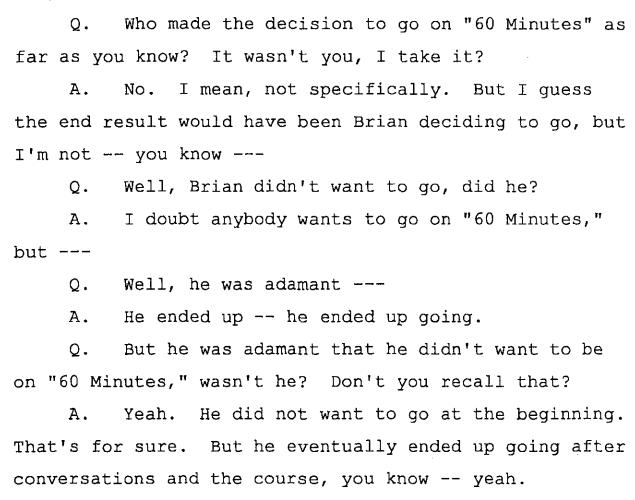
60 Minutes
might have been a last-gasp for DSI's reputation, but DSI official Michael Burrows also understood the grim situation that the company occupied given the program's interest.
Another DSI employee, noting that really no one wants to go on 60 Minutes.

If Meehan, as this deposition suggests, actually did prepare for the 60 Minutes interview for three days, what would he have been like without any preparation at all?
To say the Meehan-led DNA Security was a fly-by-night affair is an understatement; at the time the company was sold to Clark (in 2004), DSI had less than $2000 cash on hand.
When speaking of the company before the sale, Meehan had a tendency to speak of himself in the royal "we." Here, he concedes that he functioned not only as lab director at pre-2004 DNA Security, but also as the company's janitor.

The firm never did very well: Meehan bought out his two DSI partners for . . . $3000.

And Meehan sold the company in 2004 for a rather paltry $80,000.

DNA Security official Michael Burrows, reflecting on repeating the company line that DSI made no mistakes:

More on the harmful financial effects resulting from the exposure of Meehan's dubious conduct.
This DSI e-mail confirms how the lacrosse case devastated business for the company.
A DSI official on Clark's determination to get rid off Meehan, at any cost:
This cryptic item from the Clark deposition suggests that DNA Security representatives remained in contact with Mike Nifong even after Nifong was off the case.
An unintentionally comical statement from Clark on why he didn't allow Meehan's COLA adjustment in 2006:
DSI head Richard Clark, confirming the initial financial boost to the company caused by the Duke case.
The contents of this file would be interesting to see.

When all else failed, DSI employees suggested Meehan had been "tricked" by 60 Minutes:

DNA Security's Michael Burrows, outlining the devastating business effect that Meehan's performance at the 12-15-06 hearing:


And this is Burrows on the business impact of Meehan's weak 60 Minutes showing:

Here is Burrows suggesting that the company officials read a certain blog that "doggedly" criticized Meehan and his cohort.
Clark, like Burrows, appeared quite concerned with what people on the internet were saying about the company. (He appears to be referencing this post.)
Here's the accreditation agency's letter confirming the investigation of DNA Security.

Just as Mike Nifong exploited his son at the State Bar hearings, so too did Meehan cite his son as the reason he wanted to come clean to 60 Minutes.

Here is what Fred Antoun, brought in to advise DSI on how to handle the post=Dec. 2006 controversy, wanted Brian Meehan to say during Meehan's 60 Minutes interview:

Wednesday, July 11, 2007

The Depositions and the Whichard Committee, II

Yesterday’s post examined how the depositions prepared for the Nifong ethics hearing illustrated the Durham Police Department’s inability to evaluate basic evidence. Today’s post will look at how the Himan, Gottlieb, Wilson, and Ripberger depositions reveal a department careless about basic investigative practices and disrespectful of principles of due process.

Basic Investigative Practices

Long before Mike Nifong was disgraced, the “straight-from-memory” Gottlieb notes exemplified the shady practices associated with this case. In mid-July—after defense filings had revealed major problems in Nifong’s case—Gottlieb produced the typed, undated “supplementary case notes,” with handwritten notes confined to two insignificant items from an afternoon in late April.

Gottlieb’s notes contained yawning discrepancies with the rest of the file. He claimed that the photos from this session showed Crystal Mangum with face and neck bruises. And he recalled Mangum giving dead-on descriptions of the three accused players (descriptions that looked a lot like their profiles from the Duke lacrosse website) at the March 16, 2006 interview—even though Himan’s contemporaneous handwritten notes showed entirely different descriptions that in no way resembled either Reade Seligmann or Collin Finnerty.

In his deposition, Gottlieb conceded that he had, in fact, produced the notes straight from memory—asserting that he remembered Mangum giving these dead-on descriptions nearly three months after the date of the interview. The claim, of course, was absurd.

So what happened to Gottlieb’s handwritten notes? As he explained in the deposition,

I did take notes to organize myself and to help Investigator Himan organize the investigation just on my board. And I have a board in my office, it’s a dry-erase board. And, for example, Investigator Himan would say, “I need to have someone look at different things, how we can get a hair analysis done,” And I would put my name next to that. And then he’d say, “I need a background done for this person.” I would assign someone to do that if he wasn’t going to do it. He’d say, “I need a court order to get e-mail records,” put his name next to that, et cetera, et cetera, et cetera. I had asked him and was under the impression that he was taking photographs of the board, and when we finished that we would clear it. That wasn’t done. And I apologize for that.

This explanation was so absurd as to be comical—until remembering that the “straight-from-memory” notes were treated as legitimate evidence by both Nifong and the Durham Police (and, for that matter, the New York Times).

Most cops are compulsive note-takers: how else could they remember events months, or even years, afterwards, if they are called to testify? Surely, therefore, his superiors must have rebuked Gottlieb for such a blatant violation of standard investigative practice. Yet, to date, no evidence exists that anyone in the DPD ever expressed any discomfort with Gottlieb’s peculiar notetaking strategies.

Yet a member of the force did come under investigation for his behavior in the case. The DPD powers that be went after the first officer to encounter Mangum after the lacrosse party—Sgt. John Shelton. Shelton concluded, correctly, that Mangum was likely lying, and he made his opinion perfectly clear, in both handwritten notes and a timely supplementary filing.

For doing so, he was trashed repeatedly in depositions, criticized on the stand by ex-DA Nifong, and—according to the deposition of Linwood Wilson—subjected to an internal affairs inquiry.

So: the DPD did nothing to an officer who, on the surface, appears to have manufactured evidence to try to convict innocent people; and at the same time went after the one member of the force who got things right from the start. That’s quite a record.

Principles of Due Process

In one of the single best lines this case produced, USC law professor Susan Estrich wrote, “There are reasons you follow procedures. In general, they are there to spare outrage.”

This comment certainly applies to the April 4 lineup, in which Nifong ordered the DPD to ignore its own procedures—which required five filler photos per suspect—and produce a lineup confined to lacrosse players. Gottlieb ran the array, told Mangum that she would only see people that the police believed attended the party, and videotaped the proceeding. The whole affair all but invited the accuser, after two failed lineups following procedure, to pick three people.

As could have been expected, the procedural monstrosity directly led to a monstrous result: the indictment, without probable cause, of three demonstrably innocent people. Even so, both the investigators involved in the case and their police supervisors continue to defend the photo array as perfectly proper.

Lt. Mike Ripberger—who supervised both Gottlieb and Himan—said that he “did not have concern” with the suspects-only lineup, either at the time or later. Why not?, asked Bar attorney Doug Brocker. Ripberger: “Because I did not look at this as a lineup or an array to identify a particular suspect or known suspect.”

In other words, Mangum was (1) going to be shown photographs of only people that the police and Nifong had publicly identified as suspects; (2) and asked if she remembered how she interacted with them on the night of the party—(3) at a time when she was claiming that she had interacted with three of them by being sexually assaulted. But that’s not a lineup, according to Ripberger. The lieutenant’s suggestion: even if Mike Nifong hadn’t ordered Gottlieb and Himan to run a lineup contrary to procedure, the department’s officers wouldn’t have followed procedure anyway.

With their immediate superior displaying such a cavalier attitude toward procedure, it’s little wonder that Himan and Gottlieb did as well. In their depositions, both asserted that the April 4 event wasn’t a “lineup” since they were only seeking to identify potential witnesses among the lacrosse players. Gottlieb added the peculiar rationale that the procedure also would test for whether Mangum was given a date-rape drug.

The duo conceded, however, that the March 16 and March 21 photo arrays--in which Mangum was shown photos of lacrosse players named Matt, Adam, Brett/Breck, Dan Flannery, and Dave Evans, with five other lacrosse players serving as fillers for each array--were lineups, and therefore covered by the General Order regulation.

This explanation means that Dave Evans was considered:

  • a “known suspect” from March 16 until at least March 21;
  • not considered a suspect at all as of March 31 (and perhaps earlier) until April 4;
  • conveniently viewed as a suspect again sometime after April 5.

No one from the Durham PD has ever explained what new information the department received between March 21 and March 31 that prompted Himan and Gottlieb to abandon their earlier assumptions that Evans (as well as Flannery and the players named Matt, Adam, Brett/Breck) were the known suspects.

In effect, then, as things now stand, the DPD’s position on lineups amounts to the following: General Order 4077 requires five filler photos per suspect, as a way of guarding against false identifications. But in tough cases, or in cases where an accuser or witness can’t identify anyone, the department will just ignore the procedure and confine the lineup to suspects. To cover themselves, they will say that the purpose is to identify “witnesses” and that the people previously identified as suspects no longer are considered so. Maybe the lineup will get thrown out in court, but unless the defendant has an attorney of the quality of Jim Cooney—the architect of the December 14 suppression motion—it’s unlikely a judge would also bar the accuser/witness from making an in-court ID, which could well suffice to get a conviction.

The Ripberger/Gottlieb/Himan thesis leaves two and only two options for any fair-minded investigative committee: either the DPD is full of incompetent people, including high up the chain of command; or the department knew exactly what it was doing in constructing a procedurally flawed lineup, and concocted the “search for witnesses” story as a cover. (Both explanations are also possible.)

A Cover-up?

That the April 4 lineup was intended to identify people to arrest, not to produce witnesses, is obvious both from its structure and how it was used:

1.) Even though police did not tape the first two lineups, which unquestionably were designed to produce people to arrest, they did tape the April 4 lineup, with Gottlieb’s notes revealing an expectation that a jury would then be able to view the proceeding.

2.) If the goal were to prompt Mangum to identify witnesses from the party, it’s hard to explain why police would have excluded from the lineup three people (Devon Sherwood and two non-lacrosse players) that officers knew attended the party but who Nifong or his office had publicly ruled out as suspects.

3.) Despite the Ripberger/Gottlieb/Himan trio’s claims that the department didn’t have to follow procedure because the lineup was designed to provide openings to identify witnesses, no evidence exists that police ever used the lineup for the purpose of speaking to potential witnesses.

a.) Had the lineup actually been intended to produce witnesses, for instance, the police should have called up Brad Ross to say that Mangum had noticed him “standing outside talking to the other dancer,” and asked what else he saw at the party. Instead, of course, it was Ross’s attorneys who provided evidence to the police that Ross actually had been in Raleigh for the party’s duration. Since the police don’t appear to have taken Mangum’s ID of Ross as a witness seriously, this information had no effect on their actions.

b.) And had the lineup been intended to produce witnesses, the police should have confined their efforts in the April 13 nighttime sojourn to the Edens dorm to those who Mangum recalled seeing at the party. In his justification for the suspects-only lineup, Himan declared, “We were trying to get it narrowed down to who we cold go speak to or who we should go speak to . . . narrow our investigation down t see who she does recall, who does she remember.”

Yet in that trip to Edens, police spoke to one and only one lacrosse player at any length—Michael Young. Here was the relevant portion of the April 4 lineup regarding Young:

IMAGE 2 (Michael Young)

Mangum: I don’t recognize him.

So: (1) the police taped the April 4 lineup—for the “jury”—and didn’t tape other, procedurally proper lineups; (2) they claimed to be using the lineup to search for witnesses, but excluded from the lineup three people they knew were present at the party; (3) despite the stated claim that the lineup’s purpose was to narrow the list of people with whom they could speak, the only lacrosse player with whom they spoke at length between April 4 and the indictments was someone that Mangum didn’t recognize in the April 4 lineup.

On the surface, then, it appears that the DPD not only blatantly violated its own procedures, but also concocted a not-too-believable tale to cover up for its misconduct.

How could any fair-minded committee not be horrified by such a record?

Tuesday, July 10, 2007

The Depositions and the Whichard Committee, I

The depositions of Officer Ben Himan, Sgt. Mark Gottlieb, ex-Investigator Linwood Wilson, and Lt. Mike Ripberger should be required reading for all members of the Whichard Committee, which is investigating the DPD’s mishandling of the lacrosse case.

Much of the blame for what Lane Williamson appropriately termed the “fiasco” has fallen on the shoulders of Mike Nifong. But the officers’ depositions reveal a department:

  • unable to evaluate basic evidence;
  • careless about basic investigative practices; and
  • unwilling to follow its own procedures, as part of a general disrespect for principles of due process.

Today’s post will look at the first of these items—the department’s apparent inability to evaluate evidence. Tomorrow’s post will examine the other two issues.

During his deposition, Sgt. Mark Gottlieb three times asserted that Crystal Mangum’s basic story remained consistent from the time Mangum first interacted with SANE nurse-in-training Tara Levicy on March 14, 2006 until the Linwood Wilson “interview” of December 21, 2006.

  • “From the time that she [Mangum] spoke with the SANE Nurse [in training] all the way up through December, her story didn’t really change.” (p. 94)
  • “That is what I was talking about as far as her story not changing from the time she was with the SANE nurse [in training] up until November. I think there were minor things, but nothing dramatic.” (p. 104)
  • “As soon as Nurse Levicy was able to calm her down, which didn’t take long at all, she never changed her story from that point.” (p. 185)

(Between April 6 and December 21, Mangum was never asked about the specifics of the “attacks” by any representative of either the police or of Nifong’s office—so her story couldn’t change over that 7½-month period.)

Sgt. Gottlieb first went to work in the Durham Police Department in 1987. It would seem reasonable to assume that an officer the department would keep on the force for the better part of two decades would have sufficient basic comprehension skills to understand when a story changed and when it didn’t “really change.”

Based on his deposition comments, however, Gottlieb appears to lack the ability to analyze witness statements to determine consistency—something that would seem to be a basic qualification for any police officer.

Take, for instance, the chart below, which is adapted from an item that State Bar attorney Doug Brocker presented during the Nifong ethics hearing. It examines who allegedly did what to Mangum, as well as the marital status of her “attackers”:

  • A green X corresponds to the story that Mangum told Tara Levicy on March 14, 2006.
  • A blue Y corresponds to the story that Mangum told Gottlieb and Officer Ben Himan on March 16, 2006.
  • A red Z corresponds to the story that Mangum provided in her April 6, 2006 official statement.


Oral

Anal

Vaginal

Married

Matt

X

YZ

XZ

X

Brett


YZ

YZ


Adam

XY

X


Z

Mangum, in short, described three quite different “attacks.” Of course, when she was asked about the “attack” on December 21, she would come up with a fourth different story. And when the special prosecutors would ask her about the “attack,” she would come up with a fifth, entirely different, story.

Given that in the three stories Mangum had different people doing different things to her; different numbers of people doing different things to her; and, actually, different things being done to her, how could a veteran of the force possibly say that “as soon as Nurse Levicy was able to calm her down [on March 14], which didn’t take long at all, she never changed her story from that point”?

Is Gottlieb similarly unable to evaluate the evidence before him in all his cases? And given these disparities, why did his supervisors not step in?

Or take the role of Kim Roberts in the “attack.” In her March 14 statement to SANE-in-training Levicy, Mangum accused Roberts of robbing her. She also described Roberts as an accessory to the rape—helping to carry her unwillingly back into the house and cleaning her up after the “attack.”

In Mangum’s March 16 interview with Himan and Gottlieb, Roberts played a passive role—neither facilitating the “attack” nor being victimized by it.

In Mangum’s April 6 written statement to police, Roberts was a fellow “victim” and, in fact, a vital witness to the “crime.” She, like Mangum, was scared by the racial epithets—indeed, was in tears. And she was torn away from Mangum and the three “attackers” at the bathroom door by three never-identified people, after which she suffered a fate unknown.

How could Gottlieb—a police officer of two decades’ experience—possibly say that the wildly contradictory versions of Kim Roberts’ role reflected a story that “didn’t really change”?

Mangum also varied in her claims about whether the players used first-name aliases. In her March 14 story to Levicy and her March 16 interview with Himan and Gottlieb, she suggested that her attackers were named Matt, Adam, and Brett—so much so that the police ran lineups with the lacrosse players named Matt, Adam, and Brett/Breck as the suspects.

By the time of her April 6 statement, however, Mangum was certain that “Matt,” “Adam,” and “Brett” were aliases. How did she reach this conclusion? She didn’t say, and the police apparently didn’t ask.

The above items, meanwhile, don’t even take into account the version of events that Mangum told UNC doctors on March 15, 2006—one day after SANE-in-training Levicy supposedly “calmed” her down.

On that occasion, she said that she was “drunk” and “felt no pain” on the night of the “attack”—even though Levicy had based much of her analysis on the fact that Mangum supposedly was in pain and was not drunk. Mangum also claimed to have been hit in the face and pushed backwards into the sink, on which she hit her head, details that didn’t appear in her March 14, March 16, or April 6 versions of events.

When asked about these discrepancies by Doug Brocker, Gottlieb—astonishingly—replied, “This is not a report that I have had time to review.”

The grand jury that indicted Reade Seligmann and Collin Finnerty, therefore, never heard about the UNC report. Yet what the grand jury did hear from Gottlieb flowed from his inability to evaluate the evidence before him.

In response to a question from Nifong attorney Dudley Witt, Gottlieb said that he told the grand jury that “as soon as Nurse Levicy was able to calm her down, which didn’t take long at all, she never changed her story from that point.”

In making its indictments, therefore, the grand jury relied on Gottlieb’s assertion that—despite transforming Roberts from a criminal to a fellow victim, and despite alleging that different people did different things to her, and despite sometimes claiming to be drunk and sometimes not, and despite changing her mind on whether first-name aliases were used—Mangum “never changed her story” between the time she first encountered Tara Levicy to the time that Gottlieb spoke to the grand jury.

How could any fair-minded committee not be horrified by Gottlieb’s admission that his inability to evaluate evidence led to a grand jury receiving such an inaccurate portrayal of the facts of the case?

Monday, July 09, 2007

The Linwood Wilson Deposition

The idea that Linwood Wilson—a figure who, the N&O noted, faced “repeated complaints and at least seven formal inquiries into his conduct” as a private investigator—ever could have been the chief investigator for a district attorney would seem possible only in the Wonderland that is Durham.

The Wilson deposition to the Bar suggested that the (now-fired) investigator didn’t suddenly develop an ethical core when he went under oath. He alternated between scarcely credible and wholly non-credible assertions as he explained his involvement in the lacrosse case—which began with the arrest of Seligmann alibi witness Moezeldin Elmostafa and ended with SANE nurse Tara Levicy “remembering” that Crystal Mangum was uncertain about whether her “attackers” used condoms.

The December 21st Interview

Nowhere was the ex-investigator less credible than in his discussion of the Dec. 21st “interview” with Mangum. In that interview, which was untaped and which Wilson conducted alone, Mangum told an entirely new story, one that conveniently seemed to cover many of the yawning gaps in the evidence.

What necessitated the interview on December 21st, one day after Nifong received notice from the Bar that it was considering an ethics complaint against him for withholding DNA evidence? Wilson: “There were some discrepancies between what Kim Roberts had said and what Crystal Mangum had said,” as well as between Mangum’s various versions of events and the time-stamped party photos broadcast by MSNBC’s Dan Abrams. Both sets of discrepancies, Wilson said, needed to be cleared up.

Indeed. There had been “some discrepancies” between what Mangum and Roberts had said since March 22, 2006, when Roberts gave her statement to police. And there had been “discrepancies” between what Mangum’s stories and the time-stamped photos since April 2006, when Abrams first broadcast the photos.

Why did Wilson and Nifong wait eight months to try to resolve these discrepancies? Wilson didn’t say. Why was it so important to address this issue four days before Christmas, without any member of the Durham Police present for the interview? Wilson, again, didn’t say.

How, then, did the “interview” wind up creating a wholly new version of events?

According to Wilson, Mangum was having “flashbacks,” and then, during his visit, “she just started talking” about them. (I’m not making this up.) As an officer of the law, he felt duty bound to write down these flashbacks—but not to tape the conversation, nor to ask any questions about the obvious contradictions this new version of events revealed. He said he didn’t feel it was “appropriate” to do so at that time.

After the “flashback” session ended, Wilson decided to show Mangum some of the party photos. But as he opened his briefcase, he just happened to have the photos from the April 4 lineup (which were then the subject of a suppression motion). And, further, he just happened to have Dave Evans’ photo in plain sight. And, even further, Mangum just happened to know Evans’ name. And, further still, Mangum just happened to remember that on the night of the party Evans didn’t have a mustache—as Mangum had claimed on April 4 and the defense had recently disproved with photos from the time—but a five o’clock shadow.

The reaction of Katherine Jean, who was conducting the deposition for the Bar, dripped with incredulity, even on the transcript.

Investigatory Skills

Wilson brought along for the deposition evidence of the “investigation” carried on by the Nifong team. This “investigation” waited over a year to speak to the neighbors of 610 Buchanan—who told Ben Himan that the lacrosse players’ most grievous offense was an inability to park cars correctly(!). At the same time, Wilson and Nifong appear to have been remarkably interested in random e-mails from unknown parties (such as “Becky Lane, Ph.D.”) offering theories that could support their hope that a crime actually occurred.

Despite Nifong’s claim on the stand that he had relieved Wilson from interviewing witnesses at an undetermined time in late 2006 or early 2007, as of the date of his deposition (May 23, 2007, or three weeks before the DA made the assertion under oath), Wilson declared that this role remained part of his job description: “I interview witnesses if the assistant district attorney requests that I do that.”

In a follow-up question from Katherine Jean, Wilson confirmed the point. Had his duties, Jean asked, “been the same since you became the investigator in October of ’06?” Wilson’s response: “They have.”

Wilson also wanted it known that—throughout the case—he initiated nothing. “I didn’t,” he informed Jean, “do anything on my own.” The message: if he committed misconduct, it’s the fault of whoever ordered him to do something improper. (Wilson contradicted this claim later in the deposition, when he conceded that he had initiated a meeting with Mangum to discuss the first 60 Minutes broadcast.)

Wilson’s admitted role, in any event, was considerable: Nifong tasked him with “re-interviewing” every witness in the case, including every police officer who had any contact with Mangum. Neither the ex-DA nor his ex-investigator ever said why witnesses needed to be “re-interviewed,” and, if so, what qualified Wilson to perform such an important job.

Moreover, as Joe Neff’s Sunday article revealed, Wilson claimed that part of his job was coordinating an internal affairs investigation of Sgt. John Shelton—the only member of the Durham Police who got the case right from the start and recognized that Mangum was lying.

Himan

According to Wilson, Himan—not Wilson or Nifong—was running the investigation throughout the fall.

This was news to Katherine Jean, who asked Wilson how many interviews he and Himan did together. “Every interview I was involved in,” proclaimed Wilson.

Well, except for those of “the police officers Barfield, Sutton, Stewart, Shelton, [and] Jones.” And except for “the December 21st interview of Crystal Mangum.” And except for “the interview of Kim Roberts in July where she was in our office.”

Oh.

Wilson on Nifong

Wilson stated that he had “always thought that [Nifong] was a very ethical person.” Coming from a person with Wilson’s own dubious ethical record, perhaps this character reference wasn’t terribly valuable for the ex-DA.

Meanwhile, the ex-investigator described the ex-DA as someone who “does pay attention to details”—an image wholly contrary to Nifong’s self-portrayal of a figure who couldn’t be bothered to read documents fundamental to the case in the course of nine months.

Wilson and DNA

Wilson wanted Jean to know that if there was a conspiracy to withhold exculpatory DNA evidence, he wasn’t a party to it. In fact, he told her, the first he had heard of this information came in court on December 15.

How could he be sure? Because “I’ve never read Dr. Meehan’s report that I know of.”

This was the same Linwood Wilson who, on the courthouse steps in June, interrupted Joe Cheshire’s press conference to declare “that he personally read all 1814 pages of discovery documents”—documents that included, among other items, Dr. Meehan’s report.

Elmostafa

Wilson’s description of his involvement in the Elmostafa arrest was comical. Liestoppers summed it up: “Anonymous or unknown tipster from within DA’s office or maybe the Clerk’s office leads Wilson to warrant by suggesting that Elmostafa may have written a bad check(!). He presents warrant in meeting with Gottlieb, Himan, Nifong, and Candy Clark. Alternately, he or Nifong hands warrant to Himan or Gottlieb. Wilson didn’t expect Himan and Gottlieb to serve the warrant themselves.”

While he couldn’t recall the identity (or even the gender) of the anonymous tipster, and he didn’t remember if he spoke with this person or simply received a message from him/her, Wilson did recall with precision that the tipster told him to “check for a worthless check” on Elmostafa.

When asked whether he recalled any discussions about whether the arrest and prosecution of Elmostafa might be perceived as retaliatory, Wilson replied that he believed that such conversations did occur—but he could remember no additional details. “I don’t specifically recall having that conversation with Mr. Nifong,” Wilson reported—though “I’m not saying I didn’t.”

As Wilson spent his time on attempting to discredit an innocent bystander who had come forward to tell the truth and not remembering conversations he might or might not have had with Nifong, he found out that Crystal Mangum had previously claimed to have been gang raped not from his investigatory work—but from the AP, which broke the story.

At Nifong’s request, Wilson then traveled to Creedmoor, where the alleged incident occurred, to attend the press conference at which Creedmoor town officials discussed Mangum’s never-pursued claim. According to Wilson, the only person involved in the case who thought this incident might affect Mangum’s credibility was Officer Himan.

Two ex-Creedmoor police officers currently work for the Durham Police Department. Wilson said that in early May 2006, he looked into contacting them to see whether they had any more information about the alleged crime. More than eight months later, when Nifong recused himself from the case, Wilson hadn’t gotten around to speaking with either officer. Why not? The ex-investigator blamed Himan for not setting up the meeting.

Wilson the Skeptic

Wilson claimed that, from the start, he harbored doubts about whether Mangum was telling the truth. He pressed Nifong to ask her to take a polygraph.

But Nifong refused, saying, “I don’t polygraph victims, especially sexual assault victims, and make those victims think I don’t trust them or believe them.”

There were, of course, no witnesses to corroborate Wilson’s alleged skepticism.

---------

For those who argue that Nifong has been punished enough, the Wilson deposition is Exhibit A on the necessity for a criminal investigation. The descriptions above came from a man who did everything he could, for nearly a year, to use the power of the state to send to jail three demonstrably innocent people, for a crime that they not only didn’t commit but never occurred.

Thursday, July 05, 2007

The Himan Deposition

Officer Ben Himan was one of the key players in Mike Nifong’s ethics hearing; his deposition makes for fascinating reading, and covers considerable territory beyond what we heard in court.

The highlights:

The Early Investigation

Asked to describe how the captains behaved on the evening of March 16, Himan was blunt: “Anything that I asked, they did.”

Also, it was apparent to anyone who looked that Kim Pittman Roberts’ March 22 statement was irreconcilable with whatever version of events Crystal Mangum happened to be offering.

Doug Brocker: Even at that point on the 22nd of March, it was fairly obvious to you that either Ms. Mangum or Ms. Pittman wasn’t telling the truth about some of the events that had happened.

Himan: Yes.

That said, it’s clear that--at least early on--Himan was disinclined to believe Roberts. (He suggested that she was minimizing what happened to Mangum as a way of avoiding becoming a witness, and therefore having her own parole violation discovered.) The decision not to rely on a witness whose March 22 statement was largely accurate was a highly unfortunate missed opportunity.

Sgt. Shelton

Himan said that Sgt. John Shelton—the officer who first encountered Mangum, and who correctly realized that she was lying—gave him, not Gottlieb or Nifong, a copy of his report, handwritten, in a sealed envelope marked “confidential.” Himan also confirmed that, at Duke Hospital, Shelton told people he thought Mangum was lying.

That said, Himan disagreed with Shelton’s performance, arguing that he failed to show Mangum sufficient “empathy” and that he was overly “confrontational.”

The deposition also notes Shelton’s role in a heretofore unexplained aspect of the case. In May, a Duke report seemingly geared toward attacking the lacrosse players unintentionally aided them by revealing that Duke Police Officer Christopher Day overheard a DPD officer say that Mangum claimed to have been raped by 20 men.

Day’s report was downplayed at the time, however, including by Duke Police. According to the N&O,

Aaron Graves, associate vice president for campus safety and security, said the report was a preliminary account for informational purposes only. Duke police were not directly involved in the investigation into allegations by an escort service dancer that she was raped by three men at a Duke lacrosse party.

Duke officials said the officer did nothing wrong, but Graves added, “We clearly could have done a better job.”

It turns out that Day’s version of events was correct all along, raising questions about why Duke officials didn’t squarely stand behind their officer: he overheard Shelton telling a superior that Mangum at one point claimed 20 men raped her.

Nifong’s Role

Gottlieb informed Himan on March 24, 2006 that everything in the investigation would need to be funneled through Nifong.

The first meeting between the three occurred on March 27. Nifong has claimed the session was confined to a discussion of the McFadyen e-mail, but Himan recalled that Nifong asked for Mangum’s statement (which, of course, at that point didn’t exist), Kim Roberts’ statement, and the captains’ statements. Also, Himan commented that Nifong himself “brought up the discrepancies” in Mangum’s version of events, such as the differing statements on the number of “attackers”—only, in the ex-DA’s case, to try to explain them away.

Himan also reported that Nifong was aware of discrepancies from the police reports even before their initial meeting. He suspected that some of this information had come from Nifong’s then-assistant, Sheila Eason (who Jim Hardin just rehired), whose husband worked for the Duke Police.

In addition to revealing Nifong’s March 27 comment—“You know, we’re fucked”—Himan said that a few days later, Nifong admitted that prosecuting this case would be “very hard.”

Himan, for his part, told Nifong that Mangum appeared to be in pain at the March 16 interview and it looked as if she was telling the truth. Himan eventually would change his mind on this point; Nifong never did.

The DNA

Confirming Dr. Brian Meehan’s deposition—and casting further doubt on Nifong’s veracity—the Himan deposition recounted how Nifong actively questioned Dr. Meehan about the substance of Meehan’s DNA tests.

Confirming the recollections of Jackie Brown, Himan noted that he could “tell Mr. Nifong wasn’t in the best mood” in the return trip from Burlington on April 10—the day the ex-DA learned of the results showing DNA from multiple unidentified males.

Himan said he wasn’t sure if, at the May 12 meeting, they went over Meehan’s report “line by line,” but Meehan clearly went over each specific item in the report with Nifong—which would, again, suggest that Nifong perjured himself when he claimed to have never read the report.

Himan—like Gottlieb—believed Meehan’s May 12 report was the final report.

The Gottlieb Role

With extraordinary understatement, Himan conceded that Gottlieb’s notes of the March 16 Mangum descriptions differed from his “a little bit.” In fact, Himan’s notes bore no resemblance to Gottlieb’s—in all likelihood because Gottlieb’s were produced nearly four months later, after indictments, and seemed designed to match the three accused players.

Calling into question the claim of Gottlieb and Nifong that Himan was running things and therefore responsible for any shortcomings in the investigation, Himan said that before April 10, he never spoke to Nifong about the DNA test results or the search for an alternative lab to do testing. These tasks, he reported, were handed by Gottlieb and Officer Michele Soucie.

Himan also noted that Gottlieb and Soucie, not he, initially briefed Nifong on the results of the procedurally flawed April 4 lineup.

In other words, on the two critical items of the investigation—Meehan’s DNA lab and the April 4 lineup—Gottlieb, not Himan, was the DPD’s point person with Nifong.

That fact alone makes it a little unsettling to see Himan represented by the same attorney who is representing Gottlieb.

The UNC Medical Report

Mangum traveled to UNC Hospital on March 15—and told a very different story than she did before or than she would later. She was “drunk and felt no pain.” During the “attack,” the “assailants” hit her in the face, causing her to fall backwards and hit her head on the sink.

Himan—and even Gottlieb—understood that this version of events contradicted any of the stories Mangum had told them, so Gottlieb asked her about it. Mangum’s response? “Crystal said she doesn’t recall ever making those statements to them.” Amazingly, both the DPD and Nifong appear to have taken Mangum at her word on this point.

The UNC medical reports also referenced Mangum’s psychological history. Himan, however, could not recall Nifong ever discussing Mangum’s mental health before seeking indictments.

A final item on this issue: even Himan and Gottlieb recognized that the UNC report was potentially very harmful to their case. Yet in Duff Wilson’s August 25 New York Times magnum opus, Wilson portrayed the UNC medical report as favorable to Nifong.

The Indictments

Again illustrating who was making the key decisions, Himan heard of the decision to seek indictments against Reade Seligmann and Collin Finnerty from Gottlieb—who had been told this by Nifong.

Himan’s response, as he would later testify, “With what?”

According to the deposition, both Gottlieb and Himan protested the decision to indict Seligmann; Nifong overruled them.

Himan never heard directly from Nifong why it was so important to move forward with indictments at the April 17 grand jury session; indirectly, he heard that Nifong preposterously asserted that school would soon be out, and the players would be leaving the state.

The “Re-Interviewer”

According to Himan, Linwood Wilson said that Nifong had tasked him with “re-interviewing” every witness in the case. And, indeed, Wilson appears to have “re-interviewed” virtually everyone involved, including police officers.

Asked about Wilson’s role, Himan noted, “To begin with, to be honest, I didn’t understand why Linwood was coming in.” After May 8, he said, “my main point was Linwood Wilson. I mean, he got his direction from Mr. Nifong.”

Asked about the genesis of Wilson’s December 21 interview with Mangum, Himan replied diplomatically, “He gave me an explanation that he wasn’t going over there for an interview.” Himan, however, had accompanied Wilson in all previous interviews with Mangum. When Himan read Wilson’s report, he said, “It didn’t make any sense, she changed her story completely.”

Nifong dismissed the rape charges at 11.37am, on December 22. He called Himan to relay the news sometime between 11.15am and 11.30am that morning.

At the January 10, 2007 “re-interview” with SANE nurse Tara Levicy, Wilson, not Himan, raised the question of Mangum’s possible condom use—after the Bar had charged Nifong with fraud and misrepresentation for his springtime musings about possible condom use.

Levicy, of course, obliged, remembering ten months after the fact that, despite her contemporaneous notes, Mangum actually was uncertain about whether her “attackers” had used condoms.

The January 11, 2007 Nifong-Mangum Meeting

Himan picked up Mangum to bring her to the DA’s office on January 11—for, he assumed, a follow-up interview in which he, Gottlieb, and Linwood Wilson would explore with her the contradictions in her December 21 version of events.

Instead, she was brought into Nifong’s office for a lengthy period—Himan guessed around 90 minutes. Nifong told her that he was recusing himself,* but stressed the tough path ahead. The clear implication: Nifong wanted Mangum to drop the case, so he wouldn’t have to turn it over to the attorney general’s office.

There had been rumors about Nifong’s recusal floating in the weeks before the ex-DA handed the case over, “and I remember Mr. Nifong saying he wasn’t going to let someone take it away from him.”

When he changed his mind, Nifong said he did so because “the media had already thought badly of him, and he didn’t want the jury in Crystal’s case . . . to judge Crystal by Mr. Nifong’s actions.”

Himan’s Conclusions

As to the defense, Himan noted, “It was unbelievable how much stuff they actually turned over to the Attorney General’s office”—pictures, documents, alibis, receipts. Nifong, Himan conceded in response to a question from Doug Brocker, could have had access to all this information.

Asked what he believed by the end of the investigation, Himan responded,

I came to the conclusion that she had made up—that she was not telling the truth about anything. That she was improvising everything that she has said. That everything she was contradicted with, she would make up improvisation of what actually happened—of why this happened, why this didn’t happen.

By the end of the case, Mangum was accusing Himan of being paid off by Duke, as part of her general claim that Duke—the same institution whose activist faculty had portrayed the players as racists and likely rapists and whose president had said “if they didn’t do it, whatever they did was bad enough”—had manipulated the evidence to ensure the players’ innocence.

Of all the stories that Crystal Mangum told, this one might have been the strangest.

*--corrected