Three brief items:
1.) The N&O reports that Crystal Mangum, in papers filed by her de facto attorney, Sydney Harr, has demanded that her bail be reduced (to $50,000) and that the murder charges against her be dismissed, on grounds of self-defense.
The Harr/Mangum team had already made requests along these lines; chances of getting a better outcome this time seem doubtful.
2.) Speaking of Harr (a local retiree best-known for heading a committee of die-hard Nifong fanatics): the Durham News reports that the State Bar will investigate him for practicing law without a license. Harr had admitted that he had "helped" Mangum write her previous legal filings, but argued that he did so after informing her he wasn't an attorney.
“You can’t disclaim the unauthorized practice of law simply by saying I am not an attorney,” David Johnson, deputy counsel for the State Bar, told the Durham News.
Harr (hilariously) claimed he wasn't aware of the rule. (This is the same figure who has termed himself so expert in ethics rules that he can demonstrate the incorrectness of Nifong's disbarment.) He also has told the Bar he won't practice law again--a promise that would seem to be undermined by his delivery of the most recent batch of Mangum papers.
3.) Continuing the practice of Duke elevating Group of 88'ers into positions of authority, as of July 1 the Duke Sociology Department will have a new chair--Eduardo Bonilla-Silva, one of the two or three most extreme members of the Group. In addition to signing the Group statement, Bonilla-Silva had signed onto an even more extreme case-related document, a May 1, 2006 letter that could only be described as willfully ignorant about events in the case.
I looked at Bonilla-Silva's scholarship and teaching record in this post. To give a taste: in a syllabus (a legally binding document between university, the professor, and students), Bonilla-Silva wrote, “We conclude the class with a discussion of some of the solutions that have been proposed to deal with the racial dilemmas plaguing the United States of Amerikkka (I will remove the three Ks from this word when the USA removes racial oppression from this country!).”
And, as an example (he said) how he wasn't biased against white people, the chairman-designate noted, “Historically, many good people supported slavery and Jim Crow”—just like the “good people” in the current environment who “oppose (or have some reservations about) affirmative action.”
Imagine the (appropriate) howls of outrage if a university like Duke named as a department chair someone from the far right whose views and rhetoric were as extreme as Bonilla-Silva. Perhaps Bonilla-Silva is being prepped to succeed Paula McClain when his Group colleague steps down as graduate dean.
Showing posts with label faculty; false accusers. Show all posts
Showing posts with label faculty; false accusers. Show all posts
Thursday, June 28, 2012


Wednesday, November 02, 2011
Updates
A few update items:
(1) Group of 88 extremist Grant Farred is back in the news, after the Cornell student government—with only one negative vote—passed a resolution (unsuccessfully) urging the Cornell administration to reconsider its decision to have Farred chair the Africana Studies Department’s search for a new department chair.
The genesis of the controversy was Farred’s 2010 decision to refer to two female African-American graduate students as “black bitches.” The chair of the student government’s Women’s Issues Committee, who sponsored the resolution, asserted that the appointment of Farred indicates that we don’t have the support of the University in reversing sexism on campus.” Note, of course, the presumption—asserted as unchallengeable fact—that “sexism on campus” at Cornell is so pervasive as to need to be reversed.
The co-director of Africana Studies, David Harris, dismissed concerns with Farred’s appointment, which he deemed an “administrative service” and which he—almost hilariously—implied gave Farred little power to shape the future direction of the department. (Harris is a 1997 Ph.D. with several book chapters and articles, but without a scholarly monograph. He has served as Cornell’s interim provost; his course list includes “Race and Policy”; “Research Seminar in Race and Ethnicity”; “The Demography of Race”; “Racial and Ethnic Identity”; “Introduction to Social Inequality”; “Elementary Statistics”; and “Race, Class, and Social Policy.”) Harris also denied that Farred’s role in chairing the search would make it harder for Cornell to recruit quality applicants. “We are a month away from deciding who we will bring in to interview and I have yet to hear people say [that] ‘I am concerned about coming here because of Grant,’” he said. “What I am hearing is that people are concerned about Cornell because of all the negative press … I think that has a much greater effect on our search.”
Harris’ statement confirms guidance I once received from a long-time mentor in the battle for academic freedom on campus: even in a campus dominated by the race/class/gender trinity, he reminded me, in the end, race trumps all. And certainly applicants to chair an Ivy League Africana Studies Department would recognize as much. So despite the oft-stated concern among the politically correct campus left with sexism, it seems entirely plausible that no applicants would have any trouble with Farred, despite his sexist statement—since, in the end, his status as a race-based demagogue is almost without parallel at Cornell.
And, not to belabor the obvious, it’s worth pointing out that no one at Cornell has even attempted to offer an explanation as to why the university would choose a figure who had slandered students at his previous university while deeming students from his current school “black bitches” to run such an important search.
--
(2) False accuser and accused murderer Crystal Mangum has been deemed mentally competent to stand trial—in some ways, a surprising ruling given the extent of her mental difficulties.
Additionally, the accused murderer’s request to reduce her bail was denied. Mangum, remarkably, had based her claim on a desire to see more of her children—the same children who were in the other room as she attempted to set fire to her previous boyfriend’s bathroom.
--------------------
(3) Finally, a follow-up on Lubiano-Chafe student/Group of 88 apologist Melissa Harris-Parry, and her remarkable argument that as a practitioner of “black feminist scholarship,” she can rely on “experiential knowledge” as significantly as actual evidence in constructing arguments.
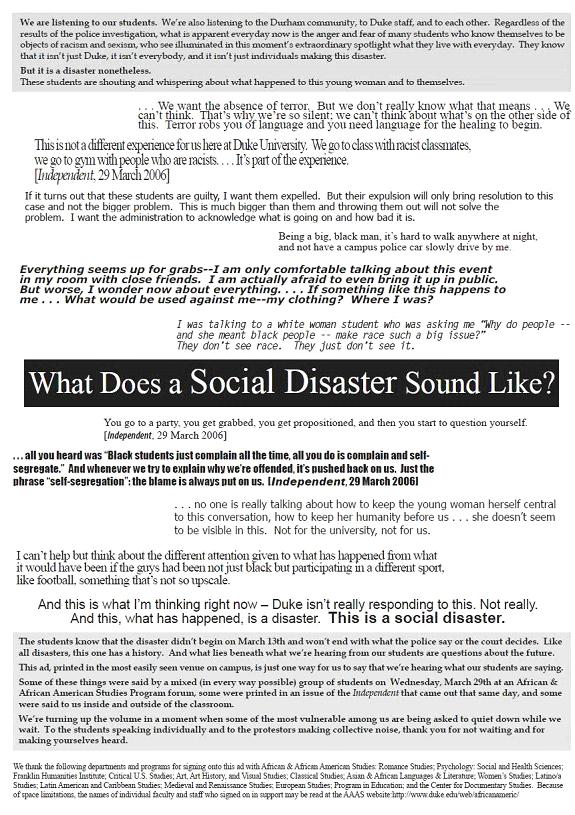
A point from her recent book provides a sense of how such “experiential knowledge” works in practice. Among Harris-Perry’s other claims was the following, about the origins of the Group of 88 statement: “Less than a year after Hurricane Katrina revealed patterns of festering racial inequality and prompted national conversations about black citizenship, these eighty-eight members of the Duke faculty chose to frame the lacrosse scandal as a disaster. In the long shadow of Hurricane Katrina, this choice is an important clue to the multiple meanings associated with the rape accusation. In this context,‘disaster’ evokes a sense of unequal vulnerability to supposedly neutral processes. The faculty members were drawing a link between the abandonment of black citizens in the aftermath of Katrina and the sense of vulnerability that many black men, white women, and especially black women felt on Duke's campus.”
As with Harris-Perry’s general interpretation of the Group and its critics, the Katrina-Group statement traces its roots to the unsubstantiated claims of former Africana Studies chairman Charlie Piot. And, of course, linking the Group’s statement to Katrina provides a way of removing some of the tarnish from the faculty’s actions: if the Group’s protest derived from the horrors of Katrina, it would seem, the Group should be seen as noble critics of an indifferent or even racist American state.
There is, of course, only one problem with Harris-Perry’s claim: there’s no actual evidence to link the Group’s statement with Katrina. In the 15 sentences from the Group’s statement that appeared in the faculty’s own words, no mention was made of Katrina. In the e-mail sent by the statement’s author, Wahneema Lubiano, soliciting membership in the Group, no mention was made of Katrina. In the alleged statements from anonymous alleged students quoted in the ad, no mention was made of Katrina.
But, of course, Harris-Perry doesn’t need “evidence” to advance her arguments. She is, after all, a practitioner of “black feminist scholarship.”
Subscribe to:
Posts (Atom)