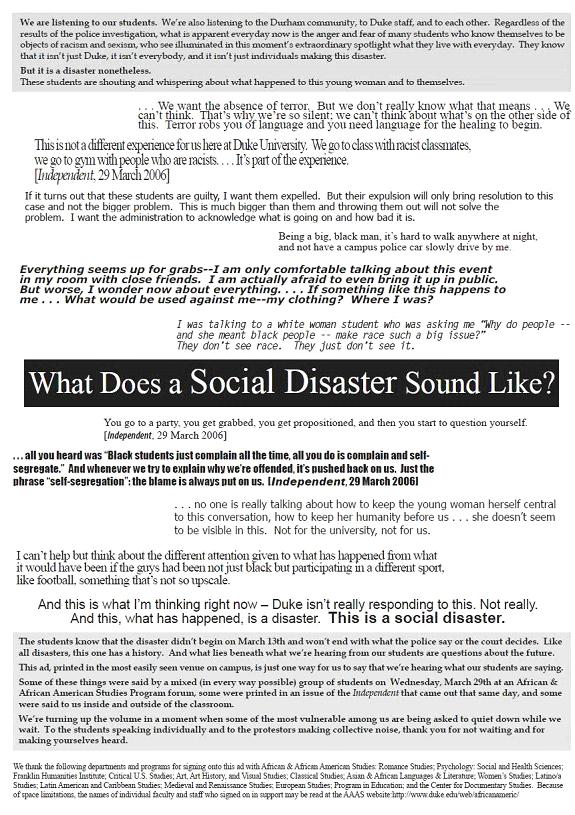
Among the faculty, the best example of reticence was the principal organizer
of the Group of 88 statement, Wahneema Lubiano. Lubiano, author of two
perpetually forthcoming manuscripts, aggressively solicited signatures for the Group ad, but
subsequently refused all comment to me (or to any other blog that focused on
the case), leaving unanswered such critical questions as to why she (falsely) claimed
that five academic departments endorsed the statement. Within the
administration, the case reticence award went to Larry Moneta, who declined an
interview request for UPI, and who
did his best to stonewall comment in this interview:
To what extent, however, could it be said that the blog (or,
I suppose, other blogs) was unfair in not including sufficient information from the Duke faculty and/or administration?
A few days ago, I was asked this question which is a rather interesting one, in reference to this post, which
examined how the Duke and Durham communities responded
to the sexual assault of Duke student Katie Rouse in a dramatically different
approach than how the very same people had responded to the lacrosse case.
The post included one Moneta statement about the assault, in
an interview with NBC-17 captured by Liestoppers: The situation was “part of the reality of collegiate life and of experimentation and some of the consequences of students not necessarily always being in the right place at the right time. This happens around the country. Duke is no different in that respect.” The post did not include
Moneta’s earlier statement on the case, a four-sentence press release mentioned
here, which claimed that Duke was giving an unidentified type of “support” to the student and
cooperating with the police investigation.
Duke not cooperating with the police investigation likely would have violated federal law, and so saying the university was cooperating with police would be a little like saying the sky is blue—clearly true, but of no relevance. In this instance, then, by the time of the post, the only appropriate reference to the Moneta press release would have been sarcastic—to note that a prominent Duke administrator apparently was defining “support” as seeming to shift the blame for the crime to the student.
But what if Moneta hadn’t done the interview with NBC-17? It’s
still hard to see any news value in his press release, which was little more
than pabulum. Given his position as president, the blog in general referenced all case-related press releases
from Brodhead (even those that amounted to little more than pabulum), but
generally referenced lower-level administrators only when they said something
of substance. The handful of people who had any interest in generic statements
issued over the signatures of various Duke officials could find them on the Duke
website.
The idea that statements from affected parties must be
referenced in the name of fairness—even if those statements either don’t say
anything or non-responsive—has become a hallmark of contemporary political
journalism, as reporters desperate to prove their “objectivity” include quotes
from campaign press officials that amount to little more than talking points about issues that are at best tangential to the subject of the article. Reading past such non-sequiturs has become a requirement for anyone
who glances at articles in the Times,
Washington Post, or Politico. “Fairness” doesn’t immediately
jump to mind when describing the impact of the inclusion of such statements.
The lesson from the Moneta press release? If administrators
want their words noticed, their statements should actually say something. Then again,
at Duke during the lacrosse case, administrators’ most substantive remarks
(for instance, Brodhead’s
April 5, 2006 letter to the campus community) often backfired. Perhaps they should have stuck to the pabulum strategy.