Sunday, November 30, 2008

Crime & Punishment

The Chronicle reports that Michael Burch was recently arrested on charges of rape. Burch is the same man arrested for rape after a February 2007 party at a house rented by members of Duke’s predominately African-American Phi Beta Sigma Fraternity. The Chronicle reminded us that “police had found marijuana, cocaine and Oxycontin in the house” at which the February 2007 party was held. Burch, who is not a Duke student, is African-American; his February 2007 accuser, who was a Duke student, is white. Neither the Chronicle nor the N&O revealed the race of Burch’s second accuser.

After his February 2007 arrest, Burch was held on a $50,000 bond. It was hard to miss the disparity between this figure and the amount ex-Nifong boss and current Durham judge Ronald Stephens assigned to the falsely accused lacrosse players—$400,000, with a requirement for posting the entire amount in cash, rather than (as Burch received) a 10% bond. The father of Burch’s accuser certainly noticed how Durham Justice operates:

We feel eschewed because the Duke lacrosse players had to post $400,000 and this individual had to post $50,000. From a racial aspect, on the outside looking in, [it seems they thought] ‘four white kids from the North let’s make it $400,000 and for a black guy let’s make it $50,000.’ A crime is a crime.

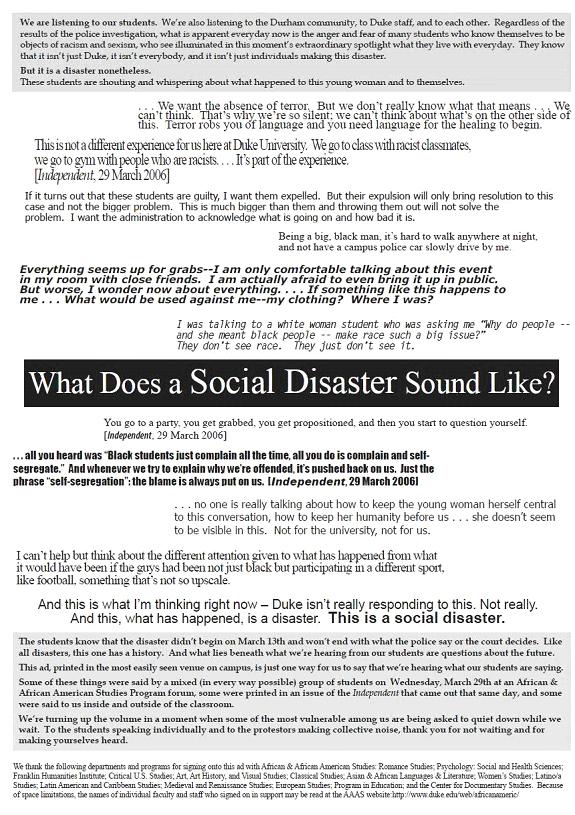
Of course, the Burch case revealed not only the double standards in Durham Justice but in Duke Justice. The clarifying faculty told us that the Group of 88 had—based only the version of events presented by Mike Nifong and Sgt. Mark Gottlieb—proclaimed that something “happened” to Crystal Mangum, had thanked protesters who carried a “castrate” banner, and had promised to continue their crusade “regardless of what the police say or the court decides” because of “the atmosphere that allows sexism, racism, and sexual violence to be so prevalent on campus.”

Certainly, then, we should have expected a cacophony of protest from the Group targeted at Burch—given that his alleged victim was a student at the University from which the Group members draw their salaries. And yet the Group’s sound was silence.

Burch’s second arrest? Again, not a peep. I’ll be checking the pages of the Chronicle for another Wahneema Lubiano-organized ad, but I’m not betting on it. Could the Group members have become latter-day civil libertarians?

As for the University? In the Burch I case, Larry Moneta appeared to shift the blame to the accusing Duke student, commenting that the situation was “part of the reality of collegiate life and of experimentation and some of the consequences of students not necessarily always being in the right place at the right time.” (Imagine if Moneta had issued a statement early in the lacrosse case seeming to blame Crystal Mangum.) Neither Moneta nor anyone else from Duke has issued a statement in Burch II; it’s unclear if Moneta still maintains his selective blame-the-accuser approach.

The house rented by the fraternity members had four students; Moneta told the N&O that Duke had moved the quartet to temporary campus housing, because “we wanted them to be able to concentrate on their classes.” That’s the same Moneta who, in the lacrosse case, told two Duke students whose house was besieged by a mob of potbangers that they should call the Durham Police for assistance, since he couldn’t do anything.

By the way: Burch will come to trial sometime in 2009, so his case will be handled by a D.A.’s office under the leadership of newly elected D.A. Tracey Cline. That’s the same Cline who issued misleading or outright false statements about her role in the office’s lacrosse case misconduct, and was scheduled to assist Nifong in the prosecution of the bogus charges. How reassuring.

Wednesday, November 26, 2008

Duke As Plaintiff: Sues Its Insurance Company

Both the N&O and the Herald-Sun are reporting that Duke is suing its insurance company, National Union Fire Insurance Co--who Duke accuses of acting in a manner "willful, wanton, malicious, without justification or excuse." The H-S reports,

Sources close to the case say National Union is refusing to pay because it believes its policy is capped at $5 million for legal expenses and Duke has submitted legal bills -- alone -- of about $11 million to date, and that Duke refuses to accept the $5 million cap.

Duke's demands are considerable: it wants National Union to "advance and/or pay all of Duke’s Defense Costs (as defined in the insurance policies) for the Underlying Claims and the full amount of Duke’s settlement with certain claimants," and "a declaratory judgment (i) that National Union is liable to advance the costs for any future defense of Duke in connection with the Underlying Claims, and (ii) that National Union is liable for any reasonable settlement entered into by Duke in the Underlying Claims and/or any judgment entered against Duke in the Underlying Claims."

A key issue in the case seems to be the role of Duke Hospital (home, of course, of former SANE nurse-in-training Tara Levicy), and the degree to which Levicy's misconduct could or should have been supervised by Duke officials. Duke actually has two insurance carriers--National Union, which insures Duke Hospital, and United Educators Insurance, which insures Duke. The H-S reports that sources say the two companies "are bickering over which company -- if not both -- has the responsibility to pay." National Union's argument appears to be that the wrongdoing was either committed by Duke University employees, or, in the case of Levicy, a failure to supervise by Duke University employees, and therefore it has no responsibility to cover Duke's misconduct.

The H-S comments section featured a telling remark:

When one takes out a homeowner's insurance policy and then sets fire to his home, is the insurance company liable? When one takes out a life insurance policy and then commits suicide, should the insurance company have to pay? As far as I'm concerned, Duke negated its coverage when its administration willfully and purposefully undertook wrong and destructive actions against wrongfully accused students, thus violating its obligation to them. Every single Duke administrator who had a hand in perpetrating this gross injustice, and especially Richard Brodhead, should pay whatever damages are awarded out of his/her own pocket. Of the lacrosse scandal triumvirate of Nifong, Brodhead, and Bob Ashley, only Nifong has gone down. Ashley will, alas, remain unscathed. But Brodhead, however much he has suffered, hasn't yet suffered enough. Perhaps this will at last be the beginning of his end.

It will be interesting, to say the least, to read the insurance company's response to this suit. For now, one obvious effect of the lacrosse case: given that the university hasn't acknowledged any specific errors in its handling of the case, nor made changes designed to prevent a repeat performance in future, I suspect Duke's insurance premiums will be going through the roof.

Monday, November 24, 2008

Amazing

For those who thought that nothing left in the case could shock them, guess again.

The Charlotte Observer revealed that Board of Trustees chairman Bob Steel has become a . . . movie investor. (Steel, of course, has additional time on his hands, having presided over the collapse of Wachovia.)

That’s the same Bob Steel who:

  • privately claimed that something “terrible, terrible” happened in the lacrosse captains’ house;
  • misled other trustees into believing that the administration had stayed in close contact with the families of the three falsely accused players;
  • said that the Trustees had approved of Richard Brodhead’s “principles that he established and the actions he took,” including the president’s indefensible statement that a trial would allow “our students to be proved innocent.”

According to financial disclosure forms required from Steel’s tenure at the Treasury Department, Steel invested between $1 million and $5 million in a movie based on a book penned by a Duke faculty member.

The faculty member? Tim Tyson.

That’s the same Tim Tyson who:

  • in seeming violation of the Faculty Handbook, participated “as a teacher” in a “candlelight vigil” outside the lacrosse captains’ house;
  • suggested that that Duke students refusing to speak to Sgt. Mark Gottlieb without presence of their attorneys “may be illegal”;
  • wildly claimed that Duke students embodied “the spirit of the lynch mob”;
  • blamed society for Crystal Mangum’s conduct.

And then, when the case upon which he had based his calumnies utterly collapsed, Tyson proclaimed that he would “stand by” everything he said, and that he had articulated a “reasonably thoughtful stance(!!)” on the case.

That’s the faculty member whose work product has benefited from a huge investment the chairman of the Duke BOT?

Will we next hear that Steel has doubled down, and donated to the Mike Nifong legal defense fund?

Monday, November 17, 2008

Odds & Ends

The shameless Wendy Murphy is back, this time spouting off in a Boston Globe letter to the editor. Conducting an investigation and presenting physical or DNA or witness evidence in court? Not a requirement, it seems, to Murphy: “There's nothing inherently difficult about prosecuting rape. It is, in fact, the easiest and least expensive crime to investigate and prosecute. The victim takes the stand and says she was forced to have sex without her consent. If the jurors believe her beyond a reasonable doubt, they vote guilty.”

The villains? “We've always used the law as a way of indulging male entitlement over women's freedom. That we allow defense attorneys to obfuscate and eroticize rape trials as a way of distorting the truth to produce an unfair result only adds insult to injury.”

In reality, what “only adds insult to injury” is that anyone could take seriously the utterances of Murphy, a figure who seems oblivious to the truth, and someone who seems unaware of the basic tenets of due process. What does it say about the values of the Massachusetts Bar that it allows such a person to practice law in the Bay State?

---------

The Durham “grassroots” has also made its return, this time in the form of Fahim Knight, “chief researcher for the “Keeping It Real Think Tank.” (The think tank’s mission: “to inform African Americans and all people of good will of the pending dangers that lie ahead; as well as decode the symbolisms and reinterpret the hidden meanings behind those who operate as invisible forces, but covertly rules the world.”)

In a recent post, Knight brought his . . . unusual . . . analytical tools to the lacrosse case. How and why were charges dismissed? Due to the machinations of . . . Duke! That, of course, is the same Duke that reached a settlement with the falsely accused players and is currently facing massive civil rights lawsuits for violating the unindicted players’ rights. But, in the world according to Knight, Duke was actually rigging the case in the players’ behavior.

Nifong, of course, is a victim in this version of reality: “Duke University used its enormous influence and power to punish District Attorney Michael Nifong and to set an example for other ambitious adversaries who might consider in the future of contesting Duke’s power. Nifong has been character assassinated [sic] and has been publicly ridiculed for daring to come up against this historical great tobacco rich and aristocratic dynastic family institution. The North Carolina Bar Association, which is controlled by Duke(!) eventually disbarred Nifong stripping him of his law license and ability to earn money.”

And what of the false accuser, Crystal Mangum? Knight writes, “This writer also believes the victim [sic] Crystal Mangum who resides down the street from where I live, and I believe she was also paid off by Duke. Duke in one sense made her to go away. She has recently published her memoirs [en]titled, “The Last Dance for Grace: The Crystal Mangum Story” and willing [sic] to bet you she has been very selective at the advisement of her attorneys[?] about how far she was going to go with telling the story because I am quite sure she had signed a clause with Duke University forbidding her of speaking or writing the truth.”

Unclear is exactly what Duke paid for. While Mangum never told the same story twice, she did claim to prosecutors that she had been attacked (while, as a reminder, she was levitating in midair, and shortly after she had spent seven minutes chatting with her father while simultaneously performing an exotic dance). Perhaps Knight is claiming that Duke paid Mangum to offer a story so bizarre that no one except Mike Nifong and most of the Group of 88 would believe it?

On Friday, I e-mailed Knight to ask him why Duke would have “paid off” Mangum to help students that the University’s leadership and activist faculty had gone out of their way to revile. He didn’t respond.

---------

ESPN ombudsman Le Ann Schreiber recently commented on the network’s decision not to report allegations that Jets quarterback Brett Favre had phoned the Detroit Lions management to pass along inside information about his former team, the Green Bay Packers. The reason?

“When allegations are made against somebody,” [ESPN senior vice president and director of news Vince] Doria said, “with no confirmation or evidence on our part, and you go to the person and get a denial, and then use the denial to you as justification for putting the allegations out there—to me, that has always seemed an unethical way to get a story out if it involves a matter of character.”

That is old school journalistic ethics, music to any ombudsman’s ears, and yet Doria is right about the perception problem. ESPN can’t win on this one, because no one can come up with recent precedents.

One reason, of course, that “no one can come up with recent precedents” is how espn.com handled (and, by refusing to repudiate the story, continues to handle) the lacrosse case. An ESPN piece that appeared as an insert column on April 11, 2006—the day after defense attorneys announced that the DNA tests Mike Nifong had promised would exonerate the innocent all had come back with no matches—was reported by Eric Adelson.

Citing one and only one source—and an anonymous source, at that—Adelson provided “a detailed account of the exotic dancer’s arrival at the hospital the night of the alleged sexual assault.” The source claimed that Mangum was “beat up . . . She was hysterical . . . She was crying, she was pretty banged up.” Paraphrasing the anonymous source, Adelson suggested that “there were bruises on her face, neck, and arms” and “there were injuries to the woman’s pelvic area.”

Adelson’s performance would hardly conform to “old school journalistic ethics.” There were, in fact, only two logical explanations of his column: (1) He invented the anonymous source; or (2) An anonymous source—which, as a thread in the old Liestoppers convincingly argued, was probably former Duke Police Officer Sara Falcon—lied to him.

Astonishingly, even after the completion of the Attorney General’s investigation—which provided, it’s worth reiterating, not a scintilla of evidence to corroborate the claims of Adelson’s single anonymous source—Adelson stood by his story. Last summer, I e-mailed Schreiber to bring to her attention the errors in Adelson’s story. She didn't respond.

--------

Duke scored a victory late last week, when Judge James Beaty upheld the University’s argument that it had the power to unilaterally defer meetings to discuss discovery requirements. Beaty wrote,

Having considered the arguments of the parties, the Court concludes that allowing discovery to proceed further at this time, prior to the filing of Answers and prior to a determination of the claims and parties that will remain following resolution of the Motions to Dismiss, would be premature and inefficient, particularly in light of the scope of this litigation and the number of claims asserted and the number of Defendants named. In addition, proceeding with full discovery at this time would likely result in significant discovery disputes that could only be resolved by determination of the issues raised in the Motions to Dismiss.

Under these circumstances, the Court concludes that further discovery should proceed only after the pending Motions to Dismiss are resolved.

The decision was a perfectly logical one, although, of course, normally one party in a case doesn't get to unilaterally change the rules.

--------

And the Durham Police Department sustains its classy reputation.

Monday, November 10, 2008

Durham: "State Law Can't Touch Us"

In its most recent filing, the city of Durham claims absolute immunity for the portions of the civil suit dealing with North Carolina law.

In some intriguing legal reasoning, Durham’s attorneys concede:

A city may waive its governmental immunity under North Carolina law by purchasing liability insurance or participating in a local government risk pool that covers losses arising from tort claims for which a city would otherwise be immune.

And they note that

The City maintains three consecutive annual excess liability policies that may potentially be implicated by the time period of conduct alleged in the Amended Complaint.

But, they maintain,

By the express terms of each policy, the excess coverage is not triggered until the City has exhausted a self-insured retention that it is “legally obligated to pay.” Because the City cannot be “legally obligated to pay” losses arising from claims for which it has immunity, it cannot exhaust its self-insured retention with those losses. Thus, the excess coverage is not triggered, and the City’s immunity remains intact.

In other words, cities can purchase liability insurance whenever they desire to do so, and fall back on a claim that they still have absolute immunity because that liability insurance never should be allowed to kick in.

---------

On another matter, two significant North Carolina results from last Tuesday’s election.

First, in the Attorney General’s race, Roy Cooper not only won reelection, but topped the ticket, capturing 61.1 percent of the vote. The margin of victory came despite the last-minute retribution from the Wilmington Journal, which urged North Carolina voters to punish Cooper for failing to sustain charges against demonstrably innocent people.

Second, in the U.S. Senate race, North Carolina voters ousted GOP senator Elizabeth Dole. That’s the same Elizabeth Dole who not only refused to demand a DOJ investigation of Mike Nifong’s misconduct, but preposterously asserted ten weeks after Cooper exonerated the falsely accused players that the lacrosse case was still “an ongoing criminal investigation and pending judicial proceeding.”

Dole, by the way, stayed classy right to the end, closing her campaign with an ad leaving the false impression that her opponent, Kay Hagan, had cried out, “There is no God!”


Monday, November 03, 2008

October Events in the Case

October in the case was highlighted by release of serial fabricator Crystal Mangum’s “memoir.” Among other things, Mangum:

  • Invented a whole new version of the “crime,” this one in which she implicitly admitted that she had falsely accused Collin Finnerty (without of course, issuing any apology to Finnerty);

  • Lashed out at the special prosecutors, whose job she seemed to believe was to accept anything she had to say at face value, not seek the truth;

  • Suggested that “hidden” DNA evidence existed—even though the DNA evidence was publicly discussed, at great length, in the Dec. 2006 hearing and Mike Nifong’s Aug. 2007 criminal contempt trial;

  • Challenged the journalistic integrity of Ed Bradley and 60 Minutes; and

  • Described the party in such a way that contradicted not only the photos of the event but also her own cell-phone records and the credit-card receipts of her “driver.”

Mangum did have positive things to say about two people: Mike Nifong and Tara Levicy. Nifong and Levicy have another thing in common: both left the jobs they had in disgrace.

Mangum reached the bottom of the barrel in scraping up “collaborators” for her memoir:

  • Co-author “Ed” Clark came across as someone with a schoolboy crush for Mangum, a figure who uncritically accepted whatever sweet nothings his Dulcinea chose to offer;

  • Academic advisor Myra Shird (North Carolina A&T) penned a preface to the memoir in which she seemed to be auditioning for a position in any of the myriad Duke departments dominated by the Group of 88; and

  • The NAACP’s Al McSurely made his reappearance, as the “agent” for the press that published the memoir.

In other events:

  • Vanderbilt’s “Take Back the Night” event featured Houston Baker, the Group of 88 member who most aggressively defended Mangum’s hoax. Why? Gushed one of the event’s sponsors, “When I think of Houston these days and all that he has done and all that he continues to do for women, the only word that comes to my mind is gratitude. Thank you Houston, for teaching us both within the classroom and outside it, for walking with us in this struggle to end violence against women.”

  • Important civil case filings from Bob Ekstrand responded to many of the Duke straw men arguments.

In political news related to the case:

  • The Wilmington Journal, home of Cash Michaels, carried through on its January 2007 threat and endorsed Attorney General Roy Cooper’s challenger. The reason? Cooper’s refusal to try three people his own investigation had determined were innocent.

  • Academics entered the presidential campaign, but in a way that suggested extremists were the exception rather than the norm in many humanities and (some) social science departments—a portrayal of the academy at odds with a fundamental lesson of the lacrosse case.

Finally, Zack Greer is now at Bryant, where he’ll play this spring for Coach Mike Pressler. His new number? 88.

Friday, October 31, 2008

The Least Surprising Endorsement

In January 2007, just after Mike Nifong turned the case over to Roy Cooper, the Wilmington Journal (the paper best known for pushing the bizarre theories of "Cousin Jakki," a/k/a Clyde Yancey) published an op-ed on the case. The column contained a thinly veiled threat--that if the Attorney General wanted the votes of North Carolina blacks, he needed to push forward with Crystal Mangum's fantastic lies.

Cooper, to his eternal credit, refused to bow to such crude tactics. His office investigated the case thoroughly, and then let the facts speak for themselves: the charges not only were dismissed, but the falsely accused players were factually innocent.

In its pre-election endorsement editorial, the Wilmington Journal exacted its revenge:
Per another office, NC Attorney General, this newspaper has endorsed challenger Robert Crumley over long time incumbent Roy Cooper, though there really is not much new about attorney Crumley positions beyond that he would be a better AG.

In our opinion, Mr. Cooper lost our vote, and our respect, when he refused to allow a trial to go forth in the Duke Lacrosse rape case, and then declared the three white suspects who allegedly raped a young black female ''innocent.''

Sorry, Mr. Cooper. Attorney Crumley now gets our support.
Disgraceful. And a reminder to all North Carolina readers of DIW to vote for Roy Cooper next Tuesday.

Monday, October 27, 2008

Reflections on the Mangum Opus

As could be expected from the work of a serial fabricator, Crystal Mangum’s memoir is little more than a tissue of lies.

1.) The book restated one of Mangum’s most transparent lies—that she was consistent in describing the “attack.”

Mangum writes, “My account of what happened next is the same as I have described all along. It has been said that I gave varying accounts but that just isn't true.”

This statement is nothing short of breathtaking. In fact, Mangum never told the same story twice.

  • The number of attackers varied (from 20 to 6 to 5 to 4 to 3 to 2 to 0).

  • Kim Roberts’ role varied (from accomplice in the “attack” to impartial observer to fellow “victim”).

  • The time of the “attack” varied (from no time, to just after 11.00pm, to—in the memoir—just after 11.15pm).

  • The laws of physics varied (Mangum’s spring 2007 version had the “attack” occurring as she was levitating in mid-air).

Even in her pre-indictment versions of the events, Mangum’s basic description of who allegedly did what wildly varied:

  • A green X corresponds to the story that Mangum told Tara Levicy on March 14, 2006.
  • A blue Y corresponds to the story that Mangum told Gottlieb and Officer Ben Himan on March 16, 2006.
  • A red Z corresponds to the story that Mangum provided in her April 6, 2006 official statement.


Oral

Anal

Vaginal

Married

Matt

X

YZ

XZ

X

Brett


YZ

YZ


Adam

XY

X


Z

Whether Mangum—as a serial fabricator—simply can’t tell the truth, or whether—as Attorney General Cooper speculated in April 2007—her mental problems lead her to believe her own lies is immaterial. For her to claim that she described “what happened” the same way throughout the case is absurd.

2.) Mangum is a great believer in conspiracy theories.

Everyone, it seems, was out to get Mangum (except for Mike Nifong and former SANE nurse-in-training Tara Levicy).

  • Bad stories about her character? The fault of former associates from the world of exotic dancing, who didn’t like her.

  • News about her medical history? The fault of her doctor, who must have leaked the information. (In fact, the first word of her mental problems came from an Esquire interview with her mother.)

  • The time-stamped photos that directly contradicted her stories? The photos were doctored, perhaps by Duke.

  • The DNA evidence that directly contradicted her stories? There’s secret DNA evidence, that some sort of conspiracy has prevented ever being made public.

  • The lack of any corroborating witnesses for her myriad tall tales? According to Mangum, “They are going to get away with it because Duke has paid everyone to be silent.”

  • Her hero, Mike Nifong, being disbarred for ethical misconduct? “The [unnamed] forces aligned against the case needed Nifong’s license.”

The media (especially 60 Minutes and CNN), defense attorneys, Kim Roberts, and bloggers also enter into various conspiracy theories against Mangum.

3.) The book continued Mangum’s tendency to consistently adjust her story to fit newly publicized facts that undermined her previous version of events.

Perhaps the best example of this pattern came in the Dec. 20, 2006 frame, in which she changed the time of the “attack,” abandoned her claim that Dave Evans had a mustache the night of the party, and said she no longer could be sure she was raped—all to address unimpeachable physical evidence that disproved her March/April 2006 stories.

The most apparent “convenient recollection” from her memoir came in her contention that her alleged second attacker “decided to penetrate me again. This time anally and painfully. He removed himself just before he had an orgasm and ejaculated on the floor.”

This item wasn’t described in that fashion in any of her (myriad) stories—but its inclusion in the memoir allows her to suggest a grand conspiracy to conceal evidence that somehow corroborates her story. She writes,

I also believe the police found one other DNA sample that has rarely been mentioned in any news accounts. That sample was found near the sink in the bathroom. From what I was told, it was semen from one of the individuals who had been at the party. Again, we will never know unless the case file is made public.

Despite Mangum’s insinuations, this information (coupled with the name of Matt Zash, someone Mangum twice failed to recognize when shown his photo) has been public since at least May 2006. Moreover, in (most of) Mangum’s stories, the “second attacker” was Collin Finnerty. Zash is just under 6 feet, with black hair and a stocky build. Finnerty is tall, with light brown hair, a distinctive face, and a lean, athletic build. In short, Mangum’s new “second attacker” looks nothing like her 2006 claimed “second attacker.”

At the very least, does Mangum apologize for making what even she now concedes was a false allegation against Finnerty?

Of course not.

4.) Inconvenient facts can simply be ignored.

The DNA from multiple, unidentified males found in her rape kit and concealed for months by Nifong and former lab director Brian Meehan?

  • Not according to Mangum: “I have seen reports implying that I had multiple sex partners in the days or maybe hours before the incident. This was not proven in the DNA samples that were taken at the hospital.”

The photos showing Mangum outside the lacrosse captains’ locked door (which was locked to prevent her from gaining re-entrance into the house)?

  • Not according to Mangum: She actually was inside the house when the door was locked.

Her loss of a driver’s license, from her previous conviction of stealing a taxi and then trying to run down a cop in a drunken rage?

  • Not according to Mangum: “Having a driver is part of the business for a vast majority of the girls. Not only does the driver make sure you get where you need to go but also serves as protection.”

The many photos, showing an incredibly dull party, with lacrosse players uninterested in Mangum’s performance?

  • Not according to Mangum: “It seemed as though the entire crowd was going to converge on us. They were so much more vocal than the people I danced for at the Platinum Club, and they looked as though they wanted to provoke a confrontation . . . we were confronted by a group of angry guys. It seemed as though they were yelling and screaming at the tops of their lungs . . . The crowd was extremely agitated . . . I could hear yelling in the other room. It sounded like the way people scream and cheer at a football game.”

5.) Mangum has reached the bottom of the barrel with her current enablers.

Anyone who followed the lacrosse case knows of the despicable performance of Al McSurely, the NAACP lawyer who published the August 2006 error-laden, guilt-presuming “memorandum of law” about the case.

The other key figures in producing the Mangum book? Academic “advisor” Myra Shird preposterously suggested that those who had determined that Mangum had lied—and was a figure of, to put it mildly, dubious character—were guilty of the kind of prejudgment that led to slavery and the Holocaust.

And co-author “Ed” Clark produced a preface that more resembled the work of a love-struck schoolboy (“My heart pounded. I had been waiting for the opportunity to meet the accuser”) than a serious writer.

Both Clark and Shird provide heavy helpings of race-baiting rhetoric—as could be expected from the ranks of the true believers.

--------

The best evaluation of Mangum’s opus came from Joe Cheshire: “Her continued assertion that an assault happened is really pathetic . . . She’s clearly doing this to make money. By continuing to lie, she makes everything in the book, everything she says, a lie.”

Saturday, October 25, 2008

Mangum Takes on the Special Prosecutors

While she praised the unethical efforts of Mike Nifong, Crystal Mangum had nothing but contempt for the special prosecutors who took over the case after Nifong recused himself. She especially seemed not to like Assistant Attorney General Jim Coman. In her first meeting with the new prosecution team, she recalled,

Both Mary Winstead and Jim Coman struck me as professional people, but I was a bit nervous. I thought that they were representing me and I did not expect them to be hostile. [emphasis added]

Mangum appears unaware that—unlike Nifong, who repeatedly referred to Mangum as “my victim”—prosecutors do not “represent” accusers. They represent the people.

The second meeting with the special prosecutors went worse—because state law enforcement officials, unlike Nifong, had the temerity to question Mangum’s myriad, often contradictory, versions of events:

There were four white males and one white female. Later a black woman joined us. The three white men were identified as members of the State Bureau of Investigation (SBI).

The extra people in the room made me especially uncomfortable. I was not expecting such a large gathering and the demeanor of those watching did not make me feel they were on my side. We all sat around a large conference table. There was an easel set up; I was given a long pointing stick and asked to go over the events of the night of March 13 while the people in the room stared at me. I was visibly uncomfortable. I struggled with my words and felt confused at times because I could not stand the looks I was getting. I was told I needed to describe again in detail what had happened. It was excruciating and humiliating, trying to tell my story to people who were visibly hostile.

After breaking down in tears, Mangum recalls,

Jim Coman launched into a series of rapid-fire questions. “Where were you raped? Which door did you enter and exit? Were they the same doors? Did Mr. Nifong tell you the names of your attackers?” I felt like I had answered all those questions a dozen times already. Mr. Coman’s delivery of the questions to be trying to frustrate me . . . Why was not someone on my side in this? I had met with the police and Mike Nifong and never once did I feel like I was not being respected.

Mangum’s response to these events? Blame everything on . . . Duke(!). She told the special prosecutors, “They are going to get away with it because Duke has paid everyone to be silent.” The serial fabricator also offered the wild claim that Duke had doctored the photos of the party.

(This, of course, is the same Duke that—in the grip of the Group of 88—did everything but take out a full-page ad in the New York Times distancing itself from the three students Mangum falsely accused.)

While Mangum discusses her first and second meetings with the special prosecutors, she doesn’t mention her final meeting with state law enforcement officials—the meeting to which she arrived impaired from a cocktail of prescription drugs. That finding, documented in the AG’s report, wouldn’t support her self-portrayal as a kind of anti-drug crusader in the world of exotic dancing.

Mangum’s reaction to the Cooper Report was, to put it mildly, bizarre: “I thought that if they did not want to pursue rape charges they could move forward. If nothing else, there should have been enough evidence to prove that racial slurs where used during the assault.”

The report, of course, concluded there was no assault. Even in Durham, it would seem impossible to use “racial slurs” in an “assault” that never occurred in the first place.

Reflecting on the demise of her hoax, Mangum did give a shout-out to her hero, Mike Nifong, for whom she felt “sorry.” And she again lashed out at defense attorneys, who she denounced as “free to go about getting as much money as they could from anyone they could sue. With his law license gone, Mike Nifong was vulnerable. He had served Durham for a long time and now on account of me, he was going to have to pay with his career. It did not seem fair and I believe the majority of people who think rationally know what the North Carolina Bar did was well beyond what was necessary or had ever been done in the past. Nevertheless, the forces aligned against the case needed Nifong’s license or there would be no grounds for the law suits that were to come.”

Mangum offered no evidence to corroborate her attack against the State Bar. Nor did she explain how “the forces aligned against the case” controlled the Bar’s actions. As the book proceeded, the anti-Nifong/Mangum conspiracy that the serial fabricator imagined had grown to enormous proportions.

In addition to castigating the special prosecutors and the State Bar, Mangum laced into CNN. It turns out that she had consented to a lengthy interview with Soledad O’Brien, at which she presumably told one of her myriad stories about what happened in the case. The result?

After allowing them into personal life and my home, someone at CNN decided this reporting was not something they wanted the public to see . . . Now, when I call CNN, no one will take my call(!!). They have nothing to say about what they saw.

Mangum appears unaware that—if only due to fear of a libel suit—most major news organizations will not give TV time to someone who’s offering a demonstrably false story.

In a line that could define chutzpah, the woman who leveled false allegations of a horrific crime against three innocent college students concluded, “I am left with hating the way it felt to be accused of being something I was not.”

Friday, October 24, 2008

Crystal's Many Enemies

The Mangum Opus is an oddly structured book. After introducing her invented reminisces of the party—drawn, seemingly willy-nilly, from her April 6, 2006 and December 20, 2006 stories—Mangum then provides a long section in which she criticizes her father, her mother (who was admitted to hospital for psychiatric problems), and her brother, while providing page after page of jealousy toward her sister. She also goes after one other family member, in the process rebuffing once and for all the Cash Michaels/Wendy Murphy claim that she was offered a $2 million bribe to drop all charges. The allegation—which was investigated and debunked during the case itself—was made by her “Cousin Jakki,” the sometimes car salesman, sometimes “performer” otherwise known as Clyde Yancey, who became something of a media sensation. Writes Mangum, “Even more disturbing was when some of my other relatives started to appear on television. People like my brother and my cousin Jackie. Even though most of the time they talked positively about me, they never once talked to me about the case.”

I emailed Murphy to ask if she would retract her (oft-made) claim based on Mangum’s denial. The adjunct law professor did not respond.

Mangum returns to the scene of the hoax by presenting a theory of the “attack” that most resembles her March 14/March 16 stories. During the “attack,” she contends, “the third attacker said, ‘I don’t want to. I love my fiancé and we are going to get married.’ The other two attackers coaxed him into taking his turn. When he finally did, each thrust hurt and it felt like my insiders were being ripped out.”

Of course, no lacrosse player was engaged to be married—as Mangum, who has admitted that she followed media reports on the case, is well aware. Perhaps that explains why she modified her story from her original version, in which she had claimed that the third “attacker” was getting married the following day. Now he is only “going to get married” at some indefinite point in the future.

Mangum then added a new twist, contending that her second attacker “decided to penetrate me again. This time anally and painfully. He removed himself just before he had an orgasm and ejaculated on the floor.”

This item wasn’t described in that fashion in any of her (myriad) stories—but its inclusion in the memoir allows her to suggest a grand conspiracy to conceal evidence that somehow corroborates her story. She writes,

I also believe the police found one other DNA sample that has rarely been mentioned in any news accounts. That sample was found near the sink in the bathroom. From what I was told, it was semen from one of the individuals who had been at the party. Again, we will never know unless the case file is made public.

Of course, this information (including the name of the unindicted player, someone Mangum twice failed to recognize when shown his photo) has been public since at least May 2006. The passage represents nothing more than an attempt by Mangum to make unsubstantiated allegations against lacrosse players she didn’t manage to target the first time around.

Having alternatively portrayed Kim Roberts as a co-conspirator in the rape (3-14-06), neutral bystander (3-16-06), and fellow victim of rape (4-6-06), Mangum has now returned to her March 14 storyline, to wit:

The guys wiped me off quickly and attempted to straighten my clothes. Nikki entered the bathroom and helped them finish fixing my clothes. I wanted to run out of there, and I tried.

Mangum can scarcely conceal her hatred for the defense attorneys whose work exposed her attempted hoax. “It did not help,” she fumes, “that the attorneys for the lacrosse players called press conferences and appeared on cable talk shows more than anyone else. In their zeal to serve their clients, it seems as though they were calling as much attention to the case as possible.”

Of course, the attorneys went public only because Mike Nifong had elected to try the case in public, thereby tainting any potential jury pool. Mangum doesn’t seem to see a problem in Nifong’s ethically improper statements, however. “People can criticize how the district attorney handled the case,” she concedes, “but I am not sure he knew what to do either. The truth is I had very little contact with him over the course of the media spectacle. I did not sit down with him for an extensive interview until December 2006.”

(A Mangum-Nifong “extensive interview” in December 2006 has never been even hinted at before publication of the Mangum book.)

Mangum also lashes out at Ed Bradley and the 60 Minutes team, which uncovered the tape of Mangum dancing—in a most limber fashion—at the Platinum Pleasures Club eleven days after the “attack,” at a time when she was claiming massive injuries. Her assertion? “The alleged videotape of me dancing at the club was from several months before the incident at 610 North Buchanan.”

Her evidence for her claim? None. We should, according to Mangum, simply accept her word for it.

Having challenged 60 Minutes, Mangum then offers wild theories about the DNA evidence. “I have seen reports implying that I had multiple sex partners in the days or maybe hours before the incident. This was not proven in the DNA samples that were taken at the hospital. If the DNA confirms that none of the people charged left DNA on me, then the test performed their function. I cannot and will not argue with that. Nevertheless, I believe there are DNA tests in the case file that may tell a different story. Unfortunately, with the case file not being public record, we can only go on what the defense attorneys want to release to the public.”

Mangum offers no indication of what “secret” DNA evidence she’s talking about. Since the story of the entire DNA evidence was highly public—indeed, it formed the basis of the Dec. 15 Meehan hearing—her assertion is nothing short of bizarre.

But Mangum saves most of her venom for the lacrosse players whose lives she tried to ruin. Channeling the peculiar legal theories of Group of 88 member Grant Farred, she muses, “Would people feel different about things if they realized that a hate crime was committed against me? If nothing else, there is ample enough evidence to prove that racial slurs were used during my time in that house.

There is, of course, absolutely no evidence “that racial slurs were used during [Mangum’s] time in that house.”

Mangum also darkly hints that unnamed players destroyed evidence or otherwise obstructed justice:

It is dismaying to know the police did not go into the house until two days after the party. People would have plenty of time to clean the house of evidence. There was also time to contaminate evidence as well . . . With the records from the case being sealed, the only people who have any real knowledge about what truly happened in those two days are the people at the party.

Of course, all the “evidence” was still in the house.

In her race to the bottom, Mangum does manage to throw the Group of 88 under the bus. She writes,

It was always strange to see that people such as Jesse Jackson, Al Sharpton, professors at Duke, and many others who either spoke on television or went to the house at 610 North Buchanan to make statements. I really started to worry when none of them actually came to my house to talk to me and offer assistance. If they were so concerned, why had I never met any of them?

Mangum does praise two people—former SANE nurse-in-training Tara Levicy, and Mike Nifong.

Regarding Levicy, she writes, “I am convinced that the hospital staff that night did their jobs. I have not spoken to any of them since that night, but I assure you they were not manufacturing the injuries they reported finding on me.”

Of course, the point is that Levicy didn’t find injuries on Mangum—apart from non-bleeding scratches on her knee and ankle.

Regarding Nifong, she suggests, “I know now that the entire identification process was questionable, but I believed then and now that Mike Nifong was not directing anyone to harm anyone else. He was always kind and polite.”

The “kind and polite” Mike Nifong and the serial fabricator Crystal Mangum. A perfect match.

Crystal Does the Party

Mangum opens her “invent-all” memoir with her latest story about her introduction into the world of exotic dancing; and then a wildly non-credible recapitulation of the party.

Here’s the serial fabricator on how she allegedly got into exotic dancing.

It would be much more money than I could ever earn up on stage, and I didn't like the atmosphere in the clubs that much anyway. The one thing she pointed out about me was that I did not have a pimp like the other girls at the club. I wasn't a prostitute and wouldn't have all of what that meant hanging over me . . . Since I was going into this strictly as a performer, sex with complete strangers was not something I was ever willing to consider.

So from where, exactly, did all that DNA from multiple unidentified males originate? Mangum doesn’t even bother to try to lie: she just doesn’t mention the finding.

Here’s how Mangum describes getting to the party:

I know there has been some discussion and eyebrows raised about having people drive me to my gigs. Having a driver is part of the business for a vast majority of the girls. Not only does the driver make sure you get where you need to go but also serves as protection.

Mangum leaves out a rather significant point: the reason she needed a driver was because she had no drivers’ license. She lost her license after stealing a taxi in a drunken outburst and then trying to run down a police officer.

Her usual driver, she recalls, was fellow NCCU student Jerriel Johnson: “Jerriel also knew my boyfriend and that made it more comfortable for Mat to know that I was being watched after.”

Johnson, of course, is the person who admitted in his police statement that he had sexual relations with Mangum. The serial fabricator doesn’t say if they told her boyfriend about their affair.

Mangum devotes the bulk of her party chapter, however, to a blow-by-blow refutation of the Attorney General’s report, as if Roy Cooper, his prosecutors, and the State Bureau of Investigation had simply made up their report.

Writes she,

Frustrated and not exactly sure where 610 North Buchanan was, I called my dad for better directions. He pointed us right to where we needed to go. We arrived at the house at about 11:15 pm.

Mangum had previously claimed she arrived at the party around 11.45—a version of events corroborated by Roberts, neighbor Brian Bissey, her cellphone records, and the credit card receipts of “driver” Brian Taylor. In her December 2006 attempted frame, Mangum revised her arrival time to 11.00pm—to make up for the fact that both Reade Seligmann and Collin Finnerty had airtight alibis for the time of the alleged “rape” based on her 11.45 arrival. Now she’s split the difference and claimed she arrived at 11.15pm—which would still suggest (based on her cellphone records) that she was either planning or performing a nude dance as she happily chatted on the phone with her father, asking him for directions to 610 N. Buchanan.

Mangum darkly hints at a date rape drug, since “we will never be sure what was in the drinks that Dan gave us.” And yet she describes herself throughout the chapter as not under the effects of any drug.

Shortly after her arrival at the house, Mangum recalls racial epithets—joining Mike Nifong and Duff Wilson of the New York Times as the only people still clinging to this version of events:

Then I heard it for the first time; someone in the crowd was referring to us as “black bitches.” It was not said just once. It was almost as if that was our names.

And yet: Kim Roberts—a person, it’s perfectly clear, who was extremely sensitive to racial insults—never mentioned such obviously inflammatory behavior. Nor did Devon Sherwood—the African-American player on the team, who was present for the party.

Mangum continues her long-existing (and scarcely credible) pattern of treating Kim Roberts as the more disgusting of the two dancers:

We had only been performing a matter of minutes and Nikki had taken things way beyond anything I had planned. I glanced and saw her panties lying beside her.

Yet Mangum has to come up with some way to account for the fact that photos showed her both on the floor in both a sexually suggestive and seemingly drunk state. In an almost hilarious passage, Mangum claims that her utter shock (shock!) at Roberts’ loose behavior—and not her drunkenness/drug-induced status—caused her to fall on the floor and appear to be either drunk or high:

The way I ended up on the floor was completely an accident and the result of my complete and utter surprise at what was going on.

Again, all who believe that can sign up for Mike Nifong’s campaign to become the next Supreme Court Justice.

How did the dance come to a conclusion?

“We need to get out of here. They are going to try and use that broom on us,” Nikki screamed at me over the chaos. She looked scared and I felt it. By now I heard the words nigger, bitch, and other names. They were definitely not happy with the performance.

Again, Roberts—a person, it’s perfectly clear, who was extremely sensitive to racial insults—never mentioned such racist insults occurring inside, during the party. Nor did she ever tell police that she had said anything like, “We need to get out of here. They are going to try and use that broom on us.”

This version of events, it seems, combines the “timid Crystal” presented in the April 6, 2006 police report and the “Crystal-changes-her-story-to-address-all-the exculpatory-evidence” Mangum offered in the Linwood Wilson December 2006 frame.

Mangum, who admitted that she closely followed media reports about the case, sometimes attempts to fit into her story known facts that undermined her myriad claims. For instance, photos showed Mangum banging on the back door, with a smile on her face, trying to get back into the house around 12.30am. But Matt Zash had locked the door, in part to keep the clearly imbalanced Mangum out.

In Mangum’s new version of events, Zash locked the door after she returned to the house: “I felt even more in a panic when I saw one of the guys go to the door we had just entered, to close and lock it behind us. That struck me as odd since people had been moving freely in and out all night. That move seemed especially sinister in light of the way everyone was acting.”

How, then, do we explain the photos of Mangum outside the locked door? Perhaps the woman who alleged rape-by-levitation also believes she could simultaneously be inside and outside the house.

Mangum falls back on her April 6, 2006 version of the beginning of the “rape,” when one of her “attackers” uttered a 1950s-movie line: “Sweetheart, you can’t leave.” And such almost comical lines came amidst a wild party: “It seemed as though the entire crowd was going to converge on us. They were so much more vocal than the people I danced for at the Platinum Club, and they looked as though they wanted to provoke a confrontation . . . we were confronted by a group of angry guys. It seemed as though they were yelling and screaming at the tops of their lungs . . . The crowd was extremely agitated . . . I could hear yelling in the other room. It sounded like the way people scream and cheer at a football game.”

And here are some of the actual photos of these “angry guys” at this “agitated” party.


Wild, indeed.

As AG Cooper noted in his remarks, perhaps Mangum—due to her myriad psychological problems—actually believes some, or all, or the myriad, mutually contradictory, stories she has told. But the photos don’t exactly corroborate her wild claims.

Those who desire a minute-by-minute recapitulation of the party can find it in the AG’s report. The document directly contradicts virtually everything Mangum claimed in her “invent-all” memoir.

The Fantastic World of Vincent "Ed" Clark

After leading off with the almost laughable Shird preface, the Mangum Opus segues into a chapter from Mangum co-author Vincent “Ed” Clark, the figure who the N&O delicately described as “a self-employed publicist.”

Clark recalls for readers his first reaction upon hearing news of the Mangum’s fantastic charges:

I hated anything related to Duke sports.

So much for collaborator Myra Shird’s linking the dangers of prejudgment to slavery and the Holocaust.

Clark’s recollection of his first meeting with Mangum reads like the tales of a love-struck teenager:

My heart pounded. I had been waiting for the opportunity to meet the accuser. The case had been constantly on my mind. For some reason I felt as though I needed to know her. I needed to know as much as I could.

And Mangum didn’t disappoint her new, fawning friend:

From that moment [when Mangum first spoke to him] I believed something had happened, too. This person sitting in front of me was supposed to be delusional. I had met plenty of people like that and this person did not strike me that way.

Clark doesn’t share with readers his psychological training, or how else he is equipped to determine when a person is “delusional.” Nor does he reveal why his travels have caused him to encounter “plenty” of “delusional” people, and how he determined that these people were, in fact, “delusional.”

Indeed, Clark himself seems a bit delusional when he discusses the media’s handling of the case:

There was not one positive thing I had seen or read about this woman, and she had no way of knowing if I believed what I had read about her.

At other points in his introduction, Clark claims to have read everything he could about the life and times of his newfound, schoolboy crush. And yet he claims not to have encountered the myriad “positive” portrayals of Mangum as a hard-working mother—the paeans given to her by the potbangers, figures on the NCCU campus or at the state NAACP, and media personalities such as Nancy Grace?

When Clark gets to the facts of the case, his delusions only increase.

If people were willing to tell the truth they would acknowledge that people produced to discredit Crystal were facing their own legal troubles and were represented by lawyers who were members of the players' defense team. They would come forward and tell why Crystal’s medical records were leaked to the public to imply she had mental health problems. Others will say how they floated stories implying Crystal had been sexually promiscuous immediately before the alleged events when there was no proof she had been.

What case is he talking about? Mangum was “discredited” not by anyone coming forward, but by the public revelations of the procedurally flawed lineup, the exculpatory DNA evidence, and the myriad contradictions between the myriad stories she told. She was discredited, in short, by hard evidence, not by personal testimony from anyone.

And what of his claim that “Crystal’s medical records were leaked to the public” In fact, Mangum’s medical records were under seal, and have never been leaked—indeed, their specifics have never been publicly revealed. It’s true that those covering the case looked at the records’ existence “to imply she had mental health problems.” It seems to me—and Clark might disagree—that when a judge in open court holds up a psychological case file of around 1000 pages, the subject of that case file can be described as having “mental health problems.”

And what of Clark’s accusation that “others . . . floated stories implying Crystal had been sexually promiscuous immediately before the alleged events when there was no proof she had been.”

No proof? How, then, does Clark explain the fact that the DNA of multiple unidentified males was found in Mangum’s rape kit? Does he subscribe to Mike Nifong’s theory that this DNA might have come from Mangum’s young children?

Lacking facts to justify his assertions, Clark (as noted yesterday) regularly plays the race and class cards. “North Carolina,” writes he, “was not immune to unfairly prosecuting poor men. I just could not comprehend how having Joe Cheshire as your lawyer was being put at a disadvantage.”

And he continues, in a passage that could have been stolen from any of a number of Group of 88 members,

The idea of a white man abusing some black prostitute has appeal for some folk. Other white men consider black women there to be used, easily accessed, so it goes, and it has been that way since the first enslaved Africans came to America.

Clark concludes with a tribute to Durham, which he celebrates as a city ruled by African-Americans in which the “conservative block [sic]” cannot elect candidates. What’s Durham like, he asks. “Yes, there are murders, rapes, and other mayhem but nothing on the scale of what I saw when I traveled away from home.”

And where are these mysterious places to which Clark has “traveled away from home”? He doesn’t say.

The Shird Preface

The preface to the Mangum Opus was penned by a North Carolina A&T professor named Myra Shird—perhaps best known on campus for abruptly resigning her department chairmanship in the middle of the semester last year. Shird’s preface is . . . eye-opening.

Shird reflects on her introduction to the case, and the negative reception from the media she claims serial fabricator Crystal Mangum received:

Public ridicule? Should I even know the victim’s name so early in the investigation? Aren’t their [sic] laws that protect the victim [sic]?

Shird appears unfamiliar with basic U.S. law: there are no “laws” dealing with topics such as knowing “the victim’s name so early in the investigation.” (A side note: most college professors know the difference between when to use “there” and when to use “their.”)

Shird continues,

I can only imagine that every word out of the accused mouths was orchestrated . . . On the other hand, there was no one “real” there for the accuser.

The “accused mouths”? What is she talking about? (This, again, is the writing of a college professor.) And the assertion “there was no one ‘real’ there for the accuser”? Did Mangum have “unreal” associates?

As has become customary with those associated with the Nifong/Mangum effort, Shird plays fast and loose with the facts. “The Friends of Duke,” writes she, “raised millions to assist the Duke players with their defense.”

In fact, the Friends of Duke was a grassroots alumni organization devoted to returning the university to traditional academic principles of upholding due process. The group raised nothing—much less “millions”—to “assist the Duke players with their defense.”

Shird laments the unfair treatment she claims Mangum received because of the serial fabricator’s chosen profession:

If an exotic dancer is promiscuous and sleeps with five or six guys within a twenty-four-hour time period, do we find her less credible if she says that the seventh guy raped her?

Yes—if, as in this case, the “exotic dancer” denied having had sex not just “within a twenty-four-hour time period” before the party, but for a whole week before the party.

Shird occasionally veers toward uncomfortable conclusions. She reflects on AG Roy Cooper’s press conference announcing the players’ exoneration:

Cooper further explained, “We believe it's in the best interest of justice not to bring charges.” Whose best interest, Mr. Cooper?

Whose, indeed. Is Shird now suggesting that it would be in Mangum’s best interest for the state to bring charges against her for filing a false police report?

Shird wraps up her preface with two passages that offer an unintentional, if revealing, insight into her skewed mindset. She asserts,

I know women who call exotic dancers whores, but who find their own penchant to only sleep with BMW-driving, well-dressed, white-collar, college graduates who pay their bills as a simple act of self-preservation.

Who are these women? Shird, of course, doesn’t say.

And what is the appropriate historical context through which to interpret the reaction to Mangum? Shird makes Group of 88’er Bill Chafe (who said that the whites who beat, kidnapped, and murdered Emmett Till provided the appropriate historical contest through which to interpret the actions of the lacrosse players) look like a piker. Shird detects enormous implications to the alleged prejudgment of Mangum:

The hypocrisy of judging or labeling has led to major societal catastrophes such as slavery and the holocaust.

The Holocaust? Slavery? And Crystal Mangum’s treatment by the press?

Shameless.

Thursday, October 23, 2008

Shameless

A few things in the lacrosse case have been certain. Former lawyer Mike Nifong would violate the Bar’s ethics rules whenever presented with the opportunity. Group of 88 leader Wahneema Lubiano’s “forthcoming” books will still be “forthcoming.” And serial fabricator Crystal Mangum—the woman who could never tell the same story twice—will continue to fabricate.

At one level, it should come as no surprise to see Mangum’s fabricating today—in the three released chapters of her “invent-all” memoir, or in a treacly morning press conference. At another level, however, the performance was shameless—this woman whose lies caused so much harm lacks the decency not to publicly offer new lies.

As Joe Cheshire correctly noted, “Her press conference and her continued assertion that an assault happened is really pathetic . . . She’s clearly doing this to make money. By continuing to lie, she makes everything in the book, everything she says, a lie.”

Three chapters of the “invent-all” memoir have been released; here’s a summary of the peculiar tales offered by Mangum and co-author Ed Clark, who the N&O delicately describes as “a self-employed publicist.”

The Big Lie

At her press gala, Mangum affirmed, “I am still claiming that a sexual assault happened . . . [her story] has never changed.”

It’s worth reiterating, I suppose, that Mangum never even told the same story twice, much less consistently. Among the changes:

--Mangum variously claimed that there were 20, 6, 5, 4, 3, 2, or zero “rapists.”

--Mangum variously claimed that Kim Roberts, the second dancer, was an accomplice in the attack on her, a neutral bystander, or the victim of a “rape” by three other lacrosse players.

--Mangum originally asserted that the “rape” occurred in a manner consistent with the normal laws of physics, only to conclude the case by describing an “attack” while she was being suspended in mid-air (just after, it should be noted, she was chatting with her father on the phone during her exotic dance and even as one of her “attackers” was chatting on the phone with his girlfriend).

But the serial fabricator asserts that her story “has never changed.”

The “Star Student”

Mangum, Clark writes, “could talk about news events, politics, and sophisticated concepts in psychology.”

Indeed. And Mike Nifong is in line to become the nation’s next Supreme Court Justice.

In another factual whopper, Clark assures readers that Mangum has never really had a problem with drug abuse.

This is, of course, the same Crystal Mangum who was on several drugs during her final interview with the special prosecutor, and who seemed to be "hospital shopping" early in the case to get some additional Percocet from UNC Hospital.

Press Conference Bizarro World

Mangum unleashed a howler at the press conference, asserting that she had decided to write her "invent-all" memoir because she hadn't had a chance to tell her story.

This is, of course, the same Crystal Mangum who was sought for an interview by 60 Minutes, ABC's Law & Justice Unit, the AP, the N&O, and the Herald-Sun, among other media sources.

She also hinted that she never had an opportunity to tell her side of the story--even though she was repeatedly interviewed by the special prosecutors.

In the event, she had little interest in telling her side of the story at the press conference, declining to answer such basic factual questions as how often she met with Mike Nifong.

The Vast Right-Wing Conspiracy

Writes Clark,

I began to notice most of [Sean Hannity’s] rants were identical to [those of: sic] people such as Internet columnists Michael Gaynor, Stuart Taylor, and K.C. [sic] Johnson. I found it amazing that these non-local people invested so much time and energy on the case . . . A group of right-wing bloggers, . . . the people who peddled the libelous and slanderous stories about Crystal are the same people who have been behind the Terry Schiavo case and have worked on such causes as the Linda Tripp defense fund.

Just to correct the record—since I’m sure Clark wouldn’t knowingly include false information in his product:

Stuart formerly wrote for the New York Times (he was nominated for a Pulitzer) and currently writes for National Journal, a high-brow Washington publication that focuses on politics and public policy. Neither the NJ nor the Times are “internet” publications.

As for me: I opposed the Clinton impeachment, consider Linda Tripp a pathetic person with whose defense fund I had no involvement, and strongly opposed the Bush administration’s attempts to intervene in the Schiavo affair, which I viewed as emblematic of the dangerous influence of the GOP’s Christianist wing. Few people would describe as “right-wing” someone who publicly supports Barack Obama, abortion rights, and gay marriage—but perhaps Clark shares the Group of 88’s definition of “right-wing.”

Clark is, however, absolutely right in saying that I do not live in Durham. I congratulate him on getting something accurate in this passage.

The Race Card

Clark unsurprisingly plays the race card, suggesting that those who contended that (white male) Mike Nifong violated prosecutorial ethics or (white male) Mark Gottlieb violated normal police procedures were racists determined to uphold the position of white males.

Moreover, Clark contends, “hundreds” of prosecutors do what Nifong did, and go without punishment. He doesn’t list any of these prosecutors.

On the other side, he suggests, Mangum never employed emotion, and only wanted to get the facts out. The result, he suggests: “Whenever anyone wants to discuss the merits of the case, no one can really remember any of the facts.”

This claim is almost hilarious: if nothing else, those critical of Nifong were swimming in facts.

Clark continues with an even more astonishing assertion: “The weak link for the prosecution . . . was the accuser’s life story and not the facts of the case.” This attempt to rewrite history might even make the Group of 88 blush. Of course, the “weak link for the prosecution” was that Nifong had no “facts,” and constantly violated ethics rules to prop up his non-existent case. Mangum’s “life story” played almost no role in the defense presentations to the court in 2006.

Coming Clean?

Now that Mangum has publicly challenged the conclusions of the Attorney General’s report, will she finally release her psychological case file, so that readers of her “invent-all memoir” can evaluate her credibility?

For instance: has Mangum ever falsely accused anyone else—including medical personnel—of a violent crime?

When was Mangum first prescribed anti-psychotic medication—and was she taking her medication regularly in spring 2006?

Does Mangum have a history of hearing voices that order her what to do, or other symptoms associated with psychotic behavior?

When did Mangum first tell the DPD or Nifong of her serious psychological problems?

Clark asserts that the full Mangum Opus will be available tomorrow. I’ll review it when it appears.