Thursday, March 31, 2011

Beaty Decision (Evans Lawsuit): Key Passages (Updated)

Seligmann attorney Richard Emery: "The opinion is what I would call, overall, a ringing success for the boys . . . We’re glad that we’re moving ahead with the case.” Duke spokesperson Michael Schoenfeld commented, "The few claims remaining are substantially narrowed, as we had hoped."

Somehow, I doubt that Duke "hoped" that at this stage of the game, the university, Pres. Brodhead, Bob Steel, Tara Levicy, Dean Sue Wasiolek, and Duke Health would remain as defendants, and thus be subject to depositions and discovery. The university did score a victory in the dismissal of claims against the most virulently anti-lacrosse member of the upper administration, Larry Moneta. I will have more on the unindicted players' suit tomorrow.

--------

Key passages:

Beaty complains about the filing’s length, but then adds a strong conclusion: “The Court is also compelled to note that the allegations in the Second Amended Complaint that are going forward, particularly as to Counts 1-3, set out allegations of significant abuses of government power. Indeed, the intentional use of false or misleading evidence before a grand jury to obtain an indictment and arrest without probable cause is exactly the type of “unreasonable” search and seizure that the Fourth Amendment was designed to protect against, and would violate the most fundamental concepts of due process. In this regard, it has been noted that “‘if any concept is fundamental to our American system of justice, it is that those charged with upholding the law are prohibited from deliberately fabricating evidence and framing individuals for crimes they did not commit (indeed, we are unsure what due process entails if not protection against deliberate framing under color of official sanction).’”

. . . Defendants in this case essentially contend that this Court should take the most restrictive view of the applicable doctrines and should conclude that no provision of the Constitution has been violated, and that no redressable claim can be stated, when government officials intentionally fabricate evidence to frame innocent citizens, even if the evidence is used to indict and arrest those citizens without probable cause. This Court cannot take such a restrictive view of the protections afforded by the Constitution." [emphasis added]

Counts 8-12—conspiracy under § 1985—dismissed

Beaty holds that the counts could apply only if the lacrosse players were a protected class, which they are not (in other words, municipalities can’t be held liable under § 1985 for deciding to go after white males)

Count 13: conspiracy to commit malicious prosecution

Very high standard, but enough to go forward at this stage: “Defendant Nifong enjoys absolute prosecutorial immunity for the decision to prosecute, but that immunity does not extend to investigatory acts by Defendants Nifong and Wilson, particularly the creation of false and misleading evidence during the investigation.” [emphasis added]

Count 15: emotional distress—dismissed

Very high standard under North Carolina law, yet “Plaintiffs do not include any specific allegations of emotional or mental disorders or severe and disabling emotional or mental conditions suffered by any of the Plaintiffs individually.”

Counts 18-22: negligence claims against Durham, DNA Security

Beaty dismissed the claims against DNA Security, noting that the company had no specific obligation to the lacrosse players. (Its “client”—to use Brian Meehan’s term—was Durham.) He allowed the claims against the city to proceed, but strongly hinted he would dismiss them at summary judgment.

Count 4—false public statements--upheld

Beaty: must move beyond reputational harm; “Plaintiffs contend that they have stated a claim because the false public statements made by governmental officials in this case were intended to inflame the grand jury pool and result in indictments against Plaintiffs.”

“Plaintiffs have alleged that each of the named Defendants made deliberately false public statements in connection with the alleged falsification of evidence that was used to subject them to indictment and arrest. In addition, this right was clearly established well before the conduct alleged in the present case, and a reasonable official would have known that it violated clearly established constitutional rights to deliberately make false public statements regarding a citizen in connection with an unlawful arrest of that citizen.”

Count 5: city liability because of poor policies, insufficient supervision—upheld in part

“The Court concludes that Plaintiffs have alleged that the City had a policy of targeting Duke students that led to multiple constitutional violations against Duke students, particularly by Gottlieb, and that the City through its final policymaking officials nevertheless continued the policy and ratified and condoned those violations. Plaintiffs have stated a plausible claim that this condoning of constitutional violations in the enforcement of the policy led to the constitutional violations and injuries”

Nifong, however, is a different story: “the City could not have delegated its policymaking authority to Nifong, and the claims against Nifong in his “official capacity” are claims against the State, not the City. In light of this conclusion, the City cannot be liable under § 1983 for “official capacity” claims against Defendant Nifong or for alleged conduct by Nifong as a “policymaker.’”

Essentially holding that what Durham did was against the law, but the city cannot be held liable for it.<

Count 6: supervisory liability—upheld

“Under the Fourth Circuit’s decision in Shaw, it was clearly established that an official violated the Constitution if, in deliberate indifference to the constitutional rights of citizens, the official knew of his subordinate’s constitutional violations and failed to act.”

But plaintiffs must “pinpoint” what each defendant knew, when he knew it, and what he did about it.

Counts 1-3: alicious prosecution, concealment of evidence, and fabrication of false evidence—upheld

City had argued for dismissal based on grand jury indictment—Beaty says no

The D.C. Circuit recently concluded that in a civil case for malicious or retaliatory prosecution, a grand jury indictment is only prima facie evidence of probable cause that may be rebutted by evidence that the indictment was “produced by fraud, corruption, perjury, fabricated evidence, or other wrongful conduct undertaken in bad faith.” Moore v. Hartman, 571 F.3d 62, 69 (D.C. Cir. 2009).

The Fourth Circuit has likewise recognized that when police officers effect a “seizure” by arresting an individual pursuant to an arrest warrant, the officers are liable under the Fourth

Amendment if the officers “intentionally lie in warrant affidavits, or recklessly include or exclude material information known to them.” Miller, 475 F.3d at 630.

the Fourth Circuit has also recognized that even when a probable cause determination has been made by a neutral third party, “an officer who intentionally or recklessly puts lies before a magistrate, or hides facts from him, violates the Constitution unless the untainted facts themselves provide probable cause.” Miller, 475 F.3d at 630-31.

Defendants’ response: “This analysis includes extensive parsing of pieces of the Second Amended Complaint, as well as contentions by the Defendants blaming one another for any alleged violation here.” Such a matter can’t be covered in a motion to dismiss.

Plaintiffs can meet the standards set out above, specifically by alleging that Plaintiffs were arrested pursuant to an indictment that was obtained by the intentional or reckless creation of false or misleading evidence used before the grand jury that was necessary to a finding of probable cause, or the deliberate or reckless omission of material information that officials knew would negate probable cause.”

14th amendment claims regarding false arrest generally held to high standard, but “the Fourth Circuit has also held that individuals possess a Fourteenth Amendment Due Process right not to be deprived of liberty as a result of the deliberate fabrication of evidence by a government officer acting in an investigating capacity.”

Absolute immunity for grand jury testimony, but “the Fourth Circuit has held that even though an officer cannot be held liable for his testimony in a legal proceeding, this immunity does not extend to the “initial act of fabrication,” and would not protect an officer who allegedly fabricated a police report where the report was later used at trial.”

Nifong and Wilson claimed absolute prosecutorial immunity, but “the Supreme Court [in Buckley v. Fitzsimmons] ultimately concluded that the prosecutor was not entitled to absolute immunity for his investigative work, including his alleged efforts to fabricate evidence prior to initiation of judicial proceedings.” And “based on the allegations . . . Nifong was acting far outside his prosecutorial role and was instead assuming an investigatory role in this matter, going so far as to assume supervision of an investigation that had just begun.”

Counts require demonstration of individual actors committing specific acts that violated the plaintiffs’ constitutional rights—clear in the case of Nifong, Gottlieb, Himan, shakier in the case of Meehan, Wilson, but still enough to move forward.

Breaking News

Motion to dismiss the civil lawsuits denied in part and granted in part. Immediate reaction: suits against Durham, Nifong, Wilson, the DPD, DNA Security, Duke, Brodhead, and Tara Levicy go forward--to include discovery. I suspect it will be a gloomy night in Durham. More to come, including analysis of the judge's order.

A Multiple Choice Quiz

Student A, who describes himself as black and Hispanic, receives a 98 on a statistics test; his professor also writes “excellent” beneath the grade. Student A peers at the tests of blonde, blue-eyed Students B and C, both of whom have told him their parents are WASPs. They both received grades of 100, but the professor—at least as far as Student A can see based on his (seemingly improper) peeking at their exams—did not write “excellent” beneath their grades.

What does the above scenario indicate?

a.) The professor liked Student A, and didn’t particularly like Students B or C.

b.) Student A’s test score was a dramatic improvement from his previous performance, so the professor wanted to give him particular encouragement, while Students B and C had been consistently excellent.

c.) Student A’s exam had been on the top of the pile, while those of Students B and C were on the bottom. The professor got progressively more tired as she graded the exams, and by the time she got to the bottom of the pile, simply indicated grades without any additional commentary.

d.) The professor’s implied message was that scoring a 98 was exceptional for Student A because he's black and Hispanic, but not for the white students.

If you answered a, b, or c, you might console yourself for having common sense—but you should also immediately withdraw your application from any Group of 88-dominated department at Duke.

In the scenario above, Student A was none other than Group of 88 extremist Eduardo Bonilla-Silva; and he recounted the story, with option (d) as his explanation for the event, to the Duke Public Relations office for its article commemorating him and fellow 88’er Paula McClain as two of the three members of the entire Duke faculty singled out for their “mentoring” of Ph.D. students.

Obviously, “mentoring” in this case means training students to be extraordinarily sensitive to any potential racial, ethnic, sexist, or heterosexist slight, no matter how remote the probability.

As for Student Bonilla-Silva’s statistics professor: she should learn from this episode that no good deed goes unpunished, and should remember that the next time she wants to praise a student for a job well done, she might be setting herself up to be attacked as a covert racist.

Friday, March 18, 2011

Stay Classy, Linwood!

Few figures associated with the lacrosse case are quite so pathetic as Linwood Wilson—the ethically-challenged, Bible-singing p.i. hired by the equally ethically-challenged Mike Nifong to be Nifong’s chief investigator.

Wilson, who was summarily fired as soon as the disbarred Nifong left his position, has had a rather checkered career since his time as Sheriff of the Lacrosse Case. As a defendant in civil suits filed by the falsely accused players, he elected to represent himself, in the process proving the aphorism that a man who represents himself has a fool for a client. And he experienced life as a criminal defendant, when his wife accused him of threatening to kill her, sending her a text-message stating, "'til death do we part remember your wedding vows.. you never know the day or the time.” Wilson allegedly informed her that he could get away with it since “he owned Durham [and] lawyers and judges would do anything he said."

Wilson booking photo

On March 8, Counselor Wilson previewed his client’s strategy in addressing the issues with his wife. After erroneously filing a criminal complaint, Wilson, again acting as his own attorney, filed a civil lawsuit—alleging, almost comically, federal civil rights violations—against his wife, her sister, and her parents (or, in Wilson’s wording, her “co-conspirators”).

The basics of Counselor Wilson’s claim: Linwood Wilson doesn’t much want to work, and his wife, by walking out on him (after he allegedly threatened to kill her) left him to pay the mortgage on their house, thereby defrauding both him and the bank that holds the mortgage note.

In his filing, Counselor Wilson states that his client is “unemployed and had been since June 25, 2007.” The filing gives no indication that Wilson has looked for work at any point in that time; instead, he was the “dependent spouse based solely on the income of . . . Barbara B. Wilson,” who worked for the local Coca-Cola plant. He nonetheless asks for damages to cover “past and future economic loss”—and also “Attorneys’ fees.” (Wilson’s filing doesn’t say what he’s charging himself.) The Counselor also requests damages to counter his “loss of reputation.” I wasn’t aware that Wilson had a good reputation to lose.

Counselor Wilson’s filing, ironically given its intent, paints a somewhat sympathetic figure of his estranged wife. Wilson—a man, again, who by his own admission hasn’t earned a cent since June 2007—affirms that he complained about his wife engaging in “unnecessary spending,” which led her to store some of her clothes at her workplace. And, Wilson admits, while he and his wife might have led a swingers’ lifestyle, “She was not forced when having sex with other couples or Pat Wilson.” I wonder where in the Bible Wilson found justification for his engaging in the sort of behavior that his attorney’s filing has conceded.

Counselor Wilson’s chief aim in his filing, however, seems to be to spread dirt against his wife. He passes along news that she admitted to “misappropriate [I’m assuming Counselor Wilson meant to say “inappropriate” here] sexual contact” with another man, her “paramour.” And, tapping into sexist sentiments that might have been mainstream in the 1970s, Counselor Wilson claims that his wife went to Delaware to live with her parents not to escape his tyrannical behavior but because “menopause” might have caused her “emotional problems.”

Counselor Wilson has requested a jury trial. He better hope there aren’t any women who sit in judgment of him.

Monday, March 14, 2011

The Chronicle Remembers

Interviews with '06 and '07 editors Seyward Darby and Ryan McCartney. I never met Darby; I had a few conversations with McCartney (whose work I admired very much). Both are asked--appropriately--what they would do differently, with the benefit of hindsight; and both have some ideas. But from my perspective, both performed extraordinarily well under extraordinarily challenging circumstances.

And, it's worth remembering: as they and their colleagues repeatedly outperformed the New York Times, they were full-time college students.

Friday, March 11, 2011

The DNA Security File

Brian Meehan, the former lab director of DNA Security (DSI) who was fired after the nature of his . . . incomplete . . . report in the lacrosse case came to light, has filed a quixotic appeal to his quixotic wrongful termination suit. (His suit failed to survive summary judgment.) Meehan’s chances of appeal aren’t exactly high, but his appeal has produced a document dump. (The post below contains the choicest excerpts from several hundred pages of depositions, exhibits, and internal DSI documents.)

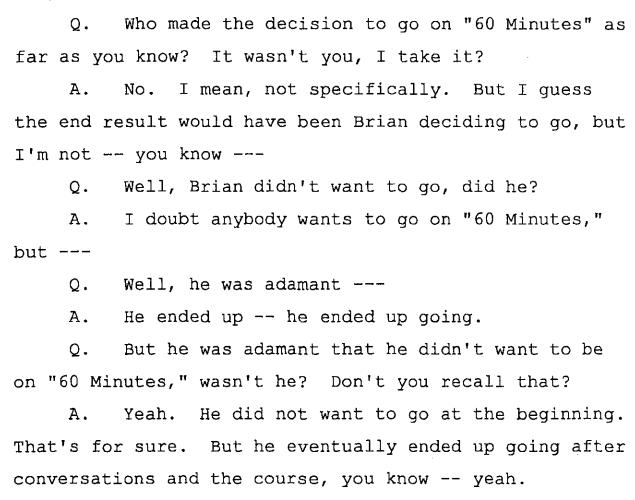
Two items spring out from the lawsuit documents: (1) the lacrosse case represented a potential windfall for DSI, which had otherwise struggled since its inception financially; and (2) DSI head Richard Clark offered self-contradictory statements regarding whether or how he pressured Meehan to discuss the lacrosse case during the ex-lab director’s infamous 60 Minutes interview.

The documents bring into relief DNA Security’s precarious financial state. Meehan co-founded DSI with two friends from Michigan; he bought the duo out in the early 2000s for a measly $3000 apiece. The company struggled so much financially—Meehan admitted that he did everything, ranging from lab director and “janitor”—that he had to look for a second job in 2004. Ironically, he applied for a position at Richard Clark’s other company (a business whose profit margins peaked in mid-1990s). After some discussion, Clark agreed to purchase DSI for $80,000, with an agreement to keep Meehan on staff for seven years. At the time of the purchase, DNA Security had less than $2000 cash-on-hand.

Over the next two years, DSI lost money every month—until Mike Nifong gave it business in the lacrosse case. (April-May 2006 was the only stretch in which DSI ran a profit between 2004 and 2007.) Meehan himself said that he had followed the early reports of the lacrosse case, and was “excited” to get an opportunity for involvement. Clark seems to have shared his lab director’s sentiments, given that the lacrosse case was the biggest of the company's career.

Both Meehan personally and DSI collectively, therefore, had considerable incentive to do what they could to appease their “client,” the term that they used to describe Nifong. If the client wanted an incomplete report that violated DSI company protocol by failing to provide all test results, such a report he would receive.

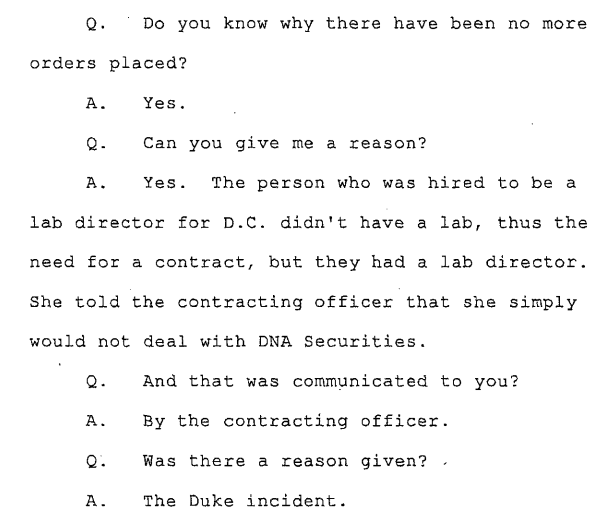
Ironically, of course, Meehan’s dubious conduct, first exposed by Brad Bannon and Jim Cooney in the December 15, 2006 hearing, wound up harming DNA Security’s bottom line. E-mails and depositions from other DSI executives recall how law enforcement agencies from Florida to Wyoming ended involvement with DSI after Meehan’s Dec. 15, 2006 performance—if only because they recognized that having DSI do their testing would provide defense attorneys with an easy opening for impeachment.

Meehan’s 60 Minutes interview was a defining moment for the company. DSI brought in an outside attorney, Fred Antoun, to offer both legal and public-relations guidance, and Antoun believed (not unreasonably) that Meehan had to go on 60 Minutes to respond to repair the p.r. damage from his disastrous performance at the December hearing. Clark, who comes across in the documents as even more defensive and arrogant than Meehan (which is saying something), strongly supported the appearance, stating—according to Meehan, anyway—that “any publicity is good publicity.” A few other DSI officials worried about this approach, and Meehan initially didn’t want to submit to questions. The ex-lab director said he changed his mind when reflecting on how his son would think of him otherwise.

Meehan spent three days preparing for the interview, only to flub his lines, and affirm that he committed a “big error” in his handling of the case. Antoun wanted Meehan to confess only to a minor error in judgment and to avoid questions about the December hearing, with the following line: “In retrospect, I didn't put all the stuff in the report, blah, blah, blah.”

The documents offer three tantalizing, though very incomplete, revelations regarding DSI and the lacrosse case. First, Meehan’s deposition features the clearest indication to date that the April and May 2006 conversations between the lab director, Mike Nifong, and Sgt. Gottlieb involved specifics of the case, most significantly how non-lacrosse player DNA could have been transferred to false accuser Crystal Mangum. Nifong, of course, always maintained that his discussions with Meehan never involved anything that could involve theories of the case. Second, DSI admitted that it kept what it called a “Duke Lacrosse case file”—which, unfortunately, is not reproduced in any of the court filings. Finally, Richard Clark, seemingly inadvertently, admitted that the lab remained in contact with its future co-defendant Nifong even after Nifong recused himself from the lacrosse case. There would seem to have been no professional reason for continued DSI-Nifong exchanges after January 12, 2007.

Meehan’s deposition exhibits familiar characteristics for anyone who followed the lacrosse case. There’s “Mr. Obfuscation,” with Meehan trying to compare his having amended his lacrosse report to include all rather than just some of the test results to his having previously amended reports to correct typographical errors. There’s the clueless scientist, who penned emails to his superiors demanding a raise--a few weeks after his disastrous performance in the December 2006 hearing. There’s the defiant Meehan, alternatively blaming Nifong for his problems, affirming that Mangum was “the victim,” and misrepresenting his May 2006 report (which went out of its way to falsely insinuate that Dave Evans’ DNA might be present) as everything the lacrosse players could have wanted.

(Meehan also got a friend, Mississippi lab director R.W. “Bo” Scales, head of Scales Biological Laboratory, to say what a good job he did, and that his May 12, 2006 report was acceptable and even appropriate. Scales added that he charges $250/hr. and $1800/day to testify.)

But perhaps the most remarkable Meehan Moment came in his discussion of the December 15, 2006 hearing. Meehan simultaneously affirmed that he always told the truth at the hearing and that he did nothing wrong in the case. How, then, to explain the following passage, the Perry Mason moment of the case?

In his deposition, Meehan claimed that his words were “taken out of context.” How, exactly, his straightforward response to a straightforward question from Cooney could be taken out of context Meehan did not reveal.

Finally: one of the odder moments of the case for me came when I heard (from two sources) that Nifong was a regular DIW reader. It turns out that the people at DNA Security also checked in on the blog. One DSI worker worried that “blogs were out there” criticizing the company. Clark himself took issue with this DIW post, which portrayed DNA Security as a “fly-by-night” operation that had started in a garage. (Nothing in the document dump has led me to revise my opinion of the company.) And DSI’s Michael Burrows remembered that “one of the web publications had attacked us early on, and rather doggedly.” He said he questioned the wisdom of Meehan going on 60 Minutes lest the DIW criticisms of DSI get a national audience.

These documents reveal a company that was at best over its head in the lacrosse case and at worst either wholly incompetent or blatantly unethical.

hat tip: Ml.

Document Excerpts: DSI File

Here is Meehan's complaint misrepresenting his May 2006 report, which actually did everything it could, short of simply lying about the results, to prop up "client" Nifong's case.
Given the reality of his report, Meehan really didn't want to appear in court on Dec. 15, 2006, as this deposition excerpt from a Meehan co-worker suggests. Not too hard to figure out why. Meehan's 2006 W-2, showing how he earned $125,000 even as his unprofessional behavior helped prop up a case against innocent people.
From his complaint, Meehan affirms that he testified truthfully in the Dec. 2006 hearing. Leaving aside the absurdity of this claim (since he initially tried to parry Brad Bannon's questioning until he figured out that Bannon knew what he was talking about), this admission seems to confirm that he told the truth to Jim Cooney.

From his complaint, Meehan blames Nifong for his problems.
From his deposition, Mr. Obfuscation suggests that he can't remember who Lane Williamson was.
From Meehan's deposition, a potentially significant revelation: he and Nifong, in spring 2006, appear to have discussed the non-lacrosse player DNA found in Mangum's rape kit.

Meehan had admitted that he followed the lacrosse case pretty closely in the media before he got involved. But, he claimed, he stopped reading newspapers--especially the N&O--once he was the subject of negative scrutiny.
Meehan's refusal to admit error consisted of his suggesting that DNA labs are always attacked by defense lawyers and the media. The company's attorney asked him whether the SBI DNA lab was attacked in the lacrosse case.

In his deposition, Meehan occasionally would lapse into his "Mr. Obfuscation" mode. Here, he tries to imply that his amended report in the lacrosse case (in which he added test results he hadn't reported) could be seen as the equivalent of correcting a typo.

In his deposition, Meehan conceded that the lacrosse case was the biggest case DSI ever had--showing again the financial incentive to pacify the firm's "client," Mike Nifong.

In the annals of chutzpah, this e-mail from just over a month after the disastrous Dec. 2006 hearing features Meehan complaining about his not having received his promised raise.
Clark's letter firing Meehan combined the DSI head's blustery refusal to acknowledge error with his obsession with image.

Meehan's friend and fellow lab director, Bo Scaife, defended Meehan's May 2006 report. Scaife is based in Mississippi--which raises questions about what sort of cases he's handled there.

Scaife adds that the finding of no DNA matches should have been enough to prove the lacrosse players' innocence. Meehan, of course, doesn't appear to have pressed this point to Nifong.

In his deposition, Meehan claimed he didn't have enough time to prepare for the 12-15-06 hearing. A lack of preparation wouldn't seem to explain his admissions that his report didn't contain all the results and that he and Nifong had mutually agreed upon such a strategy.

In his deposition, Meehan admitted that initially he was "excited" to have been involved in the lacrosse case.

DSI saw the 60 Minutes show as the last chance to save the company's public image; here was the script prepared by DSI lawyer Fred Antoun on how Meehan should handle the inevitable tough question about his testimony.
DSI president Richard Clark testily denied coaching Meehan for the 60 Minutes interview.
Despite his passionate denial (above) that he had not coached Meehan, Clark subsequently admitted that he had done so:

60 Minutes
might have been a last-gasp for DSI's reputation, but DSI official Michael Burrows also understood the grim situation that the company occupied given the program's interest.
Another DSI employee, noting that really no one wants to go on 60 Minutes.

If Meehan, as this deposition suggests, actually did prepare for the 60 Minutes interview for three days, what would he have been like without any preparation at all?
To say the Meehan-led DNA Security was a fly-by-night affair is an understatement; at the time the company was sold to Clark (in 2004), DSI had less than $2000 cash on hand.
When speaking of the company before the sale, Meehan had a tendency to speak of himself in the royal "we." Here, he concedes that he functioned not only as lab director at pre-2004 DNA Security, but also as the company's janitor.

The firm never did very well: Meehan bought out his two DSI partners for . . . $3000.

And Meehan sold the company in 2004 for a rather paltry $80,000.

DNA Security official Michael Burrows, reflecting on repeating the company line that DSI made no mistakes:

More on the harmful financial effects resulting from the exposure of Meehan's dubious conduct.
This DSI e-mail confirms how the lacrosse case devastated business for the company.
A DSI official on Clark's determination to get rid off Meehan, at any cost:
This cryptic item from the Clark deposition suggests that DNA Security representatives remained in contact with Mike Nifong even after Nifong was off the case.
An unintentionally comical statement from Clark on why he didn't allow Meehan's COLA adjustment in 2006:
DSI head Richard Clark, confirming the initial financial boost to the company caused by the Duke case.
The contents of this file would be interesting to see.

When all else failed, DSI employees suggested Meehan had been "tricked" by 60 Minutes:

DNA Security's Michael Burrows, outlining the devastating business effect that Meehan's performance at the 12-15-06 hearing:


And this is Burrows on the business impact of Meehan's weak 60 Minutes showing:

Here is Burrows suggesting that the company officials read a certain blog that "doggedly" criticized Meehan and his cohort.
Clark, like Burrows, appeared quite concerned with what people on the internet were saying about the company. (He appears to be referencing this post.)
Here's the accreditation agency's letter confirming the investigation of DNA Security.

Just as Mike Nifong exploited his son at the State Bar hearings, so too did Meehan cite his son as the reason he wanted to come clean to 60 Minutes.

Here is what Fred Antoun, brought in to advise DSI on how to handle the post=Dec. 2006 controversy, wanted Brian Meehan to say during Meehan's 60 Minutes interview:

Monday, February 28, 2011

Money Badly Spent

At Minding the Campus, I have an essay on a highly dubious federal funding decision: nearly $50,000 to a conference organized by Paula McClain--yes, that Paula McClain--to "offer guidance" to minority political science junior faculty members on how to achieve tenure. Among the apparent items discussed--how to reconcile the tenure bid with engaging in the type of social activism championed by the Group of 88.

In any event, below is the complete workshop program for which taxpayers forked over nearly $50,000. Note that, contrary to most academic conferences, it contains no specific presenters or topics of presentations, only vague seminar session titles. And even this took some effort to receive--it's not posted on the Duke program website, the program's office repeatedly refused to provide it to me, and I only obtained if through the gracious intervention of the NSF program officer.

Enhancing Research: A Workshop for Political Scientists from Underrepresented Groups. Funded by the National Science Foundation (NSF)

Center for the Study of Race, Ethnicity and

Gender in the Social Sciences (REGSS)

Duke University

February 3 to 5, 2011

Workshop Agenda

Thursday, February 3, 2011

6:30 p.m. Dinner, Spring Hill Suites, Morehead Conference Room, 5310 McFarland Drive, Durham, NC 27707

Friday, February 4, 2011 – Erwin Mill Bldg, Room A103, 2024 W. Main St., Durham, NC

7:30 p.m. Bus to Social Science Research Institute/Center for the Study of Race Ethnicity and Gender in the Social Sciences (REGSS)

8:00 a.m. Continental breakfast

8:30 to 11:00

Panel 1. Norms, Mentoring and Networks

11:00 to 11:30 Break/stretch/walk around

11:30 Lunch served/working lunch

11:45 to 2:15

Panel 2. Balancing Publishing, Teaching and Family/Social life

2:15 to 2:45 Break/Stretch/Walk Around

2:45 to 5:15

Panel 3. Pre-tenure Review, Moving toward the Tenure Review, and Final decisions on tenure.

5:15 to 5:45 Reception and Working Dinner-Erwin Mill Bldg., Room A103, 2024 W. Main
Street, Durham, NC

5:45 to 8:00 p.m.

Panel 4. Tenure Reviewers’ Panel.

Saturday, February 5, 2011

8:00 a.m. Check out of hotel/buses to SSRI

8:30 a.m. Continental Breakfast

9:00 to 11:30 a.m.

Panel 5. What Went Wrong? Candid Conversations

11:30 Lunch and transport to airport

Friday, February 25, 2011

Context & A "Controversial" Newspaper

[Update III, 4.42pm: This story has been now been covered by the Detroit News, the Daily News, the N&O, WRAL, Lax Power, and Deadspin; and yet, to date, no reporter has answered either of the following two questions: (1) Why was a tax lien sent not to the subject but to the offices of a man named David Weiss?; (2) Did David Weiss actually have anything to do with Seligmann's taxes? It would seem to me before rushing to print reporters would get these questions answered.]

[Update II, 3.47pm: And now the Daily News chimes in (as does the Daily Mail in Great Britain). Again, if and when the lien is withdrawn, I wonder how many of these outlets will run the news, featured in as prominent a place. I plan to keep track.]

[Update, 10.11am: The story has now been picked up by WRAL, the N&O, and Deadspin, with the N&O article including this charming quote from Raleigh tax attorney Jack Cummings: "You've got enough zeros there that somebody has bound to have thought about it and decided that they didn't owe any tax." Since the same article features a quote from Jim Cooney saying all taxes were paid, and since Richard Emery previously had stated that the lien was imposed in error, Cummings is essentially accusing Seligmann's attorneys of having lied.* I don't have much of a doubt which of the two is more credible.

If and when the lien is withdrawn, I wonder how many of these outlets will run the news, featured in as prominent a place.]

The Detroit News blared the following headline: “Controversial ex-Duke lacrosse player owes IRS $6.5M; lawyer calls it mistake.” The lede: “Nearly four years after receiving an undisclosed settlement from Duke University, Reade Seligmann, one of three lacrosse players exonerated in a racially charged rape case, owes the IRS almost $6.5 million in taxes, according to public records.”

The story, originally posted on the News’ “Tax Watchdog” blog by Robert Snell, has a few problems.

The first, of course, is its headline. There are a lot of adjectives or adverb-adjective combinations that come to mind in describing Reade Seligmann. “Falsely accused” is the obvious selection. “Widely praised” is another. But “controversial” seems like a highly unusual choice. What exactly is “controversial” about Seligmann?

The controversial headline selection is particularly problematic in that the dubious word choice appeared not in the posting by Snell, whose headline was fair and highlighted the denial by Seligmannn’s attorney. Instead, the controversial selection of the adjective “controversial” appeared in an item (with the same text, and linked above) that appeared on the News’ website. I e-mailed the News’ metro editor and web editor to ask why they chose “controversial” to describe Seligmann; neither replied.

The Snell posting itself suffers from two problematic elements. The first comes in its use of the “reportedly” standard. Snell concludes his article with the following line: “[Seligmann] reportedly is studying law at Emory University in Atlanta.” I did a Google search of “Reade Seligmann Emory” a few hours after the Snell posting appeared; the two items that most prominently appeared were posts from the Liestoppers board and the Free Republic board. Snell considered these items credible enough to use in his article, with a “reportedly” tag. So his article provides an example of the standards for which he uses a “reportedly” standard. (I don’t see any problem with how Snell handled this matter.)

Snell’s post—a he-said, IRS-said item that to any neutral reader would almost certainly leave the impression that the IRS is right—hinges on a quote that he obtains from an expert, “Tax lawyer Jeffrey Freeman of Birmingham, Mich.” According to Freeman, as paraphrased by Snell, “someone would have to make about $20 million in one year to generate a $6.5 million tax bill.”

Yet by the posting’s “reportedly” standard, Snell’s expert would seem to have undercut the lien’s validity. In July 2007, Bernie Reeves of Metro reported, “The settlement paid by Duke University to the three families of the falsely accused lacrosse team members — estimated to be around $18 million — follows on the heels of similar deals.”

The settlement amount, of course, was confidential. But Reeves’ item would seem to be a credible enough source—by a “reportedly” standard, in any case—for use by the News. Passing along the information from Metro would have tilted Snell’s story from its he-said, IRS-said approach to a story that the IRS might well be wrong. (The amount of the lien would have exceeded the amount of Seligmann’s individual settlement by around $500,000, producing a tax rate on the settlement of more than 100 percent.) And if the IRS made a mistake, Snell’s post is a much different story—something to the effect of “Falsely Accused ex-Duke Player Still Getting Unfair Treatment.”

I e-mailed Snell to ask him why he used the “reportedly” standard to include a throw-away item about Seligmann and Emory but declined to use the “reportedly” standard to include an item that would seem quite germane to his story. He said he wasn’t aware of the Raleigh Metro item, nor a vaguer comment by anti-lacrosse extremist (but very well-connected) Tim Tyson that seemed to confirm the Metro report. He was kind enough to respond (twice), and I appreciate his candor, but the problem with the exclusion remains.

Snell’s second problematic element: his post (accurately) reported that the lien notice was sent not to Seligmann but to a New York accountant named David Weiss. Snell paraphrases Seligmann’s civil case attorney, Richard Emery, to the effect that Weiss was someone “with whom the Seligmann family consulted several years ago.”

Why the IRS would send a tax lien notice not to the subject of the lien but to someone with whom the subject’s “family consulted” Snell doesn’t say. I suspect that most fair-minded readers would come away with the impression that Weiss prepared Seligmann’s taxes (I certainly did)—even though the article never actually makes such a claim. And if, in fact, Weiss did no such work, then the story is a much different one—something to the effect of why the IRS would be sending a huge tax lien to an accountant that actually hadn’t been responsible for preparing Seligmann’s taxes.

There’s something “controversial” going on here. But the controversy doesn’t involve Seligmann.

*--modified slightly for clarity, and to point out Richard Emery had already gone on the record, publicly, to deny the validity of the lien before Cummings accused Seligmann or "somebody" representing him of being a tax cheat.

Friday, February 18, 2011

Guidance from Dr. Brodhead [Updated Twice]

[Update, 6.31pm, 23 Feb.: Business Week reports that Duke and AIG have settled their lawsuit, which resulted from AIG's unwillingness to shoulder at least some the defense costs associated with the lawsuits against Duke filed by the falsely accused players and other former Duke lacrosse players.]

Two tangentially related items [with an update at end, added Sunday, 3.34pm]:

First, in one respect, the discovery that Richard Brodhead was selected by the President of the American Academy of Arts and Sciences,Leslie Berlowitz, to co-chair “a national commission to bolster teaching and research in the humanities and social sciences, fields that are critical to culture, education, and to America's economic competitiveness” is beyond belief. Incredibly, Berlowitz was responding to a request from members of Congress, to ascertain, “What are the top ten actions that Congress, state governments, universities, foundations, educators, individual benefactors, and others should take now to maintain national excellence in humanities and social scientific scholarship and education, and to achieve long-term national goals for our intellectual and economic well-being; for a stronger, more vibrant civil society; and for the success of cultural diplomacy in the 21st century?”

Upon what could Brodhead offer counsel: how to stand clear of the social sciences and humanities faculty mob on campus? How to issue an apology months after the fact, while repeatedly promoting those among his social sciences and humanities professoriate who misbehaved? How he felt as members of the Durham Chamber of Commerce applauded him in April 2006, when he announced, of Reade Seligmann and Collin Finnerty, “Whatever they did [drink beer and attend a party they played no role in planning] was bad enough”?

In another respect, however, the award demonstrates a central theme of the lacrosse case: the almost complete lack of accountability in contemporary higher education for inappropriate conduct that was based on prevailing race/class/gender sentiments on campus. That a figure such as Brodhead wasn’t completely discredited for his mishandling of the lacrosse case isn’t surprising in an academy where Group of 88 members Baker, Farred, and Payne got hired away from Duke for better jobs; or where the Duke faculty elected Group regular Paula McClain as their leader shortly after the AG declared the students to be innocent; or where several members of the Group of 88 have received deanships despite (because of?) their behavior in the lacrosse case.

Second, the Florida International University administration declined to suspend the university’s star baseball player, Garrett Wittels, who was charged with sexual assault in a strange case in the Bahamas.

The specifics of the case, based on press reports: Wittels and two college-age friends went back to a hotel room to hook up with two women who presented themselves as college students but were in fact 17 years old. Both sides agree that sexual intercourse occurred; Wittels’ attorney says it was voluntary, at the prompting of their fathers the next morning, the 17-year-olds said it was not. Before any additional investigation took place, but apparently acting consistently with both Bahamian judicial procedures and more general pressure from the U.S. embassy, Wittels and his friends were arrested.

The FIU decision has generated predictable outcry. Miami Herald columnist Linda Robertson hyperbolically demanded Wittels’ suspension, noting, “No one except the people in a Paradise Island hotel room knows what happened inside it Dec. 20. But something happened.”(Despite Robertson’s insinuation, no one involved in the case denies that “something happened.”) Consistent with longstanding media practices, Robertson had no trouble repeatedly using Wittels’ name, but refused to identify the name of Wittels’ accuser.

Perhaps more disappointingly (given the high standards in the lacrosse case from the Duke Chronicle), the FIU student newspaper, The Beacon, advocated suspending Wittels, arguing, “Even if Wittels is innocent, the situation he has put himself in has tarnished the image of the University and its Athletics department. Furthermore, allowing that distraction in the locker room would be a disservice to the entire baseball team.” If universities around the country followed the policy of suspending athletes for engaging in a “situation” like that of Wittels “even if . . . innocent” (hooking up, in a somewhat boorish fashion, while on vacation), there’d be an awful lot of suspensions, on a lot of different teams, around the country.

I’d like to think that in handling the Wittels matter, the FIU administration learned from Brodhead’s rush to judgment in the lacrosse case, and in particular understood the significance of examining the particular context of the allegations. As both Robertson and The Beacon note, Wittels might, in fact, be guilty. But the preponderance of publicly available evidence doesn’t suggest abandoning the presumption of innocence; and the overall allegation (an alleged 3-on-2 gang rape, in which the accusers voluntarily left the scene of the alleged attack without even attempting to contact law enforcement officials) would be very unusual indeed. Perhaps more important, the FIU administration took into account the different legal procedures in The Bahamas, which appears to have an arrest-first, ask-questions-later approach.

A final point: at least based on what I’ve seen from press reports and from speaking to a friend with contacts at FIU, there has been no equivalent of the Group of 88 on the FIU campus. Perhaps Wahneema Lubiano can be dispatched to South Florida to provide guidance.

[Update: On Sunday morning's Outside the Lines, ESPN profiled San Antonio Spurs player Gary Neal.

Towson--which accepted Neal as a student and a basketball player despite the rape allegations, under the "innocent until proven guilty" mantra, provides another, FIU-like, example of the anti-Brodhead. And Towson acted before the lacrosse case erupted, suggesting an alternative path for Duke.

Two other items from the report. One, the Neal saga confirms a post made some time back on the absurdity of the claim--repeatedly offered during the lacrosse case--that if the lacrosse defendants had been African-American, the media would have treated them much worse. The allegations against the LaSalle basketball players (African-American defendants, race of accuser unclear) received fairly minor national coverage (the New York Times, for instance, ran 12 articles on the LaSalle case, five of which were on the acquittal or the attempts of the accused players or their coaches to move on from the scandal).

Second, the ESPN report is sympathetic to Neal. It allows him to discuss the "stigma" of the charges, notes that the charges cost him a scholarship and any chance of playing in the NBA immediately after college, and shows how even unproven charges can have horrific effects on the wrongly accused. Yet even this sympathetic account, and even after a trial that resulted in an acquittal, cannot bring itself to remove the mask of anonymity from Neal's accuser.]