Tuesday, May 02, 2006

The Coleman Committee Report--and "Aggressive Body Language"

Slate has a piece by David Feige, an author and former public defender in the Bronx, outlining the myriad of procedural abuses associated with the D.A.’s indictment of two Duke lacrosse players. Feige’s conclusion: “In the end, between his media mania, harassing search warrants, and the outrageous attempt to interrogate individuals already represented by counsel, Mike Nifong has exposed a reality of the criminal-justice system that can often escape our attention: Prosecutors captivated by the beneficial glare of the media spotlight are often ready to ignore convincing evidence of innocence in the politically motivated pursuit of criminal defendants. The Durham district attorney's actions raise the question of whether prosecutors really are willing to win elections at the cost of wrongful prosecutions. Sadly, for Durham and Duke and for all of us, the answer in this case seems to be ‘yes.’”

As a reminder that flawed processes can sometimes produce flawed results, as part of a set of motions, defense attorneys released a photo of one indicted player, Reade Seligmann, time-stamped from an ATM machine at a time when the police report alleged that the rape was occurring. (Since Nifong, for reasons that remain unexplained, made the arrest before even investigating whether Seligmann had an alibi, the prosecution never presented this evidence to the grand jury; there are several other photos of the ATM scene.) In his only quote of the day, the D.A. said that he plans to seek a third indictment in two weeks. But from taking a look at the Raleigh TV websites, last night’s 11pm news ignored Nifong’s promise and instead, quite correctly, showed the Seligmann photo.

In a surprise, a Duke committee recommended restoring the lacrosse program in 2007, coupled with appropriate stringent regulations regarding behavior and consumption of alcohol by team members. That a law professor, James Coleman, chaired the committee was a good sign; the report contained none of the unfortunate tone or substance that has characterized previous statements on the issue from the Duke faculty. The report’s data also presented a much less negative view of the team than we’ve seen over the past six weeks.

The report makes clear the disturbing pattern both of increased excessive alcohol use by team members and team members’ disproportionate violation of college alcohol policy. But the document also condemns the administration for insufficient oversight in general and poor communication with the (ex-) lacrosse coach in particular; and contextualizes the issue by noting a more general problem of all Duke students ignoring the college’s alcohol policy, which the report calls “arbitrary and often ineffective.” And other aspects of the report portray the players as about as far from Nifong’s “hooligans” as imaginable. The team members are warmly praised for their courtesy to athletic staff, their good relationship with the women’s lacrosse team, and their record of volunteer service in the community; the report found no evidence that “the cohesiveness of this group is either sexist or racist.” None of this material excuses the (admitted) actions on the night in question, but it certainly calls into question allegations, like that of Duke professor Houston Baker, that these actions typified the team’s behavior.

For me, the single most interesting aspect of the report came in its discussion of the players’ athletic performance. Last year, more than half the team made the ACC’s academic honor roll, more than any other school, and between 2001 and 2005, the Duke lacrosse honor roll total more than doubled that of any other ACC school. The committee interviewed 10 Duke professors who had taught significant numbers of lacrosse students. Nine of the ten offered positive comments; one professor noted that “the lacrosse players were willing to defend unpopular positions in class.” Given the ideological tenor of the Duke faculty, it’s not hard to imagine what some of these positions might have been.

That analysis is worth remembering when taking into account the response of the tenth professor interviewed by the committee. Peter Wood, a member of the History Department, was a lacrosse player at Harvard and then coached the Duke women’s lacrosse team when it had club status; perhaps this common bond led lacrosse players to seek out his classes. That clearly was a mistake. Wood, co-author of the textbook Created Equal, which bills itself as “emphasizing social history—including the lives and labors of women, immigrants, working people, and persons of color in all regions of the country” based on “an expanding notion of American identity—one that encompasses the stories of diverse groups of people,” teaches courses in African-American and Native American history. Wood’s scholarship and teaching seem to reflect a clearcut slant on the American past—one well within the historiographical mainstream, but also, perhaps, not a good environment for students generally “willing to defend unpopular positions in class.”

Wood certainly didn’t welcome the students to his class. After his 2004 Native American history course, Wood wrote a letter to the dean complaining about “the decline in classroom behavior of lacrosse players in particular and athletes in general.” The committee noted that Wood has given a substantially harsher version of events in recent weeks than he did in his 2004 letter (which the report doesn’t release). In an attempt to verify Wood’s claims, the committee spoke to his teaching assistant, who reported that “she did not think the lacrosse players intentionally intimidated other students, but thought that they displayed aggressive body language in class.” So, the committee uncovered nine professors who said either that the players were no problem or that they were assets to the class—even if they “were willing to defend unpopular positions”—and a tenth who had only negative things to say about team members, and whose teaching assistant, incredibly, accused the players of “aggressive body language.” It is, of course, possible that members of the team behaved totally differently in Wood’s class than they did in the other nine classes the committee sampled. But I’d say it’s rather unikely.

[Originally published in Cliopatria.]

Monday, May 01, 2006

Duke's Poisoned Campus Culture

In response to the scandal surrounding the men’s lacrosse team, Duke president Richard Brodhead has initiated a “conversation on campus culture.” The first installment provided little insight. To Mark Anthony Neal, a professor of African and African-American Studies, recent events showed that “we need an innovative and brave curriculum that will allow our students to engage one another in a progressive manner.” It’s worth remembering that only two years ago at Neal’s institution, a department chairman jokingly explained the faculty’s ideological imbalance by noting, “If, as John Stuart Mill said, stupid people are generally conservative, then there are lots of conservatives we will never hire.” It seems rather unlikely that Duke’s curriculum lacks a sufficiently “progressive” nature.

Indeed, far from needing a more “progressive” campus culture, the lacrosse scandal suggests that a considerable portion of the Duke faculty and student body need to reread the Constitution and consider the accused — regardless of their group identity — innocent until proven guilty. Moreover, if, as Duke officials have claimed, Brodhead seriously desires to use this event as a “learning opportunity,” he needs to explore why voices among the faculty urging local authorities to respect the due process rights of Duke’s students seemed so overpowered by professors exhibiting a rush to judgment.

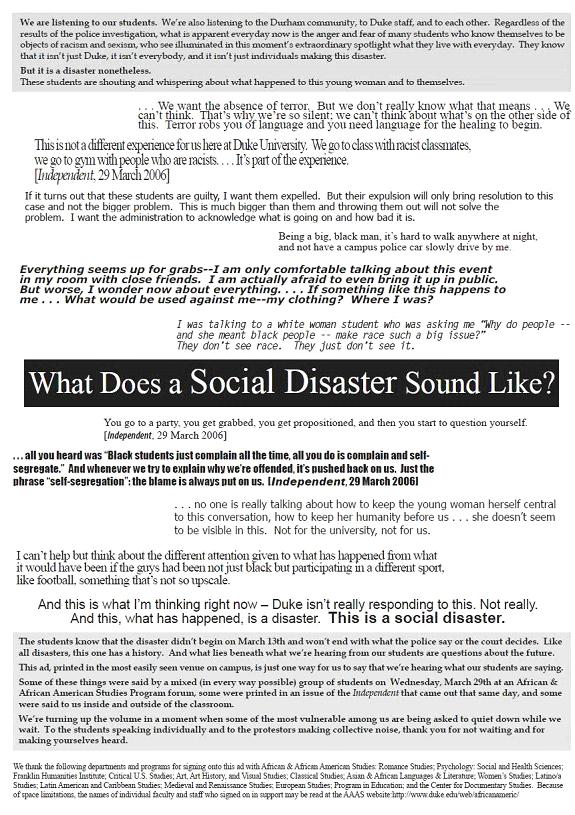
In early April, prior to his peculiar commentary on campus culture, Professor Neal joined 87 other Duke professors in signing a public statement about the scandal. Three academic departments and 13 of the university’s academic programs also endorsed the statement, which was placed as an advertisement in the student newspaper, The Duke Chronicle, and is currently hosted on the Web site of Duke’s African and African-American Studies program. That 88 faculty members — much less entire departments — would have signed on to such a document suggests that whatever plagues Duke’s campus culture goes beyond the lacrosse team’s conduct and the administration’s insufficient oversight of its athletic department.

Few would deny that several players on Duke’s lacrosse team have behaved badlly. Two team captains hired exotic dancers, supplied alcohol to underage team members, and concluded a public argument with one of the dancers with racial epithets. In response, Brodhead canceled the team’s season and demanded the coach’s resignation. Yet the faculty members’ statement ignored Brodhead’s actions, and instead contributed to the feeding frenzy in the weeks before the district attorney’s decision to indict two players on the team.

The 88 signatories affirmed that they were “listening” to a select group of students troubled by sexism and racism at Duke. Yet 8 of the 11 quotes supplied from students to whom these professors had been talking, 8 contained no attribution — of any sort, even to the extent of claiming to come from anonymous Duke students. Nonetheless, according to the faculty members, “The disaster didn’t begin on March 13th and won’t end with what the police say or the court decides.” It’s hard to imagine that college professors could openly dismiss how the ultimate legal judgment would shape this case’s legacy. Such sentiments perhaps explain why no member of the Duke Law School faculty signed the letter.

More disturbingly, the group of 88 committed themselves to “turning up the volume.” They told campus protesters, “Thank you for not waiting and for making yourselves heard.” These demonstrators needed no encouragement: They were already vocal, and had already judged the lacrosse players were guilty. One student group produced a “wanted” poster containing photographs of 43 of the 46 white lacrosse players. At an event outside a house rented by several lacrosse team members, organized by a visiting instructor in English Department, protesters held signs reading, “It’s Sunday morning, time to confess.” They demanded that the university force the players to testify or dismiss them from school.

The public silence of most Duke professors allowed the group of 88 to become, in essence, the voice of the faculty. In a local climate that has featured an appointed district attorney whose behavior, at the very least, has been erratic, the Duke faculty might have forcefully advocated respecting the due process rights of all concerned. After all, fair play and procedural integrity are supposed to be cardinal principles of the academy. In no way would such a position have endorsed the players’ claim to innocence: Due process exists because the Anglo-Saxon legal tradition has determined it elemental to achieving the truth. But such process-based arguments have remained in short supply from the Duke faculty. Instead, the group of 88 celebrated “turning up the volume” and proclaimed that legal findings would not deter their campaign for justice.

When faced with outside criticism — about, for example, a professor who has plagiarized or engaged in some other form of professional misconduct, or in recent high-profile controversies like those involving Ward Churchill at the University of Colorado — academics regularly condemn pressure for quick resolutions and celebrate their respect for addressing matters through time-tested procedures. Such an approach, as we have frequently heard since the 9/11 attacks, is essential to prevent a revival of McCarthyism on college campuses.

Yet for unapologetically urging expulsion on the basis of group membership and unproven allegations, few professors have more clearly demonstrated a McCarthyite spirit better than another signatory to of the faculty statement, Houston Baker, a professor of English and Afro-American Studies. Lamenting the “college and university blind-eying of male athletes, veritably given license to rape, maraud, deploy hate speech, and feel proud of themselves in the bargain,” Baker issued a public letter denouncing the “abhorrent sexual assault, verbal racial violence, and drunken white male privilege loosed amongst us.” To act against “violent, white, male, athletic privilege,” he urged the “immediate dismissals” of “the team itself and its players.”

Duke Provost Peter Lange correctly termed Baker’s diatribe “a form of prejudice,” the “act of prejudgment: to presume that one knows something ‘must’ have been done by or done to someone because of his or her race, religion or other characteristic.” It’s hard to escape the conclusion that, for Baker and many others who signed the faculty statement, the race, class, and gender of the men’s lacrosse team produced a guilty-until-proven-innocent mentality.

Baker’s attacks on athletics added a fourth component to the traditional race/class/gender trinity. It’s an open secret that at many academically prestigious schools, some faculty factions desire diminishing or eliminating intercollegiate athletics, usually by claiming that athletes are lazy students, receive special treatment, or drive down the institution’s intellectual quality. In fact, with the exception of the two revenue-producing sports (men’s basketball and football), the reverse is more often true at colleges like Duke, Vanderbilt, Stanford, or the Ivy League institutions.

I admit to a bias on this score: My sister was a three-year starter at point guard for the Columbia University women’s basketball team. Seeing how hard she worked to remain a dean’s list student and fulfill her athletic responsibilities gave me a first-hand respect for the challenges facing varsity athletes at academically rigorous institutions. In addition to the responsibilities sustained by most students (challenging course loads, extracurricular activities, often campus jobs), athletes in non-revenue producing sports have physically demanding practice schedules, in-season road trips, and commitments to spend time with alumni or recruits. They play before small crowds, and envision no professional careers. It’s distressing to see that many in the academy share Baker’s prejudices, and view participation in college athletics as a negative.

With the most vocal elements among Duke’s faculty using the lacrosse case to forward preconceived ideological and pedagogical agendas, it has been left to undergraduates to question some of the district attorney’s unusual actions — such as conducting a photo lineup that included only players on the team, sending police to a Duke dormitory in an attempt to interrogate the players outside the presence of their lawyers, and securing indictments before searching the players’ dorm rooms, receiving results of a second DNA test, or investigating which players had documented alibis. In the words of a recent Newsweek article, the lawyer for one indicted player, Reade Seligmann, produced multiple sources of “evidence that would seem to indicate it was virtually impossible that Seligmann committed the crime.” To date, the 88 faculty members who claimed to be “listening” to Duke students have given no indication of listening to those undergraduates concerned about the local authorities’ unusual interpretation of the spirit of due process. Nor, apparently, do the faculty signatories seem to hear what The Duke Chronicle editorial termed the “several thousand others of us” students who disagreed that “Duke breeds cultures of hate, racism, sexism and other forms of backward thinking.”

The Raleigh News and Observer recently editorialized, “Duke faculty members, many of them from the ’60s and ’70s generations that pushed college administrators to ease their controlling ways, now are urging the university to require greater social as well as scholastic discipline from students. Duke professors, in fact, are offering to help draft new behavior codes for the school. With years of experience and academic success to their credit, faculty members ought to be listened to.” If the group of 88’s statement is any guide, this advice is dubious. Even so, Brodhead has named two signatories of the faculty group to the newly formed “campus culture” committee. Given their own record, it seems unlikely that their committee will explore why Duke’s campus culture featured its most outspoken faculty faction rushing to judgment rather than seeking to uphold the due process rights of their own institution’s students.

[Originally posted through Cliopatria.]

Sunday, April 23, 2006

The Group of 88

88 members of the Duke faculty—including 11 members of its History Department, among them such luminaries as William Chafe and Claudia Koonz—and 15 academic departments or programs recently signed a public statement saying they were “listening” regarding allegations against the Duke lacrosse team. The statement spoke of “what happened to this young woman” (which at that point consisted of nothing more than uncorroborated allegations) and gave a message to campus protesters: “Thank you for not waiting” until the police completed their investigation. Activities of these campus protesters, as we now all know, included such items as the “wanted” poster and branding the team “rapists.”

In today’s Newsweek, a student at predominantly African-American North Carolina Central carried the Duke 88’s thinking to its logical, if absurd, extreme. The student said that he wanted to see the Duke students prosecuted “whether it happened or not. It would be justice for things that happened in the past.”

Newsweek also became the second major news outlet (ABC is the other) to have received access to the exculpatory evidence of one of the indicted players, Reade Seligmann. (The story confirmed that the D.A. refused to review this evidence before making a charge, despite a request from defense attorneys.) According to the magazine, during or within the 16 minutes after the time of the alleged rape, Seligmann placed eight calls on his cell phone, was waiting on a curb a block away from the site of the alleged rape, where he was picked up by a cab; and he then went to an ATM machine, a fast-food restaurant, and card-swiped his way into his dorm. The cab driver has given a statement, cell-phone records exist of the eight calls, the ATM withdrawal slip was saved, and the card-swipe was timed by Duke’s security system.

At this stage, we don’t know whether a crime was committed in this case. But unless Seligmann had contact with the accuser before the alleged crime (which no one is claiming) or his defense team has engaged in a massive doctoring of evidence that fooled both Newsweek and ABC, it seems unlikely that Seligmann (who has no prior record of any misconduct, and who has received an outpouring of support in recent days from those who know him) committed any crime. In the words of Newsweek—hardly known as a bastion of overstatements—Selgimann’s “lawyer was able to produce evidence that would seem to indicate it was virtually impossible that Seligmann committed the crime.”

How many of the Duke 88 would affix their signatures to a public affirmation that they are “listening” to the exculpatory evidence of a student at their own institution, and expressing concern that local authorities could be veering toward a miscarriage of justice regarding Seligmann? Or do they “listen” only to versions of events that conform to their preconceived worldview, like the student at North Carolina Central, seeking “justice for things that happened in the past”?

[Originally posted at Cliopatria.]

Friday, April 21, 2006

Duke's Campus Culture

The Duke Chronicle has coverage of the first university-wide event, held last night, to address campus culture at Duke. Professor of African and African-American Studies Mark Anthony Neal maintained, “We need an innovated and brave curriculum that will allow our students to engage one another in a progressive manner.” Remembering that this is the same college whose philosophy chairman joked that there were few conservatives on the faculty because J.S. Mill held that conservatives aren’t very smart, I doubt that an insufficiently “progressive” curriculum is Duke’s main problem. When a student in attendance called on Duke to do more address “heretosexism” (again, not an obvious problem issue emerging from recent events), a panel member, in the words of the Chronicle reporter, “described a hypothetical situation about an incoming freshman finds out his or her future roommate is homosexual and thus requests to be paired with a different person. ‘Instead of simply letting people avoid these uncomfortable situations, we should make these students sit down and talk to each other, and to make progress in accepting one another.’”

Leaving aside the question of whether it’s a good idea to force a gay incoming freshman to live with someone who’s homophobic, it would seem to me that Duke has enough issues to consider without inventing “hypothetical” ones.

And if Duke president Richard Brodhead really is serious about using the recent events to improve campus culture, there’s an issue that should be addressed: the “campus culture” of guilty-until-proven-innocent exhibited by a vocal faction of the student body and a very vocal minority of the faculty in the initial weeks after reports of the rape accusation emerged. Duke is, after all, a campus where, before even hearing both sides’ initial version of events, students and some faculty held candlelight vigils and protests with slogans such as “Real men don't protect rapists”; where a prominent faculty member, Afro-Am Studies professor Houston Baker, issued a public letter urging that the lacrosse players be dismissed from school; where students produced a “wanted” poster with photographs of 43 of the 46 white lacrosse players, accusing the players of withholding evidence, with one student participant noting, “It is dangerous to wait for the conclusion of the criminal investigation because the community, in strong numbers, have raised their voices of what this means to the history of the University.”

It’s easy, of course, to question such behavior in retrospect—now that we’ve seen two arrests based on a photo ID that seems, to put it charitably, procedurally flawed. That the accuser was only shown photos of members of the lacrosse team perhaps explains why at least one of the two arrested players seems to have overwhelming evidence that he wasn’t even at the house at the time the alleged rape occurred. (The second, meanwhile, claims to have been at a restaurant at the time of the party, and media reports suggest that he’s not shown in any of the party photos.) And the searches of the arrested players’ rooms—conducted, perplexingly, after rather than before the arrests—yielded nothing more incriminating than a newspaper article on the case and an Ipod., coming after a DNA test that the D.A. had publicly promised would identify the guilty instead produced no matches.

From where does this campus guilty-until-proven-innocent mentality originate? In Shadow University, Alan Kors and Harvey Silverglate suggest one culprit—campus “judicial” systems. At many institutions, a student accused of sexual harassment or assault isn’t entitled to counsel. (My favorite such story in the Kors/Silvergate book involved MIT, which allowed the accused’s family members but not lawyers into campus disciplinary hearings—a policy changed after Alan Dershowitz’s nephew was hauled up on sexual harassment allegations, and Dershowitz got access to the hearing as the uncle of the accused.) Similarly, at many institutions, the accused (or his representatives) cannot cross-examine the accuser, and sometimes can’t even be in the same room when the accuser relays her story. In short, campus disciplinary proceedings relating to alleged sexual offenses often lack any semblance of due process: the accused really is guilty until proven innocent, just as the Duke protesters of a few weeks back, and professors like Houston Baker, maintained about the Duke lacrosse players.

The recent Chronicle coverage suggests a shift in campus attitudes regarding the case—a recognition that at least one of the players seems to have been falsely accused, and that people are innocent until proven guilty, especially in a case like this, where so much exculpatory evidence exists. But I rather doubt that we’ll see Duke examine the “campus culture” that led to events such as the “wanted” poster. Instead, like the panelist at last night’s campus forum who addressed the issue of “heretosexism,” those on campus who previously deemed the lacrosse players guilty will speak of a “hypothetical” case in which the facts better fit their preconceived view.

[Originally posted at Cliopatria.]

Sunday, April 16, 2006

Duke News

There aren't too many people who have come out of the current Duke controversy looking good, but there are two that have performed about as well as possible, it seems to me, under current circumstances. The first is the editor (and by extension, the reporters) of the Duke student newspaper, the Chronicle, whose coverage has been first-rate. As the Crimson demonstrated last spring during the Summers controversy, student newspapers with talented reporters can actually outperform the regular media on campus stories.

The second is Duke's president, Richard Brodhead. He--quite appropriately, it seems to me--suspended and then cancelled the lacrosse season; based on the most benign interpretations of their actions, many of the lacrosse players were guilty of conduct unbecoming university students and gravely embarrassing the school. He's reached out to students and administrators at NCCU. At the same time, he's avoided any rush to judgment--unlike a handful of Duke professors, led by Afro-Am studies professor Houston Baker, who essentially advocated dismissing the lacrosse students from school. (Baker, alas, looks mild compared to Jesse Jackson, who yesterday promised that the Rainbow/PUSH Coalition would pay the accuser's tuition, even if her story proved false.)

That said, I was somewhat troubled by Brodhead's rather weak response to events of last Thursday. In the latest in what has seemed a poorly managed investigation, the Durham police gained entry, without warrants and apparently without the assistance of the Duke police, to Duke dorms and attempted to interrogate several lacrosse players, who all sides knew had lawyers. When asked about the matter Friday, Brodhead said he didn't know enough about the issue to comment, and hasn't said anything since.

While Brodhead is obviously in a very difficult position, if I were a Duke parent, I would have expected more from him on this matter. From the standpoint of legal ethics, the police were clearly in the wrong; pragmatically, the DNA and photo evidence of the past week, while not exonerating the players, substantially boosted their presumption of innocence. In an era of speech codes, when universities often improperly act in loco parentis, there are times when administrators ought to act in loco parentis. Police offers attempting to gain access to dorms to question students without their lawyers' presence is one such instance.

[Originally posted at Cliopatria.]