Showing posts with label media; faculty. Show all posts

Tuesday, March 25, 2014

A Turn of Season

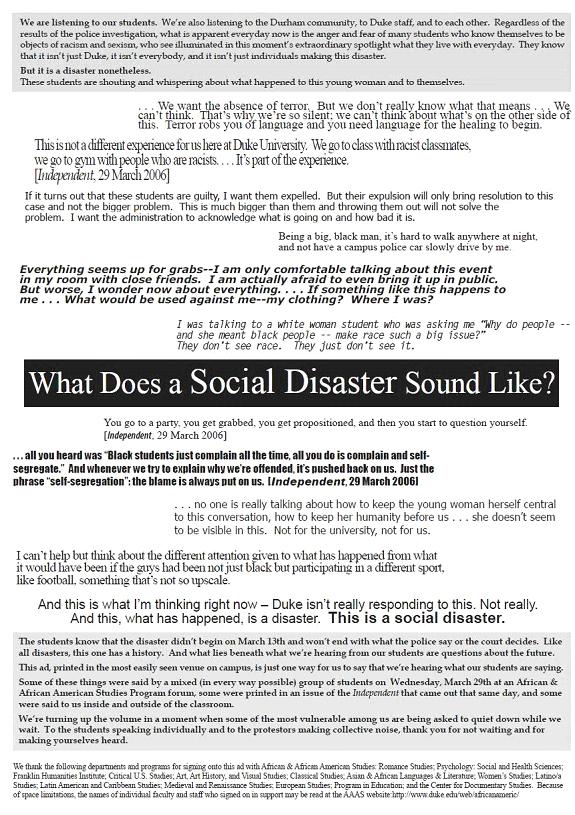
For the politically correct, the lacrosse case proceeded through three stages. The first came in spring 2006, when figures like Selena Roberts and factions like the Group of 88 not merely presumed guilt, but drew broad moral lessons from the crime they were certain occurred. The second came in winter 2006 and spring 2007, when many of these same figures denied they their previous comments had referred to the criminal case at all, and instead launched a biting cultural critique against the lacrosse players. The third came in summer 2007, when the politically correct rushed to move on.

A few recent signs, however, suggest we might be moving back toward that second phase. The most obvious comes from cnn.com, which found time to break away from its round-the-clock coverage of the Malaysian Airlines disaster to run a column on the  . . . cutting-edge . . . topic of lowering the drinking age (to 19, rather than 18, suggesting that the author believes it’s OK to prevent some people who can vote and die for their country from drinking alcohol).

The argument of the column, by William Cohan—that the lacrosse players were drunken louts, that we’ll never know if something happened to Crystal Mangum, that despite their innocence the players should have faced a trial—is little more than a warmed-over version of the Herald-Sun editorial pages from winter 2006. But given the column’s ill-concealed status as a promotion for Cohan’s forthcoming book, presumably this thesis will reappear in Cohan’s April publication as well. So I assume we’ll be hearing lots more about how college students should be judged on how the worst of their group behaved at a spring break party—a standard that the paragons of political correctness rarely apply to all college students.

A second sign came in Jim Coleman’s comments to Radley Balko. The Duke law professor wildly claimed that the three falsely accused students failed to have used their experience “as an opportunity to subject the criminal justice system to a searing review. It’s as if they believe the only bias in the system is against wealthy white college students.”

Less than a minute on Google proves the falsity of Coleman’s statement: Reade Seligmann, for one, has been extremely active with the Innocence Project, to such an extent that his work received extensive press coverage and an “Advocate for Justice” award from an Innocence Project committee. (Collin Finnerty and Dave Evans likewise have worked with Innocence Project events.) Would Coleman be willing to compare Seligmann’s record on this issue with that of any member of the Group of 88? Why does Coleman consider a law student repeatedly working with the Innocence Project to constitute a failure “to subject the criminal justice system to a searing review”?

As with Cohan, it appears that Coleman has retreated into a factually-challenged cultural critique. To date, he has not retracted his statement about Seligmann.

Finally, this tweet from the left-leaning journalist Howard Fineman

recalls what might have passed for humor on the Upper West Side in summer 2006.


Expect more of this sort of cultural “critique” to coincide with the Cohan book.

Tuesday, January 07, 2014

Harris-Perry, Race, & the Group's Legacy

In one respect, the lacrosse case was extraordinarily unusual: actions of campus extremists don’t often get much attention outside of campus walls. The national media doesn’t cover higher-ed ideological or pedagogical issues all that much; and when it does (as in the recent controversy over Title IX and sexual assault policies), it often covers the issue poorly. The behavior of the Duke faculty in the lacrosse case attracted so much attention largely for accidental reasons: the case itself was a media firestorm, and then the Group of 88’s inability or unwillingness to apologize for what they did seemed unjust.

Yet on the rare occasions when the world of higher-ed ideas does seep into the public consciousness, the result is an almost stupefied horror. The best recent example (about which I’ve written over at Minding theCampus) came when the American Studies Association formally endorsed a boycott of Israeli institutions of higher education—a flagrant violation of academic freedom that the ASA justified, in Orwellian language, as the protection of academic freedom. (The other rationale: according to the ASA president, describing the organization’s penchant for boycotts that allegedly promote human rights, “one has to start somewhere.”) 

The ASA move earned widespread rebuke from editorial boards, politicians, and more than 100 college presidents—the people at universities whose jobs depend on dealing with the public, and therefore are particularly sensitive about their schools looking like hotbeds of out-of-touch extremism.

The Group of 88 statement, and the ASA anti-Israel resolution, exemplify the pernicious effects of groupthink—the phenomenon best described by Mark Bauerlein in which the position regarding commonly-held beliefs shifts toward the most extreme perspective, because of a lack of dissenting viewpoints on campus.

Since academics of the anti-Israel or race/class/gender types have little influence outside campus (they have, of course, enormous influence on campus), their actions get noticed only by their colleagues or their school’s administrators. And since tenured and tenure-track jobs are so precious in today’s academy, very few groupthink-type academics leave the academy to take non-academic positions. Their ideas, it seems, are hermetically sealed on campus.

One of the very few exceptions to this pattern, however, is Melissa Harris-Perry, the MSNBC host who has been much in the news lately. Harris-Perry holds a Ph.D., from Duke, where she studied under William Chafe and Wahneema Lubiano, and is listed as a full-time faculty member in Tulane’s Political Science Department. As I’ve noted previously, Harris-Perry has a very close relationship with several members of the Group of 88 (Karla Holloway actually appeared on her MSNBC broadcast), and offered a full-throated (and almost comically misleading) defense of the Group of 88 in a 2011 book. The book, indeed, faithfully reflects the extreme views on issues of race, class, and gender prevalent on campus but largely absent anyplace else.

But not on Harris-Perry’s TV program. The host recently did a segment on the Romneys, in which she, and two guests, mocked a Romney family photo that contained the entire Romney family, including a child of color adopted by one of the Romney sons and his wife.

It’s possible to imagine a segment on Romney and family values that would comport to the public policy focus that ostensibly characterizes Harris-Perry’s program. (For instance: Romney values the importance of marriage and family personally, but campaigned on a platform to annul, via constitutional amendment, around 100,000 marriages nationally, and leave kids in those families without married parents.) But Harris-Perry wasn’t interested in content.

The segment triggered widespread condemnation—as much for its sneering tone as for its content. (National Review claimed, in a report denied by MSNBC, that the network had instituted new editorial checks on Harris-Perry’s scripts.) Harris-Perry subsequently apologized via twitter, accompanied oddly by a hashtag, followed by a tearful apology on her program. But she demonstrated no problem at all with the content during the broadcast itself. The apology, therefore, seemed more than a little forced.

The backlash against the Harris-Perry segment reflects the media’s (and the public’s) predictable horror at getting a first-hand taste how issues of race are too often viewed behind campus walls.

As for one of Harris-Perry’s mentors on the issue of race in America? Here’s Wahneema Lubiano, offering her insights while speaking a few months back at Duke's "National Dialogue on Race Day":


If you can work your way through the jargon, the basic Lubiano argument is that racism is inherent in the capitalist system, and that referencing black-on-black crime is racist.

While Harris-Perry remains a moderate by comparison, the Harris-Perry/Romney vignette, like the far more substantial Group of 88 statement and ASA resolution, should provide a tip-off to journalists that they might want to pay a little more attention to just how extreme campus discourse in some quarters has become.