Showing posts sorted by relevance for query group of 88. Sort by date Show all posts

Wednesday, July 19, 2006

Open Letter to Brodhead

Today's Duke Chronicle features an open letter to President Richard Brodhead and Duke's Board of Trustees. Sponsored by Friends of Duke University, a grassroots organization, the letter urges the Brodhead administration to do more to speak up for Duke students, in part by "formally demand[ing] that Mr. Nifong immediately correct, to the extent now possible, the grave errors that he has committed to date." The letter also notes that beyond acknowledging bad conduct by the lacrosse team, as he has repeatedly done, Brodhead needs to "call attention to the larger, more positive, context the [Coleman] committee found” about the team. In general, the letter advocates a more robust response by Duke to the crisis, asking the institution to use its formal but especially informal powers on behalf of both itself and its students.

The letter concludes by reminding Brodhead:

One of our university's finest moments occurred 100 years ago during the Bassett Affair. When a member of the university community unfairly came under attack, the President and Board of Trustees refused to cave into momentary expediency. Instead, Duke's leaders spoke out for what was right. In the end, rather than suffer for it, Duke's reputation was greatly enhanced by the courage of the President and Board. Can we now say the same about the Lacrosse Affair?

(Disclosure: I'm a strong supporter of this organization, and the FODU website has posted links to my writings on the case.)

The open letter comes almost exactly 100 days after another full-page Duke Chronicle ad: the so-called "listening" statement, signed by the Group of 88. Even now, there seems to be no recognition on the signatories' part as to how a large group of professors issuing a public, denunciatory statement about their own school's students would have facilitated D.A. Mike Nifong's witch-hunt. Yet there are some positive developments about the campus climate regarding the statement. In a recent discussion thread at John in Carolina's blog, a commenter incorrectly identified as a Group of 88 member Professor Orin Starn, who has criticized the lacrosse team as part of his campaign to transform Duke into an athletic version of Haverford. Within an hour, Starn requested a retraction. When even Orin Starn wants to avoid association with the Group of 88, a sea change in attitudes has occurred.

The group's collective profile is revealing. To begin with, only 69 of the 88 are tenured or tenure-track faculty: seven were visitors (it's understandable why they would care little about the fate of Duke students); seven teach in the University Writing Program; and one each was a program registrar, graduate student, program administrator, clinical nurse, and "affiliate" to an unspecified Duke program. Statement sponsors haven’t explained how they determined who was eligible to sign the document.

The 69 permanent faculty signatories included only two professors in math, just one in the hard sciences, and zero in law. (It would have been difficult indeed for a law professor to have signed a statement deeming irrelevant "the results of the police investigation.") Of the permanent signatories, 58—an astonishing 84.1 percent—describe their research interests as related to race, class, or gender (or all three), in some cases to an extent bordering on caricature. One Group of 88 member stated that his current project "argues that unless we attempt to read racialized trauma according to a more Freudian, Lacanian understanding for subjectivity we will continue to misunderstand why racial stigma persists and, more generally, why the laws humans create to protect against forms of discrimination leave in place a notion of the racialized subject as emptied of interiority and the psychical." Another reasoned that "it was not merely military mobilization . . . that paved the path to war [in Iraq] but a highly gendered war talk." An example? Laura Bush’s late 2001 comments about the plight of Afghan women, which “furthered the [U.S.] imperial project in her highly gendered appeal to a world conscience.” A third signatory, after beginning her career exploring "postmodernist theory about the individual and the body," is now " working on a new project critiquing animal rights from speciesist perspective."

Some Group of 88 members, as I've noted before, have started to re-invent themselves as neo-temperance activists. But most remain mired in a classic example of what Mark Bauerlein, in his 2004 essay for the Chronicle of Higher Education, described as academic "groupthink." Under increasing criticism from Duke alums (I've been forwarded a couple dozen such emails), many seem genuinely puzzled that their actions have attracted outside attention. After all, in one respect, the statement represented a not uncommon event on campus: race/class/gender professors wielding their collective muscle, with little or no public opposition from professors who fear being branded as insensitive to the contemporary academy's Trinity. One signatory responded emphatically to whether she would consider signing a public statement urging due process for the lacrosse players: "NO." There's no need: as another signatory recently claimed, the Group of 88's statement "has nothing to do with the LAX case."

It's remarkable that anyone could argue, in good faith, that a statement asserting something "happened" to the accuser and publicly thanking protesters who distributed wanted posters and banged pots and pans while calling the players "rapists" had "nothing to do with the LAX case." After all, the issue was hardly being ignored by faculty at the time. Houston Baker's public demand for the immediate expulsion of the "team and its members" was well known; a lacrosse parent recalled a class with History professor Reeve Huston: "The week following the news of the allegations, my son was in class and was subjected to a professor's personal editorial barrage regarding the guilt of the entire team. He left the class rather than be subjected to assertions that he knew were not true."

Recent attempts to rationalize their actions have provided an unintentional, and unpleasant, look inside the Group of 88's mindset. Karla Holloway, for instance, has termed herself a "victim" of the affair—though how, exactly, the holder of an endowed chair is a "victim" of an unethical prosecutor targeting three Duke students remains unclear. Holloway also has claimed that by joining the Group of 88, she was merely expressing her support for "all" Duke students. When asked, however, whether that support extended to the lacrosse players, she declined to respond.

Then there's Hollaway's AAAS colleague, Wahneema Lubiano. Three days after revelations that no DNA evidence implicated team members, she dismissed the news as part of a "demand for perfect evidence on the part of the defenders of the team." (It was actually not team defenders but Nifong, of course, who had first stated that “DNA evidence requested will immediately rule out any innocent persons.”) While History professor Thavolia Glymph fretted that the negative DNA tests could result in the Group of 88's crusade to transform the campus "moving backwards,” Lubiano interpreted campus patterns with more savvy. She was pleased "that the Duke administration is getting the point”: the banging of pots and pans had hammered home that a specific claim to innocence in this case mattered little. "Regardless of the 'truth' established in whatever period of time about the incident at the house on N. Buchanan Blvd.," she mused, "the engine of outcry in this moment has been fueled by the difficult and mundane reality that pre-existed this incident." To Lubiano, the "members of the team are almost perfect offenders in the sense that [critical race theorist Kimberle] Crenshaw writes about," since they are "the exemplars of the upper end of the class hierarchy, the politically dominant race and ethnicity, the dominant gender, the dominant sexuality, and the dominant social group on campus."

"Perfect offenders," however, can't be innocent, as perhaps even Lubiano would concede privately. As a recent article in the New York Times noted, "It's easier to spin the narrative of race, class and [gender] when it's not attached to a real person." One such person, Reade Seligmann, seems to be a combination of demonstrably innocent and of high character. So in Lubiano's "truth," the Group of 88's statement has come to represent not an attempt by faculty to exploit the crisis to further their on-campus aims, but instead an effort to defend "students who were being told to shut up.” Who were these students? Who was telling them to "shut up"? Who even possessed such authority? These questions are irrelevant. In a groupthink world, it's obvious that students who champion a race/class/gender worldview would have to "shut up." After all, how else could one explain the apparent ideological chasm between the faculty and student body on most campuses?

The comments of figures such as Lubiano and Holloway exemplify elements that Bauerlein identified as common to a "groupthink" faculty. "Apart from the ill-mannered righteousness," he noted, "academics with too much confidence in their audience utter debatable propositions as received wisdom"; questionable assertions—like those in the Group of 88's statement—are "put forward not for discussion but for approval." The process, Bauerlein recognized, produces comments whose "tendentiousness is striking to everyone except those involved." As a result, "Instead of uniting academics with a broader public," groupthink "isolates them as a ritualized club."

Ironically, the most extreme manifestation of groupthink has come from one of the few Group of 88 members whose research eschews race/class/gender issues. Philosophy's Alex Rosenberg is the only signatory to have had Reade Seligmann in class. I e-mailed Rosenberg, said that I had blogged about the case, and asked whether the fact that he had taught Seligmann altered his perspective on the statement. Channeling the spirit of Ivan Tribble, Rosenberg dignified me with a reply even though, he revealed, in his opinion bloggers are cranks with too much free time on their hands. The sole defenders of the lacrosse players in this case, the professor suggested, are extreme advocates of the economic status quo—a revelation that no doubt will come as news to, among others, Jeralyn Merritt, a liberal trial attorney whose blog has provided the most incisive legal critique of Nifong's behavior. An article from Sunday's Times featured several of Seligmann's high school teachers issuing what could only be termed glowing descriptions of his character; a recent Duke graduate, Katie Fisher, recalled, "When I heard it was Reade, I knew 100 percent in my heart this was a completely false allegation." Rosenberg, instead, recommends the novel public relations strategy of those who know Seligmann remaining silent amidst Nifong’s deceptive publicity barrage. Perhaps the professor might want to offer his services to the second dancer—who remains without representation after being rejected as a client by a New York p.r. firm, to whom she e-mailed, "I'm worried about letting this opportunity pass me by without making the best of it and was wondering if you had any advice as to how to spin this to my advantage."

Most stunningly, Rosenberg claimed that every member of the Group of 88 believed that Nifong was motivated not by the pursuit of justice but by the looming Democratic primary for D.A. If true, this breathtaking assertion means that the Duke faculty, despite recognizing that a local prosecutor was abusing his office to railroad their own institution's students, chose to go public instead with a mass statement denouncing the students targeted by that very same prosecutor.

Duke's admissions home page promises, "Our faculty members are committed to giving students the individual attention that nurtures ideas and pushes them to excel." Ironically, two of the professors profiled on that page (Ariel Dorfman and Arlie Petters) belong to the Group of 88. If the behavior of Rosenberg, Lubiano, and other Group of 88 members typifies "the individual attention that nurtures ideas and pushes [students] to excel," Duke needs to go back to the drawing board. Following the advice of the Friends of Duke University's open letter would be a good place to start.

Update, 3.45pm: La Shawn Barber has an excellent analysis of the unsavory media aspect of this case--a point that's been nicely explicated by John in Carolina as well. With the exception of N&O reporter Joseph Neff, the local press coverage of this affair hasn't been impressive. The Duke Chronicle, however, continues its fine work, with a lengthy article of what things were like for lacrosse players this spring. The item that caught my eye:

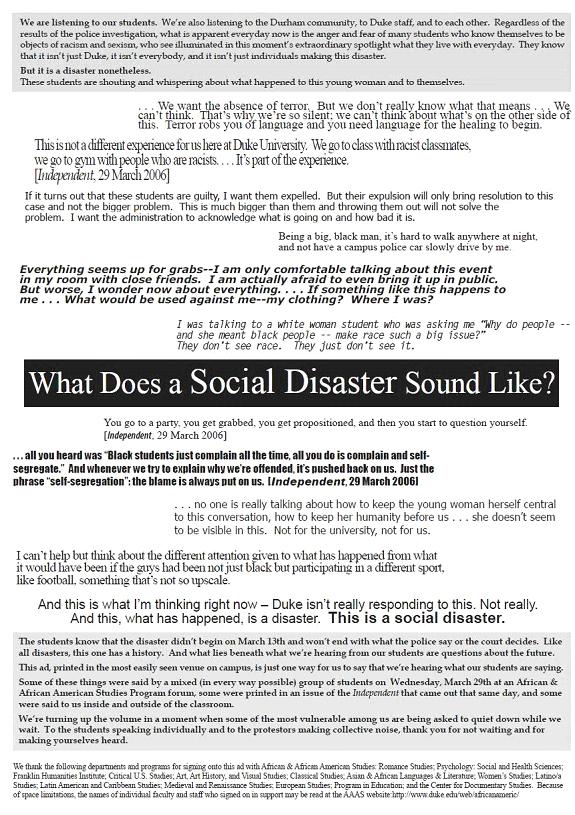
"This is a social disaster."

That was the tagline of a paid advertisement signed by 88 members of the Duke faculty that appeared in the April 6 issue of The Chronicle.

"I think that all of us kind of checked over our teachers to make sure they weren't on that list," Carrington said.

[Originally published in Cliopatria.]

Friday, March 16, 2007

Group Profile: Moving Forward with McClain

In recent weeks, a consistent mantra from the Group of 88 has been the need to “move forward.” A late February op-ed coordinated by Group of 88 stalwart William Chafe raised the theme the most explicitly, with the accompanying caveat that how the arts and sciences faculty responded to the lacrosse case should, at all costs, remain unexamined.

But Chafe and his ideological allies also want to remain free to exploit the lacrosse affair to advance their personal, ideological, or pedagogical agendas, all while implying that the institution should act as if that the facts involving the lacrosse team’s behavior are unchanged from March 31.

The Group of 88’s position amounts to the following: other Duke faculty should accept its agenda uncritically, without exploring whether the Group’s dubious conduct over the past year calls into question the merits of its recommendations.

It is difficult to reconcile the claims of Chafe and his colleagues that they are interested in “moving forward,” in encouraging a healing process on campus, with the decision of Group of 88 member Paula McClain to run for chair of Duke’s Academic Council. A strong candidate with impeccable Duke credentials, Craig Henriquez, was willing to serve. (Henriquez, a professor of biomedical engineering, received his B.A., summa cum laude, and Ph.D. degrees from Duke.) He had taken no outspoken positions, one way or the other, on the lacrosse case.

Instead, Academic Council members narrowly elected McClain, a figure with minimal Duke connections. She received her B.A. and Ph.D. from Howard, and came to Duke only in 2000, as part of a wave of “diversity” hires championed by then-Dean Chafe.

McClain, it’s worth recalling, has done more than affix her signature to the Group of 88 and “clarifying” faculty statements.

  • When asked over the summer if she was willing to speak out publicly to urge due process for the Duke students targeted by Nifong, McClain answered succinctly: “No.”
  • When asked about Paul Haagen’s proposal to pair individual professors with athletic teams, to give the faculty a better sense of athletic life for Duke students, she told the N&O that “people are just aghast that it’s being considered.” To reiterate, McClain and her supporters were aghast not that the common-sense idea was adopted, but that an idea she didn’t like was considered. Was this a preview of the type of open-minded leadership that she’ll provide over the next two years?
  • McClain incorrectly asserted, in a summertime interview, that black faculty members never got to meet with a top administrator to discuss the lacrosse case, even though a University-prepared timeline of the administration’s actions indicated that President Brodhead himself met with black faculty on April 3 to discuss the incident.

While extraordinarily sensitive to perceived racial slights from the administration, McClain remained silent as her Group of 88 colleagues delivered racially inflammatory statements. She said nothing when Houston Baker issued a public letter that mentioned the players’ race, in a derogatory fashion, no fewer than 10 times. She stood aside as Grant Farred preposterously alleged a “secret racism” among Duke students. She had no rebuke as Karla Holloway sent out an e-mail containing unsubstantiated, fifth-hand, slanderous allegations against Duke students.

McClain’s presence as chairwoman of the Academic Council means that the Group of 88’s response to the lacrosse affair will remain alive for at least the next two years, since any position that she takes will have to be viewed in the context of her apparent desire to promote the most extreme aspects of the Group’s agenda.

Consider her celebrating the findings of the Campus Culture Initiative:

The reality is the world is changing, the country is changing, and we have to change. If Duke wants to remain competitive and remain a top-notch institution, it’s got to change with the times. Change is very difficult, especially for people who came through Duke years ago.

Quite beyond her condescending dismissal of Duke alumni, a critical aspect of the CCI’s proposals is the Group of 88 Enrollment Initiative, the measure to require all Duke students to take a class that engages “the reality of difference in American society and culture.” The vast majority of these offerings are taught by . . . the Group of 88.

Take, for instance, McClain herself. Her website lists three undergraduate classes that she teaches:

  • Race and American Politics
  • Introduction to Racial and Ethnic Minorities in American Politics
  • Race in Comparative Perspective

Each of these offerings would be included in the Group of 88 Enrollment Initiative. So Academic Council Chairwoman McClain will use her position to champion the agenda of Group of 88 member McClain to boost the enrollment of classes taught by Professor McClain.

McClain’s narrow election suggested a peculiar tone-deafness among the Academic Council. It does not serve the best interests of either the faculty or the institution for the Council to be led by a figure whose statements and actions of the past 12 months have discredited her.

McClain did not respond to multiple e-mails requesting comment.

Tuesday, May 01, 2007

The Group: Divided, Defiant, Delusional

Yesterday’s Chronicle featured a statement endorsed by more than 1,000 Duke students asking, “What Does a Social Disaster Sound Like?” To the students, it sounded like a group of 88 professors who, “in a time of intense emotions and enormous stakes, when our community dearly needed a call for calm, for patience, for rational and careful thinking . . . instead took a course of action which escalated tensions, spurred divisions along lines of race and class, and brought our community into greater turmoil.” The Duke students termed themselves “ashamed by the apparent decision of these faculty members to exploit a tragic situation to further their own political and social agendas.”

Accordingly, the students demanded either an apology from the Group of 88 or President Brodhead to “come forward and defend his students against the assaults launched by his own faculty.”

The timing of the student ad could not have been more appropriate: it coincided with a major article from the Chronicle’s Chelsea Allison and Nate Freeman exploring the Group’s attitudes after the AG’s report explaining his proclamation of the players’ innocence. The headline: “Profs stand by ‘social disaster’ ad.” There would be no apologies from the Group of 88. (One of the 88, Math professor Arlie Petters, had previously expressed his regrets for signing the ad; the other 87 signatories have refused to do so.)

That said, the Group members quoted in the article—History’s Claudia Koonz, Pete Sigal, and William Chafe; and History/Women’s Studies professor Jocelyn Olcott—appeared to take different approaches to the path ahead.

Divided. Koonz’s comments best captured this division. She admitted that Mike Nifong had committed “misconduct”—an almost unprecedented assertion for a Group member, most of whom spent months enabling the disgraced district attorney’s efforts. She also conceded that the signatories of the ad were “naïve”—a remarkable statement in many respects, given that we’re talking about professors at one of the country’s best universities. More important, Koonz affirmed that while she would still support the statement, “I would just add one more sentence: ‘Let the justice system decide.’”

The Group’s statement, of course, declared that something “happened to this young woman [Crystal Mangum]”—not “allegedly” happened or “might have” happened. It also said “thank you” to protesters “for not waiting and for making yourselves heard”—protesters who in the 10 days before the statement appeared had blanketed the campus with “wanted” posters and who had carried banners reading “Castrate.”

In short, the philosophical change that Koonz retrospectively endorsed would have required re-writing much of the statement, not just one sentence. At least, however, she was somewhat apologetic in tone, and wasn’t attempting to deny the ad’s purpose.

Defiant. Contrast Koonz’s approach with the hard-line responses of Olcott and especially Sigal.

Olcott declared, “We have a lot of work to do to close the wounds that have opened up, but I hope that the healing can start now.” This is an admirable sentiment—but since Olcott refuses to acknowledge that the actions of the Group contributed to the “wounds that have opened up,” her call for “healing” to “start now” seems more like a desperate plea for the Group not to be held accountable for its actions.

Olcott also bizarrely rationalized her decision to sign the statement by citing the media portrayals of Duke from late March and early April of 2006—most of which, as we know now, were based on a false premise that a crime occurred. The women’s studies professor told the Chronicle, “I’ll admit that the combination of all these stories coming out made me ask myself, ‘Would I want my niece to come to Duke?’ I want this to be a place where someone like her can thrive intellectually and personally, and that wasn’t what I saw.” I e-mailed Olcott to ask whether, given the conduct we have seen from Duke professors over the past 13 months, she would want a nephew who played lacrosse to come to Duke. She didn’t reply.

Sigal, meanwhile, suggested that the ad wasn’t even about the lacrosse case—its copious references to events of March 13/14, and the guilt-presuming student quotes, and the thanking of protesters apparently referenced some other, unknown, event. He added that he signed the statement because “I support working with students to help amplify their voices.” I e-mailed Sigal to ask how many other full-page Chronicle ads he had signed onto (either before April 6, 2006, or since that time) containing anonymous student quotes. I also asked what steps he took to ensure that the quotes in the ad were accurate, and actually came from Duke students, as opposed to non-Duke students who attended the March 29, 2006 forum. He did not reply.

It is, moreover, difficult to take seriously Sigal’s “student-based” agenda given his silence, and that of every other Group member, to obvious attempts to silence student voices—whether in the form of death threats against Reade Seligmann last May, or questionable in-class conduct by some Duke professors (including several in the History Department) late last March. It seems as if Sigal is more interested in “working with students to help amplify their voices” if he agrees with those students’ positions on issues of race, class, and gender.

Delusional. Meanwhile, William Chafe identified the true victims of this case—the Group of 88. And he lashed out at the real villains—people who produce blogs.

In an e-mail to the Chronicle, the former Dean of Faculty wildly contended, “I am appalled at the way that bloggers who have targeted the ‘Group of 88’ have put words in our mouths, denied our individuality and [used] racist and violent language to attack us—including sending us e-mails and making phone calls wishing our deaths and calling us ‘Jew b-’ and ‘n-b-’.” [emphasis added]

Chafe cited no evidence to substantiate his allegation about “bloggers who have targeted the ‘Group of 88’.” But coming from the same person who argued that the whites who kidnapped, beat, and drowned Emmett Till provided the appropriate historical context through which to view the behavior of the lacrosse players, unfounded allegations are no surprise.

Quite beyond the unintended irony of accusing “bloggers”—as a bloc, stripped of their individuality—of denying the “individuality” of people who signed a joint public statement, Chafe’s claim is absurd on its face. Imagine how such a threatening phone conversation would work:

Chafe: Hello?

Blogger Who Has Targeted the Group of 88: Prof. Chafe?

Chafe: Yes.

Blogger Who Has Targeted the Group of 88: I am a blogger who has targeted the Group of 88. I now am going to shower you with vile racist, sexist, and anti-semitic epithets . . . By the way, please visit my blog at www.racist.blogspot.com.

Unfortunately, since the Group has publicly claimed to have involved the police in this matter, Chafe’s very specific allegation—that not anonymous e-mailers but “bloggers who have targeted the ‘Group of 88’” have engaged in criminal activity—needs to be treated seriously. I contacted every blogger who has done more than one post about the Group and its activities (except for Johnsville News, which has no e-mail contact info). I asked each whether he or she had phoned or e-mailed Chafe or any other Group member; and if so, in what context.

The responses: Bill Anderson, Michael Gustafson, and La Shawn Barber, as well as the bloggers from Liestoppers, Friends of Duke, Lead and Gold, Betsy’s Page, Crystal Mess, and John in Carolina all noted that they had never called or e-mailed Chafe. Anderson, Gustafson, and JinC noted that they have had a few pleasant, professional exchanges with other Group members; the others had no e-mail or phone contact with any Group member.

I have e-mailed many Group members at various stages of the case to request comment. Along these lines, I e-mailed Chafe once, on May 3. The full text of my e-mail exchange with him is here. I doubt that anyone could argue that my two e-mails wished his death or in any way used violent language.

So who, precisely, are these “bloggers who have targeted the ‘Group of 88’” to which Chafe referred? I suspect that we will learn their identity at about the same time the Group of 88 takes the advice of the masses of Duke students represented in yesterday’s ad and issues a joint apology.

Friday, May 25, 2007

The Group of 88: Non-Endorsement "Endorsements"

The Group of 88’s ad did not include a list of all 88 Duke faculty members who signed onto the statement. But it did specifically assert that five Duke academic departments (Romance Studies; Psychology: Social and Health Sciences; Art, Art History, and Visual Studies; Classical Studies; and Asian & African Languages & Literature) as well as 10 academic programs formally endorsed the statement.

It is hard to overstate how unusual such an endorsement is. Academic departments rarely sign onto statements that do not directly deal with departmental concerns. That nearly 20 percent of a school’s arts and sciences departments would endorse a statement such as that produced by the Group of 88 is extraordinary. These departmental (and program) endorsements gave the statement added heft—perhaps explaining why the statement’s principal author, Wahneema Lubiano, included the names of the relevant departments in the text.

How could it be, as occurred in each of the five departments above, that a majority of a department’s professors did not sign onto the ad individually, but then took the far more significant step of supporting a formal departmental endorsement of the statement?

Well, it turns out, they didn’t.

In some, and perhaps all, of the five departments, no vote to sign onto the ad ever occurred. There was no informal polling of department members, either. Some, and perhaps all, of the departments listed as signing onto the Group of 88’s statement did not, in fact, ever endorse the ad.

Two members of the Classical Studies Department had informed me that no departmental vote on whether to endorse the ad occurred, and so I asked the department’s chairman, Peter Burian, what had happened. He replied,

Your information is correct. The department did not vote to endorse the ad. An individual faculty member gave the “go ahead,” and at least one member of the department was upset that this had happened without departmental consent. The action was well-intentioned, if in retrospect it may appear mistaken; it needs to be understood in the context of the immediate, highly emotional reactions to the first reports of the incident.

In effect, then, a professor decided to confer upon herself the authority to speak on behalf not only of her 10 colleagues but also an established department of Duke University.

No doubt that the situation in Durham was highly emotional last spring. It’s worth remembering, however, that the Group’s statement was hardly immediate—it went to print on April 6, more than a week after defense attorneys had publicly asserted that the DNA tests that Mike Nifong had promised would exonerate the innocent would all come back negative, and nearly two weeks after the first press reports on the case. Indeed, the rush to produce the ad appears to have stemmed less from emotion than from Lubiano’s desire to get the ad published before the DNA test results came back.

Academic freedom carries with it responsibilities as well as rights—and one responsibility is to follow accepted procedures, or at least make a good faith effort to do so. It’s hard for me to believe that a tenured, full professor was unaware that she did not have the authority to unilaterally say that her department endorsed a public statement.

An even murkier situation exists in the (since consolidated) Department of Psychology: Social and Health Sciences. Two members of the (then) department told me that no vote occurred on whether the department as a whole should endorse the ad; and the department’s then-chairman, Tim Strauman, confirmed that he had no recollection of any vote. Had such a vote taken place, of course, the motion to endorse almost certainly would have been rejected—since not even one member of the department individually signed the Group of 88’s statement.

So on what basis did Lubiano claim that Psychology: Social and Health Sciences endorsed the ad? She isn’t saying: she earlier had instructed me, when I asked her what evidence she possessed that the Brodhead administration had responded last spring in an overly favorable fashion to the lacrosse players, “Do not email me again. I am putting your name and email address in my filter.”

The “endorsement” of a third department also does not appear to have occurred: In Art, Art History, and Visual Studies, 10 of the 12 faculty did not sign the statement individually. I e-mailed the department chairman, Hans van Miegroet, to ask under what procedures his department endorsed the ad; he declined comment.

The chairs of the other two departments to sign onto the ad (Leo Ching and Margaret Greer) were members of the Group of 88. They did not reply to requests on what procedures their departments followed in electing to sign onto the ad.

At the Volokh Conspiracy, Northwestern law professor Jim Lindgren (who has served as an associate dean at two universities) explained the severity of this breach of academic protocol.

Could it be that one or more of the approximately 15 departments or programs that supposedly endorsed the letter did not do so? Did the letter writers fabricate departmental or programmatic support that did not exist, either intentionally or out of confusion?

That is a truly frightening possibility, even if less likely to have happened than some of the other [possible explanations]. After the Group of 88’s letter was published with departments and programs at Duke presented as official signatories, the President or the administration would likely have talked to at least a few chairs to determine the circumstances of their departments’ signing on. Is it possible that the President or another member of his administration had discovered that the authors of the Group of 88 were falsely claiming official Duke departmental endorsements that were fraudulent—and kept silent about it?

Leading a university is like herding cats, and faculty members can be expected to make many irresponsible statements for which the administration can’t reasonably be held responsible. But claiming departmental support (if there were none) is a claim that an administration would have a moral (and perhaps a legal) obligation to correct. Publishing the Group of 88’s letter certainly damaged the reputation of the Duke students accused of rape, and encouraged those who were harassing them. If a professor lied about whether departments or programs at Duke joined in the denunciation of the accused Duke students, that lie would have damaged the reputation of those students.

The false claim of departmental endorsements, ironically, was then reaffirmed in the January “clarifying” statement—which defiantly rejected calls to apologize or to back down in any way from the Group of 88 statement. Whatever else motivated them, the “clarifying” faculty certainly were not responding to the emotions of Crystal Mangum’s initial allegations and Mike Nifong’s pre-primary publicity barrage. So it remains the official, public position of more than 100 Duke professors that the departments of Classical Studies, Psychology: Social and Health Sciences, and Art/Art History formally endorsed the Group of 88 ad.

---------

Last spring, there was a spring break party that featured drinking and boorish, raunchy entertainment—hardly an extraordinary occurrence, except perhaps at institutions such as Liberty or BYU that most politically correct professors disdain. The party—because, it’s worth remembering, all such writers claimed they weren’t prejudging the criminal case—triggered hostile op-eds or letters from no fewer than 14 Duke arts and sciences professors, critical comments from at least a dozen more, a denunciatory ad signed by 88 faculty members, and presidential comments inaccurately suggesting that the lacrosse team had a history of racist behavior and asserting, “Whatever they did is bad enough.”

A few weeks later, what Lindgren correctly called a “frightening” breach of academic protocol occurred, in which three and perhaps five departments were listed as endorsing a highly controversial public statement even though the departments had never voted to endorse the statement—and, in fact, even though a majority of at least three of the departments clearly did not support it. This abandonment of standard academic procedure has, to date, produced no critical comment at all, from anyone in the Brodhead administration.

In one of her essays on the case, USC law professor Susan Estrich wrote, “There are reasons you follow procedures. In general, they are there to spare outrage.” Following procedures in this instance would have spared the outrage of a document prominently cited in the defense change-of-venue motion falsely claiming endorsement from several of Duke’s academic departments.

Wednesday, January 10, 2007

Conflicting Pressures

It’s been interesting to see the differences between how most newspapers and most blogs interpreted the recent Richard Brodhead statement. Most media coverage—even from the heretofore consistently pro-Nifong Duff Wilson of the New York Times—stressed the sections in which the president criticized Nifong, in strong and commendable language. Most case-oriented blogs, on the other hand, focused on the statement’s defense of the Group of 88, and its defense of the Group of 88-led Campus Culture Initiative.

Perhaps this bifurcated response was inevitable. It seems as if Brodhead currently has to satisfy several different constituencies, most of which place competing demands on him. That the state and national media focused on his call for due process suggests that, overall, the address was a positive development, despite its disappointing comments about the Group of 88.

Legal

Only the naïve would believe that last week’s filing of the Dowd lawsuit represents the last or most significant legal matter that Duke will face before this affair has ended. This case began with discussions about legal action against Duke—local attorney and Nifong backer Mark Simeon, joined briefly by high-powered plaintiffs’ attorney Willie Gary, seemed to dream of a lawsuit by Kim Roberts and the accuser against Duke.

That the accuser will never have grounds for a civil suit is hardly a revelation; indeed, it’s far more likely that she’ll face charges for filing a false report or have to fight child custody issues.

Duke, therefore, finds itself in an awkward position. The major legal threat it seemed to face last spring, when the key decisions (and non-decisions) in this affair were made, came from the accuser. Now, it faces a looming legal threat from some of its students. Counsel undoubtedly has told Brodhead that any admission of improper conduct by faculty in last spring’s classes will strengthen the next case against Duke, and that he should stress the administration’s efforts to uphold the presumption of innocence, even though this seems to have been, at most, a secondary concern in March, April, May, and June.

Parents

While legal concerns would dictate the kind of robust defense that Brodhead offered of the Group of 88’s actions, pleasing parents would pull the president in the exact opposite direction. Duke’s current tuition is more than $40,000 annually; it, fittingly, competes for student talent against the Ivies and other elite schools, like Stanford, Michigan, or Berkeley. Parents who spend such an amount want to ensure that their children will be treated well by the school.

More than 80 percent of Duke’s arts and sciences faculty did not join the Group of 88. No Engineering professors did so. In the last week, 19 Economics professors publicly stated that they welcomed all Duke students into their classes—regardless of race, ethnicity, gender, or athletic status. The Economics professors’ statement appears in today’s Chronicle. No question exists that most Duke professors care very much about their students.

But there’s also no question that one Duke professor, after suggesting—falsely—in writing that two of her own students were accomplices to rape, gave both of them an F on their final paper. (Nor is there any doubt in my mind that we’ll be hearing more such tales—perhaps not quite so dramatic—over the coming months.) There’s no question that ESPN reported that document author Wahneema Lubiano moved forward with the Group of 88’s statement fully aware that some would interpret the document as a “stake through the collective heart” of some of her own school’s students. Or that not a single member of the Group of 88 has publicly conceded doubts, in retrospect, about the timing of their statement; or its thanking of protesters whose behavior most people would consider indefensible; or its refusal to mention the due process rights of their school’s own students.

From a standpoint of reaching out to parents, then, Brodhead has every reason to concede that mistakes were made last spring—not to seek scapegoats, to challenge tenure, or to fire people, as was done to former lacrosse coach Mike Pressler. But to reassure prospective Duke parents that the administration is taking positive steps to ensure that every arts and sciences professor at Duke treats every student at the institution fairly.

Alumni

Brodhead’s address did not include a discussion of the role he sees the institution’s alumni playing as part of the Duke community. I’ve corresponded with lots of Duke graduates over the past nine months, and have met a smaller number personally. It’s my sense that a significant swing in opinion has occurred—from embarrassment and concern that a crime might have occurred last spring, to disappointment that the institution didn’t do more to protect the due process rights of its students now.

Duke’s official attempts to communicate with its alumni have been either one-sided or bumbling—only heightening the risk of an alumni backlash as the full scope of Nifong’s misconduct becomes clear.

Brodhead’s remarks against Nifong were the right thing to do. But they also satisfied pressure from alumni, a group that no president can afford to alienate. On the question of challenging Nifong, Duke’s institutional self-interest and Brodhead’s moral obligations are one and the same, and Brodhead’s actions over the past month seem to recognize this fact.

Faculty

The principle of academic freedom in the United States dates from World War I. It originated in response to decisions by prestigious universities (notably Columbia and Stanford) to fire professors because of their political beliefs. It gradually, and appropriately, expanded to include the argument that professors’ specialized training should give them freedom to conduct their research as they see fit, and to have final say on what is taught in the classroom.

In recent years, however, academic freedom has been redefined by some to suggest that it should leave academics free from outside criticism of anything they say or do. This sentiment certainly appeared in the sections of Brodhead’s address dealing with blogs (I presume including, in the interest of full disclosure, this blog) that have criticized the Group of 88.

I would be surprised if many Group of 88 members haven’t already consulted counsel, and I would be even more surprised if counsel hadn’t told them the ambiguity of the statement’s language could be made, in a court of law, to show that the signatories were saying things against the lacrosse team. Because of their overall record of statements and actions, several arts and sciences professors would seem to be at least as legally vulnerable as is Kim Curtis.

Even if the threat of lawsuits didn’t exist, though, I suspect Brodhead would have denounced the critics of the Group of 88. Professors, as a whole, resent outside criticism. Duke, in particular, has aggressively recruited professors in the last 15 years with a promise of a comfortable intellectual atmosphere on campus. Unfortunately, Brodhead seems unwilling or unable to give even a mild statement of rebuke, perhaps delivered in the passive voice, regarding inappropriate faculty behavior.

Trustees

At most institutions, the Trustees also would be placing pressure on Brodhead. But in this affair, BOT chairman Bob Steel has resolutely backed the president.

On one side, then, legal advice and faculty pressure suggest that Brodhead will continue with his January 7 line of wholeheartedly defending the Group of 88. At this stage, the question would seem to be whether pressure from alumni or prospective parents will force him to reconsider this approach.

But the administration seems to have embraced a policy of demanding that Durham authorities treat Duke students with the same procedures accorded to all Durham residents—a most welcome, and highly positive, development.

Clarification:

After Monday’s post, I received a thoughtful e-mail from a DIW reader chastising me for appearing anti-Duke, and for leaving the impression that all professors at the school agreed with the Group of 88. The reader especially objected that my bullet-pointing four professors (Farred, Crowley, Curtis, and Davidson) left this incorrect impression.

I should have been clearer in my language in that section of the post, and I apologize. I bullet-pointed these four professors not because I considered them representative of the Duke faculty (I don’t), but because they were the four Duke professors that had most recently experienced criticism from the blogs—the specific point that Brodhead had made, but without mentioning their names, in the faculty section of his address.

Friday, February 09, 2007

Friends of Duke Confronts the Group of 88

Friends of Duke University continues its important work, with a full-page ad in yesterday’s Chronicle presenting some questions for the Group of 88.

FODU spokesperson Jason Trumpbour explains:

These professors who became known as the “Group of 88” were widely criticized for prejudging the guilt of members of the men’s lacrosse team and for attempting to advance whatever agenda they had at the expense of these students and their reputations. Their ad was also cited by defense attorneys in their motion for a change in venue as evidence of extremely prejudicial pretrial publicity.

Nine months later, on January 16, 2007, a group containing most of the same members and now calling itself the “Concerned Faculty” posted an open letter on their website defending their original ad. Claiming that the original ad had been “broadly, and often intentionally, misread . . . as rendering a judgment in the case,” the group rejected calls to retract or apologize for it.

Yet, as Trumpbour correctly notes, the clarifying faculty’s “open letter begs more questions than it answers about the purposes of the ‘Listening’ ad and the sort of conversation being sought given the peculiar language used to express its points and communicate its premises.” Accordingly, FODU put together a list of questions for the “clarifying” faculty based on comments from the FODU site and from Durham-in-Wonderland.

Why did FODU pursue such a high-profile listing of questions? Unfortunately, previous outreach attempts to the Group of 88 have been, Trumpbour laments, “ignored or rebuffed.” In a July open letter, FODU expressed its hope that Group of 88 members would “count themselves among those victimized by this spring’s false accusations” and “realize now that our enemies are not each other, but those who would profit from the unfair denigration of our university and its members.” Alas, no Group member did so.

More recently, FODU “attempted to find common ground with [the Group of 88] by asking if they would join the University in calling for due process for Reade Seligmann, Collin Finnerty and David Evans, an issue on which we hoped everyone could agree.” Not even one Group member responded positively.

As Trumpbour notes,

We are dismayed that, not only would they chose to ignore our efforts, but that they would instead respond with a defiant refusal to admit mistake either in judgment or expression and that they would insult the motives and/or intelligence of their critics. We do not begrudge members of the Group of 88/Concerned Faculty their right to call attention to social issues of concern to them. We instead condemn the unfair public vilification of members of the lacrosse team done in the course of expressing their concerns.
Below is the full text of the FODU ad, published yesterday in The Chronicle.

Some Things to Consider from the Friends of Duke University
In a recent Duke Chronicle article, Group of 88 member Ronen Plesser maintained that the new statement of a group calling itself “Concerned Duke Faculty” would form a “basis for a conversation on campus . . . a conversation that will eventually lead to some understanding.”

Friends of Duke University endorses this conversation. But we also believe that the basis for one aspect of this conversation—the meaning of the Group of 88’s April 6 ad—needs more clarification. In that light, we would like to offer some questions for the “Concerned Duke Faculty.”
Principles of Due Process

  • The April 6 ad explicitly thanked “students speaking individually” and “protestors making collective noise” for not waiting. The fundamental question is what was not worthy of being awaited. Time for reason to assist emotion? Time for evidence to be gathered and assessed? Time for a defense to be made? If you were so attuned to due process, why did you fail to mention it in your April 6 ad?
  • In your recent statement, you stated “We do not endorse every demonstration that took place at the time. We appreciate the efforts of those who used the attention the incident generated to raise issues of discrimination and violence.” Do you or do you not endorse the “potbanging” protest that was widely covered in the media? Could you explain to the University community what criteria you used in the April 6 ad to determine which protests were worthy of your endorsement and which protests merited your disapproval?
  • In your recent statement, you claim to “stand firmly by the principle of the presumption of innocence.” What, then, should readers of the April 6 ad have inferred from your reference to “what happened to this young woman”? Given that she had accused members of the Duke lacrosse team of rape, isn’t that the obvious inference, carrying with it implied guilt of some members of the lacrosse team?
  • Do you believe that Mike Nifong acted properly when he went to the grand jury on April 17 to seek indictments against Reade Seligmann and Collin Finnerty?

Statements of Your Fellow Signatories

  • Do you agree with the March 31 Chronicle op-ed of your colleague and fellow signatory, Bill Chafe, who suggested that the whites who lynched Emmett Till provided an appropriate historical context through which to interpret the actions of the lacrosse players?
  • Do you agree with the claim of your colleague and fellow signatory, Karla Holloway, that innocence and guilt have been “assessed through a metric of race and gender. White innocence means black guilt”? If so, which pieces of evidence cited by defenders of the players relate to race and gender?
  • Your colleague and fellow signatory, Alex Rosenberg, told the New York Sun on October 27 that he signed the ad because he was bothered by “affluent kids violating the law to get exploited women to take their clothes off when they could get as much hookup as they wanted from rich and attractive Duke coeds.” Was raising this issue one of the ad’s purposes?

The University and Its Students

  • Will you document the methodology used to obtain a representative cross section of campus opinion for the “listening” statement?
  • The April 6 ad contains the following anonymous quote from an alleged Duke student: “Being a big, black man, it’s hard to walk anywhere at night, and not have a campus police car slowly drive by me.” Have any of you approached the Duke police force to ask if it has a policy of slowing down when officers see a Black man on campus? Have any of you experienced or observed this phenomenon?
  • In your recent statement, you criticized those who read the April 6 ad “as rendering a judgment in the case.” That ad quoted an anonymous student, who allegedly said, “no one is really talking about how to keep the young woman herself central to this conversation” another anonymous student allegedly said, “If something like this happens to me . . . what would be used against me—my clothing?” Would you agree that these anonymous students appeared to have rendered a judgment in the case?

Looking Ahead

  • Given that in your new statement you criticized an atmosphere that allowed “sexual violence to be so prevalent on campus,” would you recommend that female students accepted to the Class of 2011 attend Duke? If so, how could you support their entering an environment that you have publicly described as so dangerous?
  • Would you be willing to sign a statement, such as that of the Economics Professors, saying that all students, including lacrosse players and other student-athletes, are welcome in your classes?

Perhaps these questions would be useful to raise at Monday night’s edition of the Group of 88 rehab tour?

Wednesday, February 28, 2007

More on the CCI

Having gone through the full report of the Campus Culture Initiative, it’s easy to see why it received such a tepid reception from President Brodhead. The report combines a series of unobjectionable, even laudable, recommendations with persistent references to “last spring’s lacrosse event” that act as if time stopped on March 31st, when the potbangers, Group of 88, and Mike Nifong were still riding high.

The theme of the lacrosse case has been flawed procedures beget flawed results. The CCI’s record conforms to the pattern. With three of the committee’s four subgroups chaired or co-chaired by among the campus’ most extreme critics of the lacrosse team, is it any wonder that the CCI produced a report that validated the worldview of . . . the campus’ most extreme critics of the lacrosse team?

---------

The two workable recommendations:

(1) create more physical space for student social activity around campus;

(2) streamline the faculty administrative structure to increase faculty-student interaction.

It’s hard to see how anyone could object to either of these goals, and Brodhead should allow these two and only these two items to form the legacy of the CCI.

---------

Three minor items give a sense of the report’s quality and biases:

(1) The report’s first line: “Duke University is a university of the 21st century, emboldened and challenged by the dynamics of a changing world.” Is there any university in the country to which this statement would not apply?

(2) The 25-page report—a product of months-long inquiry by prestigious academics—cited a grand total of two (2) publications. The chosen duo? William Bowen’s screed against Division I athletics; and Janet Reitman’s widely disparaged Rolling Stone article—which, perhaps because it places the Duke student body in the worst possible light, is assigned reading in Anne Allison's spring semester class. Apparently, CCI members decided not even to try to conceal the membership’s biases.

(3) The report listed four and only four campus groups and offices with which CCI members “connected”: the Women’s Center; the Center for Lesbian, Gay, Bisexual, and Transgender Life; the Council on Civic Engagement; and the Mary Lou Williams Center for Black Culture. Some might suggest that this quartet would provide a rather one-sided view of campus culture.

---------

The Alcohol subgroup was the only subgroup not chaired by an extreme critic of the lacrosse program. The recommendations of the CCI’s alcohol subgroup recognize the difficulty of alcohol on contemporary college campuses, but do not single out athletes as any worse (or better) than all Duke students on this question. This section, no doubt, will pose problems for the latter-day neo-prohibitionists among the Group of 88.

---------

Other items in the report are unintentionally revealing.

(1) “There are often pressures for conformity which work against our institutional vision as an inclusive academic community.” (p. i) “The Committee came to better understand problems that exist—ranging from simple acts of uncivil speech and intolerance to what some have called a ‘culture of excess.’” (p. 4) “Last spring’s events revealed that Duke must do better in learning how to engage difference constructively.” (p. 8)

Some might think that these statements describe the potbangers or the Group of 88. In fact, the report’s implication is that those who opposed the potbangers or the Group of 88 were guilty of exercising “pressures for conformity” or engaging in “uncivil speech and intolerance” or of failing “to engage difference constructively.”

(2) “Last spring’s lacrosse event and its ensuing controversies evoked strong emotions and discussions about issues of race and gender, class and privilege, difference and respect, athletics and academics, and town and gown.” (p. 1)

It appears as if CCI members suffered from a form of Durham Rip van Winkle disease, having gone to sleep on or about April 6 and missed “strong emotions and discussions” about issues of faculty groupthink, prosecutorial misconduct, a rush-to-judgment mentality, or professors who fail to respect all their students, regardless of race, gender, or athletic status.

Those “ensuing controversies” the CCI members were bound and determined to ignore. I wonder why?

(3) “In their first year at Duke, about 15% of Black students reported that Duke instructors treated them badly because of their race/ethnicity,” as opposed to much smaller percentages for other groups. (p. 6)

This claim is a shocking one: the CCI has suggested, without any hard investigation, that a considerable portion of Duke faculty members engage in racist behavior.

(4) [update, 1.12am]: A commenter notes, “I was astonished to read in the CCI report that the Duke Class of 2010 includes 41 percent students of color. Yet, the next paragraph calls for additional consideration for admissions from 'under-represented groups.' What groups could remain under-represented?”

A good question, to which the CCI offered no answer.

(5) “Analyses conducted over the last four years indicate that this decision has increased the number of students who are not adequately prepared to benefit from, or contribute to, the work of the academic community, event with enhanced academic support services. This places Duke’s admirable graduation rates at risk, reinforces negative stereotypes, and does not serve the best interests of these students themselves, their peers, or their faculty.” (p. 22)

Reread the statement above. Some might think it came from an ultra-conservative critic of “diversity” college admissions policies.

But it came from the CCI. For those who guessed that it refers not to African-American students with poor SAT scores and pre-Duke academic preparation, but instead refers to a class of Duke students consistently targeted by the Group of 88 and figures such as Peter Wood and Orin Starn, a free guest pass to the next “Shut Up and Teach” event is yours for the taking.

---------

In the end, there never was any doubt about what the CCI would produce, with Peter Wood and Group of 88 members Karla Holloway and Anne Allison chairing or co-chairing three of its four subgroups. As a Chronicle editorial noted a few weeks back, “The composition of the CCI’s steering committee has hurt its credibility . . . Stacking the CCI with critics of ‘white male privilege’ suggests that the initiative was created to pacify countercultural professors, rather than to shape a new and improved campus culture.”

The most chilling provision of the CCI report is the Group of 88 Enrollment Initiative, with the Group seeking to use the lacrosse case to force all Duke students to take their classes. The report urges a requirement that all Duke students take a class that engages “the reality of difference in American society and culture. The vast majority of these offerings are taught by . . . the Group of 88.

Over the past 10 months, most Group of 88 members have made clear their belief that the Faculty Handbook provisions requiring Duke professors to treat all students with respect do not apply to them. The idea that all Duke students should be forced to take a class from a Group of 88 professor or a handful of the Group’s ideological allies in the name of “improving campus culture” is Orwellian.

Monday, July 13, 2009

Checking in with the Group

A recent issue of Duke Magazine featured three members of the Group of 88 showing that critical self-reflection is not a hallmark of Group scholarship.

The first essay—coupled with a bizarre photograph—came from Karla Holloway, identified as “James B. Duke Professor of English and professor of law.” (Holloway is the very rare member of an elite law school’s faculty who does not possess a J.D.)

Holloway’s essay is a paean to the right to privacy. Writes she,

The right to privacy that allows us to associate our homes with sanctuary and that places the highest value on an "inviolable personhood"—a nineteenth-century notion of "the right to be let alone"—is a right we still understand and desire today. But in twenty-five years, I suspect that we will barely recognize how public—and indeed how violated—our inviolable personhood has become. In fact, we have encouraged some of this slippage. The threat of terrorism has been enough to persuade us to accept warrantless searches. And when these searches became virtual in the form of warrantless wire-tapping, it seemed merely a change of venue rather than a loss of constitutional rights. In the battle between privacy and national security, the nation followed its fears.

Holloway also expresses grave concern about how DNA—even when given up voluntarily—can cause a loss of privacy. “As the science advances, the material you sent in for one purpose may end up being used for something entirely different—from medical research for the public good to tracking down a suspected criminal in your family, using the very genetic markers you made available for discovery.”

Is this the same Karla Holloway who couldn’t be bothered when a local judge demanded that some Duke students who weren’t even in Durham County the night of an alleged crime had to turn over their DNA, under force of compulsion, to local authorities? We all know how Holloway responded to that loss of privacy—she signed onto the Group of 88’s statement, proclaiming that something had “happened” to the accuser and thanking protesters who had (in another seeming violation of privacy) blanketed the campus with “wanted” photos of the lacrosse players.

You’d think that having seen this remarkable transgression of privacy rights, occurring to students at her own institution, might have caused Prof. Holloway to reflect on her part in events of 2006 and 2007. But it appears that for the ”James B. Duke Professor of English and professor of law,” some invasions of privacy aren’t much of a problem.

-----------------------

Duke Magazine also brought to alumni the insights of Group of 88’er Paula McClain. McClain, who offers a variety of courses on race and American politics but seemingly teaches nothing else, cautioned that the election of Barack Obama does not signal “the end of issues of race or racism in the U.S.”

McClain concedes that, yes, the African-American Obama received a higher percentage of the white vote than did the white John Kerry. And she also notes that he carried a majority of the vote from younger whites. But these facts, she cautions, shouldn’t detract from Victimology 101, “because so many areas of structural inequality in the U.S. have existed for so long.”

How should this “structural inequality” be addressed? McClain doesn’t say, although she implies support for a continued racial preferences scheme coupled with government assistance to minorities. And even if Obama did everything she wanted, the Group of 88’er asserted that “much would remain to be done after he leaves office.”

McClain concluded with an off-the-wall comment: “As the nation becomes increasingly multiracial over the next twenty-five years, the imperative to confront these inequities will be even more important if the nation is to continue moving forward.”

Of course, “as the nation becomes increasingly multiracial,” the racial preferences system will almost certainly become harder to sustain. To take the most clear-cut example—higher education admissions—the testing data suggests that African-Americans benefit from “diversity” admissions primarily at the expense not of whites but of Asian-Americans. How would this problem be addressed in the “increasingly multiracial” United States? McClain doesn’t seem interested in exploring the matter.

-------------------

Duke Magazine readers also got to hear from Cathy Davidson (shown, like Holloway, in a somewhat peculiar photograph). In a passage that could have applied to her fellow Group of 88’ers, Davidson maintained, “Given the ever-increasing rapidity and magnitude of change on a global scale, we all need to master the precious and formidable skill of being able to stop in our tracks, discard the road map that has failed us, and try a different route on the unpredictable journey ahead.”

Her essay mostly consists of complaints that good grades don’t predict future success and that universities don’t have enough “interdisciplinary” offerings (which, freed from even the limited constraints of disciplinary bounds, are particularly appealing for the politically correct). The time has come, writes Davidson, for “radical educational transformation.” Of course.

-------------------

Davidson, McClain, and Holloway would be well-served by reading an essay published last week by Cass Sunstein, President Obama’s nominee to head the Office of Information and Regulatory Affairs, whose work I have cited on other occasions in the blog. The title could be a description of the Group of 88: “To become an extremist, hang around with people you agree with.”

As Sunstein notes, research shows that “much of the time groups of people end up thinking and doing things that group members would never think or do on their own . . . when people find themselves in groups of like-minded types, they are especially likely to move to extremes. And when such groups include authorities who tell group members what to do, or who put them into certain social roles, very bad things can happen.“

What explains group polarization? According to Sunstein, the key “involves the exchange of new information. Group polarisation often occurs because people are telling one another what they know, and what they know is skewed in a predictable direction. When they listen to each other, they move.” Applied to the Duke case: In the race/class/gender world of the Group of 88, where dissenting opinions are rarely if ever heard, the natural development was a movement to a position that was more extreme than what all but a handful of the Group of 88 (perhaps Wahneema Lubiano, Grant Farred, and Eduardo Bonilla-Silva) would have taken on their own.

Again describing a phenomenon we saw with the Group of 88, Sunstein notes, “People tend to respond to the arguments made by other people — and the pool of arguments, in a group with a predisposition in a particular direction, will inevitably be skewed in the direction of the original predisposition.”

The contrast: “Those who lack confidence and who are unsure what they should think tend to moderate their views. Suppose that you are asked what you think about some question on which you lack information. You are likely to avoid extremes. It is for this reason that cautious people, not knowing what to do, tend to choose some midpoint between the extremes. But if other people seem to share their views, people become more confident that they are correct.”

As we saw with the lemming-like signatures to the “clarifying” letter, in which Group members proudly proclaimed they would never apologize, a certainty of their rightness characterized the Group throughout the case.

Thursday, January 18, 2007

The Group of 88's Myths and Realities

If nothing else, the rump Group of 88 has demonstrated a talent for revisionist history. Their recent statement unsuccessfully attempted to explain away both the context and the actual wording of their springtime ad.

Myth #1: The Group of 88’s statement had nothing to do with the accuser’s March 14 allegations.

The new statement claims that many (unnamed) people have “intentionally” misread the April 6 ad as, among other things, “a comment on the alleged rape.”

Reality

It’s hard to treat this assertion seriously.

The lead section of the Group of 88’s statement mentioned “what happened to this young woman.” I doubt that signatories were referring to the accuser’s dangerous habit of mixing alcohol and Flexeril; or were expressing their concerns about the impropriety of filing a false police report.

Moreover, the statement’s author herself, Wahneema Lubiano, conceded the connection between the statement and the case; ESPN reported that she prepared the statement fully aware that it could be seen as “a as a stake through the collective heart of the lacrosse team.” A vivid image.

Finally, four of the ad’s eleven anonymous statements that allegedly came from Duke students specifically referenced the accuser’s allegations.

Myth #2: The Group of 88 was committed to upholding the presumption of innocence for the lacrosse players.

The new statement claims that the signatories “stand firmly by the principle of the presumption of innocence.”

Reality

As with the first myth, it’s hard to treat this claim seriously.

Several Group members independently commented on the case either shortly before or shortly after the ad appeared:

  • Houston Baker penned a public letter denouncing the “abhorrent sexual assault, verbal racial violence, and drunken white male privilege loosed amongst us” and urging the “immediate dismissals” of “the team itself and its players”;
  • William Chafe published an op-ed suggesting that the behavior of the whites who lynched Emmett Till provided the appropriate historical context through which to interpret the lacrosse players’ actions;
  • Wahneema Lubiano told the N&O that “people can’t imagine that the woman could have made a false rape allegation.”

These remarks do not suggest a passionate commitment to the lacrosse players’ presumption of innocence.

Several of the ad’s anonymous statements that allegedly came from Duke students also do not reflect the presumption of innocence. One anonymous student allegedly said, “No one is really talking about how to keep the young woman [the accuser] central to the conversation, how to keep her humanity before us.” Another anonymous student allegedly said, “If something like this happens to me . . . what would be used against me—my clothing?” A third anonymous student allegedly said, “Duke isn’t really responding to this. Not really. And this, what has happened, is a disaster.’

These remarks do not suggest a passionate commitment to the lacrosse players’ presumption of innocence.

Finally, and most obviously: if the Group members were so concerned with presumption of innocence back in April, why didn’t they include those three words somewhere in their statement? And why, after all this time, has not even one of the 87 who signed the “clarifying” statement denounced Mike Nifong for mistreating their own institution’s students?

Myth #3: In saying “thank you” to anti-lacrosse player protesters, committing themselves to “turn up the volume,” and announcing that the affair “won’t end with what the police say or the court decides,” the Group of 88 in no way prejudged the case.

The new statement claims, “We do not endorse every demonstration that took place at the time. We appreciate the efforts of those who used the attention the incident generated to raise issues of discrimination and violence.”

Reality

As with the first two myths, this claim, too, is difficult to treat seriously.

In the Group’s after-the-fact justification, 88 Duke faculty members failed to notice protesters who had branded the players guilty, even though the potbangers received extensive media coverage at the local, statewide, and national level. The Group of 88 also failed to notice the “wanted” posters that were plastered around campus. So when their statement said “thank you” to the protesters, Group of 88 members were actually thanking other, unidentified protesters.

In the event, the rump Group’s statement—just like the original Group’s statement—goes out of its way to thank the potbangers. The rump Group stated, “We appreciate the efforts of those who used the attention the incident generated to raise issues of discrimination and violence”—the very agenda that the potbangers claimed to support as they held signs demanding “Castrate” and “Time to Confess.”

As Stephen Bainbridge points out, the rump statement appears to bolster its contention through a distorted quotation:

The ad thanked "the students speaking individually and...the protesters making collective noise. We do not endorse every demonstration that took place at the time. We appreciate the efforts of those who used the attention the incident generated to raise issues of discrimination and violence."

Notice the strategic use of ellipses in the second paragraph's quotation from the original ad. Here's the relevant passage of the original ad in full text:

To the students speaking individually and to the protestors making collective noise, thank you for not waiting and for making yourselves heard.

Is it just me, or does thanking students for "not waiting" - presumably for the legal system to do its thing - sound a lot like rendering a judgment?

In fact, the Group’s new claim that the April 6 ad dealt not with the lacrosse case in particular but broader problems of racism and sexism in general mimics the very same strategy adopted by . . . the potbangers.

On April 10, shortly after defense attorneys announced there were no DNA matches, it briefly appeared as if the case would end. Potbanger leader and Duke graduate student Rann Bar-on predicted that “the media will turn to a pretty harsh, but pretty short-term assault on us (the people who ‘jumped to conclusions’...we will see that phrase a lot in the near future).” To address the problem, he recommended that the potbangers

focus on the notion that this case merely uncovered a far deeper problem, namely the sense of entitlement and privilege so pervasive on Duke's campus. Duke-Durham relations are tense for a reason: Duke kids are upper-class, rich, entitled, privileged and so on. This case merely highlights their lack of respect for the community in which they live. The players’ guilt or lack thereof has no effect on this.

Bar-on wrote these words on April 10. In their new statement, the Concerned (with Being Sued) Duke Faculty are following in the potbangers’ steps: to avoid expected condemnations of having rushed to judgment, they contend that their goal all along was “a far deeper problem,” wholly unconnected to the condemnations of the lacrosse players.

Some might deem this approach the height of cynicism.

Myth #4: The “clarifying” statement will limit the Group of 88’s legal liability.

Reality

Given that this new statement was undoubtedly cleared by a lawyer, I’d suggest that the rump Group find new counsel.

I hear that Mike Nifong might be looking for work soon. Given how much the Group of 88 has assisted him over the past ten months, perhaps he’d be willing to take their case on a pro bono basis?

Tuesday, August 29, 2006

Duke-in-Wonderland

In the upside-down world that has prevailed in Durham for the last five months, Duke students have increasingly risen to the challenge as the institution's arts and sciences faculty has sunk to progressively lower depths. Two developments yesterday reinforced the pattern.

On the positive side, a new student group emerged: Duke Students for an Ethical Durham. We often hear faculty and administrators championing participatory democracy, or expressing their hopes that students will demonstrate greater civic involvement. Normally such statements amount to little more than cloaks to advance various curricular agendas.

Duke students, however, have taken the advice literally. Students for an Ethical Durham is conducting a voter registration drive on the Duke campus, so that Duke students can have a voice in restoring a sense of civic justice to the community in which they live. The group is a bipartisan one: its two spokespersons, Emily Wygod and Christiane Regelbrugge, disagreed on the better candidate in the 2004 presidential, but they have no doubt that Duke students need to participate in the Durham political process if they expect fair treatment from local authorities. As Regelbrugge noted, "The people that Durham residents elect need to be held accountable to treat every resident fairly. Those who've been elected have really not been held accountable at all." The spokespersons said they hope to register 2000 Duke students by the deadline for the November election; currently, less than 10% of Duke students are voters in Durham County.

At a time when D.A. Mike Nifong plows forward with a case created on a tissue of ethical violations and his chief investigator submits an after-the-fact typed report than even a high school reporter might consider fradulent, Durham clearly is a city in need of ethical improvement.

The contrast between the Duke students group and a citizens' group just announced on behalf of D.A. Mike Nifong's campaign is telling. The Nifong effort is also headed by two people: Kim Brummel, who isn't even a resident of Durham County; and Victoria Peterson. As blogger John in Carolina has noted,
Peterson flanked Malik Zulu Shabazz, the national chairman of the New Black Panthers Party, as he announced during a visit to Durham, "We are mad and fired up. We demand justice, and we will have justice, one way or the other." These are the people Mike Nifong (who said "it made me feel good" when Peterson and Brummel pledged their support) wants to chair his citizens' committee? Duke Students for an Ethical Durham didn't appear a moment too soon.

While Students for an Ethical Durham offers a vision of undergraduates at their most idealistic, looking to change society through collective action, this week's ESPN Magazine provided an example of a faculty that has lost its moral compass. The well-written story examines how the events of last spring affected six people on the Duke campus.

One is women's lacrosse coach Kerstin Kimel, and the ESPN article provides yet another reminder of why Kimel is one of the few genuine heroes of this affair. In the early stages of the crisis, reporter Jon Pessah notes, Kimel
wondered why no one at Duke was looking out for the players. This was not a Duke that Kimel recognized, not the one she fell in love with more than a decade ago, not the one that gave coaches the resources to build elite programs. Certainly not the one she told parents about while she sat in their living rooms. "You're not joining a team," she'd say. "You're joining the Duke family."

Kimel recalled an e-mail she received from one of her students: "One of my teachers knows there are six male lacrosse players in the class and said some things that were very out of line this morning. The boys ended up leaving, which made me rather emotional. It just makes me so sad. I feel like the boys are going to feel unsafe in this class from here on out"; in another e-mail, a player told Kimel that her professor calling lacrosse players "animals." Kimel demanded that the Duke administration do something to stop the harassment--a demand, from all accounts, that came from no other person at Duke. To date, there is no evidence that Duke has even investigated any of these incidents, much less meted out punishments to professors who engaged in such unprofessional behavior.

What sort of academic culture can exist in which faculty members see nothing wrong with such behavior? One, apparently, that fosters professors such as the Group of 88. The group's "Social Disaster" ad, which appeared in the April 6 Duke Chronicle and remains posted on the Duke African-American Studies program's webpage, is the low point of the institution's response to this crisis.

  • Ignoring the academy's celebration of dispassionate analysis of all available facts, the Group of 88 relied solely on Nifong's words to definitively state that "something happened" to the accuser.
  • Setting aside the academy's commitment to due process and procedural regularity, a cardinal principle of higher education at least since the McCarthy era, the Group of 88 said "thank you" to campus protesters who had created "wanted" posters of the lacrosse players and had banged pots and pans outside one player's residence, shouting, "Time to confess."
  • Bypassing the academy's promise to do whatever is ethically possible to shield our students from harm, the Group of 88 contributed to what Times columnist David Brooks has termed a "witch-hunt" atmosphere at a time when Nifong had made no indictments.

In recent weeks, some Duke professors have tried to backtrack from the straightforward wording of the Group of 88's statement. We heard that the professors really worried most about an alcohol culture--even though the statement contained not a single mention of Demon Rum. From others came the claim that the Group of 88's statement "has nothing to do with the LAX case." Privately, I've been told, some faculty were even framing the statement as a benevolent expression of common principles--no more, no less.

Such arguments, of course, required a considerable suspension of judgment: in effect, 88 faculty members at a great university wanted observers to believe that they didn't mean what their own words said. In light of the ESPN article, these claims can be fully dismissed.

The publication reveals that the point person for the Group of 88 statement was Wahneema Lubiano, a professor of African-American Studies. Lubiano looked over the final draft--it appears that at least some of the signatories didn't even know which student quotes and which specific faculty wording would appear over their own signatures. No matter--the student gathering from which quotes were culled was hardly representative. According to ESPN, the meeting had two white women, "a few Latino and Asian students and a couple of white faculty members. Everyone else was black."

Lubiano, reports the magazine, "had heard for years about the poor reputation of the lacrosse team, heard some of her students call them racists. A Facebook photo of a male student in blackface, believed to be a lacrosse player, had been e-mailed around before and after the alleged rape." That the Coleman Committee investigated such allegations and found no evidence to substantiate them seems to have had no effect on Lubiano's certitude.

The Group of 88 reflected broader faculty culture. In late March, a meeting of about 200 anti-lacrosse faculty members occurred, at which "a senior professor stood and berated the team, saying the school needed to flush it down the drain and start over." The African-American Studies professor, meanwhile, entertained no doubt about the significance of the Group of 88's action: "Lubiano knew some would see the ad as a stake through the collective heart of the lacrosse team." She didn't care. At a time when the district attorney was threatening to indict not just alleged rapists but the entire team--and on a day, as we know now, that Nifong understood he had no DNA evidence to move forward--a professor holding such sentiments about her own students is chilling.

Lubiano's hostility to the lacrosse players only intensified after the Group of 88's statement appeared. On April 13, three days after public revelations that no DNA evidence implicated team members, she dismissed the news as part of a "demand for perfect evidence on the part of the defenders of the team." (It was actually not team defenders but Nifong who had first stated that “DNA evidence requested will immediately rule out any innocent persons.”) But if the case wasn't moving forward as she might have hoped, the campus culture was turning in Lubiano's direction. She was pleased "that the Duke administration is getting the point”: the banging of pots and pans had hammered home that a specific claim to innocence in this case mattered little. "Regardless of the 'truth' established in whatever period of time about the incident at the house on N. Buchanan Blvd.," she mused, "the engine of outcry in this moment has been fueled by the difficult and mundane reality that pre-existed this incident." To Lubiano, the "members of the team are almost perfect offenders in the sense that [critical race theorist Kimberle] Crenshaw writes about," since they are "the exemplars of the upper end of the class hierarchy, the politically dominant race and ethnicity, the dominant gender, the dominant sexuality, and the dominant social group on campus."

If Duke had more people who conceived of their roles as has Kerstin Kimel and less who acted like Wahneema Lubiano, I suspect the institution could have offered a successful moral resistance to Nifong's behavior. If the school spawned more groups like Duke Students for an Ethical Durham and less like the Group of 88, perhaps Duke could even have publicly demanded that local authorities treat Duke students according to local procedures.

In the short term, Duke's failure has harmed three of its students, one of whom is demonstrably innocent and the other two who almost certainly are. In the long term, it will be up to the students--people like Emily Wygod and Christiane Regelbrugge--to revitalize the institution's moral core that their administrators and faculty have sacrificed.