Showing posts with label administration. Show all posts

Monday, June 02, 2014

More on McLeod

[Update, Monday at 11.15am: in the WSJ Law Blog, Jacob Gershman has an excellent summary of the case, including a revealing comment from the Duke spokesperson.]

Last year, James Taranto published a sensational piece on a kangaroo court at Auburn; I praised it at Minding the Campus. Taranto’s effectiveness came in his ability to bring observers inside a badly flawed sexual assault process.

The Liestoppers board has posted many of the documents from the McLeod lawsuit against Duke. In a different way than occurred with Taranto’s article, they help bring us inside Duke’s curious processes and seemingly ever-shifting standards. Some discussion below, and I will also have some more to come at MTC.

Duke made two arguments against the McLeod lawsuit. The first, which Judge Smith at least at this stage rejected, was that Duke had no legal obligation to follow its own standards, and therefore the expulsion should stand. (More on this below.) The second, on which Judge Smith has deferred, was that McLeod had no right to a Duke degree, since McLeod “failed to meet the standard of conduct required of members of the Duke community.”

Duke further added that awarding McLeod a degree would “hinder Duke’s ability to act out its values.” And in testimony before Judge Smith, Dean Sue Wasiolek affirmed that a Duke degree suggests that a student is “of high character.” McLeod’s attorneys correctly countered that “rather than Duke’s ‘honor’ being at stake, the only ‘injury’ is that a small number of Duke administrators would be angry or offended” by the court acting.

The assertions by Duke and Wasiolek are baffling, for three reasons. First, it’s true that some schools, usually affiliated with the religious right (e.g., Liberty, BYU, Baylor) have student character clauses. But it’s inconceivable for any elite institution to claim that each and every one of its graduates is of “high character,” since such a policy basically means that students have no academic freedom at all.

Second, even if Duke had such a standard, it has never before applied it to sexual assault. The filing for McLeod’s attorneys reveals that “Dean Sue Wasiolek testified that up until Mr. McLeod’s case, no Duke student had ever been expelled for sexual misconduct.” If true, does that mean that until 2013, Duke believed that students who committed sexual misconduct were of high character? Or does it mean that Duke has no such degree standard?

Finally, assume for the sake of argument that Duke had such a standard and has applied it for some time. By what grounds could the university have concluded that Chauncey Nartey fit this amorphous good-character requirement? Nartey was the Duke student who sent a menacing e-mail to the Presslers (“WHAT IF JANET LYNN WERE NEXT???”) referencing their daughter’s name as possibly “next”—at the height of the media and faculty frenzy against the lacrosse team. Later on in his Duke career, the fraternity of which Nartey was president was suspended for inappropriate behavior.

If, as Wasiolek claims, Duke has a “high character” standard for a degree, it’s hard to imagine how the author of such an e-mail could have passed the test. Yet not only did Nartey receive his degree, he did so with a full scholarship (at least according to his website), thanks to funding from a Duke “scholarship program specifically targets exemplary students of African descent.”

The McLeod filings also indicated another intriguing linkage to the lacrosse case. Even a figure as biased as author William D. Cohan conceded that a member of the Duke administration shouldn’t have counseled the lacrosse captains not to tell their parents about the investigation—silence that delayed the hiring of attorneys by around a week. Cohan suggests that this move played a role in Duke’s decision to settle with the falsely accused players.

And yet the university didn’t seem to learn any lesson. McLeod claims that Dean Stephen Bryan told him (according to the filing) “that an attorney would not be useful or necessary in the disciplinary matter.” The advice could not have been more unhelpful. The filing makes clear that McLeod’s non-attorney “advocate,” while well-intentioned, was of little or no assistance. He only met with McLeod twice (and one of those times only briefly), provided routine and perhaps even counterproductive feedback on drafts of McLeod’s statements to the tribunal; and had never served as an advocate for a student who would face expulsion if found guilty. Nor, it appears, had the advocate received any special training in how to determine intoxication levels for accusers—the key issue at play in the case.

Finally, the McLeod filings return to an old standby for Duke—the university’s assertion that while it can use the student bulletin to enforce punishment against students, the school has no legal obligation to be bound by the bulletin’s provisions. Going even further than they did in the lacrosse case, Duke’s attorneys refer to the bulletin as an almost ephemeral document, one “based on an aspirational “statement of principles.”

They’ll only go so far to say that Duke has an “intention to administer” [emphasis added] its disciplinary process as outlined in the guide (explaining, perhaps, why it was OK to change the punishment protocol without adding it to the guide). At most, according to Duke, the guide provides “a hearing free from procedural errors that substantially affect the fairness of the hearing.” But in in a hearing based on a preponderance-of-evidence (50.01 percent) threshold virtually any procedural error would affect the outcome.

[I should note that while Duke, both here and in its lacrosse-case filings, dismisses any legal obligation for the university to uphold the terms of the student bulletin or faculty handbook, it never has taken that position in admissions office publications or in communications with prospective students or parents on its website. It’s almost as if the university doesn’t want the people who will be spending more than $200,000 over four years to have access to this information.]

As to what constitutes “due process” at Duke, the university suggests that McLeod was entitled to five elements: (1) receiving the material to be used against him five days before the hearing; (2) right to witnesses; (3) ability to present questions to the disciplinary panel, which the panel might (or might not) then present to the accuser and other witnesses; (4) an opportunity to give opening and closing statements; (5) an opportunity to present written character statements from other people. How ensuring a student of sexual assault these five items means that the student gets anything approximating a fair process Duke doesn’t say.

No wonder Judge Smith issued a preliminary injunction.

Thursday, April 17, 2014

Cohan's Approach to Op-Eds, New Items in the Book

For those who want to read it, my general review of the Cohan book, published by Commentary, is here. Stuart has reviewed the book in the New Republic, and Peter Berkowitz has an intriguing review in Real Clear Politics.

A few notes on the structure of the book. Much of the publication—perhaps as much as half of the 600-plus pages—consists of little more than repackaged summaries of material published by other journalists, columnists, speakers, or bloggers. Cohan offers all (or virtually all) these summaries without any analysis on his part. The effect is to present some of the most dubious pieces of writing on the case as credible. Whether this effect is intended or not is hard to say: but occasionally Cohan allows the mask to slip, and praises some of the most questionable commentators on the case.

Commentary

Presumably modifying summaries prepared by a research assistant, Cohan plows through scores of op-eds and news articles, but almost never provides analysis. So unless the reader is unusually attentive, or is willing to go on the web and track down the articles herself, there’s no way of detecting how the stories of figures like Selena Roberts changed as it became increasingly clear (except in the minds of Nifong and, apparently, Cohan) that a rape never occurred. Indeed, Cohan seems to praise one of Roberts’ op-eds (p. 247), calling it “devastating.”

Similarly, the work of Hal Crowther—which has poorly stood the test of the time—gets hailed (p. 386) as the writing of “the conscience of progressive thinkers in North Carolina,” the ruminations of a man who “tried to put the still-unfolding drama into perspective.” As a center-left Democrat, the idea that anyone could consider someone like Hal Crowther the “conscience” of any state’s progressive thought is repulsive.

Along these lines, Cohan sympathetically quotes John Feinstein—after the exoneration—complaining that (p. 545) “it is almost pointless to argue with the Duke loyalists who have bought into the notion that the lacrosse players were guilty of nothing more than ‘boys being boys.’” Unmentioned at any point in Cohan’s book is the commentator’s own indefensible statements from early in the case, including this gem (30 March 2006): “You know, I don’t want to hear any ifs, and, or buts. These kids have acted disgracefully, just by the fact that not one of them—I don’t want to hear about the code, among buddies and among teams. A crime was committed. There were witnesses to the crime. They need to come forward and say what they saw . . . They won’t, and that’s why I’m saying the hell with them—strip their scholarships.”

Feinstein never apologized for this statement, or the others he made in March 2006. Quite the reverse, in fact: after the exoneration, he asserted that Seligmann, Finnerty, and Evans were “probably guilty of everything but rape.” It’s little surprise that Feinstein (described by Cohan, p. 616, as the “world-famous journalist” who was “extremely generous” with his time) is Cohan’s kind of commentator.

While Cohan summarizes (p. 394) in two paragraphs Stuart Taylor’s critique of the Times August 2006 whitewash, in his own words he terms the Times article “comprehensive.” The Herald-Sun never gets analyzed; it receives the hilariously understated description as (p. 437) “generally supportive of Nifong”—just as, I suppose, Russia Today is generally supportive of Putin.

Finally along these lines, the Janet Reitman Rolling Stone article (which many of the Group of 88 seemed to welcome) received a five-page summary—by far the longest summary in the book for any article. The general pattern—articles or columns that presumed guilt, stressed racism/sexism, or attacked the lacrosse players’ character received lengthier coverage than those that did not. By contrast, Cohan harrumphs (p. 411) about the “constant haranguing of the bloggers.” He doesn’t identify which bloggers he’s talking about (I invite readers to take a guess…); and the critical Liestoppers blog doesn’t merit an entry in the book’s index.

Me

As someone who wrote about the case while it was occurring, I receive several mentions in the book. Those who slog their way through the entire manuscript (where several blog posts are quoted fairly, presumably based on summaries by Cohan’s research assistant; and where many items from UPI resurface without attribution) doubtless will be surprised to see that the final reference to me (p. 619) claims that I suffered from “obvious bias.” Since Cohan doesn’t say what my alleged bias is—and since even Cohan criticizes Duke’s unsuccessful effort to go to court to force me to reveal confidential exchanges with sources for the book and blog—some readers might even guess that I shared Cohan’s pro-Nifong bias.

Oddly, on p. 409, Cohan notes that I said the blog “received about one hundred thousand visitors.” Actually, as of the date of publication of Cohan’s book, the blog has received 5.575 million visitors and 9.022 million page views. Roughly 90 percent of that total occurred by the end of 2007, when I ceased blogging on a daily or near-daily basis. (As regular readers know, since 2009 I have blogged far more frequently at Minding the Campus.) Rather than checking with me about the blog’s visitor rate, Cohan published an inaccurate figure that’s less than 2 percent of the blog’s total visitors, and Scribner’s fact-checkers let the item appear in print. I’m not difficult to reach: my e-mail address and cell phone number are right on my webpage. If either Cohan or the fact-checkers in the “definitive, magisterial” account had gone to the webpage, or just looked at the blog, they also would have discovered that my name is KC Johnson. It’s not clear why Cohan elected to randomly insert periods into my name, as he does throughout his book; perhaps I should follow his standards and hereafter refer to the book written by Will.i.am Cohan.

New Items

For such a long book (more than 600 pages), Cohan has surprisingly few new items—apart from trivia of the type that Susannah Meadows mentioned in her review. Meadows also lists three substantive new items, but two of these weren’t new, and the third (the settlement claim amount) is almost certainly wrong. Likewise, other ostensibly “new” items—Kirk Osborn’s payment record; the Bar’s internal strategy about Dave Evans testifying; a Nifong-Osborn meeting—are false (the first item) or wholly non-credible (the other two) in that they rely on the uncorroborated, self-serving recollections of a convicted liar.

Of the new items, by far the most interesting is Cohan’s report that by January 2007, Nifong “had given up on reading the newspapers—except for the New York Times.” Somehow I don’t think “Mike Nifong’s Favorite Newspaper” would be a good slogan for the Times. Likewise, as noted before, the book reveals that Nifong felt that he had been mistreated by Duke in not receiving enough financial aid from the school.

Bob Steel was the only current or former member of the Duke administration who spoke to Cohan on the record. Steel’s basic interpretation of the case, as told to Cohan, resembles his earlier recollections to Jason Trumpbour (something “terrible, terrible” happened in the lacrosse captains’ house) and to Stuart, in Stuart’s interview with Steel for UPI. Like Nifong and Cohan, Steel believed that something happened, and like Nifong and Cohan, Steel won’t say (“I don’t need to be graphic,” p. 534) what he believes actually occurred. That said: since publication of the book, and Cohan’s insinuation that Steel joined Nifong and Mangum in a consensus that a rape occurred, the former BOT chairman has substantially backtracked.

Regarding Duke, Steel comes across as petulant, angry that outsiders failed to appreciate all he did to keep the school together during 2006 and 2007. (p. 534): “I busted my ass to keep the board on the same page.”) But he also now admits (p. 532) that “our support of the students was deficient,” though he doesn’t say what Duke should have done differently. Cohan produces no evidence that he pressed Steel on the issue. Nor did the Cohan-Steel interview shine any light on whether Steel or Brodhead had the predominance of power regarding the university’s response to the case.

That said, Steel now offers (pp. 532-3) two criticisms of Brodhead. First, Steel, joining virtually everyone else who commented on it, delicately notes that he would have liked a “do-over” on Brodhead’s infamous Durham Chamber of Commerce address. (Even if Reade Seligmann and Collin Finnerty were innocent, the president publicly proclaimed, whatever they did was “bad enough.”) Second, Steel condemns Brodhead’s performance in the civil suit depositions (which, alas, the public almost certainly will never see): “Dick’s vocabulary, on occasion, strayed . . . Dick is a talker . . . [Duke’s lawyer said], ‘Dick, you’re the worst person I ever tried to teach about depositions. You talk too much.’ . . . [In depositions,] Dick wants to pontificate. He’s an English professor.”

These two paragraphs are well beyond anything that Steel said either to Stuart or to Peter Boyer, and represent genuinely new material.

Cohan also uses “one highly placed Duke official” (it’s not clear if this is the same anonymous official he has explaining why Duke settled the case, or if it’s Steel speaking on background, or if it’s a third figure) stating, as was widely believed, that former athletic director Joe Alleva, who decamped to LSU, was not wanted back. Referring to a one-year extension of his original contract, the unnamed source said (p. 540), “He’s lucky to get what he got.”

Cohan quotes (pp. 67-8) from seven internal Duke e-mails, dating from 16 March 2006. An e-mail chain between Dean Sue, John Burness, Larry Moneta, and two lower-level Duke administrators provides the first notice that Duke had of the event. The e-mails contain nothing out of the ordinary—people sensing a potential problem and desperately trying to find out information—but do confirm that the Duke administration knew from the start that the lacrosse players were wholly cooperative with police. Dean Sue: “Here’s the latest update on the situation . . . Most important is that the students who reside in this house have been fully cooperative.” According to Cohan, this e-mail went to a “wider group” of administrators than just those on the e-mail change.

Finally, in what appears to be an e-mail provided by anti-lacrosse extremist Peter Wood, Cohan extensively quotes from an e-mail sent to Wood, from sometime in late March 2006, by Group of 88 member Susan Thorne. Thorne’s name should resonate with followers of the case: she privately apologized to one of the lacrosse players for signing the statement and promised a public repudiation of the statement—only to turn around and sign the “clarifying” statement, in which she announced that she’d never apologize for affiliating with the Group. Cohan doesn’t mention this episode in his book—perhaps because it reflects poorly on the Group of 88, rather than on the lacrosse players.

According to Cohan (p. 180 in the text, p. 182 in the index—there are lots of minor indexing errors in this book), Thorne praised Wood’s “wonderfully eloquent, if chilling” 2004 letter attacking the lacrosse players. Describing the lacrosse players in her own class as “academically underprepared,” Thorne announced, “I am clearly no judge of character. I was totally blind to any warning signs . . . I vainly gave them moral credit for taking my classes, which are intensely antiracist.” Did Thorne believe that there were “pro-racist” classes at Duke? What exactly makes an “antiracist” class?

Thorne concluded: “As a redneck [does Thorne normally employ such disparaging racial descriptions of her associates?] friend of mine remarked about all this, these kids have no idea what all the fuss is about. A street kid [does Thorne normally employ such disparaging classist descriptions of students?] would know. But these kids think it was all just a case of bad judgment, a party out of hand. But of course that’s how their obnoxious behavior has been treated in the past—and how this was treated by Duke for about a week after the party was reported.”

Given that he considers her viewpoint of such importance that he quotes from it at length, it’s puzzling indeed that Cohan doesn’t describe Thorne’s later role in the case. By the way, here’s the two-faced Thorne privately on the case in January 2007, featuring a very different, almost apologetic tone about the very lacrosse players she condemned to Wood, as she explained why she wouldn’t make her promised public statement repudiating her membership in the Group of 88:
Now that Nifong’s gone, I don’t think there is anything left for ME to say that isn’t already being said in newspapers all over the country.  Joining the chorus in print now appears and feels self serving. 
This is also the sense of the friend to whom I sent what I’d written (he was out of town; by the time he returned and read it, the news had made it obsolete).  It would seem I’ve missed my chance to be of some use to the families.
Indeed she had.

Friday, December 13, 2013

Accountability

The post below reflects on the almost utter lack of media accountability regarding those who got the lacrosse case wrong. Selena Roberts is Exhibit A for the pattern--a figure who rushed to judgment and then has offered wildly misleading accounts of what she had written, apparently believing that readers can't read for themselves what she wrote in 2006.

A lack of accountability has been a major theme in the academic world, as well. The Group of 88 ad violated Duke procedures; the public statements of several Group members (plus Peter Wood) seemed to violate Duke's Faculty Handbook and Student Bulletin. Yet to the best of my knowledge, there never was any discipline against a Group member.

Perhaps one reason for this lack of accountability is that discipline would have needed to come from a deeply compromised figure himself, Richard Brodhead. The lacrosse case probably finished any chance of another university hiring Brodhead as president, but otherwise the man who reacted to the first two arrests by asserting of his students that whatever they did was bad enough has seen his career flourish.

The latest: The Carnegie Corporation recently conferred upon Brodhead an Academic Leadership Award (there were four recipients), designating him among the "exceptional leaders in higher education." Imagine if one fact in the lacrosse case had been reversed: that to prevail in the 2006 primary, Mike Nifong had needed white votes rather than black votes, and therefore had manufactured evidence against black Duke students, and then-President Brodhead, as he did in the lacrosse case, had joined the rush to judgment against his innocent students.

Does anyone believe that such a record would not have permanently (and appropriately) disqualified Brodhead from future prestigious academic leadership awards?

In American Thinker, Bernie Reeves has an excellent column on this issue, and takes to task a forget-the-past editorial hailing Brodhead from the N&O.

Tuesday, August 13, 2013

Brodhead, Colbert, and Questions

Richard Brodhead will be appearing Thursday night on Comedy Central’s Colbert Report. Let’s set aside the obvious: why would a group that wants to promote increased public support for the humanities select as its spokesperson a figure best known outside the academy for this disastrous appearance on 60 Minutes?

Instead, since Brodhead himself has said that he sees the interview as “a good chance to show off Duke,” perhaps Colbert could find the time to ask him why, in his first public appearance after their arrest, he said that even if Reade Seligmann and Collin Finnerty were innocent, whatever they did was “bad enough.” Does he continue to believe what he told the Durham Chamber of Commerce in April 2006, and if not, why did he never retract or apologize for his remarks?

Some other items that remain unanswered:

(1) Why specifically did Brodhead and the Duke Board of Trustees demand Mike Pressler’s resignation in early April 2006? What did they expect the public reaction to their move to be? Did they recognize at the time that the forced resignation would likely be interpreted as a sign of the players’ likely guilt?

(2) When did Brodhead and the trustees first learn of the conduct of former SANE-nurse-in-training Tara Levicy? After so learning, what steps did the Duke leadership take to ensure that Levicy would not affect any additional sexual assault cases?

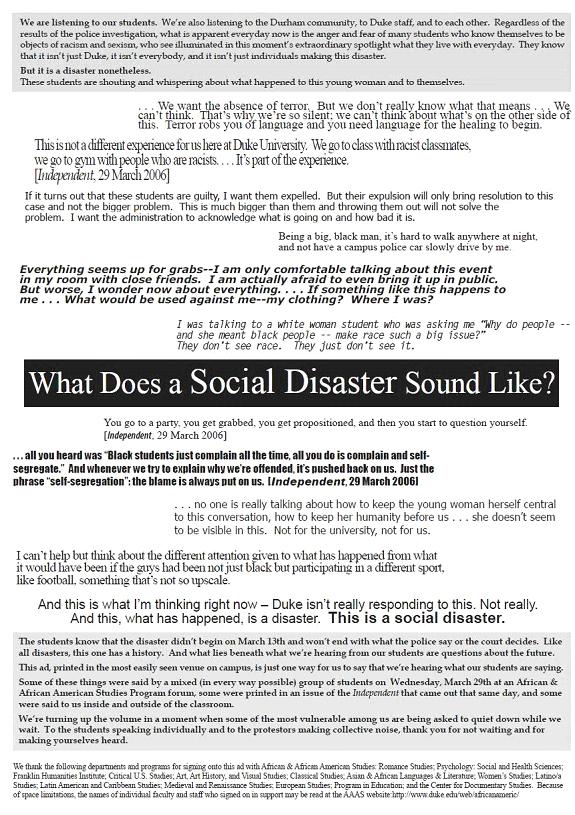
(3) What steps, if any, did the Duke administration take against either Wahneema Lubiano or the African-American Studies Department for their decision to improperly use Duke funds to pay for an ad denouncing the school’s students, and for their falsely claiming that numerous Duke departments officially endorsed the ad? If, as is widely believed, the university took no disciplinary steps on the matter, should Duke professors interpret this inaction as an implicit statement that Lubiano and her department really didn’t do anything wrong?

(4) Why didn’t Duke administrators reveal to the Coleman Committee the university’s then-secret arrangement with the city for Duke students—and only Duke students—to be prosecuted to the maximum for alcohol-related offenses?

(5) Does the university continue to stand by the Bowen/Chambers report as the best analysis for how the administration should have handled the case? If so, how can the university explain the millions of dollars in settlements and legal fees for administrators’ conduct that Bowen and Chambers ignored? If not, why did the university never elect to commission a Freeh Report-style white paper for Duke?

Somehow, I doubt any of these questions will get asked. And in the unlikely event they were asked, I can all but guarantee they would generate a non-responsive reply.

Wednesday, July 24, 2013

The Perils of Political Correctness

Two items showing the continuing failure in the academic world to learn the lessons of the lacrosse case.

The first comes from the Chesterfield (VA) Observer, which ran an article on the status of African-Americans in the sport of lacrosse. The Observer interviewed Jay Coakley, professor emeritus of sociology and sport at the University of Colorado-Colorado Springs. According to the Observer:

In the aftermath of the 2006 Duke lacrosse rape scandal, Coakley was invited to speak to a national lacrosse convention in Philadelphia. His message – that the sport desperately needed diversity – wasn’t well received. “When I gave my presentation, probably about 100 white men walked out,” Coakley recalled.

He offered up slides of photos culled from college websites, which showed a preponderance of white men playing the game. “I was accused on local talk radio of pushing political correctness and not understanding what lacrosse is all about,” he said.

The address to which Coakley referred occurred at the 2007 US Lacrosse convention, which was held January 12-14 in Philadelphia. It’s worth noting the context: by this point, disciplinary charges had been announced against Mike Nifong; Crystal Mangum’s story had been changed to claim that no actual rape had occurred; and even Richard Brodhead (though not the Group of 88) had been moved to denounce Nifong. In short, the version of events to which so many politically correct figures on campus had attached themselves had been revealed as an utter fraud. Yet Coakley’s remarks appear to have ignored the jarring transformation of the case between March 2006 and January 2007; he spoke, instead, as if all events were as commonly understood in early April 2006.

Since there was no record of Coakley’s remarks online, I e-mailed him. He graciously summarized his main points, which—to put it mildly—were stronger than the Observer article entailed. That wasn’t too surprising, since it was all but impossible to imagine that a banal call for more racial diversity in lacrosse could have triggered the mass walkout that he alleged.

A few items: (1) Ignoring any of the new developments between early April 2006 and January 2007, Coakley linked the case to a call that (paraphrased) the “sport desperately needed diversity” because it had (paraphrased) “a preponderance of white men playing the game.” (Whites were, of course, a preponderance of all college-aged men in January 2007.) Even if some sort of racial balancing in college men’s lacrosse was or is desirable, how, precisely, could this goal be linked to the Duke lacrosse case in a way that would reflect well on Coakley?

It’s true that, if the accused students were African-American rather than white, the lacrosse case would have differed. Neither Nifong nor the Group of 88 would have had any reason to have exploited the case, and therefore it likely would have never moved forward or received much campus or media attention. But suggesting that a sport having more black athletes minimizes the possibility of a local prosecutor or a school’s faculty engaging in race-baiting behavior doesn’t strike me as a  . . . progressive . . . argument.

Coakley seems to be insinuating, instead, that if more African-Americans were on the 2006 lacrosse team, the team would have treated the strippers more sensitively. That strikes me as a highly implausible conclusion.

In general, his view of events seemed then, and still seems, frozen in time, as if no additional facts about what occurred at the party came out after early April 2006. He suggested to me that racial epithets were directed at false accuser Crystal Mangum (there’s no evidence of this, since Mangum was passed out during the racially charged argument between Kim Roberts and a lacrosse player that concluded the evening) and that other lacrosse players somehow should have intervened to stop the exchange between Roberts and their teammate. But it’s not clear how they could have done so, since all accounts of the evening suggested that Roberts then immediately called the police claiming a “hate crime,” and then drove off, while the captains told the remaining handful of players to go home. Coakley’s comment about intervention only makes sense if he believes that racial epithets occurred during the party itself—yet the only figures connected to the case to ever have made such a claim were Mangum and Mike Nifong. That he still seems to view the duo as credible speaks volumes as to the biases he brings to the case.

(2) In his e-mail to me, Coakley linked his criticism of the lacrosse team in part to the hiring of strippers—an act that I, too, find distasteful. Yet it’s hard to see any connection between his critical comments about the team’s (or, more generally, lacrosse’s) racial makeup and the hiring of strippers. After all, a few weeks before the party, the majority African-American basketball team had hired strippers for a team party.

More broadly, his basic approach in the 2007 talk—on which he doubled down in his Observer interview—suggests that the hiring of the strippers, and Coakley's seemingly inaccurate view of the development of the party, was such a grave character flaw that it overcomes all that we subsequently learned about members of the lacrosse team, whether in the Coleman Committee report, or in their post-case behavior in the 2006-7 academic year. Much like the Group of 88, it’s as if, for Coakley, the team’s character is frozen in time, as of early April 2006, and nothing that came after was allowed to disturb the preconceived ideological notions that he brought to the case.

(3) In his interview with the Observer, Coakley said that he “was accused on local talk radio of pushing political correctness.” (Coakley didn’t cite which local talk radio leveled the accusation against him; it’s intriguing that he’s evidently a talk-radio listener.) In the event, at least based on what he shared with the Observer and later with me, the accusation seems to be a valid one.

It’s unclear how many people share Coakley’s perspective; in society as a whole, it’s almost certainly a minority, and perhaps a small minority indeed. On campus, however, his politically correct approach is very much mainstream—as we saw, yet again, in a recent event at Duke.

Of all the campuses in the country, it would seem as if Duke—whose students were the victims of the highest-profile rape hoax in modern American history—would bend over backwards to protect due process in sexual assault cases. The reverse was true: in 2009, the university implemented a new sexual assault definition, in which students could be found guilty of rape on the following criteria: “Real or perceived power differentials between individuals may create an unintentional atmosphere of coercion.” Why a student could be deemed a rapist based on unintentional actions that any accuser happened to perceive Duke never said, and amidst an outcry from alumni and from national groups, especially FIRE, Duke quietly dropped the new criteria in 2010.

But otherwise, a due process-unfriendly sexual assault policy remained in place—until earlier this month, when Duke announced an adjustment. Students found guilty by the university now will face a presumed penalty of expulsion. Remarked Larry Moneta to the Herald-Sun, “This is not like the measles; there’s no vaccine . . . This is a very complicated issue that is not unique to us that just requires persistence and a multi-varied approach.” Moneta did not mention the importance of due process for sexual assault allegations.

Students properly deemed rapists certainly should be expelled. Actually, of course, they should be sent to jail—but university activists tend to strongly oppose the idea of allowing the criminal justice system, rather than university bureaucracies, to address allegations of sexual assault.

In the event, the heightening of the punishment has to shine the spotlight on the procedures the university employs, since the error resulting from a procedurally flawed decision is now so much greater. Duke’s policy is for a university administrator or a hired outside investigator to examine the allegations. The investigation is almost guaranteed to be slipshod: “Allegations of sexual misconduct will be investigated in a thorough and timely manner, typically within 15 business days of receipt of a complaint.” (Imagine if the police had such a requirement, amidst a bureaucracy that’s strongly predisposed, for ideological reasons, to believe all allegations of sexual assault, as is the case at Duke and many other universities.) The accused student doesn’t have the right to be represented by outside counsel, only a “member of the university community,” and even the role of this advocate is severely restricted: “He/she may only confer quietly or through notes with the complainant and may not address the panel.” And a finding of guilt occurs at the lowest possible threshold—a preponderance of evidence, or 50.01 percent.

In explaining the new penalties, Moneta didn’t reference the lacrosse case, or explain why a campus that witnessed such an extraordinary violation of due process wouldn’t be vigilant about due process on such matters in the future. But Bob Ashley’s Herald-Sun filled the void. In an unsigned editorial celebrating Duke’s action (there’s a surprise!!), the H-S reflected in the following manner: “One legitimate debate fueled by the infamously false rape allegations against Duke lacrosse players in 2006 concerned the overall culture of gender relations on Duke and other campuses.” It’s easy to see how “legitimately false rape allegations” might have triggered a debate about why so many on Duke faculty members were willing to rush to judgment against three of the university’s male students. But somehow I doubt that’s the sort of “legitimate debate” about “gender relations” on the Duke campus that Ashley had in mind.


Beyond the rare admission from Ashley that the charges his paper so consistently framed as true were actually false, it’s as if for the H-S editor, much like Professor Coakley, events in time are frozen as of April 2006. 

Monday, July 15, 2013

The Brodhead Commission Report

That any commission, of any type, could consider Richard Brodhead as a vehicle to build public support for anything related to higher education is nothing short of astonishing. That a figure who presided over one of the highest-profile university scandals of recent years—a scandal in which his school’s humanities professors played an outsized role—would seem like a good choice to improve public backing for the humanities is almost comical.

Yet a 53-person commission of the American Academy of Arts and Sciences, which produced a lengthy report at the behest of a bipartisan groupof legislators, did just that. The Brodhead commission report is a combination of the banal with the wonderfully self-unaware. (By the way, the 53-person committee included Ken Burns; perhaps his work on the project suggests theorigins of filmmaker Burns’ . . . unusual . . . interpretation of the lacrossecase.) The commission featured not only Brodhead but several other paragons of campus political correctness, Harvard president Drew Faust, Amherst president Carolyn Martin, and Penn president Amy Guttmann.

Some of the report’s conclusions were almost caricatures of the banal. For instance, who could disagree with the following statement, which appears on page 16? “Our need for a broadly literate population is more urgent than ever. As citizens, we need to absorb an ever-growing body of information and to assess the sources of that information. As workers, we need to adapt to an ever-accelerating rate of technological change and to reflect on the implications of these changes. As members of a global community, we need to look beyond our borders to communicate and interact with individuals from societies and cultures different from our own. As a nation, we need to provide an educational foundation for our future stability and prosperity— drawing on all areas of knowledge.”

Or consider this item, from the study’s acknowledgements: the report “identifies three overarching goals: 1) to educate Americans in the knowledge, skills, and understanding they will need to thrive in a twenty-first-century democracy; 2) to foster a society that is innovative, competitive, and strong; and 3) to equip the nation for leadership in an interconnected world. These goals cannot be achieved by science alone.” Do those who oppose the study’s recommendations favor a society that is luddite, uncompetitive, and weak?

The report also champions such public policy goals as strengthening support for teachers, enhancing access to material available online, supporting study abroad programs, boosting funding for NEH, and promoting the learning of foreign languages. Of course, all of these proposals (each of which seems to me an excellent idea) take money, and the Brodhead commission doesn’t quite explain how or why more tax revenue will find its way into higher education.

And there’s one funding-related question that the Brodhead commission dare not touch. We live in a society that’s deeply polarized along ideological and partisan lines. And yet the humanities skews—wildly—in one direction, to such an extent that it seems almost certain that today the ideological median of humanities professors is further away from the ideological median of society at large than at any other point in American history. Is it possible—just possible—that this ideological chasm, a general sense among most politicians that today’s humanities departments aren’t exactly the most intellectually diverse entities around, has caused a reluctance to fund? The Brodhead commission doesn’t ask that question—perhaps because it doesn’t want to know the answer.

In at least three other respects, the commission is almost blissfully self-unaware in its commentary. First, the commission expresses grave concern about the state of affairs in high school history and social studies instruction. We need more high school civics classes, the report declares, and the quality of teacher preparation is dangerously low.  The report (p. 19) foresees “grave consequences for the nation” that “humanities teachers, particularly in k-12 history, are less well-trained than teachers in other subject areas.”

It’s not hard, however, to detect at least one importance reason for this problem. Public school curricula continue to be set by state boards of education—which are responsible to the public, and which generally mandate curricula that would be deemed somewhat “traditional.” Students in high school history classes are supposed to learn about, among other things, Presidents, and wars, and key court decisions, and major elections.

Yet Brodhead and the many other college presidents who were part of the commission have presided over universities that have emphasized “diversity” and the hiring of specialists in areas related to race, class, or gender over the study of more traditional aspects of the American past. I most recently discussed this issue in a multi-part series at Minding the Campus. As a result, most public school teachers can go through college and M.A. programs with little—or in the case of U.S. military or constitutional history, almost certainly no—exposure to specialists in the fields that they then have to teach to the nation’s public school students.

And so the report urges an expansion of “education in international affairs” (p. 12)—without mentioning the massive decline in the past generation in faculty positions devoted to U.S. diplomatic or military history, the result of hiring decisions that these very same presidents (or their predecessors) have ultimately approved.

The nation’s founders, the report intones (p. 15), understood that the country’s well-being depended on citizens who “understand their own history,” and it’s particularly important to study “jurisprudence.” Yet the report makes no mention that the field of U.S. constitutional history has been all but eliminated in the nation’s history departments, the result of hiring decisions that these very same presidents (or their predecessors) have ultimately approved.

Indeed, virtually the only high-profile president in recent years who was concerned about such matters was Harvard’s Larry Summers. And he was deposed via a faculty revolt.

Second, the commission’s report veers into territory that it would seem to want to avoid—in that it calls into question the ideological imbalances in the contemporary academy. For instance, on page 10, the report asserts that “humanists and social scientists are critical in providing cultural, historical, and ethical expertise and empirical analysis to efforts that address issues such as the provision of clean air and water, food, health, energy, and universal education.”

Health, environmental, and energy policies are among the most contentious in our current political climate. What incentive would GOP legislators or conservative donors—two groups ostensibly targeted by the report—have to boost humanities funding if the result is increased attention to policy proposals where 90 percent or more of today’s humanities professors are on the other side from the targeted funders? I find it hard to believe, for instance, that this line of argument would persuade the Kochs that it’s a good idea for them to start making more donations to college humanities programs.

Finally, the commission itself was blissfully self-unaware in allowing Brodhead to function as its public face. In its section analyzing the problems facing higher education, the report’s first footnote is none other than an item from Brodhead, entitled, “Rebuilding the Public’s Confidence in Higher Ed.” This would be the same Brodhead whose highest-profile off-campus appearance came in a widely-panned 60 Minutes appearance in which he tried, in vain, to defend his university’s rush to judgment in the lacrosse case. Or whose highest-profile off-campus reputation dealing with the humanities came in his presiding over a school that had dozens of humanities professors sign a public declaration affirming that something had “happened” to false accuser Crystal Mangum, and thanking protesters who had urged among other things the castration of the lacrosse captains.

The Brodhead commission report seeks to build off-campus support for the humanities—from legislators, from donors, and ultimately from the public. Yet Brodhead’s record in the lacrosse case is merely a click away for any of these target audiences. Could the commission not have found someone less compromised than Brodhead to serve as its public face?


The commission’s selection of the Duke president as its member most likely to persuade legislators or the public would be a little like trying to persuade a gay rights group by turning to a high-ranking figure in the Catholic Church; or seeking to solicit financial contributions from a mining organization by soliciting a report penned by a prominent Sierra Club lobbyist. After his performance in the lacrosse case, why should any public official accept Richard Brodhead’s advice about anything?

Wednesday, June 19, 2013

Astonishing

The liberal arts are “endangered,” according to a new report. The New York Times describes the document’s high profile: “Requested by a bipartisan group of legislators and scheduled to be distributed to every member of Congress, it is intended as a rallying cry against the entrenched idea that the humanities and social sciences are luxuries that employment-minded students can ill afford.

And who was the co-chairman of the commission that produced the report? None other than . . . Richard Brodhead.

In what other profession would a figure as utterly discredited by his actions—at least to anyone outside the profession—as Brodhead then be tasked with writing a major policy document justifying the existence of a key portion of that same profession?

Perhaps, it might be surmised, a reason why the liberal arts are “endangered” is that they embody a profession in which accountability seems like a dirty word.

Monday, February 11, 2013

Campus News

A few items from Duke and other campuses:

First, a horrifying story of anti-Asian prejudice from a Duke fraternity (followed, a few days later, by reports that at least some Duke students—there are debates about how many—were mocking a NC State basketball player over his grandmother’s death). These are not signs of a healthy campus culture.

The recent events recalled an item from UPI, revealed by Stuart’s reporting—that in the 2005-6 academic year, around 20 student groups hired strippers for campus parties. That well-meaning and basically decent students could make such poor choices provided a legitimate ground for the university to launch an impartial examination of campus culture. So, too, did the issue of whether prejudice was too rooted on the Duke campus.

But examining these issues would have required shining a harsh light on not merely Duke students but also some Duke faculty—it would be hard to argue that prejudice did not factor into the behavior of at least some of the Group of 88, such as Houston Baker, Wahneema Lubiano, and Grant Farred. So the Brodhead administration avoided these difficult issues and instead implemented the Campus Culture Initiative, allowing three of the CCI’s four subcommittees to be run by anti-lacrosse extremists. The CCI unsurprisingly produced a report so extreme (urging that Duke adjust its scheduling policies to basically force the university to withdraw from the ACC, recommending a curricular change that would have compelled the vast majority of Duke undergrads to take a course from a Group member) that even Brodhead had no choice but to shelve the panel’s findings.

Duke has suspended the anti-Asian fraternity, allegedly for reasons unrelated to the prejudicial behavior.

Second, at Penn State, the Paterno Family has released its long-awaited critique of the Freeh Report. I analyzed the document over at Minding the Campus. The report provides almost no new evidence, continues the general pro-Paterno pattern of insisting on wildly counterintuitive interpretations of circumstantial evidence, and presents several odd interpretations of due process. On the latter point, for instance, the Paterno Family attacks Freeh’s investigators for not interviewing two senior administrators (Freeh instead relied on contemporaneous e-mails from the duo) who declined to cooperate with Freeh on advice of counsel. Yet the Paterno Family’s hired attorneys and experts didn’t interview the two senior administrators, either.

In the event, so obsessed was the family with restoring Paterno’s tarnished reputation that they bequeathed a report that effectively left unchallenged Freeh’s central assertion that a handful of powerful administrators cooperated to bypass the legal requirement to report Sandusky to police—only that Paterno (a figure, apparently, without much power or influence on campus) played no role in these decisions.

It’s a document for true believers, and true believers only.

Finally, on my own campus, a shameful episode, in which the school’s political department formally (and highly unusually) voted to affiliate itself with a talk by two advocates of separating Israeli from the international community, including boycotting Israeli academics based on their nationality. Then, facing intense public criticism, the professors refused to provide a rationale for their vote. (This vision of academic freedom amounted to an accused criminal pleading the 5th amendment.) When the event occurred, a handful of anti-BDS students were expelled from the proceeding, despite the college president’s invitation to critics of the talk to attend and ask questions.

The college’s apparent disinterest in the academic freedom of its students reinforced an impression that a fear of antagonizing powerful anti-Israel forces on campus guided the administration’s approach to the case.

Hat tip—R.L.

Friday, July 20, 2012

Updates

A couple of updates:

Stuart Taylor and I had an op-ed in yesterday’s Wall Street Journal, examining the . . . considerable gap between how Penn State responded to the scandal of the Spanier/Paterno cover-up and how Duke’s trustees and administration responded to their lacrosse case failures.

The op-ed focuses on the (almost comical, in retrospect) conclusions of the Bowen/Chambers report—for background, you can see here and here.

The H-S reports that next week, the State Bar will send a letter admonishing pro-Nifong crank Sydney Harr to cease practicing law in his attempt to represent false accuser and accused murderer Crystal Mangum.

The article’s most interesting comment, however, came from Woody Vann, Mangum’s attorney. During the lacrosse case, Vann distinguished himself as one of the fiercest of Nifong enablers. Even as Nifong moved toward disbarment, Vann told the AP, "Nobody knows anything about the previous 28 years. The cases he's tried and won, and the cases he's tried well and won."

Now, however, Vann has changed his tune: “I’m the first one to say I don’t think it’s good for my client to have her name in the same paragraph with … anyone who is a member of the Committee for Justice for Nifong. All that does is tie their names together and dredge up memories of 2006 and 2007 and that’s not what we’re dealing with.”

Thursday, July 12, 2012

Duke's Version of Freeh (Updated)

[Update, 18 July, 8.38am: The Chronicle of Higher Education interviews, among others, John Burness about the Freeh Report. In his remarks, Burness essentially praises Penn State for doing what Duke did not do:
"They wouldn't have been able to put this behind them for the next several years if they hadn't gone about doing this the way they've done it—getting someone like Judge Freeh, whose character is pretty unassailable and who was given carte blanche to see what he found and report it without fear or favor," said John F. Burness, a visiting professor of public policy at Duke University and the university's spokesman during the 2007 lacrosse scandal. 
"There is some very bad news in here for Penn State and Coach Paterno and a lot of the leadership of Penn State," he said. "But this is a really critical inflection point for the institution because it is one of the thresholds they had to get through. As difficult as it will be, it was necessary to restore confidence in the integrity of the institution."]
I have a post over at Minding the Campus examining the Freeh Report—and what the document says about the continuing need for oversight by trustees. In short, at Penn State, the trustees failed in their fiduciary duties, and the university will now pay the price. The report describes a top-to-bottom failure in the Penn State administration—from the former president, to the former AD, to the former football coach, and back up again to current and former trustees.

At the very least, however, Penn State deserves credit for critically examining where and how the administration went wrong, and for trying to change a culture that both enabled and contributed to these administrative failures. And it’s hard to criticize the research behind the Freeh Report, which pored through e-mails, other university documents, transcripts of interviews, and publicly-available information from the criminal investigations. Any university that is attempting to move beyond errors would do well to look at the Freeh Report as a model.

For anyone who closely, or even not-so-closely, followed the lacrosse case, the flip-side of the Freeh Report is obvious. Though Duke steadfastly refused to publish a White Paper or even establish a Coleman Committee-like investigation of why and how the administration and “activist” faculty got the lacrosse case so wrong, there was—technically, at least—a Duke version of the Freeh Committee.

In his guilt-presuming April 5, 2006 letter (the document in which he dropped all reference to a presumption of innocence, and merely asked the Duke community to “wait until the authorities act before reaching any judgment in the criminal case”), President Brodhead announced anInvestigation of [the] Duke Administration Response.” He hoped, in part, “to address the concern that my administration did not respond as quickly as we should have and to learn any lessons this episode can teach.” The rush-to-judgment crowd that needed appeasing were unnamed “faculty, students, community members, and others.” While the identity of the “others” is unclear, it seems the remaining figures were either members of the Group of 88 or their student supporters.

To fulfill the role of Louis Freeh in the Penn State case, Brodhead chose former Princeton president and prominent affirmative action-defender William Bowen and former NCCU chancellor Julius Chambers; the duo added a third member, Danielle Carr Ramdath, who they helpfully  identified as an “African-American woman.” While the three admitted they didn’t have enough time to actually conduct a full-fledged inquiry, they nonetheless claimed that they “gained an understanding of the principal issues.”

Departing from the Freeh investigative approach, the Bowen/Chambers report gave no indication of examining internal Duke e-mails to get a sense of how and why the administration responded as it did. (Bowen and Chambers—Carr Ramdath, for reasons that are not clear, did not sign the report—never explained how they could investigate the “Duke administration response” without examining what would be the most relevant evidence to determine that response.) And the report gave no sign of the massive legal liability that Duke ultimately would face—the reported eight-figure settlement with the falsely-accused players, the legal bills piled up in defending the lawsuit from the unindicted players, the settlement with former coach Mike Pressler. Indeed, a reader of the Bowen/Chambers report—which faulted Duke largely for an insufficient commitment to diversity in its hiring process—would have been utterly mystified to ultimately learn that this “administration response” that the duo supposedly investigated had exposed the university to legal liability.

The Freeh Report is a long and difficult read. But for those with the time, compare it to the Bowen/Chambers report, to which I’ve linked in its totality. Which of the two constitutes an investigation, and which constitutes a whitewash?

Thursday, May 10, 2012

Dean McClain

[Update, Saturday, 5.57pm: And, in a further aspect of the annals of non-accountability: Duke has just extended Richard Brodhead's contract for five years. In a statement, the trustees praised Brodhead's "inspired leadership." The statement speaks for itself.]


As noted many times before, a major theme of this blog has been the utter lack of accountability for the faculty members and academic administrators whose behavior in the lacrosse case failed to meet even the minimal ethical standards that a world-class university should expect of its faculty. Duke provided yet another reminder of the pattern earlier this week, when it named Group of 88'er Paula McClain--yes, that Paula McClain--as dean of the university's Graduate School and vice provost for graduate education.


In announcing yet the latest Group member to receive a promotion, President Brodhead hailed McClain as an "outstanding university citizen." And he singled out for particular praise "her concern for the well-being of individual students."


That's a very interesting description of McClain, who in 2006-7 displayed an utter indifference to the well-being of dozens of Duke students.
  • In April 2006, she signed a statement that prejudged a criminal case against Duke students, affirming that something "happened" to false accuser Crystal Mangum, and that she would continue to protest the issue regardless of what the police or court decided.
  • The next month, in an interview with espn.com, McClain rationalized Nifong's pre-primary publicity crusade (which ultimately contributed to his disbarment), absurdly claiming, “Whether what he’s done has made it more political? . . . This would have been political, regardless.”
  • In summer 2006, McClain (apparently expressing "her concern for the well-being of individual students") issued a one-word response--"No"--when a DIW reader asked her whether she'd be willing to issue a statement on behalf of the falsely accused students, even to the extent to demanding that they receive fair treatment by Nifong.
  • A few months later, in perhaps  another expression of "her concern for the well-being of individual students,"  this time for Duke student-athletes, McClain termed herself "aghast" at a common-sense proposal to improve coordination between professors and coaches. She also openly mocked a sophomoric spoof of the proposal.  As Sports Law Blog tartly observed at the time “Apparently, Professor McClain--who is co-director of Duke's Center for the Study of Race, Ethnicity, and Gender in the Social Sciences--believes that in the aftermath of the Duke lacrosse scandal, the University needs to distance itself from its sports teams, rather than embrace them."
  • In 2007, in what  was perhaps another expression of "her concern for the well-being of individual students," McClain responded with defiance to the legal settlement between Duke and the falsely accused players--a settlement in which Duke shielded the faculty from any lawsuits filed by the falsely accused students.
This is the record of Duke's new graduate dean, an "outstanding university citizen" who has demonstrated "her concern for the well-being of individual students."


I'm sure McClain's appointment has nothing to do with Brodhead's recent remarks in which he profoundly apologized for not appointing more women and/or minorities to upper-level administrative posts--even as he, a white male, refused to resign to allow the Duke trustees to appoint a female or minority president.

Saturday, March 31, 2012

"Politic$ of Grievance" Pricetag: $13K

This decision should come as no surprise, but nonetheless is appalling. The Chronicle: "Rather than engaging in an inclusive dialogue and drawing input from across campus on a sensitive issue, the administration seemingly capitulated to a set of demands without really explaining why."

At Duke, on "diversity" issues, no explanation is necessary.

Thursday, March 22, 2012

Brodhead's Extraordinary Address

[Update, Friday, 12.45pm: On his own blog, Peter Arcidiacono has responded to Brodhead; I urge people to read the post in full.

Arcidiacono observes that the kind of research Brodhead specifically criticized--"analyzing average differences in choices across demographic groups--race included"--is "standard practice not just in economics but in all quantitative social sciences," and therefore "to suggest that this is insulting disparages the quantitative social sciences as a whole."

Brodhead obviously knows this: indeed, this type of social science research, in a less detailed form than what exists in the academy today, provided the underpinning for many of the civil rights decisions in the 1950s, 1960s, and 1970s. The only possible inference, therefore, to take from Brodhead's criticism is that at least on issues of race, this research strategy is acceptable only when it yields results that conform to the beliefs of the campus majority.

Arcidiacono adds some personal context which makes Brodhead's behavior even more troubling: "This squashing of divergent ideas also shows up in the administration's lack of defense of the study beyond issues of academic freedom and, more importantly, in the administration's lack of a substantive conversation with either myself or my co-authors. Personally, the latter is what I have found most disturbing about the whole controversy. As I have repeatedly made clear, I am happy to talk with anyone who has concerns about my work. I was disappointed when the Black Student Alliance (BSA) chose to go directly to the press rather than engage in a discussion with me--the called-for forum has not happened. But these are undergraduates. This is the president of the university. To publicly disparage my work without engaging in a conversation with me is not something I would have expected from Brodhead. To top it off, the speech alludes to administrators working on the issues raised in the paper with the BSA and yet there still have been no substantive discussions of the issues with the authors. Thank you God for tenure."]

As a university in the South—and as a university also associated in the past with the upper class—Duke contributed to the Jim Crow system that governed the region (de jure and for some time thereafter de facto) for much of the 20th century. Duke’s greatest president, Terry Sanford, courageously and forcefully confronted the legacy of this past.

Sanford resigned the Duke presidency in 1985 to launch a successful bid for the U.S. Senate. In the last quarter century, Duke—like virtually every elite university in the nation—has aggressively utilized racial preferences in admissions, while just as aggressively seeking certain types of “diversity” in faculty hires. Racial tensions doubtless remain at Duke and at all elite universities; entirely eliminating racism (or sexism or homophobia or ethnic/religious biases) is impossible. But there are few if any employers or institutions anywhere in U.S. society more “anti-racist,” to use the politically correct term, than Duke and the nation’s other elite universities.

Moreover, during the administration of President Richard Brodhead (2005-), the university’s most significant racially-oriented episode involved not racism toward African-American students or professors but a racially-charged crusade directed by members of the school’s African-American Studies Department against a group of falsely accused white Duke students. Apart from a single statement from Provost Peter Lange rebuking an outright racist screed from then-Duke professor Houston Baker—and a vague, tardy, and ultimately toothless apology from Brodhead—there’s no evidence that anyone from Duke’s administration ever addressed this faculty behavior, or ever rebuked those Duke professors whose private biases led them to ignore their obligations to their own institution’s students.

-------------

In his March 22 address to the faculty, Brodhead chose to speak about “the issue of race and inclusion in Duke's history, our recent progress, and the nature of the work that lies ahead.”

Those expecting that the choice of this theme meant that Brodhead would critically self-examine his and his administration’s failure to address the shortcomings exposed by the lacrosse case would be sorely disappointed. The race-baiting of spring 2006 wasn’t mentioned, perhaps because doing so would have forced Brodhead to ask uncomfortable questions about how so many Duke faculty members had addressed “the issue of race and inclusion in Duke’s [recent] history.” It would, for instance, have been very difficult for the president to have reconciled his Faculty Address boast that “this university has had a commitment to making Duke a place of access, opportunity and mutual respect for all” [emphasis added] with the conduct of the Group of 88 (or sympathetic faculty such as Orin Starn, Peter Wood, and Tim Tyson) during the lacrosse case.

Nor did the president display any willingness to consider whether the use of racial preferences in admissions or the obsessive emphasis on certain types of “diversity” in faculty hiring remain tactically wise or morally acceptable in the 21st century world. Once again, the posing of uncomfortable questions was not on Brodhead’s agenda, especially if asking such questions might trigger a faculty revolt.

Instead, the president offered a reflexive defense of “diversity” policies as they have been practiced at Duke (and other elite universities) over the past generation. No surprises there. But the stated motivation for his remarks did raise eyebrows. He selected his topic, he claimed, because of three recent events, the first of which was the “controversy over a piece of unpublished faculty research that appeared to disparage the choice of majors by African-American undergraduates.”

Brodhead thus joined Provost Lange and a host of other senior administrators in publicly criticizing (and in the president’s case, willfully misinterpreting) a piece of research from Duke two professors, Peter Arcidiacono and Kenneth Spenner; and Esteban Aucejo, a Duke graduate student. That paper, as I noted before, used Duke’s own data to show how African-American students (whose admissions test scores were far lower than those of whites or Asian-Americans who enrolled at the university) disproportionately migrated, after arriving at Duke, from majors (the hard sciences, engineering) widely considered as more challenging. As with virtually all other critics of the Arcidiacono, et al., paper, Brodhead did not challenge any of the paper’s data.

Brodhead’s discussion of the paper was nothing short of stunning. After an almost apologetic defense of the principle of academic freedom as applied to faculty research, the president all but seethed with rage when discussing the paper: “I can see why students took offense at what was reported of a professor's work. Generalizations about academic choices by racial category can renew the primal insult of the world we are trying to leave behind—the implication that persons can be known through a group identity that associates them with inferior powers. A further insult was that the paper had been included in an amicus brief submitted by opponents of affirmative action urging the Supreme Court to hear the case I mentioned earlier regarding admissions policies at the University of Texas.”

The last sentence is, perhaps, the most extraordinary of Brodhead’s entire address, and, indeed, one of the most extraordinary statements I have ever seen a university president make. The president of a major research university, in a formal address to his university’s faculty, expressed regret—deeming it an “insult”—that research from his own university’s faculty (research whose accuracy he did not challenge) was included in an amicus brief for a critical case before the Supreme Court.

So much for the idea that a central purpose of a research university is the dissemination of knowledge in pursuit of the truth. The president’s message could not have been clearer: those who dare to pursue research that challenges the (campus) majority’s agenda on race can expect a public shaming—regardless of whether the data those researchers uncover is accurate or fairly presented.

Brodhead concluded his address on a more personal level. “The single front,” said he, “where I myself feel the greatest frustration regards senior leadership positions at Duke.” He noted that among his eight senior administration appointments, he had named two African-Americans, one Asian-American, and one woman. But, he lamented, “the number of women on my team . . . is fewer than I would wish.” And he offered his awareness that “including African Americans in the top academic leadership of this university is a piece of unfinished business.”

If Brodhead’s personal pain about the insufficient “diversity” in the upper ranks of Duke’s administration is as genuine as his Faculty Address rhetoric suggests, an immediate step to address the issue is available to him: He could, today, submit his resignation as Duke president. That move would give Duke’s trustees the opportunity to bring more “diversity” to the school by replacing him with a female or minority leader for the university.

But I strongly suspect that Brodhead’s personal commitment to “diversity” doesn’t quite extend that far. Publicly sliming two members of his faculty is, it seems, so much more satisfying.

Sunday, December 18, 2011

A Few Updates

[Update, Tuesday, 11.51am: The N&O reports that in an unpublished decision, a three-judge panel of the state Court of Appeals has upheld the conviction of Angel Richardson, even though DA Cline didn't turn over to the defense a statement that someone else claimed he had committed the killing until the trial was already underway.

In a remarkable piece of legal reasoning, the panel conceded that the evidence was exculpatory, and acknowledged that the Supreme Court's Brady standard (as well as, of course, North Carolina's seemingly toothless open file discovery law) requires turning over exculpatory material to the defense, but that there's nothing wrong with "the disclosure of evidence at trial, so long as disclosure is made in time for the defendant to make effective use of the evidence."]

A few updates on legal matters from Durham:

False accuser Crystal Mangum has been deemed mentally competent to stand trial for murder. Such a finding, it seems to me, best illustrates how low the bar for competency actually is—if Mangum isn’t seen as mentally imbalanced under the law, it’s hard to see who would be.

That said, the false accuser still has her defenders. Mangum co-author Vincent “Ed” Clark recently offered the following:

"The one thing I would want to add to this is that the story has been reported all wrong from the beginning . . . The narrative that Crystal lied about what happened that night is not true either. I was involved in the case from nearly the start. There are so many things that people don't know . . . the Duke case got used by a lot of people to score points in North Carolina . . . Unfortunately, reporter[s] and the general public are too lazy to do the work it takes to tell the real story. If you could just see, read or hear any of the interviews Crystal did with major media like NBC, CNN and the Daily Beast, you would have a completely different impression of what went on. Unfortunately, the attorneys for the players were very affective [sic] in killing any interviews Crystal did that made her look favorable . . . What I can tell you is that Crystal didn't make up being hurt. There were problems with the case but it didn't have anything to do with the information she provided . . . attorneys for the players[:] Many of them wereon the OJ [Brad Bannon as Johnnie Cochran??], Michael Vick and other similar cases . . . Racists [sic] idiots have no idea that the poor white boys in the case are and their parents have strong connections to the very media the hate[??]. The stress and lack of support for our own community really hurt Crystal. She has struggled to try and have a normal life but can't. Those clowns have hounded her for over five years. It has been said and unnecessary."

It’s worth pointing out: (1) none of the lacrosse players sued Mangum, as they obviously would have done if they had desired to “hound” her; (2) even the Queen of Bias, former SANE-nurse-in-training Tara Levicy, didn’t find any evidence that Mangum was “hurt”; (3) if the lacrosse players’ families had such strong connections to the media, how to explain the guilt-presuming media barrage in the early stages of the case?; (4) given that Mangum went on record with her rape-by-levitation theory, it’s hard to argue that anyone could deem any of her interviews credible.

But such comments offer a sense of the continuing reputational harm to the lacrosse players caused by Mangum’s false accusations and the Nifong/DPD misconduct.

--------------------
The ethically challenged Tracey Cline remains Durham County’s chief prosecutor, even though her behavior prompted this extraordinary in-court remark from her former boss, now-Judge Jim Hardin: “In respect to motions in this court, and any others, please ensure they are factual . . . Consider this a warning and a public admonition as to that.”

That said: despite the public admonition, Hardin allowed Cline to “withdraw” her motions asking for prison-visitor records, apparently as part of an attempt to dig for evidence to prove her wild claims of a “conspiracy” against her. And Hardin chose leniency even though, as Andrew Curliss noted, “Cline offered explanations for why she sought the documents that do not match up with records requests made by her office's investigator or in the motions she presented to Hardin."

Meanwhile, the N&O is reporting that a Durham attorney, Scott Cooper, has organized a grassroots legal campaign to remove Cline from office—as the State Bar has requested between 800 and 900 pages of files from five of Cline’s cases.

--------------------

Duke has filed a follow-up motion as the university continues its efforts to conceal as much as possible regarding its spring 2006 decisionmaking process. In the McFadyen lawsuit, attorney Bob Ekstrand requested material from the two public relations firms retained by Duke to craft the university’s public response to the lacrosse case. The requested material included items of considerable interest to any student of the case:

  • Burson-Marsteller’s public relations advice and communications with Duke University, its administrators, officials, employees, alumni, board members, regarding both “on” and “off-the record” statements to members of the press;

  • Duke University’s actions on April 5, 2006, including but not limited to […] the firing of former Head Coach Mike Pressler, President Brodhead’s television interviews, President Brodhead’s Letter to the Community, setting up a committee to examine the culture of the lacrosse team, setting up a committee to investigate the Duke administration and/or the decision to create any of the 5 committees announced by President Brodhead on April 5, 2006.
In a sometimes overheated reply, Duke’s attorneys described the subpoenas as an attempt to “harass the Duke Defendants” by prying into “confidential commercial information.” Somehow, I doubt that in future letters to prospective donors, Duke will describe itself as a commercial institution.

In the event, I suspect Judge Beaty will side with Duke on this matter—but his reasoning will be intriguing.

------------------

Finally, an issue unrelated to the specifics of the lacrosse case but one that touches upon some of the themes of the case.

A few days ago, the Suffolk (MA) County DA dropped all charges against New England Patriots wide receiver Julian Edelman, who had been accused of indecent assault by a woman he allegedly groped at a Halloween Party. Early press coverage, especially from the tabloid-ish Boston Herald, presumed if not guilt at the least a demonstration of extremely poor character.

When the charges were dropped, the DA’s office also released a video of the alleged “assault,” which the accompanying press release conceded showed what was, at most, “fleeting” contact between Edelman and the accuser—who neither the Globe nor the Herald deigned to name.

Perhaps, as occurred initially when the New York Times refused to identify Mangum after the exoneration, the papers didn’t want to do anything that might deter false-grope accusers from coming forward in the future.