Thursday, February 23, 2012

Cline Hearing

Update, 4.54pm: The hearing has now come to a close. The judge says there will be no meeting tomorrow; Wednesday will have closing arguments; and the case might be decided by Friday.

Update, 4.23pm: Now on the stand, as a pro-Cline character witness, is Judge Marsha Morey. This is the same Judge Morey who served in his ethics hearing as a character witness for Mike Nifong, about whom she said, on 15 June 2007, "I have never doubted his truthfulness."

And she also had this exchange:
Q: Is it your testimony that Mike Nifong currently enjoys a reputation for truthfulness?
A: I think he does.
I'd say that Judge Morey was a particularly appropriate witness on behalf of DA Cline.

Update, 3.22pm: Cline might have just lost any chance to get hired by a Group of 88-dominated department if she's removed from her position: she suggested that people can claim racism when it's not there, and in so doing can disturb efforts to combat real racism.

That answer, alas, came as part of a give & take in which Cline refused to back down on any of the specific words she used in her anti-Hudson motions.

Update, 3.14pm: Cline continues to insist that everything in all of her filings is true, and says that she has no regrets about her decision to file complaints against Hudson.

The hearing continues:


Update, 1.22pm: From the N&O's coverage:
Cline insisted this morning that she was unfairly criticized by the News & Observer, repeating complaints she has lodged for months despite evidence that she is wrong in her assertions.

"I’m not saying I disagree with them. I’m saying they were false," Cline said. The N&O stands by its reports.

Editors at the N&O refuted Cline's assertions that it failed to report the district attorney's office provided rough notes from the SBI in a case that has since been dismissed. Last summer, Cline backed down from that after being shown the exact passage in the article that details that information. Use the controls on the right side of this page to listen to audio of that interview.

This morning, Cline again asserts that the N&O left out that piece of information.

Cline also refused to back down from assertions that N&O reporter J. Andrew Curliss was held in contempt of court in the Allen matter, even though an assistant clerk testified last week that there's no evidence of that anywhere in the court file or in the database of criminal charges.

Cline admitted she never checked the file to look for any contempt filings for Curliss. Still, she insists he was charged.


Update, 1.00pm: Cline is now saying that when she attacked Hudson's rulings for raping the community, she wasn't personally attacking Judge Hudson. She adds that she has "stacks and stacks of e-mails" to corroborate her claims. The proceedings are in recess until 2.30pm.

Update, 12.50pm: Cline seems wholly incapable of giving direct answers to simple questions. By the time she gets to the end of most of her responses, no one in the courtroom seems to remember what question was asked.

Update, 12.30pm: After repeatedly accusing Judge Hudson of improperly holding ex parte communications with defense attorneys, Cline has just admitted that she held an ex parte communication with Judge Hudson about the Allen case. But she says she didn't go to the meeting as a "prosecutor."

Update, 12.12pm: Cline is now doubling down regarding her allegations (ultimately disproved by the N&O, based on a broken time-stamp clock) that Hudson filed an order before all the evidence came in. On Friday, the clerk's office employees testified that the time-stamp clock was broken. Cline says she doesn't know if the clerks were telling the truth.

Update, 11.36am: Cline is currently being called upon her . . . incomplete . . . answers on Friday. Her general approach thus far has been to filibuster rather than offer answers, and to assert that it was "impossible" for her to remember every motion that was filed in the cases under discussion. This is an extraordinary line of defense--she's justified in lying on grounds of her not remembering whether motions have been filed.

Cline also has made a bizarre claim that she didn't go through the relevant court files to prepare for this hearing. In other words: in a hearing to decide whether she should be able to keep her job, Cline couldn't be bothered to actually research the cases under dispute.

The link to today's hearing is: .
Update, 8.59pm: Coverage of the hearing from the N&O and the H-S.

Update, 4.34pm: Cline has concluded her direct testimony; cross-examination will begin Monday morning at 9.30am. She maintains she did nothing wrong other than use some intemperate language about Hudson's behavior in her motion.

Update, 4.21pm: Cline is now complaining that Judge Hudson was pursuing a vendetta against the DA's office by refusing to schedule cases from the office. She's also suggesting that she had no choice in upholding justice but to file her complaint.

Update, 3.23pm: Cline seems unable to give a 1-minute, concise answer when a rambling 15-minute response will do. She did just say, however, that she wished that her "words had been chosen better" in her anti-Hudson motions, although she continued that she was "morally" obligated to act as she did; and that the content of her motions was "absolutely true."

Update, 3.06pm: Cline is now giving a lengthy, borderline-incoherent, response to the N&O series. She said she wanted to "explain the mental processes I was going through."

Update, 2.45: Cline now is arguing that there was no evidence for Hudson's claims that the DA's office didn't turn over all exculpatory evidence. Her basis for this claim? She says so.

Update, 2.22pm: Cline just resurrected the Mike Nifong line of defense on DNA! (She suggested that negative tests don't necessary mean a negative result.) She also is defending her bizarre town hall meeting, and has now returned to railing against the N&O.

Update, 2.20pm: Cline is now complaining about the N&O series. In what seems an almost certain untruth, she just stated that she hadn't anything heard about the various cases discussed in the Twisted Truth series for several weeks before the articles appeared. Yet the N&O reached out to her for comment at the time.

Update, 12.43pm: The hearing is now on mid-day recess. The Cline defense strategy appears to be that Judge Hudson's order in the Allen case was wrong, and the errors in the order explain (excuse?) Cline's subsequent overheated responses. As I said earlier, this is a curious line of defense, but perhaps it's the best that Cline has.

Update, 11.00am: The live-stream of the hearing is below; to date, Cline has failed to get the hearing suspended; and currently her attorneys are going through, in painstaking details, the specifics of Judge Hudson's order in the Allen case, challenging it here and there. This is a most curious line of defense.

In an even more curious development, Judge Hobgood is allowing DA Cline (a figure whose grasp of the truth is a bit of a stretch) to allow what she claims that Judge Hudson told her in various conversations.


Suspended Durham DA Tracey Cline gets to defend her record tomorrow before Judge Hobgood. I'll post a link to the hearing when it becomes available, and will have commentary on the proceedings here.

In the meantime, this blast from the past ("David Saacks and the Unethical Duo"), courtesy of the Mike Nifong 2006 website.


Saturday, February 18, 2012

Legal Updates

Cline hearing: While things haven't gone particularly well for the emotionally unstable suspended DA, Kerry Sutton's interrogation style doesn't exactly set the world on fire, either. (At one point, Judge Hobgood said that Sutton's line of questioning--on the inaccurate timestamp machine--didn't "amount to a hill of beans."):

A few legal updates:

Both the Carrington and McFadyen attorneys had additional recent filings. Though they contained nothing as explosive as Brodhead’s implicit comparison of the falsely accused lacrosse players to a sociopath who murdered a corrupt cleric, they offered more reasons why Duke shouldn’t want this case to go to trial.

The Carrington filing, which blasts “Duke’s hyper-compartmentalized approach to relevance,” offers a glimpse into the unindicted players’ litigation strategy. (Duke is trying to prevent virtually all discovery related to the university’s p.r. strategy.) The attorneys want to “establish what (and when) President Brodhead knew about the credibility of the rape allegations,” expecting “information about Duke’s public relations strategy to reveal a fixation on the institution’s public image that eclipsed any interest the university may otherwise have had in vindicating the reputations of its wrongly accused students.”

In particular, Duke has sought to block all inquiries into whether and when senior administrators were informed about the (lack of) evidence relating to false accuser Crystal Mangum’s claims. Why is this relevant? “If Duke continued to undermine Plaintiffs after learning the negative results of Mangum’s rape kit, that information would suggest that Duke’s efforts to bolster Mangum’s allegations were driven by its desire to salvage its own reputation.”

If I were a Duke attorney, I too would do whatever I could to avoid scrutiny as to who came up with the idea for Brodhead to address the Durham Chamber of Commerce shortly after the Seligmann and Finnerty arrests and deliver his infamous “whatever they did was bad enough” line.

The McFadyen filing, meanwhile, offers interesting nuggets regarding the most vulnerable area for Duke: the university’s almost unfathomable decision to turn over FERPA-protected keycard data to the police, and then the school’s decision not to come clean for months about what it had done.

Duke’s approach to defending this claim, at least to date, appears to have been the see-no-evil, hear-no-evil strategy. From the filing: “With respect to the topics relating to Plaintiffs’ fraud claim, Ms. Wasiolek had no personal knowledge of any of the material facts, reviewed a handful of documents, and spoke with only 4 people. Ms. Wasiolek had no clear recollection of the documents she reviewed, and she did not interview any of the individuals named or identified in connection with Plaintiffs’ fraud claim.” This list of four people, incredibly, did not include the Duke police officer who, in violation of FERPA, handed over the keycard data. “And yet, Ms. Wasiolek swore under oath that no one else was more knowledgeable or better able than she to testify about the noticed topics on behalf of Duke University.”

Has Duke elected to pursue willful ignorance as a defense strategy?

----------------

The Tracey Cline hearing remains scheduled for Monday, yet her newly-hired attorney, Jim Van Camp, demanded a delay. This course of action was necessary, wrote he, “because this case is both unique and special, and because of the dramatic, personal tensions inherent to allegations set forth in the Affidavit, an unnecessary and expedient hearing can only risk Ms. Cline being merely prepared to offer a mercurial defense based on emotional rather than a calm, rational defense based on facts."

That her attorneys didn’t have much time to prepare, however, was solely the fault of Cline—her delay in hiring counsel caused the problem. Kerry Sutton opposed the request, terming it “disingenuous,” and yesterday, Judge Hobgood appropriately denied it.

In addition, Sunday's N&O contained a lengthy feature on Cline and her background. Two items jumped out: (1) Cline twice had her law license suspended, because she didn't pay her State Bar fees; (2) An alleged incident in Elizabeth City. Here's how N&O reporter Mandy Locke described it:

In July 1993, she headed to the state's northeast corner to work as a prosecutor in a cluster of counties near Elizabeth City. Her stint there was short-lived, just six months, and unremarkable, according to supervisors.

But years later, when she filled out a questionnaire in 2008 when running for district attorney, Cline said that at work in Elizabeth City, she was "confronted with what I felt was a disparity in justice based solely on race. I refused to be a part of that injustice." She said in an interview last summer that she didn't recall the exact issue.

Both her bosses, former district attorney H.P. Williams and current district attorney Frank Parrish, say they have no idea what Cline is recalling. Both are mystified by her feelings about her time in Elizabeth City, saying it seemed cordial.

"I hated to see her leave," Williams said. "I'm surprised to hear she remembered that time as difficult. I would have given her a good recommendation."

Detecting racial grievances for imagined or non-existent slights? If she is removed from office, perhaps Cline can join the Duke faculty. The Group of 88 doubtless would welcome such an ideological soulmate.

--------------

Friday’s H-S referenced a long-forgotten figure, “Spoiler Steve” Monks, In an article about a petition candidate for county commissioner, reporter Ray Gronberg recalled the last time the petition tactic was used in a high-profile Durham County race—the Lewis Cheek (Recall Nifong) effort.

In that campaign, Gronberg remembered, “Write-in candidate Steve Monks in that race bypassed both the primary and petition routes and wound up getting 11 percent of the vote. That earned him a reputation as a spoiler whose involvement wound up swinging the election to the since-disbarred Nifong.”

Given how the case ended—with Nifong forced by ethics charges to turn matters over to the AG for a fair investigation—it’s easy to assume that this ending was inevitable. Yet the State Bar committee’s vote for immediate ethics charges was 9-8; without that vote, Nifong could have plowed ahead on his unethical course.

If that vote hadn’t occurred, the impact of “Spoiler Steve” would have been considerable indeed.

----

Finally, Sunday's ESPN Outside the Lines had an excellent feature on former FIU baseball player Garrett Wittels, who almost certainly was the target of a false rape accusation (the charges were ultimately dropped; video evidence contradicted the unidentified accusers' tales; the father of one of the accusers was sued by NASCAR for allegedly trying to construct a rape frame against a NASCAR employee). The allegations alone, however, were enough to prevent him from being selected in the MLB draft.

Unlike Duke's handling of the falsely accused lacrosse players, FIU didn't suspend Wittels (nor, obviously, did it cancel the baseball team's season), even though Wittels admitted all along that "something" (sex with one of the accusers) happened. There was no FIU equivalent of the Group of 88. It's worth wondering, however, whether the FIU administration would have been so respectful of due process if Wittels' accusers hadn't been rural Arkansans.

You can see the report here.

Friday, February 10, 2012

Cline Requests (And Receives) Delay

[Update, Monday, 3.23pm: The N&O reports that the beginning of the Cline removal hearing has been moved to next Monday, Feb. 20th; Cline herself will begin her defense a week from Friday. Clarifying the mystifying language from her previous filing, the suspended DA informed the court that she has not hired an attorney, though she hopes to do so.

In today's only-in-Durham moment, Cline was 7 minutes late for the start of the hearing. Here's my favorite N&O photo of the event, subtitled, "Attendees of the Tracey Cline hearing await the arrival of Durham District Attorney Tracey Cline after the hearing was called into order Monday morning."]

[Update, 10.19pm: For those interested, here's a copy of Cline's filing. She claims the complaint against her was filed by "Kerry Sutton" and "Kerrie Sutton." She writes about how "This Honorable Court determined form [sic] the review of court files . . . that there was probable cause." She reminisces about how she claimed that "Judge Orlando F. Hudson Jr. was bias [sic] against Cline." She asserts that as of 30 January, "the respondent / defendant has continued to diligently to [sic] seek counsel for this hearing when physically able to do so and as of this date has not been able to retain counsel for this hearing." (Two lines later, she states that she did find a lawyer. One line after that, she seems to backtrack on whether or not she has a lawyer.) She laments the "time restrains [sic] of the hearing."

And, as Andy Curliss points out, she claims that Judge Hobgood found probable cause regarding one element of Sutton's complaint on which, in fact, he did not find probable cause.

Again, this is a filing in a case that could bring about Cline's removal. And, as is her usual pattern, she couldn't be bothered to run a spell-check, and ensure that her facts were accurate?]

[Updated, 5.43pm: In a typical only-in-Durham moment, the N&O's Andy Curliss reports that Cline (for reasons that are unclear) decided not to file her motion requesting a delay with the court clerk. (Instead, she e-mailed her request directly to the judge.) Curliss also reports that Cline had been indicating she'd be ready for the hearing, at least to some extent, earlier in the week.]

Citing illness and a seeming difficulty in finding an attorney to represent her, Cline has requested a delay in the hearing regarding her permanent ouster as district attorney. In an e-mail to court officials quoted by the N&O, the grammatically-challenged Cline tossed in this run-on sentence: "I need to move to continue the hearing from Monday because I do not have any attorney and I have been physically sick for over a week and presently I am not physically at my best." This item sounds a bit like a late-term excuse I might receive from an underperforming student demanding an extension for submitting his or her course paper.

In her court filing, Cline claims to have been out of state when the announcement of her suspension occurred; she remained at this undisclosed, out-of-state location for three days, for reasons that she does not disclose. But then she "became physically ill and returned to North Carolina."

Beyond her illness, Cline's filing cites difficulties in securing legal representation. (At least she's not going the Linwood Wilson route and representing herself.) In yet another run-on clause, the suspended DA claims to have "consulted numerous attorneys in this area and did find one attorney who could do the hearing but he will be out of town." The implication is that several lawyers turned Cline down--though, as is the case with so much of her writing, her meaning isn't entirely clear.

It seems likely that Cline's request will be granted. But the motion itself doesn't inspire confidence in the likelihood of her ultimate success.

Tuesday, February 07, 2012

Poynter & The Serial Fabricator

I recently did a post at Minding the Campus examining how the media responded to the Times’ Patrick Witt article—a piece of “journalism” that’s looking worse by the day, and which the Times public editor has now repudiated.

The most extraordinary (and counterintuitive) critique came from Poynter’s Kelly McBride—who faulted the Times, which had bent over backwards to frame the case against Witt as negatively as possible, for not doing enough to ensure that Witt’s accuser’s story was represented. To bolster her line of argument, McBride turned to adjunct law professor Wendy Murphy, who had distinguished herself in the lacrosse case for her willingness to fabricate, fabricate again, and fabricate some more.

Poynter describes its mission as promoting “excellence and integrity in the practice of craft.” The organization claims that “we teach . . . ethical decision-making,” with teaching “focused on the highest standards of journalistic value.” How could this type of organization turn to a serial fabricator such as Murphy?

In an e-mail, I provided McBride with a list of many (but not all) of Murphy’s public, factual inaccuracies (as well as her various unsubstantiated opinions and denigrations of due process). McBride replied that she saw no problem at all in her use of Murphy as either a source or a seminar instructor. She even seemed willing to rationalize Murphy’s difficulties with the truth, describing the list in the following manner: “Some of those statements are her opinions. Some of them are statements she made based on her expertise in the subject area. Some of them are taken out of context.” I invited McBride to identify any of the factual errors as items “taken out of context”; she did not reply.

No one would expect McBride to be an expert on Murphy’s record in the lacrosse case (although the media’s failures, and Murphy’s role in them, was explored at great length in the American Journalism Review, which presumably is on every Poynter faculty member’s regular reading list). But it seems as if Murphy’s serial fabrications mattered not to McBride, who affirmed that even after hearing of them, she’d eagerly invite Murphy back to teach at Poynter.

McBride’s response confirms observations from Alex Pareene, who described Murphy’s career as showing that “there are, in the mass media, absolutely no consequences for blatant, constant lying,” and Radley Balko, who came away from his own experience of Murphy inventing facts to ask, “At some point you have to wonder, is it even possible to be too shameless for cable news?” It seems that as long as Murphy still gets quoted by the media and retains the backing of like-minded figures within the “victims’ rights” movement, two alleged Murphy qualifications mentioned by McBride, she’ll receive Poynter’s seal of approval—factual inaccuracies and wildly intemperate, unsubstantiated opinions be damned. Would Poynter be as cavalier if women or minority groups had been the targets of Murphy’s bile?

-------------------

Between April 5, 2006 and December 31, 2006, Murphy made no fewer than 18 factually inaccurate statements in her TV commentary about the lacrosse case. She made at least eight more factually inaccurate statements about the case in December 21, 2006 and January 9, 2007 “talking points” forwarded by “victims’ rights” groups, plus at least one factual error in a late 2006 USA Today op-ed. Twenty-seven outright errors of fact on a single case is quite a tally. And that list, of course, doesn’t include Murphy’s misleading statements that were phrased in the form of questions or speculation, or her use of unsubstantiated rumors.

Facts are facts, and McBride’s insinuation that “context” could somehow transform Murphy’s factual errors into “facts” is absurd. But context does matter in interpreting factual errors. That Murphy’s factual errors weren’t random but almost always tilted against the lacrosse players suggests she wasn’t simply amazingly sloppy (a problem that in and of itself would seem to disqualify someone as a Poynter source or seminar instructor). Instead, Murphy’s fabrications bolstered her preconceived views, suggesting deliberateness to her fabrications.

In this respect, and despite McBride’s implication, the broader context of Murphy’s remarks was even more damning than the myriad factual inaccuracies taken alone. Beyond factually inaccurate descriptions of North Carolina legal procedures or some defense motions, each time in such a way to reinforce the ultimately-disbarred Mike Nifong’s position, Murphy’s serial fabrications tended to fall into one of three general categories:

(1) The April 4, 2006 photo array, which provided the only specific evidence used to indict the three falsely accused players and which Nifong had ordered the DPD to confine to members of the lacrosse team, did not violate DPD procedures, because many lacrosse players didn’t attend the party, and therefore these non-attendees could be deemed fillers. Confirmation for this “fact” came from a neutral source on the criminal case, Duke president Richard Brodhead.

Here was the Poynter source/seminar instructor on May 2, 2006: “According to Durham president, the president of the university, he said March 22 in a press release, many players weren’t there that night. Well, what does that tell us? It tells us the defense motion [on the lineup] is a bunch of nonsense, because if many players weren’t there, it’s a darned good chance if this was a hoax that she could have gotten it wrong.” Murphy returned to the theme in a December 21 e-mail: “The line-ups were not unlawful. According to the president of Duke, ‘many’ players were not at the party—and many NON-players WERE.” [Emphasis added in both instances; capitalization in original.]

Murphy’s description of Durham’s lineup procedures was wrong: Nifong had publicly identified as suspects all 46 white lacrosse players, the only people included in the April 4 photo array, and the Durham Police Department procedures required photos of five non-suspects for each photo of a suspect. Wouldn’t a lawyer understand the definition of a non-suspect?

In the event, the most extraordinary element of these two statements came in Murphy’s invention of a Brodhead statement regarding the party’s composition. John Burness, Duke’s then-P.R. head, confirmed that Brodhead made no statement, of any kind, about the case on March 22, 2006; and that Brodhead never claimed, one way or the other, to possess knowledge on who did or did not attend the party. Murphy simply made up a statement to corroborate her preconceived viewpoint.

(2) Considerable evidence actually bolstered the prosecution’s version of events, although defense attorneys or the media concealed some of this evidence.

Murphy looked to bolster false accuser Crystal Mangum’s credibility to pointing out that “Brett and Matt happen to be the real names of two of the captains who lived in that home.” (At least in some of her myriad stories, Mangum had claimed that her attackers were named Adam, Matt, and Brett.) But Murphy’s statement was factually inaccurate: the first names of the captains who lived at the house were Matt, Dave, and Dan, and their names had been widely reported.

In a May 2, 2006 interview, Murphy pointed to hidden evidence (that, in fact, didn’t exist and that the police and Nifong had never claimed existed). Dismissing test results that indicated no DNA matches to any of the lacrosse players, Murphy asserted that “the broomstick DNA has not yet been revealed.” The only problem: there was no “broomstick DNA,” since even the mentally imbalanced Mangum had never claimed an assault by broomstick.

Turning her concealment argument to the lawyers, Murphy suggested that the defense attorneys had “withheld” 1000 pages of documents (sometimes she said the figure was 1200). In fact, Judge Osborn Smith had ordered the pages to be sealed, because they contained Mangum’s psychological records. That ruling had been made in open court, and was widely reported; defense attorneys releasing the records would have placed them in contempt.

When all else failed, Murphy accused the lacrosse players and their attorneys of criminal obstruction, as in her assertion that “all the photographs showing how really fine [Mangum] was when she left scene [photos frequently cited in various defense motions] were doctored, where the date stamp was actually fraudulent.” [Emphasis added in both instances.] Even the utterly corrupt Mike Nifong never challenged the photos’ veracity, and the subsequent AG’s investigation confirmed the photos’ accuracy by cross-checking various other forms of electronic data.

(3) The lacrosse players behaved as if they were guilty; or had profiles that would lead a fair-minded observer to believe they might be guilty.

In one of her first appearances on the case, on April 19, 2006, Murphy reported some basic, and seemingly troublesome, “facts”: “All of them [the lacrosse players] took the Fifth. All of them refused to cooperate. All of them refused to give a DNA sample, until the court produced an order compelling them to do so.”

Each of these three statements was a lie. No player ever invoked the Fifth Amendment, at any point in the case. The three captains who lived in the house where the party occurred cooperated (foolishly, in retrospect) wholly with police, including voluntarily giving DNA samples and offering to take lie-detector tests. A few days before this parade of falsehoods, the Poynter source/seminar instructor had invented a statement by an unidentified neighbor asserting that members of the 2006 lacrosse team had committed “other sexual offenses.” No such statement existed, and no members of the team had committed “other sexual offenses.”

The pattern of Murphy making up “facts” to portray the lacrosse players as behaving suspiciously continued throughout the case. One of the people picked by Mangum, Reade Seligmann, had an unimpeachable electronic alibi (he had called a cab with his cell phone, and then was shown on a time-stamped ATM video more than a mile away from the captains’ house) for the time of the alleged attack. This was a major problem for Nifong, but not for Murphy; in a December 21, 2006 e-mail, she simply altered “facts” to make Seligmann look guilty. She wrote, “In fact, the guy Seligman [sic] who claims his cell phone calls ‘prove’ his innocence actually lends support to the theory that he was the first guy to assault her—which is what she claims—and that it was oral—because he could have assaulted her for the first few minutes—then thought to himself ‘I’ve got to get out of here’—which explains why he frantically and repeatedly called a cab. who frantically calls a cab to see if they’re coming—in a space of five minutes—especially considering that the guy went to an ATM and a pizza place when he left—no real emergency there. Isn’t it convenient that he just happens to be one of the guys she accused?”

This statement had no relationship with the truth. Though Mangum never told the same story twice, she never claimed that one of her attackers left during the attack, nor that any of her attackers had used a telephone, nor did she ever make any clear claim that Seligmann could be identified as “the first guy to assault her.” Seligmann, whose cell-phone records were posted on the web for Murphy to see, didn’t “frantically and repeatedly call[] a cab”; he called the cab once, and the cab came a few minutes later. And before Murphy’s statement, no one had ever claimed that Seligmann went to “a pizza place when he left.”

--------------

Perhaps the most outrageous thing that Murphy said during the lacrosse case was not, because of the way she framed her remark, a demonstrably untrue statement. On May 3, 2006, in an appearance on “CNN Live,” the Poynter source/seminar instructor mused, “I bet one or more of the players was, you know, molested or something as a child.”

An unsubstantiated insinuation, on national TV, that a college student was sexually molested? That’s a disgusting statement—indicative of a coarse mind and a bullying temperament, not “dynamic and thought-provoking,” which is how McBride describes Murphy. Yet McBride, by her own admission, wasn’t surprised to see the Poynter source/seminar instructor make such an assertion. If insinuating child abuse against people* about whom she knew nothing isn’t enough for disqualify Murphy in McBride’s eyes, what would constitute going too far? And how, possibly, could a figure who made such a remark provide instruction “focused on the highest standards of journalistic value” that would promote “excellence and integrity in the practice of craft”?

In recent months, the departure of Jim Romenesko somewhat tarnished Poynter’s reputation, as has the organization’s uneven (or worse, as SI’s Richard Deitsch might suggest) performance as ESPN ombudsman. But I always had believed that Poynter was committed to journalistic integrity, and never considered that it might be an organization that would use a serial fabricator as both a source and a seminar instructor for guiding journalists’ behavior.

It appears that I was wrong in these beliefs. And unlike Wendy Murphy, I’m willing to admit when I make a mistake.

*--modified for clarity

Saturday, February 04, 2012

Two E-Mail Chains; Or R. Brodhead, Movie Critic


The closing scene of Primal Fear, the movie referenced by Richard Brodhead as, it seems, an avenue through which to interpret the lacrosse case. Brodhead's private comment came a few days after the arrests of Reade Seligmann and Collin Finnerty. Could this chilling portrayal by Ed Norton really be how the Duke president perceived his institution's own students?

--------------------

Courtesy of a Bob Ekstrand filing, two e-mail chains, including five April 2006 e-mails, from senior Duke administrators.

The e-mails are both surprising and unsurprising. The unsurprising elements: Provost Peter Lange comes across as the only humane member of Richard Brodhead's inner circle. Larry Moneta comes across as petulant and self-pitying.

The surprising: Brodhead (based, of course, on this very small sample size) appears even more crassly concerned with Duke's image than I would have expected. This concern also was demonstrated in an excerpt that Ekstrand featured from former AD Joe Alleva, who stated in a deposition that he was "crucified" by senior administrators after he appeared too sympathetic to the lacrosse players at this press conference. That revelation, it would seem, explains Alleva's becoming far colder in his treatment of the lacrosse players thereafter, even though his judgment about the team's character was confirmed by the Coleman Committee report.

The intriguing: None of the administrators (in these confidential, not-for-public exchanges) appeared even to consider that a sexual assault hadn't occurred--even though both e-mail chains came after the revelation that no DNA matches existed to any lacrosse players.

E-mail 1, from Brodhead to Moneta and Alleva, 9 or 10 April 2006:
"They have human needs."

Perhaps this can be Duke's new marketing slogan: "Send your sons to our school, at $50K/year: Our president understands they 'have human needs.'"

"We can't do anything to side with them, or even, if they are exonerated, to imply that they have behaved with honor."

Brodhead must have been stunned when he received the Coleman Committee report, and learned that they students about whom he was appalled had a history of drinking much too much but otherwise were good students and campus citizens.

E-mail 2, Moneta to Brodhead and Alleva, 10 April 2006:

"We . . . have ensured that faculty treat them fairly." I'm sure that Kyle Dowd would have been surprised to have learned this. Or the students in History classes taught by Profs. Deutsch or Thompson.

Why, exactly, did Moneta "hope" that fired coach Mike Pressler was "no longer communicating with the players"? Pressler had been virtually the team's only advocate within the Duke administration.

Moneta seems put out that the players and their parents were upset with Duke, given that "we have been supporting them throughout." If Duke's behavior between 25 March 2006 and 10 April 2006 constituted "support," imagine what opposition would have entailed!

E-mail 3: Brodhead to various administrators, 24 April 2006. By this time Reade Seligmann and Collin Finnerty have been arrested. And in response, the president traveled to the Durham Chamber of Commerce, where he roused applause with his infamous remarks about the duo: "If our students did what is alleged, it is appalling to the worst degree. If they didn’t do it, whatever they did is bad enough."


This e-mail suggests, again, a cold and calculating man. The same president who condescendingly remarked about how students facing on-campus mobs "have human needs" now mused--one month into the crisis--"maybe they just want someone to meet with them and show a humane face." A "let them eat cake" mentality.

The e-mail's other intriguing item was its first sentence. Two weeks after the revelation of the DNA test results, Brodhead doesn't even seem to have thought that maybe no rape of any type occurred. "Certainly a large number of them are [innocent] of the criminal charge." This assertion implied that Brodhead believed that at least some of the students were guilty. How, exactly, did he believe a crime occurred given the negative DNA tests?

E-mail 4: Lange to senior administrators, later that morning:


This e-mail from Lange, in response to Brodhead's missive, suggested that one "humane" person did exist among Duke's senior administrators. The e-mail suggests that Dean Sue probably fell into this category as well.

Presciently and perceptively, Lange warned that Duke's throw-them-to-the-wolves policy toward the lacrosse players "is probably mistaken."

Somewhat surprisingly, based on his closing paragraph, even Lange doesn't appear to have considered that a rape might not have occurred. It would have been shocking at this stage if any Duke administrator was certain that the accused players were innocent. (I certainly wasn't certain of it at this stage of the case, following things as I was exclusively in the media.) But it's equally shocking that the Duke leadership doesn't appear to have considered absolute innocence even as an option. That oversight helps explain why Brodhead didn't cover himself with a few throw-away presumption-of-innocence lines in his April 5 and April 20 statements.

The final e-mail, with Brodhead responding to Lange.
Even the clueless president appears to have realized that the lacrosse players and their parents wouldn't welcome a sit-down with the hopelessly-biased Moneta (who was firmly on record, by this point, as saying he didn't believe the players were innocent).

Brodhead's obsession with p.r. came in his comment about the "need to be on script"--which strongly implies that his "whatever they did was bad enough" comments were part of the "script" Duke had elected to follow.

Finally, and most chillingly, was the reference to the Edward Norton movie, Primal Fear. Here's the wikipedia description:
Martin Vail is a prominent defense attorney in Chicago who jumps at the chance to represent Aaron Stampler, a young, stuttering altar boy accused of murdering the Archbishop. At first interested primarily in the publicity that the case will bring, Vail comes to believe that his client is truly innocent, much to the chagrin of the prosecutor (and Vail's former lover), Janet Venable.

Vail discovers that powerful civic leaders, including the District Attorney, have lost millions in real estate investments due to a decision by the Archbishop not to develop certain church lands. The archbishop received numerous death threats as a result. He also learns that the archbishop had been sexually abusing altar boys, including Stampler.

Introducing this evidence, while it would make Stampler more sympathetic to the jury, would also give his client a motive for murder, something the prosecution otherwise has lacked.

The trial does not proceed well for the defense, as there is considerable evidence against Stampler and public opinion holds him almost certainly guilty. When Vail confronts his client and accuses him of having lied, Aaron breaks down and transforms into a new persona, a violent sociopath who calls himself "Roy." He confesses to the murder of the archbishop and throws Vail against the wall, injuring him.

When this incident is over, Aaron appears to have no recollection of it. Molly Arrington, the psychiatrist examining Aaron, is convinced he suffers from multiple personality disorder due to childhood abuse by his own father. However, Vail cannot enter an insanity plea during an ongoing trial.

Vail sets up a confrontation in court. After Venable questions him harshly, Aaron turns into Roy and charges at her, threatening to snap her neck if anyone comes near him. Aaron is subdued by courthouse marshals and is rushed back to his cell. In light of Aaron's apparent insanity, the judge dismisses the jury in favor of a bench trial and then finds Aaron not guilty by reason of mental insanity, and remands him to a mental hospital

Vail visits to tell him this news. Aaron says he recalls nothing of what happened in the courtroom, having again "lost time." However, just as Vail is leaving, Aaron asks him to "tell Ms. Venable I hope her neck is okay," which is not something that Aaron should have been able to remember if he had "lost time." Vail points this out, whereupon Stampler grins slyly and reveals that he has been pretending to be insane the whole time. But he didn't make up the identity of Roy, he made up Aaron.

Stampler now admits to having murdered the archbishop, as well as his girlfriend, Linda, whom the cleric also had molested. Stunned and disillusioned, Vail walks away, with Roy taunting him from the cell.

Did Brodhead see the lacrosse players as sociopaths? This cultural reference suggests an astonishingly negative view of the two students who had just been indicted. Or perhaps the president was merely asking his colleagues about the previous night's schedule on HBO.

Tuesday, January 31, 2012

Yale & Witt

Readers of the New York Times might have noticed that the paper has gone after another athlete that fits the negative race/class/gender stereotype, Yale quarterback Patrick Witt. Witt, a Rhodes Scholar finalist, was the subject of an "informal complaint" through Yale's sexual assault/harassment program, which lists an undergraduate male causing "worry" to a female as a legitimate grounds for filing complaints.

I've written three posts at Minding the Campus on the topic, one just after the story broke, the second after Witt had issued his side of the story, and the third looking at the extraordinarily poor response to the case by so-called media critics. The worst of the latter was an article from Poynter, which describes itself as an institution "that exists to ensure that our communities have access to excellent journalism—the kind of journalism that enables us to participate fully and effectively in our democracy." To whom did this institution turn for guidance on how the Times should have handled the case? You guessed it: Wendy Murphy.

Friday, January 27, 2012

Cline Suspended

[Update, Wed., 3.24pm: Retired judge Leon Stanback has been named Durham's interim DA.]

[Update, Sunday, 5.33: Gov. Bev Perdue, who just announced her retirement amidst very poor poll numbers, will appoint Cline's temporary replacement.

Judge Hobgood's order indicated that probable cause for removing Cline existed for, among others, the following items from Sutton's affidavit:


Will bring news when available on whether WRAL will stream the Feb. 13 hearing.]

The dysfunctional world of the Durham DA's office continues. A hearing on her case will take place on Feb. 13, assuming she does not resign first. Given Cline's delusional approach to affairs over the past several months, I'm not counting on an early resignation.

WRAL has posted Franklin County Judge Robert Hobgood's order; based on his preliminary findings, Cline's chances in the Feb. 13 hearing do not appear good.

Hobgood starts with a summary of the Allen case: he notes that evidence existed for Cline to bring the case to trial, but also finds that Judge Hudson's dismissal of the case (because the state hadn't turned over evidence) was correct. Hobgood reports that it was "apparent" that Cline found this decision "extremely frustrating," and that thereafter, "signals began to appear that Tracey E. Cline was losing her ability to exercise professional restraint and civility toward Judge Hudson."

Hobgood dismissed a couple of elements of Kerry Sutton's affidavit, but found probable cause for 14 paragraphs in her affidavit, and suspended Cline (with pay) until the hearing is held.

[Update, 10.36pm: Ray Gronberg of the H-S reports that as of Friday evening, it was unclear who would serve as acting DA until a final resolution of Cline's case occurs.]

Sunday, January 22, 2012

Politics of Grievance at Duke [Updated: The Group, and Tim Tyson, Strike Back]

[Updated, Friday, 1.07pm: In the race-to-the-bottom among critics of the paper, none other than Tim Tyson--yes, that Tim Tyson--has weighed in on the matter. In virtually any other environment, Tyson would have no credibility to comment on public matters. This was, after all, a figure who so badly misjudged the lacrosse case that he participated, as a "teacher," in a candlelight vigil on behalf of false accuser Crystal Mangum (who he described as somebody's "sweetheart") a couple of hours before Mangum took the stage, in a highly . . . limber . . . fashion, in a local strip club.

But in the race/class/gender-dominated academy, a race-baiter like Tyson speaks pearls of wisdom. And so in yesterday's Chronicle, Tyson goes after Peter Arcidiacono, fuming, "Who appointed [Arcidiacono] to weigh the merits of black folks being allowed into the room?" I was unaware that tenured faculty members like Arcidiacono had to be "appointed" before they could engage in scholarly inquiry.

As with virtually all of Arcidiacono's critics, Tyson does not challenge the data that the paper of Arcidiacono, et al., uncovered. Instead, he resorts to the race-baiting attack lines: after disingenuously suggesting that he's not challenging the academic freedom of people who don't share his world-view, he does just that: "Duke’s treasure, the late Dr. John Hope Franklin, whose legacy Arcidiacono treads upon, provided research for Thurgood Marshall in the Brown v. Board of Education case. But there is no constitutional right to R-E-S-P-E-C-T, as Aretha might put it. BSA members who question 'the research’s intent, methodology, analysis and conclusion, in addition to its validity,' display a generosity and deliberation far exceeding those of this study."

Once again: Tyson does not challenge in any way the data that Arcidiacono, et al., presented, that black students at Duke disproportionately migrate away from more difficult (science and engineering) to easier (liberal arts) majors.

[Updated, Wed., 8.14pm: In what could be deemed the least surprising development of this entire affair, prominent members of the Group of 88 have sharpened their race-baiting credentials to attack the paper.

Karla Holloway, notorious for her decision to pass along fifth-hand, slanderous gossip against Duke students, at least when doing so furthered her on-campus agenda, tweeted that "Duke authors' unpublished study of race + Affirmative Action lacks academic rigor." Nowhere in her twitter feed has Holloway provided any specific criticism of the study's data; indeed, in another tweet, she even elected to use scare quotes when describing the paper as a study.

The existence of the paper, the Group of 88'er wildly implied, indicated that "Duke still struggles w/issues of diversity," as she appeared to demand that Duke administrators publicly speak out about a research study from Duke professors. (This position was particularly rich coming from Holloway, who during the lacrosse case had issued the bizarre demand that Duke administrators had to publicly support her, as a Duke professor, from criticism.) In what could qualify as a textbook case of the politics of grievance in action, Holloway leveled the inflammatory allegation that the paper--a paper, again, whose data she does not appear to have publicly challenged--"re-opens old racial wounds."

The message here was clear: professors willing to provide data--even if that data is accurate--that challenges Holloway's worldview will face ill-concealed accusations of racism.

Holloway also tweeted a link to the blog run by Mark Anthony ("Thugniggaintellectual") Neal, who ran a post by David Leonard criticizing the paper. Imitating Holloway's race-baiting tactics, Leonard asserted that the paper (whose data he, too, did not challenge) "has dangerous implications."

Meanwhile the Black Student Association has upped its pressure, delivering what the Chronicle terms a "list of demands" to the administration. The list includes--of course--hiring more black professors. The almost laughable inference here is that Duke's arts and sciences faculty--a faculty where many departments are dominated by Group of 88 members, and others have strong Group influence--somehow are insufficiently attentive to hiring African-American faculty. Anyone who believes such a claim would have to reside in some sort of fantasy-land.]

Watching the returns from Saturday night’s South Carolina primary, I was struck by a focus group of Florida GOP voters, who had response dials as they listened to Newt Gingrich’s victory speech. Their dials skyrocketed into positive territory when Gingrich spoke of his willingness to stand up to ill-defined anti-Christian bigotry—this in a majority-Christian country where more than six in ten voters say they’d be less likely to support a presidential candidate who was an atheist.

But Gingrich did not need data or factual evidence to bolster his claims. Rather, as the (basically sympathetic) Sheldon Alberts correctly analyzed, the speech was part of a “broader ‘politics of grievance’ strategy that Gingrich is executing — at the moment — better than his rivals.”

As expert as Gingrich might be at practicing the politics of grievance—and he’s a master—the former Speaker can’t hold a candle to campus “diversity” advocates, who all but originated the tactic. An excellent example came last week at Duke.

The affair started with an unpublished paper penned by Peter Arcidiacono, Kenneth Spenner, and Esteban Aucejo. (Arcidiacono and Spenner are professors at Duke.) The paper used Duke’s own data to show that groups of students who receive preferential treatment in the admissions process (African-Americans and “legacy” admittees) disproportionately migrate from more difficult (science and engineering) to easier (liberal arts) majors.

The paper was cited in an amicus brief in the Fisher case. In briefs filed with the Supreme Court, a key, and persuasive, argument of opponents of on-campus preferences—including, as I wrote about at MTC, my UPI co-author Stuart Taylor—is that not only do these preferences violate the 14th amendment’s promise of all people receiving equal treatment under the law regardless of their race, but preferences don’t even benefit the people (minorities, in this instance) they allegedly were designed to serve. In this instance, the paper’s authors concluded that “attempts to increase representation [of minorities] at elite universities through the use of affirmative action may come at a cost of perpetuating underrepresentation of blacks in the natural sciences and engineering.”

As far as I can tell, no one has presented evidence that challenges the accuracy of the data that the trio presented. To reiterate: as far as I can tell, no one has presented evidence that challenges the accuracy of the data that the trio presented.

The paper first generated outrage from Duke’s Black Student Alliance. The H-S revealed that the organization e-mailed the state NAACP to complain that “the implications and intentions of this research at the hands of our very own prestigious faculty, seemingly without a genuine concern for proactively furthering the well-being of the black community is hurtful and alienating.” Newt couldn’t have handled the faux grievance angle better!

The e-mail further noted that the BSA had demanded “a dialogue” with the paper’s authors “that addresses our concerns about research’s intent, methodology, analysis and conclusion, in addition to its validity.” Yet as far as I could tell, the BSA did not challenge the accuracy of the data that the paper presented. I e-mailed BSA president Nana Asante to ask her if, in fact, she had any complaints about the accuracy of the paper’s data. She did not reply.

Even more boldly, the BSA suggested that some type of “acknowledgement or intervention took place, in the best interests of black students” by the Duke administration. I also asked Asante what type of administration “intervention” she and her colleagues envisioned. She did not reply.

To reiterate: as far as I can tell, the BSA did not challenge the accuracy of the data that the paper presented.

According to the H-S, the grievance crusade then moved on from the BSA to a group of black Duke alums. Seventeen alums wrote to the H-S to say that “we are deeply troubled and offended by the recent study emanating from faculty members at our alma mater.” The letter accused Arcidiacono, Spenner, and Aucejo of “slander” and having produced “both flawed and incorrect” research.

Yet, at least according to what was revealed in the H-S article, the letter didn’t actually identify any specific areas in which the paper was “both flawed and incorrect,” much less slanderous. It’s not even clear to me who the paper could have slandered.

To reiterate: as far as I can tell, despite their overheated rhetoric, the alums did not challenge the accuracy of the data that the paper presented.

The grievance demands triggered a joint letter from Duke provost Peter Lange and other Duke administrators (including Group of 88’er Lee Baker, now a Duke dean). The letter gave a generic defense of academic freedom. But it also included this extraordinary sentence: “We understand how the conclusions of the research paper can be interpreted in ways that reinforce negative stereotypes.”

The administrators did not identify which “negative stereotypes” they had detected, nor did they explain how “the conclusions of the research paper” could be “interpreted in ways that reinforce” these unidentified “negative stereotypes.” The administrators’ letter did not challenge, in any way, the accuracy of the data that the paper presented.

Apart from instances of academic fraud or outright racist/sexist/anti-semitic “research” claims by professors (the “work” of Northwestern’s Arthur Butz comes to mind), I can’t recall a single instance of a university’s administrators—much less a leading research university’s administrators—accusing professors at their school of producing scholarship that could “be interpreted in ways that reinforce negative stereotypes."

This administrative outrage, of course, is highly selective. Imagine the following counter-example. A couple of Duke professors pen a research paper noting (correctly) that opposition to marriage equality skews toward under-educated segments of the population. Duke’s Christian student organization, whose members oppose marriage equality but who see an association with poorly educated people as personally offensive to their religious beliefs, pen a letter wailing that “the implications and intentions of this research at the hands of our very own prestigious faculty, seemingly without a genuine concern for proactively furthering the well-being of the Christian community is hurtful and alienating.” The Christian students demand “a dialogue” with the paper’s authors “that addresses our concerns about research’s intent, methodology, analysis and conclusion, in addition to its validity.”

Does anyone believe that Duke administrators would respond to the Christian students with an open letter seeming to validate their complaints about the (accurate) scholarship, or that “we understand how the conclusions of the research paper can be interpreted in ways that reinforce negative stereotypes”? And if such a public letter were penned, does anyone believe that Duke administrators would not be facing a revolt from the Group of 88 and their allies?

To reiterate: as far as I can tell, no no one has presented evidence that challenges the accuracy of the data that Aucejo, Arcidiacono, and Spenner presented. But in the contemporary academy, which worships before the altar of “diversity,” accurate scholarship can be insufficient—and can even, as in this case, generate an implicit rebuke from a university leadership.

Hat tip--O.S.

Sunday, January 15, 2012

Yet Another Cline Embarrassment (Updated)

[Updated, Thurs., 5.56pm: "Ahab" Cline will continue her quixotic quest against Judge Hudson, the N&O reveals. Cline--the person who, it's worth noting, wouldn't recognize the truth if it bopped her in the head--wrote that "it is truth telling time" for Durham County.]

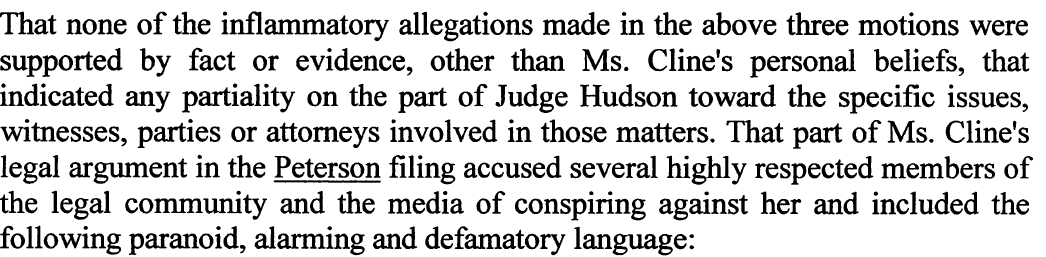
[Updated, Wed., 4.22pm: Durham attorney Kerry Sutton (who played a minor role in the lacrosse case) has filed an affidavit urging the removal of Tracey Cline as Durham DA. In the affidavit, Sutton accuses Cline of "habitual intemperance" and conduct "prejudicial to the administration of justice." Sutton, not unreasonably, characterized Cline's "inflammatory" filings against Judge Orlando Hudson as filled with "venom" and "paranoid" language, lacking in "fact or evidence, other than Ms. Cline's personal beliefs." Sutton goes into considerable length about how Cline's obsession with Hudson has both harmed the Durham DA office's reputation and consumed the Durham legal community's resources. (She also points out that the grammatically-challenged Cline also has a tendency to misspell "affidavit" in her legal filings.)

The N&O's Andrew Curliss reports that the gambit employed by Sutton is rarely used, and is believed to have resulted in the removal of only one DA in North Carolina history.]

Durham County’s minister of justice was last heard from penning a bizarre e-mail to the Herald-Sun in which she misspelled a judge’s name and asserted that “truth should be intimidated by the pressure of the powerful or the fear of failure.” This morning’s N&O exposes as false a central claim made by Tracey Cline in her quixotic crusade against Judge Orlando Hudson—that Hudson had demonstrated his anti-Cline bias by entering an August order before the prosecution even had the chance even to present all of its witnesses.

Reporter Andrew Curliss did what Cline failed to do—he actually investigated the seeming anomaly. And he discovered a benign explanation: “The clock at the courthouse that stamped the document was more than two hours slow that day.” In a situation that would seem more likely in a small town courthouse than in North Carolina’s fifth-largest city, the clock in the county clerk’s office seems to malfunction with some regularity. Curliss spoke to assistant county clerk Angela Kelly, who commented about the clock, “It is a machine that's plugged up in the wall that runs constantly. When things are filed, we stick it in there, and we always hope and pray it's correct. But there have been times when we notice that it's not correct."

Curliss confirmed Kelly’s recollection by checking into legal documents filed the next morning—which the clock erroneously stamped at 7.18am, rather than after 9.00am, when the clerk’s office actually opened. (Times public editor Arthur Brisbane might just call Curliss a “truth vigilante.”) The N&O website has a photo of the relevant filings.

Rather than assuming the worst and thereby leveling wild, unsubstantiated allegations against a sitting judge, Cline might have checked to see if there were problems with the clock in the clerk’s office, something that would have taken her only a few minutes to do. The N&O presented Cline with the information, but she declined comment, and thus did not take the opportunity to say that she would withdraw her charges against Hudson. Jim Coleman summarized the problem to Curliss: "She has made a serious allegation, and it warranted serious review by her before this filing. It is now just more evidence of a lawyer who is barreling down a hill totally oblivious to the damage she is causing to the judicial system. She is undermining confidence in the system. It's disgraceful."

Such cavalier disregard for the truth and professional behavior from his county’s “minister of justice” might be enough to cause “shame” and “anger” even from the likes of Duke professor William Reichert. But I suspect not.

Friday, January 13, 2012

The Reichert Rules

Though Duke’s race/class/gender-dominated humanities faculty members embarrassed themselves in their response to the lacrosse case, faculty in the hard sciences and engineering behaved very differently. Indeed, only one member of the Group of 88, Ronen Plessler, came from any of the sciences or engineering departments.

That said, on the one occasion in which a science professor did try to imitate his “activist” colleagues—when “Counselor” Thomas Crowley hung his shingle for readers of the Herald-Sun—the result was humiliation and a quick backtrack.

Biomedical Engineering professor William Reichert should have learned Crowley’s lesson. In what’s described as a guest “commentary” in today’s Chronicle, Reichert begins by complaining about SportsCenter devoting excessive coverage to the Jerry Sandusky case, thereby disturbing his workout. This situation—not, it seems, Sandusky’s alleged crime, but ESPN’s coverage, from which for unknown reasons he could not avert his eyes—left him “stewing . . . for weeks and weeks,” until, finally, he elected to turn to the pages of the Chronicle. (Did Deadspin, known for its biting ESPN commentary, reject his submission?)

From the Sandusky affair, Reichert moved on to a . . . curious . . . recapitulation of the lacrosse case. He confessed that “senseless behavior,” which he did not specifically define, left him with feelings of “anger” and “shame.” Of what senseless behavior, then, did he speak? His colleagues’ rush to judgment and their abandoning the basic requirements of the Faculty Handbook? The local prosecutor’s violating myriad ethical standards? The Durham newspaper’s decision to turn a blind eye to the abuses?

None of these developments appeared to produce either “shame” or “anger” for Dr. Reichert—in itself a revealing insight into his character. His “shame” or “anger” came from the “behavior of students”—presumably the lacrosse players, rather than the potbangers, though Reichert is careful not to say so (perhaps for legal reasons?). Fortunately, however, there was a hero of the affair: Richard Brodhead, who showed “courage” in prematurely terminating the 2006 lacrosse season, fully aware of “the blow back [sic] that was sure to come.”

This claim is a little bit like Cathy Davidson’s reinvention of spring 2006 as a time of terror for black students on the Duke campus. Brodhead’s canceling the lacrosse season required no courage at all. Faculty “activists” were demanding it, the team itself had virtually no supporters on campus at the time, and then-BOT chairman Bob Steel considered it a necessary sacrifice for public relations purposes.

Brodhead, in short, received virtually no “blow back” for the decision, at least at the time. Indeed, the only way in which Reichert’s “blow back” claim makes any sense would be if he’s suggesting that Brodhead fully believed that the accused students were innocent but cancelled the season anyway, thereby anticipating a “blow back” once outsiders (even the biased New York Times) came to criticize the university for its guilt-presuming action.

A question: could it be that Reichert’s other title—“Associate Dean for Diversity”—accounted for his Group of 88-like interpretation of the lacrosse case?

Thursday, January 12, 2012

Updates: Times, Cline, FERPA, Chafe

[Updated, Friday, 1.03pm: Duke has filed its discovery requests in the McFadyen lawsuit. University lawyers are asking for potentially thousands of documents, including logs of Facebook accounts, e-mails to their teammates and their parents, high school grades, drafts(!) of class papers, tax returns, and medical records since 2001.

The document requests suggest that the university's legal strategy will focus on attempting to blame the lacrosse players for any damages they received, presumably by trying to detect stray items in Facebook posts or e-mails. The strategy is unsurprising: if the Brodhead administration's actions are indefensible, the university has little choice but to go after the plaintiffs. That said, it's still striking that as the same university that wants thousands of documents from its former students has been willing, thus far, to hand over only 27 documents of its own.]

New York Times public editor Arthur Brisbane, last seen searching out Wendy Murphy for guidance about how his newspaper should report sexual assault cases, posted a provocative item this morning asking if the Times should be a “truth vigilante.”

Brisbane said that his post was prompted by reader concerns about the paper’s repeating false candidate claims (such as Mitt Romney’s repeated assertion that Pres. Obama embarked on a tour to “apologize” for the United States) without reporters pointing out that these claims were . . . false.

Of course, it’s hard to give any credibility to someone, like Brisbane, who sees Wendy Murphy as an arbiter of truth. In any case, the Times’ indifference to repeating false items obviously predated the current campaign. The factual errors from Duff Wilson’s reporting remain uncorrected.

-----------

Durham County’s “Minister of Justice” is back in the news this week. Tracey Cline, continuing her quixotic case against Durham judge Orlando Hudson, filed papers demanding Hudson’s removal from a yet another criminal case, on spurious grounds that he is biased against her office.

N&O reporter Andrew Curliss noted that Cline’s filing repeated factual errors that she’s made in previous legal documents (even if the office struggles with basic research, does anyone from the Durham DA’s office bother to read the newspaper?). At least, however, Curliss notes that Cline's 30-page submission was “much smaller than previous filings by her that attacked Hudson.”

BTW: Cline came second for worst prosecutor of the year, 2011, to John Bradley.

------------

I have a post at Minding the Campus using the recent example of former St. Joe’s basketball player Todd O’Brien to point out how universities too often abuse FERPA, using the law not as it was intended (to protect student rights) but instead as a shield to avoid public criticism.

That post suggested (and a browse through FIRE’s archive would confirm) that universities too often interpret FERPA far too rigorously. But the post also acknowledged the one high-profile instance in which a university ignored FERPA so as to serve short-term public relations interests—Duke’s decision to give the DPD keycard information on the lacrosse players—without a subpoena, and without telling the students or their parents. Intriguingly, among the handful of documents turned over to Bob Ekstrand in discovery was an email from Duke falsely claiming that the university had followed FERPA’s terms.

---------

Finally, Politico reports on a new PBS movie focusing on Bill Clinton and the former President's many, many affairs. Among the people quoted in the article--U.S. history's race/class/gender specialist, none other than William Chafe.

The Group of 88'er conclusion: Clinton's lack of control over his behavior was "terrifying." There's no indication whether Chafe will be endorsing a full-page ad in the Chronicle denouncing Clinton.


Hat tip--O.S.

Friday, January 06, 2012

Items from the Ekstrand Filing

A filing by Bob Ekstrand in the McFadyen lawsuit has revealed some interesting material about Duke’s initial response to Crystal Mangum’s false allegations. Ekstrand filed in response to Duke’s . . . miserly . . . approach to discovery—the University has turned over only 27 documents—some of which, according to Ekstrand, were duplicates.

Ekstrand’s brief included examples of material already obtained in discovery—and provides a good sense of why Duke has proven so . . . reluctant . . . to hand over material.

By far the most significant item is a March 17, 2006 e-mail from Dean Sue Wasiolek, sent to an array of top Duke administrators, including John Burness, Larry Moneta, and Tallman Trask:

Here’s the latest update on this situation. Most important is that the students who reside in this house have been fully cooperative and are concerned that their names will be in the press. Since they have not yet been officially charged with anything, they have asked that should the realty company (or anyone else at Duke) be asked for those names, that we not give them out since this is still just an investigation. Scott Selig has called Allenton Realy and alerted them to this.

The Durham police are, in fact, investigating an alleged rape/kidnapping at 610 N. Buchanan. On Monday, March 13, two strippers were hired to perform at 610 N. Buchanan. About 30 men were in attendance, all members of the Duke Lacrosse team. One of the strippers appeared to be on drugs. the men decided to pay the women early, and then asked them to leave. They refused and the men paid them more. The one stripper ended up passing out either on a porch or deck in the back of the house and the men carried her to the other woman’s car. At some point later, the passed out woman interacted with Durham police at the Kroger on Hillsborough Road and made the allegations. I believe she was examined at Duke ED.

Last night the house was searched. The men volunteered to engage in DNA testing and to take lie detector test. I believe the DNA testing was done.

Mike Pressler and Chris Kennedy are well aware of this situation. The men have denied all allegations--they obviously admit to hiring the strippers.

The Wasiolek e-mail confirms that the senior Duke administration knew from the start that the lacrosse players had fully cooperated (even to the extent of the captains volunteering to take lie detector tests) with the police inquiry. Less than two weeks later, when Mike Nifong began his pre-primary publicity crusade, he suggested something else—that, in fact, that players had erected a “wall of silence” to frustrate the investigation.

Duke administrators were under no legal obligation to correct the record. (Whether they had a moral obligation to do so is another story.) But the Wasiolek e-mail confirms that senior Duke administrators knew from the start that not only was the DA violating standard procedure by speaking early and often about the case, but that one key element of his publicity barrage—the lack of cooperation by the players—was demonstrably false.

Yet this knowledge (which, at the time, very few people outside the lacrosse team, their families, and their attorneys possessed) that the DA was publicly lying about Duke students appears to have had no impact in how Duke administrators initially responded to the case. Why was that?

The other intriguing item from the Ekstrand filing is a deposition from Associate AD Chris Kennedy, a consistently first-rate figure throughout the case. (Kennedy was quickly marginalized from discussions about how Duke should respond to Mangum’s allegations.)

Kennedy’s deposition provided an insight into the mindset of senior Duke administrators. For instance, he recalled a March 24 or March 25 conversation with Tallman Trask, in which Trask said “something to the effect of he would be amazed or astounded . . . if there was anything to the allegations.”

Obviously, public statements from Duke administrators near this time—most particularly the Brodhead April 5, 2006 “letter to the Duke community”—appeared to operate from a radically different premise. Why was that?

Kennedy’s deposition also provided useful context on how two particular actions by Duke helped shape public opinion in the case. The first came in the extraordinary decision to cancel the March 25, 2006 Duke-Georgetown game less than two hours before the game was to start. In response to a question from Ekstrand, Kennedy said he couldn’t recall an instance in which Duke had canceled an athletic contest in response to criminal allegations against team members, and added, when questioned again, that “I thought that somebody from the outside—in light of the newspaper article that appeared that morning in the News and Observer,"Dancer Gives Details of Ordeal”—I thought that that would send the message that that was, in fact, an accurate account of what had happened.”

Kennedy was right. Indeed, in their non-apology apology, the New York Times sports editors cited the unprecedented cancellation of the game and then the season as one reason for the paper’s presumption of guilt in its coverage.

The second came in Brodhead’s infamous April 20, 2006 remarks to the Durham Chamber of Commerce, shortly after the arrests of Reade Seligmann and Collin Finnerty, in which the Duke president declared of his students, “If our students did what is alleged, it is appalling to the worst degree. If they didn’t do it, whatever they did is bad enough.”

Kennedy was asked how the Durham community viewed this statement, and he responded, reasonably, "I think that someone without any knowledge of any of the facts, someone on the outside would again draw the conclusion that some kind of crime had been committed and that Brodhead believed they were guilty. And furthermore, I think it was incredibly indiscreet to say ‘whatever they did was bad enough.”

Finally, the deposition offers a revealing vignette. Kennedy spearheaded the (successful) NCAA appeal for the members of the team to obtain an extra year of athletic eligibility. He wrote the appeal document, and passed it along to the Duke counsel’s office for approval. The counsel eliminated items dealing with the on-campus threats to the students and the behavior of the Duke faculty toward their own students.

A bit of revisionist history, perhaps.

Monday, January 02, 2012

Vote for Tracey!

The competition (especially John Bradley) is stiff for worst prosecutor of the year. But Durham's "minister of justice" is definitely in the running.

Housekeeping matters: I tweet all my posts (both here and from Minding the Campus) on my twitter feed; follow me here.