Showing posts with label media. Show all posts
Showing posts with label media. Show all posts
Saturday, May 03, 2014
Media & Cohan
Stuart and I had a piece yesterday in Real Clear Politics, examining how the failure of (much of) the mainstream media--both in reviewers and interviewers--to critically examine the extreme arguments of author William D. Cohan reveals a new round in the media's rush to judgment about the case. You can read the piece here.


Friday, March 28, 2014
Coman to Neff: Nifong Characterizations "Figments of His Imagination"
Joe Neff has a breaking piece in the N&O disproving one of the many questionable assertions in the forthcoming book by author William D. Cohan. (I'm reviewing the book for Commentary, and will also comment here after the book is published.)
Neff observes that “most of the new content in the book comes from Cohan’s interviews with Nifong . . . Cohan allows the former prosecutor’s assertions to go unchallenged.” Neff's article illustrates the dangers of an author relying on the uncorrobated musings of a convicted liar.
According to Neff, Nifong told Cohan that “I have to believe, based on my knowledge of Jim Coman and Mary Winstead, that they were every bit as sandbagged by [AG Roy Cooper declaring the players innocent] as I was.” Author Cohan, for reasons that remain unclear, elected to publish without attempting to contact either Coman or Winstead for comment. I should note that it appears that many key players on the legal side of the case were similarly never contacted, for reasons that remain unclear.
It turns out--unsurprisingly--that Nifong's . . . recollection . . . was flawed. Jim Coman told Neff, “These characterizations are figments of his imagination.” After reviewing all of the evidence (it's not clear, by contrast, how much evidence author Cohan ever saw), Coman concluded the obvious: “[Crystal Mangum] lied, she made up a story, and damn it, we’ve got to do the right and ethical thing” by issuing an innocence declaration.
[Update, for those interested: it might be worth reviewing the AG's report.]
Neff observes that “most of the new content in the book comes from Cohan’s interviews with Nifong . . . Cohan allows the former prosecutor’s assertions to go unchallenged.” Neff's article illustrates the dangers of an author relying on the uncorrobated musings of a convicted liar.
According to Neff, Nifong told Cohan that “I have to believe, based on my knowledge of Jim Coman and Mary Winstead, that they were every bit as sandbagged by [AG Roy Cooper declaring the players innocent] as I was.” Author Cohan, for reasons that remain unclear, elected to publish without attempting to contact either Coman or Winstead for comment. I should note that it appears that many key players on the legal side of the case were similarly never contacted, for reasons that remain unclear.
It turns out--unsurprisingly--that Nifong's . . . recollection . . . was flawed. Jim Coman told Neff, “These characterizations are figments of his imagination.” After reviewing all of the evidence (it's not clear, by contrast, how much evidence author Cohan ever saw), Coman concluded the obvious: “[Crystal Mangum] lied, she made up a story, and damn it, we’ve got to do the right and ethical thing” by issuing an innocence declaration.
[Update, for those interested: it might be worth reviewing the AG's report.]
Friday, December 06, 2013
Selena Roberts: The Serial Misleader
The case involving Florida State quarterback Jameis Winston
is probably the highest-profile sexual assault claim involving an elite college
athlete since the lacrosse case. But the facts of the two cases have almost nothing in
common.
- The claim in the Winston case was one of acquaintance rape, his DNA was found on the accuser, and as soon as the DNA findings became public, his attorney admitted that Winston had sexual contact with the accuser. The lacrosse players’ attorneys, on the other hand, consistently denied any sexual contact—and no DNA links between them and false accuser Crystal Mangum ever were established.
- In Tallahassee, the local police seemed to bend over backwards to accommodate Winston; in Durham, the local police (ranging from the DPD leaders, who turned the case over to Mike Nifong, ranging down to ex-Sgt. Mark Gottlieb) seemed to bend over backwards to frame the lacrosse players.
- In Tallahassee, the college administration stood firmly behind Winston; in Durham, the reverse was true.
- In the Winston case, the media coverage was generally accurate and avoided a rush to judgment; in the lacrosse case, the reverse held true--especially on the pages of the New York Times.
- And, of course, there was no equivalent to the Group of 88 in Tallahassee.
Given these enormous differences, it would be a reach to
draw much of a connection between the two cases. But Selena Roberts has never
let anything like facts (or common sense) stand in her way. She embarrassed
herself earlier this year in odd ruminations about Auburn. After disparaging the
concept in her coverage of Duke, she
suddenly purported to discover the importance of due process in Auburn—only to see
several of the current and former players she had (allegedly) quoted claim that
they didn’t tell her what she claimed they did, and only to see her main
source, whom she had presented as almost certainly innocent, plead guilty to the
crime.
So now, she’s back to doing what she does best—leveling a character assault against the lacrosse players, while whitewashing her own commentary from the period before the arrests. As part of a critique about the police response in the Winston case, Roberts reached back to Durham:
“In 2006, pitched against a political backdrop of elections, District Attorney Michael Nifong aggressively pursued rape charges against lacrosse players and falsified statements about evidence. The case against the players was dismissed and Nifong was disbarred. Nifong let himself be swept into a public tinder box of scenes from the party, including porn-style pictures taken on phones of an exotic dancer -- accuser Crystal Mangum -- and a disturbing email post depicting the skinning of strippers in an ‘American Psycho’ reference. This was in addition to irrefutable accounts of racial slurs and sodomy jokes at the party and past misdemeanors involving the team.
“As I noted in two opinion pieces for The New York Times, a no-crime, no-foul approach wasn't the only answer to the Duke scandal although it was the most popular one by the lacrosse team supporters. Folks can still inspect and debate a dehumanizing culture even though what happened at Duke didn't rise to a criminal case. I wrote in March 2007: ‘No one would want an innocent Duke player wronged or ruined by false charges -- and that may have occurred on Nifong's watch -- but the alleged crime and the culture are mutually exclusive. Some readers argue no one would have known about the lacrosse team's misogyny bash last year if not for the initial rape charges by the hired dancer. True, but that’s how we often discover what goes on behind the curtains: by a botched break-in, through a door left ajar.’”
It’s curious that Roberts writes that she penned “two opinion pieces for The New York Times.” Actually, she wrote three. Two of her columns, as she noted, focused on attacking the players’ character. Those columns came in April 2006—after, contrary to widespread expectations, it was revealed that there were no DNA matches between Mangum and the lacrosse players, strongly suggesting that her story, as described, could not have occurred—and in March 2007, after Nifong’s case had utterly collapsed.
But a character-only approach wasn’t Roberts’ initial take. I wonder, therefore, why Roberts didn’t ask “folks” to review the first column she wrote on the case, published in late March 2006. Indeed, I wonder why she didn’t even mention that column. That’s the item in which she—based solely on what Nifong and Mangum were saying—unequivocally asserted that “something happened March 13” that “threatens to belie [the players’] social standing as human beings.” She compared the players’ behavior to that “of drug dealers and gang members engaged in an anti-snitch campaign.” She praised the “heartening” protests of the potbangers—people, it’s worth remembering, who carried signs reading “Castrate” and “Measure for Measure.” She falsely stated that none of the players “have come forward to reveal an eyewitness account.” She falsely contended that a “court document” described the accuser as “the victim of a hate crime.” She noted that the accuser was “reportedly treated at a hospital for vaginal and anal injuries consistent with sexual assault and rape.”
This sort of writing didn’t exactly feature a recognition that “the alleged crime and the culture are mutually exclusive.” It did precisely the opposite, by analyzing the lacrosse players’ character (in what turned out to be a wildly misleading fashion) solely for the purpose of trying to explain why the players had not turned in their teammates who had committed the rape. Comparing college students to drug dealers or gang members doesn’t scream a respect for presumption of innocence. Does Roberts believe that no one who reads her work has access to Lexis-Nexis or Proquest? Why, then, would Roberts attempt to mislead about the thesis of her columns?
While Roberts has “folks” assuming the worst about the lacrosse players’ character (all of them, in Roberts’ world, appear to be judged solely on a portrayal of the party that some didn’t even attend and the overwhelming majority didn’t plan, with no discussion of whether the party was in any way typical of tasteless spring break activities by many college students, and a convenient use of the plural to describe events at the party), examine how Roberts describes the criminal case.
Most important, Roberts still can’t bring herself to label the lacrosse players as innocent. (“The case against the players was dismissed.”) So does she believe there was some evidence to substantiate the charges? If not, why the reluctance to identify the falsely accused players as AG Roy Cooper did, as actually innocent?
As for Nifong, he almost comes across as a good guy—“swept into a public tinder box” (he had no choice!) as he “aggressively pursued rape charges” (what’s wrong with that?). So what did Nifong do wrong? Roberts can only bring herself to devote four words: the disgraced DA “falsified statements about evidence.” Actually, he concealed evidence. And he ordered police to violate their own procedures to produce inculpatory evidence. And he violated myriad ethical procedures. And he lied, in court, to a judge. But including such offenses would have distracted from Roberts’ agenda.
After all, some lacrosse
players (like hundreds of other Duke students, thanks to a then-secret
agreement between Duke and Durham) had “misdemeanors.”
Monday, November 25, 2013
Mangum, Murder, and the Los Angeles Times
The 2nd-degree murder conviction of Crystal
Mangum has, understandably, brought the lacrosse case back into the news; if
Mangum hadn’t falsely accused three people of raping her, and if the local
prosecutor hadn’t violated all sorts of rules to keep her story alive, and if
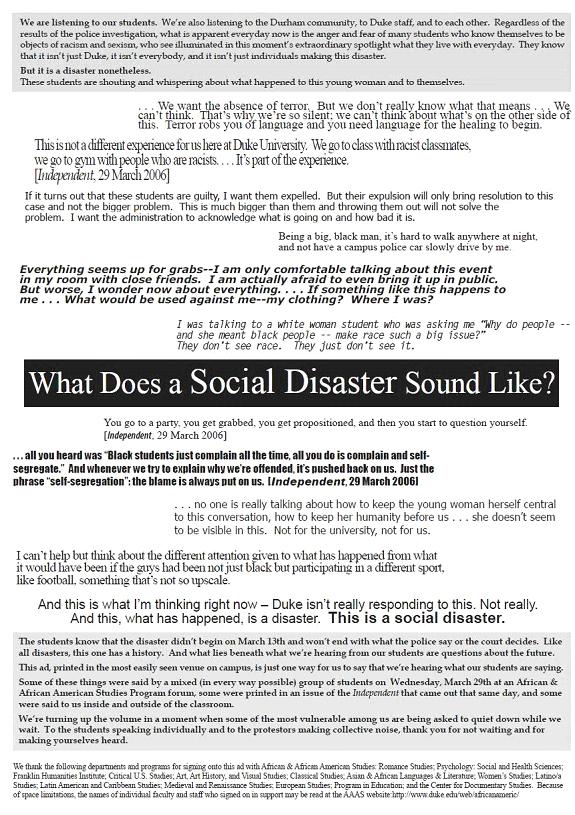
dozens of Duke faculty hadn’t published an ad that among other things vouched
for Mangum’s credibility, it’s unlikely many people outside the Triangle would
care much about Mangum’s latest brush with the law, even if this time she
managed to kill Reginald Daye.
For the most part, reports on Mangum’s conviction responsibly recapitulated lacrosse case events, given space limitations.
Perhaps the best positioning of the case came from Georgia
Parke in the Duke Chronicle: “Mangum
previously gained notoriety after accusing three 2006 Duke lacrosse players of
raping and kidnapping her. The players were eventually found innocent and
Mangum's lawyer and former Durham District Attorney Mike Nifong was disbarred
for perjury and violating professional conduct.”
Even the normally biased Herald-Sun
chose a wholly
neutral, appropriately short, and accurate summary: “Mangum drew national headlines in
2006 when she falsely accused three members of the Duke University lacrosse
team of raping her at a party near East Campus.”
The BBC strayed a little closer to the politically correct
approach: eight of
the article’s fourteen paragraphs dealt not with Mangum’s killing of
Reginald Daye but instead with the lacrosse case. And some of that description
wasn’t accurate; the BBC claimed that Mike Nifong “resigned following an ethics trial investigating whether he had broken
rules of professional conduct in the case.” Of course, the ethics proceeding
did more than investigate—it found Nifong guilty on 27 of 32 counts, and
disbarred him.
Nonetheless, the BBC also conceded that the initial assumptions about “race, class and gender elements . . . were turned upside down [except among the Group of 88] when all charges against the three students were dropped by North Carolina’s attorney general, who cited significant inconsistencies between the evidence and various accounts given by Mangum.”
Then, almost as a
counterbalance to this overall record of fairness, there’s Soumya Karlamangla of the Los Angeles Times. Karlamangla, a Cal-Berkeley graduate,
came to the Times after serving as a
web producer intern and a health reporter intern for papers in San Francisco
and Portland—and as an “editorial intern” for The Nation. Nation editorial
interns, needless to say, tend not to be card-carrying members of the Federalist
Society.
In
what purported to be a straight news article, Karlamangla devoted 12
of her 15 paragraphs to the lacrosse case; Daye got one mention. And she framed
the article in a manner that suggested a desire to relitigate the collapse of
the race/class/gender narrative and even, to some extent, the facts of the case.
Her overall portrayal of the case read as if it came from a Group of 88 press
release: “The case captured the nation’s
attention, exposing racial and socioeconomic divides not just at the elite
university, but across the country.”
The race angle: Mangum “enrolled
at the historically black North Carolina Central University, and the three men accused
were white and attended a prestigious private university that was not
integrated until the 1960s.”
The class angle: “While Duke
typically attracts students more familiar to schools in the Northeast, its
Southern home in Durham is made up of mostly blue-collar workers. As cited
frequently by the media during the court proceedings, the yearly tuition at
Duke at the time was about $43,000, while the 2000 census put the the [sic: did
anyone edit this article?!] median household income in Durham at $41,160.”
Meanwhile, Karlamangla’s
description of the actual events of the lacrosse case leaned heavily on the give-and-take of court
filings or defendants’ statements, rather than on neutral inquiries such as the
AG’s investigation or Nifong’s ethics proceedings. Indeed, while she could find
space in her 15 paragraphs for Durham’s median household income 13 years before
the murder conviction that sparked the publication of the article, Karlamangla couldn’t bring herself to
mention that the State Bar conducted an ethics inquiry into Nifong’s conduct
and found him guilty of 27 of 32 counts. The piece merely mentioned that Nifong was
disbarred without explaining how or why.
Karlamangla then presented
events of the case with action verbs (emphasis added below) all but designed to
invite the reader to doubt: “The defense claimed”
Nifong ordered a procedurally improper photo array. (Did he?, a reader might
wonder.) “The Duke players maintained
they were innocent.” (Were they?, a reader might ask.) While Karlamangla
quoted from AG Cooper’s press conference, she pointedly did not include Cooper’s
statement that the players were innocent—easily the most newsworthy item from
his remarks. But the L.A. Times reporter
found space to pass along that even as evidence of her lies accumulated, Mangum
“insisted some sort of sexual assault had taken place.”
If Karlamangla wants
to publish an op-ed in The Nation defending the framing of the case by the Group of 88 and itsallies, she’s
obviously free to do so. But the L.A.
Times should be embarrassed for allowing her item to run as a news article.
Monday, October 28, 2013
Accountability and Pre-Exising Biases
The other day, I came across an item in my Twitter
feed from
This sort of extreme victims’ rights rhetoric
was associated in the early 1990s with the far right, and is almost never (and
for very good reason) seen coming from mainstream liberals, much less from an
activist publication such as Salon. Imagine
the (appropriate) outrage if a left-of-center publication published something
along the lines of the following: “The
likelihood of being falsely accused of robbery in urban areas is no different from that of being falsely accused of any other crime.
And accusers are far more likely to be robbed than urban African-Americans are to
be falsely accused.”
The piece focused, however, on the college environment. Regarding male Division I athletes, Chemaly wrote, with an embedded link, that “while male student
athletes make up 3.3% of the U.S. college population, they are responsible for
19% percent of sexual assaults and 37% of domestic violence cases on college campuses.”
Note that the sentence was delivered in the present tense (“make,” “are”).
It turns out, however, that Chemaly misrepresented her
source, a 2012 Dartmouth Law Journal article by
Edward Sansone. Here’s how Sansone described the study [my emphases added]: “A
study of sexual assaults at thirty major
Division I universities over a three-year period in the early 1990’s came to the conclusion that male
student-athletes, compared to the rest of the male population, are responsible
for a significantly higher percentage of sexual assaults reported to judicial
affairs on the campuses of Division I universities. The survey found that while
male student-athletes make up only 3.3 percent of the college population at the surveyed institutions, they were responsible for 19 percent of
sexual assault cases and 37 percent of domestic violence cases.”
Chemaly basically copied Sansone’s second sentence (without
including quotation marks), but adjusted it in two ways. She changed Sansone’s “were”
to “are,” and changed Sansone’s “college population at the surveyed
institutions” to “U.S. college population.” Copying word-for-word might have
been dismissed as incidental plagiarism, perhaps forgivable because Chemaly
included a link. But Chemaly—a self-described
“activist and writer of feministy things”—didn’t simply copy Sansone’s
words. Instead, she copied most of them but then altered a few of them to make
it appear that the survey was current (instead of 20 years old) and
comprehensive (instead of only 30 institutions). That sort of behavior is
unethical.
What of the survey that Sansone cited? Given that his piece (which
calls for using Title IX to crack down on what he sees as disproportionate
sexual misconduct by male student-athletes) appeared in a law journal article
rather than in Salon, it might be
assumed that higher editorial standards would apply. Yet Sansone’s sole source
for his claim is an organization called the National Coalition Against Violent
Athletes. The group’s website contains the following line, which formed the
basis of Sansone’s claim: “A 3 year study shows that while male student-athletes comprise 3.3% of
the population, they represent 19% of sexual assault perpetrators and 35%
of domestic violence perpetrators.” Yet the website doesn’t contain the
actual (20-year-old) study itself. And the group’s assertion that the
highly-regarded Northeastern
University Center for the Study of Sport and Society “refused to publish these
statistics” doesn’t exactly provide reassurance about the quality of the data.
To review: a one-sentence
summary of a study on an activist group’s website was then picked up in a law journal
article (whose author, at least according to his footnotes, does not appear to
have examined the study itself). The law journal article’s item was then picked
up by Salon, which altered its meaning to make it seem as if the study
was new rather than 20 years old.
Sansone’s article, it
turns out, had another item directly connecting to the topic of this blog. Here’s
his lede sentence—opening the article’s second paragraph after a
first-paragraph vignette. “The dark secret that many male college athletes
carry is that they are one of the main perpetrators of domestic violence and
sexual assault on college campuses.”
For this extraordinary
claim, Sansone (in an article published out of an Ivy League college) cited a
grand total of one source, a 2006 article by Jake Tapper and AudreyTaylor. (While Tapper is now a reliable barometer of conventional wisdom in
Washington, he worked at Salon before moving on to ABC.) Here’s how Tapper and Taylor opened their piece,
entitled “Is Jock Culture a Training Ground for Crime?”:
A year before Duke University’s lacrosse team became the center of scandal, administrators and the school's athletic director were warned that the players had demonstrated "boorish" behavior.
According to news reports, 15 of the team’s 47 players have court records for drunken and disorderly behavior. [The ABC duo was writing before “news reports” revealed the Duke-Durham agreement to maximize charges against all Duke students who engaged in underage drinking or the type of disorderly behavior that likely wouldn’t result in an arrest of an NCCU student.] Two were arrested today on charges of raping and kidnapping a 27-year-old woman at an off-campus party.
The alleged incident may be part of a larger problem, experts said, of athletes whose attitude includes a sense of entitlement that manifests itself in crude and even lawless behavior.
Tapper and Taylor then went on to cite . . . the
very same study used by Sansone and misrepresented by Chemaly.
But, of course, the “alleged incident” that Tapper and Taylor speculated
“may be part of a larger problem” never occurred. Yet rather than Crystal
Mangum’s false charges and Mike Nifong’s unethical behavior discrediting Tapper
and Taylor’s article, Sansone had no problem citing it—and citing it for his
law journal article’s key claim—as if Tapper and Taylor’s piece provided some
sort of special insight. And the journal’s editors had no problem in clearing
the article and the citation.
How can a crime that never happened be used to demonstrate a “larger
problem” whose relevance to the case would make sense only if the crime had actually occurred? For true believers, it seems, there’s no reason to come to grips with
how the initial rush to judgment in the lacrosse case requires some
reconsideration of the broader assumptions about due process in campus sexual
assault cases embedded in both the Sansone and the Chemaly items.
Wednesday, July 24, 2013
The Perils of Political Correctness
Two items showing the continuing failure in the academic
world to learn the lessons of the lacrosse case.
The first comes from the Chesterfield
(VA) Observer, which ran
an article on the status of African-Americans in the sport of lacrosse. The
Observer interviewed Jay Coakley, professor emeritus of
sociology and sport at the University of Colorado-Colorado Springs. According
to the Observer:
In the aftermath of the 2006 Duke lacrosse rape scandal,
Coakley was invited to speak to a national lacrosse convention in Philadelphia.
His message – that the sport desperately needed diversity – wasn’t well
received. “When I gave my presentation, probably about 100 white men walked
out,” Coakley recalled.
He offered up slides of photos culled from college websites,
which showed a preponderance of white men playing the game. “I was accused on
local talk radio of pushing political correctness and not understanding what
lacrosse is all about,” he said.
The address to which Coakley referred occurred at the 2007 US Lacrosse
convention, which was held January 12-14 in Philadelphia. It’s worth noting
the context: by this point, disciplinary charges had been announced against
Mike Nifong; Crystal Mangum’s story had been changed to claim that no actual
rape had occurred; and even Richard Brodhead (though not the Group of 88) had
been moved to denounce Nifong. In short, the version of events to which so many
politically correct figures on campus had attached themselves had been revealed
as an utter fraud. Yet Coakley’s remarks appear to have ignored the jarring
transformation of the case between March 2006 and January 2007; he spoke,
instead, as if all events were as commonly understood in early April 2006.
Since there was no record of Coakley’s remarks online, I
e-mailed him. He graciously summarized his main points, which—to put it mildly—were
stronger than the Observer article
entailed. That wasn’t too surprising, since it was all but impossible to
imagine that a banal call for more racial diversity in lacrosse could have
triggered the mass walkout that he alleged.
A few items: (1) Ignoring any of the new developments
between early April 2006 and January 2007, Coakley linked the case to a call
that (paraphrased) the “sport desperately needed diversity” because it had
(paraphrased) “a preponderance of white men playing the game.” (Whites were, of
course, a preponderance of all college-aged men in January 2007.) Even if some
sort of racial balancing in college men’s lacrosse was or is desirable, how,
precisely, could this goal be linked to the Duke lacrosse case in a way that
would reflect well on Coakley?
It’s true that, if the accused students were
African-American rather than white, the lacrosse case would have differed. Neither
Nifong nor the Group of 88 would have had any reason to have exploited the
case, and therefore it likely would have never moved forward or received much
campus or media attention. But suggesting that a sport having more black
athletes minimizes the possibility of a local prosecutor or a school’s faculty
engaging in race-baiting behavior doesn’t strike me as a . . . progressive . . . argument.
Coakley seems to be insinuating, instead, that if more African-Americans
were on the 2006 lacrosse team, the team would have treated the strippers more
sensitively. That strikes me as a highly implausible conclusion.
In general, his view of events seemed then, and still seems,
frozen in time, as if no additional facts about what occurred at the party came
out after early April 2006. He suggested to me that racial epithets were
directed at false accuser Crystal Mangum (there’s no evidence of this, since
Mangum was passed out during the racially charged argument between Kim Roberts
and a lacrosse player that concluded the evening) and that other lacrosse
players somehow should have intervened to stop the exchange between Roberts and
their teammate. But it’s not clear how they could have done so, since all
accounts of the evening suggested that Roberts then immediately called the
police claiming a “hate crime,” and then drove off, while the captains told the
remaining handful of players to go home. Coakley’s comment about intervention
only makes sense if he believes that racial epithets occurred during the party
itself—yet the only figures connected to the case to ever have made such a
claim were Mangum and Mike Nifong. That he still seems to view the duo as
credible speaks volumes as to the biases he brings to the case.
(2) In his e-mail to me, Coakley linked his criticism of the
lacrosse team in part to the hiring of strippers—an act that I, too, find distasteful.
Yet it’s hard to see any connection between his critical comments about the team’s
(or, more generally, lacrosse’s) racial makeup and the hiring of strippers. After
all, a few weeks before the party, the majority African-American basketball
team had hired strippers for a team party.
More broadly, his basic approach in the 2007 talk—on which he doubled down in his Observer interview—suggests that the hiring of the strippers, and Coakley's seemingly inaccurate view of the development of the party, was such a grave character flaw that it overcomes all that we subsequently learned about members of the lacrosse team, whether in the Coleman Committee report, or in their post-case behavior in the 2006-7 academic year. Much like the Group of 88, it’s as if, for Coakley, the team’s character is frozen in time, as of early April 2006, and nothing that came after was allowed to disturb the preconceived ideological notions that he brought to the case.
(3) In his interview with the Observer, Coakley said that he “was accused on local talk radio of pushing political
correctness.” (Coakley didn’t cite which local talk radio leveled the
accusation against him; it’s intriguing that he’s evidently a talk-radio
listener.) In the event, at least based on what he shared with the Observer and later with me, the
accusation seems to be a valid one.
It’s unclear how many people share Coakley’s
perspective; in society as a whole, it’s almost certainly a minority, and
perhaps a small minority indeed. On campus, however, his politically correct
approach is very much mainstream—as we saw, yet again, in a recent event at
Duke.
Of all the campuses in the country, it would seem as if Duke—whose
students were the victims of the highest-profile rape hoax in modern American
history—would bend over backwards to protect due process in sexual assault cases.
The reverse was true: in
2009, the university implemented a new sexual assault definition, in which
students could be found guilty of rape on the following criteria: “Real or perceived power
differentials between individuals may create an unintentional atmosphere of coercion.” Why a
student could be deemed a rapist based on unintentional actions that any
accuser happened to perceive Duke never said, and amidst an outcry from alumni
and from national groups, especially FIRE, Duke quietly dropped the new
criteria in 2010.
But otherwise, a due
process-unfriendly sexual assault policy remained in place—until earlier
this month, when Duke announced an adjustment. Students found guilty by the
university now will face a presumed penalty of expulsion. Remarked Larry
Moneta to the Herald-Sun, “This is not like the
measles; there’s no vaccine . . . This is a very complicated issue that is not
unique to us that just requires persistence and a multi-varied approach.”
Moneta did not mention the importance of due process for sexual assault
allegations.
Students properly deemed
rapists certainly should be expelled. Actually, of course, they should be sent
to jail—but university activists tend to strongly oppose the idea of allowing
the criminal justice system, rather than university bureaucracies, to address
allegations of sexual assault.
In the event, the heightening
of the punishment has to shine the spotlight on the procedures the university
employs, since the error resulting from a procedurally flawed decision is now so much greater. Duke’s policy is for a university administrator or a hired outside
investigator to examine the allegations. The investigation is almost guaranteed
to be slipshod: “Allegations of sexual misconduct will be investigated
in a thorough and timely manner, typically within 15 business days of receipt
of a complaint.” (Imagine if the police had such a requirement, amidst a
bureaucracy that’s strongly predisposed, for ideological reasons, to believe
all allegations of sexual assault, as is the case at Duke and many other
universities.) The accused student doesn’t have the right to be represented by
outside counsel, only a “member of the university community,” and even the role
of this advocate is severely restricted: “He/she may only confer quietly or
through notes with the complainant and may not address the panel.” And a
finding of guilt occurs at the lowest possible threshold—a preponderance of
evidence, or 50.01 percent.
In explaining the new penalties, Moneta didn’t reference the
lacrosse case, or explain why a campus that witnessed such an extraordinary
violation of due process wouldn’t be vigilant about due process on such matters
in the future. But Bob Ashley’s Herald-Sun
filled the void. In an unsigned editorial celebrating Duke’s action (there’s
a surprise!!), the H-S reflected
in the following manner: “One legitimate debate fueled by the infamously false rape
allegations against Duke lacrosse players in 2006 concerned the overall culture
of gender relations on Duke and other campuses.” It’s easy to see how “legitimately
false rape allegations” might have triggered a debate about why so many on Duke
faculty members were willing to rush to judgment against three of the
university’s male students. But somehow I doubt that’s the sort of “legitimate
debate” about “gender relations” on the Duke campus that Ashley had in mind.
Beyond
the rare admission from Ashley that the charges his paper so consistently
framed as true were actually false, it’s as if for the H-S editor, much like Professor Coakley, events in time are frozen
as of April 2006.
Monday, July 01, 2013
W. Murphy, Hypocrite
During her myriad
media appearances commenting on the Duke lacrosse case, adjunct law
professor Wendy Murphy came up with virtually everything bad she could possibly
say about the three falsely accused players. She wondered whether one of them
had been abused as a child. She wildly claimed that false accuser Crystal
Mangum had been bribed, that exculpatory photographs had been doctored, and
that neighbors had claimed the lacrosse players were involved in other sexual
offenses. She even managed to work in an oblique Hitler comparison.
(A reminder: These
erroneous statements and bizarre comparisons did not trouble Poynter, the
supposedly good-journalism organization which brought in Murphy to lecture to journalists.)
But in all of her media appearances, one area that the
adjunct law professor did not explore was a claim that the case was receiving too much attention from journalists. There
was no Murphy denunciation of Newsweek for
placing the falsely accused players’ mugshots on its cover, under the equally
false headline of “Sex, Lies, and Duke.” Nor did the adjunct law professor criticize Nancy Grace for the extraordinary amount of time the HLN host personally devoted to the case (except, of course, on the evening of the exoneration).
Imagine my surprise, then, to read a Murphy
op-ed in this morning’s Boston Herald,
in which she lambasted the media coverage of murder charges against former
Patriots tight end Aaron Hernandez. “Like a lot of people who don’t follow
sports,” Murphy confesses, she hadn’t
known much about Hernandez until a couple of weeks ago—just as she hadn’t heard
much of other athletes charged with violent crimes, such as Kobe Bryant, Rae
Carruth, and Michael Vick. Why does her ignorance about sports matter? Because “it’s
hard for people like me to appreciate the wall-to-wall coverage of a story that
seems no different than any other gang-banger murders of late.” Curiosity about
athletes allegedly committing crimes, Murphy continues, “doesn’t make its
answer news.”
Murphy’s conclusion? “If sports were better understood as simply entertainment, the
prosecution of Hernandez would be correctly framed as a run-of-the-mill alleged
gang murder in the news section — and sports writers could spill all the ink
they want on how people feel about the
guy in their section. With angles firmly separated, nobody would
misapprehend the story as proof that some murders are more important than
others, or that some people’s lives are more valuable than others. We’ve seen
enough violence perpetrated by people of wealth, power and influence to know
that crime happens in all communities and at all points along the economic
spectrum. It’s time for the news media to start conducting itself in a manner
that reflects this reality.”
Where was this
Wendy Murphy during the lacrosse case, denouncing the media for spending far too much time covering claims against a group of college athletes? It appears as if there’s an
exception to this new Murphy rule: crimes allegedly committed by athletes in
which members of the media interview Murphy for her opinions deserve
wall-to-wall coverage. But if Murphy isn’t
seen as an expert, than excess coverage leaves the message that “that some
people’s lives are more valuable than others.”
Your daily dose of hypocrisy (and media criticism),
courtesy of Poynter’s favorite adjunct law professor.
Wednesday, May 29, 2013
Updates
Two follow-ups on recent posts.
First, an interesting column in the Chronicle from Andrew Beaton, reflecting on the Duke lacrosse team’s
recent national championship victory over Syracuse. Speaking to both current
coach John Danowski and two of the team’s star players, Beaton learned that
from recruiting to current media coverage, the legacy of 2006-7 remains.
“The scandal may never go away,” wrote Beaton, “and it may
always be among the first few results for ‘Duke lacrosse’ in a Google search.
(Even after Monday’s 16-10 national championship win against Syracuse, it’s in
the top three). And it’s a shame that a set of lies, a district attorney’s
ambitions and presumptions of guilt have made it that way.”
Current Duke students who solely read the Chronicle must have been puzzled,
however, by Beaton’s final sentence. A “set of lies”? A “district attorney’s ambitions”?
“Presumption of guilt”—including from dozens of faculty on campus, amplified by
a president too cowardly to stand up for due process?
Isn’t this the same paper that only
a few months ago informed readers that the
legacy of the lacrosse case was “a stifling effect on our administration” leading
to “the administration’s ability to comment on Duke’s social culture”? The
“enduring narrative” of the case was not, according to the authors of this
unsigned editorial, a “presumption of guilt” by those who ran the school, but
instead “of rowdy, belligerent parties—with sexist and racist overtones—and the
entitled students who attend them.”
Perhaps the authors of that
unsigned editorial might want to take a look at Beaton’s column. I should note that the column’s title—that Coach Danowski changed the “meaning” of Duke lacrosse is far more reflective of the “enduring narrative” editorial than of Beaton’s column itself.
--------------
Second, regarding the North Carolina “right to counsel” I bloggedabout below. Given the current state of affairs on college campuses, action
from state legislatures to ensure due process in campus disciplinary procedures
is about the only chance for reform. The likelihood that colleges themselves
will enhance due process is about as high as Michelle Bachmann being chosen
next year’s commencement speaker at Harvard.
The original House bill could, and should, serve as a model
for other states to follow—a clear, unequivocal assertion that accused students
have the right to a lawyer. It’s my hope that as the measure moves through the
Senate, there will be greater clarity provided to at least one of the House
modifications—namely, the provision adding “non-attorney advocate” to the bill.
(“Any student enrolled at a constituent
institution who is accused of a violation of the disciplinary or conduct rules
of the constituent institution shall have the right to be represented by a
licensed attorney or non-attorney advocate who may fully participate during any
disciplinary procedure or other procedure adopted and used by the constituent
institution regarding the alleged violation.”)
Since all universities
currently ensure “non-attorney advocates”—a toothless position—the bill’s
effects would be meaningless. If, however, the bill is clarified to ensure that
the student should have the choice
between a lawyer and a non-attorney advocate, then the bill’s promise of a
right to counsel could be significant indeed.
One other item from the bill,
which fortunately was not modified by the House. The bill calls for a “licensed
attorney or non-attorney advocate who
may fully participate during any disciplinary procedure or other procedure
adopted and used by the constituent institution regarding the alleged violation.”
One key element of the “Dear Colleague” letter (and changes demanded by “activists”
at Stanford, Yale, and elsewhere as those schools have modified their campus
disciplinary processes) has been significant structural restrictions on the
process itself—severe limitations on the ability of accused students (or their “advocates”)
to cross-examine witnesses, or to receive evidence in a timely fashion, or to
present evidence of their innocence.
A legislative commitment to
full participation might remedy some of those problems—but only, again, if the
full participation came from an attorney, not a university-approved “non-attorney
advocate.”
We’ll see what the Senate
does.
Monday, April 22, 2013
The Orin & Selena Show
In the early stages of the lacrosse case, Orin Starn
distinguished himself as among the Duke faculty members most eager to exploit
his own students’ distress to advance his campus agenda. The Sociology
professor never seemed to miss a chance to condemn the lacrosse players—and
Coach K, after he belatedly spoke up against the faculty mob—as part of his crusade
to transform Duke into a version of Haverford or Swarthmore, schools with
insignificant athletics programs. (In late summer 2006, after months of revelations
of Mike Nifong’s procedural improprieties, Starn even proclaimed that the case nonetheless
needed to go to trial, since “most Durhamites want to hear all the evidence before passing judgment,” as if basic principles of due process needed to give way to the desires of “most Durhamites.”)
This semester, Starn is teaching an on-line open class entitled
“Sports and Society,” which a Duke press release breathlessly describes
as an exploration of the “intersection of sports and American culture.” Among the
invited guest lecturers . . . “sports studies experts”(!!) like Group of 88'er Grant Farred (who perhaps can expand on his thesis that former Houston Rockets center Yao Ming represents “the most profound threat to American empire”) and former New
York Times columnist Selena Roberts.
Given his own repeated assaults on the lacrosse players’character, it comes as little surprise that Starn would deem credible a “journalist”
who engaged in a character smear against his own institution's students only days after the case first went public,
and then dissembled about what she wrote once the case collapsed. But perhaps
Roberts’ more recent work has restored her standing?
As it turns out, Roberts’ journalistic credibility has been much
in the news lately. After her departure from Sports Illustrated, Roberts moved on to a website called “Roopstigo,”
a “revolutionary digital network that presents original sports content on
demand for fans who demand more.” The “founder and CEO” of this entity is
Selena Roberts.
The site was the talk of the sports world in early April,
when Roberts published a 4000-plus word exposé of the Auburn football program. The
article awkwardly combined an inquiry into criminal charges against four former Auburn
football players with loosely-sourced allegations of rules violations by the
Auburn coaching and administrative staff. Almost immediately after publication,
the latter part of the article collapsed, as “source” after “source” claimed
that Roberts had misquoted him, or worse.
The more interesting aspect of the article, however, came in
its first area: Roberts suggested that one of the accused football players,
Mike McNeil, was likely innocent of the charges against him, and had been the
victim of some type of misconduct by authorities. The article never precisely
explained who violated McNeil’s rights or why they had done so; indeed, the article never even fully summarized
the full criminal case against him. Roberts did note that one of his
co-defendants had been convicted to 15 years in prison, but her piece veered
back and forth between a suggestion that a crime might have occurred but McNeil
was innocent to implying that perhaps the whole thing was just a
misunderstanding or even a frame orchestrated by Auburn to get rid of football
players—with dreadlocks—that the then-coach didn’t like.
What made this line of argument so intriguing is that, of course,
during the lacrosse case, this same Selena Roberts had demonstrated not a whit
of interest in due process, or the presumption of innocence, or the need for
prosecutors or police to behave in an ethical manner. Indeed, she had proven
utterly indifferent to each of these themes, and her Auburn article provided no
explanation for her newfound passion. Surely the differences in race and class
between the respective defendants could not account for her abrupt turnabout.
In the event, Roberts’ article hinged on the defense of McNeil,
who was also a principal source for her allegations of rules violations by the
Auburn football team. The man with the dreadlocks, she suggested, was persecuted
by the former Auburn coaching staff, and she came across as utterly convinced of his
innocence. If McNeil was lying about his innocence on the robbery charges, then he had no credibility as a “snitch” (to use one of Roberts’ favorite words) against Auburn.
Imagine, then, Roberts’ humiliation when, only five days after her exposé appeared, the Birmingham News reported the following:
Imagine, then, Roberts’ humiliation when, only five days after her exposé appeared, the Birmingham News reported the following:
“Judge Chris Hughes sentenced McNeil to a 15-year split
sentence that includes 3 years imprisonment and 3 years of probation after the
former football player withdrew his not-guilty plea on Monday . . . McNeil, who
wore a suit and had cut off his dreadlocks since his last court appearance on
Friday, was taken into custody by Lee County sheriff's deputies at the end of
the hearing, as his family watched from the gallery.”
The figure Roberts had portrayed as so sure of his innocence
that he would go to trial, only five days later admitted guilt. A cynical person
might suggest that McNeil’s legal team used Roberts as a way to increase
pressure on prosecutors for a better plea deal.
Perhaps Roberts can bring her unique insights on due process
in high-profile cases involving college athletes to Professor Starn’s class.
Starn’s offering is free—proving that you get what you paid
for.
Hat tip--J.
Hat tip--J.
Monday, April 15, 2013
Neff a Pulitzer Finalist
For those who hadn't seen the news, Joe Neff was part of a team of reporters at the N&O and Charlotte Observer who were finalists for the Pulitzer for local reporting, for "for their tenacious joint project investigating how the state’s major nonprofit hospitals generate large profits and contribute to the high cost of health care." (The award ultimately went to reporters at the Minneapolis Star-Tribune.)
The honor serves as a reminder that Neff's sensational work in the lacrosse case was hardly atypical of his overall journalism.
The honor serves as a reminder that Neff's sensational work in the lacrosse case was hardly atypical of his overall journalism.
Friday, March 15, 2013
Curious Commentary
[Update: I have retightened comment moderation in light of the off-topic comments.]
A few instances of . . . curious . . . commentary over the last couple of weeks: two items prompted by the settlement of the Carrington suit; the third by continued debate over the OCR mandate for colleges to lower due-process protections for students accused of sexual assault on campus.
A few instances of . . . curious . . . commentary over the last couple of weeks: two items prompted by the settlement of the Carrington suit; the third by continued debate over the OCR mandate for colleges to lower due-process protections for students accused of sexual assault on campus.
The Chronicle featured
what could charitably be described as a limited
take on the settlement of the suit. Keep in mind: though the paper’s title
remains the same, no undergraduates who currently write for the Chronicle were students at Duke during
any element of the lacrosse affair, except for the now-all-but-routine
promotions of various Group of 88 members to key administrative positions. During the lacrosse case itself, the
“As we reflect on this incident in which exotic dancer
Crystal Mangum falsely accused three Duke lacrosse players of rape at a 2006
team party,” an unsigned editorial noted, “its place in the broader history of
Duke becomes clearer. We can begin to see how it has molded and continues to
mold our campus culture to this day. For many people both within and outside of
the Duke community, this case continues to define Duke’s identity.” All quite
true.
In what ways did the case “define Duke’s identity”? Dozens
of “activist” faculty members willing to run rough-shod over the requirements
of the Faculty Handbook, exploiting
their students to advance their on-campus pedagogical or personnel agendas? An administration
so terrified of the faculty mob that the president seemed unwilling or unable
at critical points to articulate even a formulaic support for due process?
Town-gown relations so warped that the university had entered into a (secret)
agreement with the local police to allow for Duke students, and only Duke
students, to be prosecuted with the maximum harshness for certain crimes?
No. The lacrosse case “unfortunately had a stifling effect
on our administration” by scarring “the administration’s ability to comment on
Duke’s social culture.” (Of course, the administration did “comment on Duke’s social culture,” first through Richard Brodhead’s
infamous April 2006 campus letter and then through a Campus Cultural Initiative
run by some of the most extreme anti-lacrosse voices among the faculty. Does the
current Chronicle support any of the CCI’s
recommendations, such as reorienting Duke’s athletics program in such a way
that would all but certainly require withdrawing from the ACC?) “The lacrosse
scandal,” according to the Chronicle,
created an “enduring narrative . . . of rowdy, belligerent parties—with sexist
and racist overtones—and the entitled students who attend them.”
To the extent this narrative took hold, it’s a development fueled by misplaced initial media coverage, followed by the conscious efforts of Duke’s own “activist” faculty (beginning early on, with William Chafe) to transform the event into a character assault on the lacrosse players to avoid accountability for their own rush to judgment. But this “historicizing,” to use the Chronicle’s word, is of little interest to the current editors. Instead, they worry that Brodhead has been too “shy” in commenting about matters related to campus culture.
To the extent this narrative took hold, it’s a development fueled by misplaced initial media coverage, followed by the conscious efforts of Duke’s own “activist” faculty (beginning early on, with William Chafe) to transform the event into a character assault on the lacrosse players to avoid accountability for their own rush to judgment. But this “historicizing,” to use the Chronicle’s word, is of little interest to the current editors. Instead, they worry that Brodhead has been too “shy” in commenting about matters related to campus culture.
A second Carrington‑related
item came from Washington Monthly, a
publication I read regularly for its quality political analysis. This piece,
however, fell well below the publication’s usual standards.
Daniel Luzer, the Monthly’s
web editor, informed
readers that Crystal “Mangum, a black single mother, got into an argument
with several lacrosse players and accused several members of the team of rape.”
(Kim Roberts, of course, got into an argument with several lacrosse players; no
evidence ever surfaced that Mangum did.) More: “Several players were arrested
anyway, none were found guilty.” Actually, the three falsely-accused players
received a declaration of actual innocence from the AG, a far different
standard that being not “found guilty.” And lest any reader fail to detect
Luzer’s spin, he concluded his piece by quoting commentary on the lacrosse
players’ character from “one columnist,” who he declined to identify. The columnist
turned out Hal Crowther; the quoted column, from the Nifong-backing Independent, might have been the single
worst piece of commentary produced in the case.
Luzer appeared uninterested in exploring whether Crowther’s (and Indy’s) seeming ignorance of Nifong’s ethical misdeeds or the criminal case’s non-existent basis rendered less-than-credible their cultural analysis of the case. Indeed, Luzer’s post offered no hint of why, of the hundreds of pieces on the case, he chose Crowther’s as the single analysis from which to quote. Did Luzer find persuasive Crowther’s claim, in the same column, that those who criticized Nifong’s ethical misdeeds needed to “catch a glimpse of your inner racist in the mirror”? Does Luzer agree with Crowther’s characterization, in the same column, of the lacrosse players as “subhuman”? If not, why did he find Crowther credible as a source for cultural analysis of the case?
I e-mailed Luzer to ask if he, in fact, had any evidence that Mangum “got into an argument with several lacrosse players,” and noted that the players were deemed innocent, rather than “found” not guilty. He replied that he didn’t have evidence of his former claim, and ignored the latter point, but was willing to edit his post to eliminate the reference to a Mangum argument. The new post, however, did not indicate anywhere that a correction had occurred. That Luzer initially presented events at the party in an inaccurate fashion that rendered Mangum’s tall tale at least somewhat more credible, by inventing an argument involving her that never occurred, readers of non-cached versions of the Washington Monthly will remain ignorant.
Luzer appeared uninterested in exploring whether Crowther’s (and Indy’s) seeming ignorance of Nifong’s ethical misdeeds or the criminal case’s non-existent basis rendered less-than-credible their cultural analysis of the case. Indeed, Luzer’s post offered no hint of why, of the hundreds of pieces on the case, he chose Crowther’s as the single analysis from which to quote. Did Luzer find persuasive Crowther’s claim, in the same column, that those who criticized Nifong’s ethical misdeeds needed to “catch a glimpse of your inner racist in the mirror”? Does Luzer agree with Crowther’s characterization, in the same column, of the lacrosse players as “subhuman”? If not, why did he find Crowther credible as a source for cultural analysis of the case?
I e-mailed Luzer to ask if he, in fact, had any evidence that Mangum “got into an argument with several lacrosse players,” and noted that the players were deemed innocent, rather than “found” not guilty. He replied that he didn’t have evidence of his former claim, and ignored the latter point, but was willing to edit his post to eliminate the reference to a Mangum argument. The new post, however, did not indicate anywhere that a correction had occurred. That Luzer initially presented events at the party in an inaccurate fashion that rendered Mangum’s tall tale at least somewhat more credible, by inventing an argument involving her that never occurred, readers of non-cached versions of the Washington Monthly will remain ignorant.
A sense of non-accountability links the Chronicle and Luzer items: Indy seemed oblivious to Nifong’s misdeeds, and published wildly slanted (and in some cases, simply wrong)
attacks on the lacrosse players, but still can be cited by a well-regarded
publication as a reputable source for cultural analysis of the case. Brodhead’s
belated one-paragraph apology was stillborn, and his campus culture initiative
misjudged the faults that existed in 2006-7, but Chronicle editors can still yearn for his commentary on campus
culture, without any indication or reason to believe that Brodhead learned from his past mistakes.
Then there’s adjunct law professor Wendy Murphy—who,
if nothing else, is an expert on making mistakes. In an interview with AJR shortly after the criminal casecollapsed, Murphy justified her performance by citing the structure on TV or
cable news programs: she was, she said, booked to argue the prosecution’s side
of things. If she had to make things up to do so, it seemed, that was just part
of the game.
Surely someone who made things up as much as Murphy
did should forfeit all future credibility with the mainstream press. Yet
last year, there was Murphy, invited to guest lecture by none other than Poynter, an organization supposedly devoted to good-journalism principles. And a
couple of days ago, there was Murphy, an invited columnist for the New York Times’ “Room for Debate”
section, opining on the government mandate for colleges to lower due-process
protections for students accused of sexual assault.
Even more incredibly, Murphy’s piece was one of two
presented in opposition to the
government policy—on grounds that campus judicial procedures (in which accused
students usually can’t have lawyers, often can’t cross-examine their accusers,
and always can be convicted at a 50.1% threshold) don’t do enough to secure convictions.
“Fair and balanced,” Times style.
Saturday, January 19, 2013
UNC & A Credulous Press
Last year, in a post over at Minding the Campus, I examined how the University of North Carolina
responded to the Obama administration’s “Dear Colleague” letter, which required all colleges receiving federal assistance to change their sexual
assault procedures. The new procedures enhance the likelihood of conviction, by
using a “preponderance of evidence” [50.1%] standard and by introducing double
jeopardy through an accuser’s right to appeal not-guilty findings.
Even before these mandated changes, the system that
previously existed at UNC already made a mockery of due process rights for the
accused. Unless the accuser simultaneously filed a criminal complaint, the
accused student couldn’t be represented by counsel in the hearing. (“Neither a licensed attorney nor
a person who has passed a state bar examination may serve as the investigator
or defense counsel or be present during proceedings.”) When criminal charges
were filed, a lawyer could be present but not speak to the hearing panel or
cross-examine witnesses. And the hearing panel had the right to obstruct an
effective defense by restricting exculpatory evidence only to material that “does not
otherwise infringe the rights of other students.”
In response
to the “Dear Colleague” letter, UNC further weakened the due process protections
for students accused of sexual assault—and only for these students. It set up a
two-tier student judicial system. Students accused of all other offenses would
continue to be tried by the school’s Student Honor Court and according to a
standard of beyond a reasonable doubt. But students accused of sexual assault (a
far more serious allegation than most student judicial questions) would be adjudicated
under a far lower threshold (preponderance of evidence). And the claims would
no longer be heard by the Student Honor Court but by specially trained evaluators.
Celebrating
the new system in a fawning interview with InsideHigher Ed was an assistant dean of students, Melinda Manning. Manning said
the existing system (that is, the system that denied students accused of sexual
assault the right to be represented by counsel in their hearing) was too accuser-friendly, since the Student
Honor Court improperly required “victims [not ‘alleged victims’ or ‘accusers’] to be judged
by a roomful of peers.”
Ponder that
statement for a minute.
To reiterate:
last April, UNC
took a system that already denied basic due process to accused students—and
made it more likely that accused
students would be convicted, by lowering the threshold for a guilty finding in
sexual assault cases and only sexual assault cases, and by ensuring that
students accused of sexual assault wouldn’t be evaluated by the campus equivalent
of a jury of their peers.
Manning
is back in the news—as a supporter of a federal civil rights claim filed by current
and former UNC students who assert they were victims of sexual assault but that
the system described above so failed to protect their rights that it created a
hostile campus environment under Title IX. “My original plan was just to walk away and forget about
everything that’s happened,” Manning (the opponent, again, of allowing students
accused of sexual assault to be judged by a jury of their peers) e-mailed the Daily Tar Heel. “But I love Carolina too
much to do that. I can’t assume that someone else will fix these problems
without my input.”
Indeed.
The complaint
itself isn’t public, but was seen by the Daily
Tar Heel. Writes reporter Caitlin McCabe (wholly uncritically), “The complaint is rich with stories of
hostility, including the administration’s failure to train Honor Court members
who facilitated sexual assault hearings, to treat both the accused and accusing
student fairly and to keep survivors informed.” McCabe’s article also
speaks of one of the complainants working on behalf of herself and “65 sexual
assault survivors” at UNC. The word “alleged” does not appear in McCabe’s
article: as presented by the DTH,
each of these 66 accusers was, in fact, victim of a violent crime. The article
contains no mention that any of these complaints actually resulted in a
conviction (or even a trial).
McCabe did not
quote from any defense attorneys or campus civil liberties groups (such as
FIRE) in her article.
Interestingly, Star-Ledger columnist Steve Politi—who did
excellent work on the lacrosse case, and who once seemed to understand the danger
of college students facing sexual assault claims amidst a lack of due process (though
at least Reade Seligmann, about whom Politi wrote, had the right to a lawyer,
unlike accused students at UNC)—tweeted commendably
about the DTH’s uncritical coverage
of the complaint.
In the N&O, reporter
Gloria Lloyd likewise declines to use the phrases “alleged victims” or “accusers,”
and instead reports as fact that 66 rapes occurred. “The students say,” she
writes, “they are sexual-assault victims and that the university mishandled
their cases by not believing or supporting them or by accusing them of being at
fault in their attacks.”
Lloyd does not
explain how “not believing” a claim, in and of itself, could constitute mishandling
of a case. Even the pro-accuser OCR has never maintained that a finding of not
guilty (that is, “not believing” the accuser) indicates a problem with the
process.
Lloyd did not
quote from any defense attorneys or campus civil liberties groups (such as
FIRE) in her article.
The title of a Huffington Postarticle by Tyler Kingkade is “University Of North Carolina
Routinely Violates Sexual Assault Survivor Rights, Students Claim.” The article
seems to speak as if there’s no question that each rape occurred, noting that
the complaint was filed by two “survivors” and “64 other victims.” Oddly, at
other points Kingkade describes accused students as “alleged rapists” who
committed “alleged abuse.” How a “victim” is produced by a rape that remains
only “alleged” Kingkade does not reveal.
Unlike Lloyd and McCabe, Kingkade does reference—obliquely—the
UNC procedures (though he doesn’t discuss the rules against an accused student
having representation in the hearing, or the low threshold for a guilty
finding), merely noting that the Honor Court no longer is allowed to hear
cases. He then quotes from a UNC student referencing the change (designed to make
convictions more likely) as perpetuating a “culture of silence.”
Kingkade at least reached out to someone beyond the ranks of
accusers and their supporters. He interviewed Student Press Law Center attorney
Adam Goldstein, who astutely noted that “law enforcement and the adjudication
of rape cases in general does not lend itself to amateurs.”
The most
striking aspect of both the DTH and
the N&O articles came in their decision
not to describe, in any way, the procedures that supposedly treated these 66
rape victims unfairly. How could any DTH
or N&O reader know, for instance,
that a process that’s supposedly indifferent to the suffering to rape victims
in actuality denies accused students the right to counsel, or allows conviction
on a 50.1% threshold? The HuffPost
article does, briefly, mention UNC procedures, but only to bizarrely imply that
the 2012 changes perpetuate a culture of silence.
Including
the necessary procedural context, of course, would have dramatically altered
the uncritical acceptance about the facts of the complaint that the reporters
brought to their articles. Given their uncritical acceptance, however, each
buried the lede: the major issue would seem to be the discovery that the seemingly
placid UNC campus is actually a center of violent crime. According to the DTH, the N&O, and Huffington Post,
there were at least 66 sexual assaults at the University of North Carolina over
the past six years—an average of 11 sexual assaults per year. (The articles
reference 2007 as a starting date for the complaint, although they’re not
entirely clear on this point.) And, again, each article uses wording that indicates
these violent crimes definitely occurred—“survivors” and “victims,” not “alleged
victims” and “accusers.”
Accordingto FBI crime statistics during this period, Chapel Hill is listed as having had
9 rapes in 2008, 14 rapes in 2009, 11 rapes in 2010, and 7 rapes in 2011—for an
average of 10.3 per year. (Figures for 2007 and 2012 aren’t available.) In
short, comparing FBI stats to the figures presented uncritically by the DTH, the N&O, and HuffPost, every sexual assault in Chapel Hill over the past several years has
occurred to a UNC student. That’s an extraordinary development, a suggestion
that the campus is a virtual hotbed of violent crime in an otherwise utterly
placid city.
Or,
perhaps, could it be that the statistics presented uncritically by the DTH, the N&O, and HuffPost
deserved a bit of journalistic skepticism—and that a system that denies basic
due process to accused students can’t uncritically be described as mistreating
accusers?
Hat tip:
B.
Tuesday, December 11, 2012
Ken Burns' "History" Lesson
[Update, 12 Dec., 2.55pm: Yet more legal commentary from filmmaker Burns, this time on video from an appearance at the 92nd Street Y. The relevant remarks begin at 6:56 on the video.
These comments reveal (in the most charitable possible interpretation of filmmaker Burns) a figure spouting off on a case about which he knows nothing.
First: “We” didn't “fire” Mike Nifong. Nifong was disbarred by the North Carolina State Bar, after a public ethics proceeding that resulted in detailed findings of fact regarding Nifong's ethical misdeeds. If filmmaker Burns has a complaint with the performance of Lane Williamson's panel, he has yet to specify it. It does not appear that, in general, filmmaker Burns believes that unethical prosecutors should go unpunished; why, then, is he apparently so troubled by Nifong's fate?
Second, Burns appears to lament that “we sort of went crazy at how bad we'd been in accusing them.” Again, Burns' use of the royal “we” is puzzling. (To the best of my knowledge, he has never apologized to the lacrosse players.) Many people—the Group of 88, for starters, or entertainers such as Wendy Murphy or Nancy Grace—proudly, even defiantly, refused to apologize for how they mistreated the lacrosse players. Other institutions that rushed to judgment—the New York Times, the Herald-Sun—issued mealy-mouthed apologies trying to shift the blame to other parties, hardly examples of going “crazy” at how “bad” they had been. Still other members of the rush-to-judgment crowd—the likes of Selena Roberts or John Feinstein—tried to avoid apologizing altogether by . . . misremembering . . . what they had said or written in the spring of 2006. Still other commentators—such as the various sportswriters linked here—coupled acknowledgement of the dismissal of charges with continued character assaults against the falsely accused students. The City of Durham, obviously, has never apologized to the falsely accused players. It's true that a handful of people who rushed to judgment—Ruth Sheehan, Jemele Hill—issued what clearly were genuine apologies. But these statements stood out because they were so atypical of the general reaction.
Third, this appearance marks at least the third occasion in which filmmaker Burns described the process of being arrested for a crime that never occurred, suspended from school for two semesters, and seeing a Newsweek cover containing the students' mugshots under the title of “Sex, Lies, and Duke” as being an “inconvenience.” On this occasion, he slightly lengthened the time of the “inconvenience,” from a few weeks to two months.
Finally, note that in the span of 20 seconds, Burns found the time--twice, no less--to identify the falsely accused students' race.]
[Update, 11 Dec., 4.22pm: It turns out that his Phoenix interview wasn’t the first occasion in which Burns had referenced the lacrosse case through the “inconveniencing” lens. Here he was in a November interview with the Collider. Mused the filmmaker,
Nor is it clear how filmmaker Burns concluded that Nifong persecuted the lacrosse players “for a few weeks.” Each of the three was indicted. For Reade Seligmann and Collin Finnerty, the period of indictment lasted just under a year; for Dave Evans, just under 11 months. In what universe does 11-12 months constitute “a few weeks?”
At least, I suppose, Burns should be praised for referring to college students as “kids” rather than “boys.”]
These comments reveal (in the most charitable possible interpretation of filmmaker Burns) a figure spouting off on a case about which he knows nothing.
First: “We” didn't “fire” Mike Nifong. Nifong was disbarred by the North Carolina State Bar, after a public ethics proceeding that resulted in detailed findings of fact regarding Nifong's ethical misdeeds. If filmmaker Burns has a complaint with the performance of Lane Williamson's panel, he has yet to specify it. It does not appear that, in general, filmmaker Burns believes that unethical prosecutors should go unpunished; why, then, is he apparently so troubled by Nifong's fate?
Second, Burns appears to lament that “we sort of went crazy at how bad we'd been in accusing them.” Again, Burns' use of the royal “we” is puzzling. (To the best of my knowledge, he has never apologized to the lacrosse players.) Many people—the Group of 88, for starters, or entertainers such as Wendy Murphy or Nancy Grace—proudly, even defiantly, refused to apologize for how they mistreated the lacrosse players. Other institutions that rushed to judgment—the New York Times, the Herald-Sun—issued mealy-mouthed apologies trying to shift the blame to other parties, hardly examples of going “crazy” at how “bad” they had been. Still other members of the rush-to-judgment crowd—the likes of Selena Roberts or John Feinstein—tried to avoid apologizing altogether by . . . misremembering . . . what they had said or written in the spring of 2006. Still other commentators—such as the various sportswriters linked here—coupled acknowledgement of the dismissal of charges with continued character assaults against the falsely accused students. The City of Durham, obviously, has never apologized to the falsely accused players. It's true that a handful of people who rushed to judgment—Ruth Sheehan, Jemele Hill—issued what clearly were genuine apologies. But these statements stood out because they were so atypical of the general reaction.
Third, this appearance marks at least the third occasion in which filmmaker Burns described the process of being arrested for a crime that never occurred, suspended from school for two semesters, and seeing a Newsweek cover containing the students' mugshots under the title of “Sex, Lies, and Duke” as being an “inconvenience.” On this occasion, he slightly lengthened the time of the “inconvenience,” from a few weeks to two months.
Finally, note that in the span of 20 seconds, Burns found the time--twice, no less--to identify the falsely accused students' race.]
[Update, 11 Dec., 4.22pm: It turns out that his Phoenix interview wasn’t the first occasion in which Burns had referenced the lacrosse case through the “inconveniencing” lens. Here he was in a November interview with the Collider. Mused the filmmaker,
Do you remember in 2006 the white Duke lacrosse players that somebody had falsely charged? Remember that? Do you know what happened? The prosecutor was fired. The prosecutor was disbarred. The prosecutor went to jail for inconveniencing for a few weeks these white kids from Duke. I rest my case.It’s not clear to me what “case” Burns was attempting to make. Mike Nifong went to jail (for a day) not for “inconveniencing” anyone. He went to jail, for criminal contempt, because he lied to a judge about material evidence. Does filmmaker Burns believe that prosecutors lying in open court counts merely as an “inconvenience” to a falsely accused suspect, as opposed to an assault on the ideals of justice?
Nor is it clear how filmmaker Burns concluded that Nifong persecuted the lacrosse players “for a few weeks.” Each of the three was indicted. For Reade Seligmann and Collin Finnerty, the period of indictment lasted just under a year; for Dave Evans, just under 11 months. In what universe does 11-12 months constitute “a few weeks?”
At least, I suppose, Burns should be praised for referring to college students as “kids” rather than “boys.”]
Filmmaker Ken Burns is almost a caricature of the
politically correct intellectual, but his comments in a recent interview with the Boston Phoenix nonetheless were
jarring.
Burns was speaking of his new film project, a study of the
Central Park Five, a group of minority teenagers accused of raping a Central
Park jogger in one of the highest-profile cases of the era. Several of the
suspects confessed to the crime, and each was convicted and sent to prison. (Those
who confessed subsequently retracted their confessions.) In 2002, a prisoner
named Matias Reyes confessed to raping the jogger; when his DNA matched that
from the rape kit, the Manhattan district attorney, Robert Morgenthau, voided the
Central Park Five’s convictions.
In the Phoenix interview,
Burns was asked about the similarities between Central Park and the case of the
West Memphis Three. Instead, wholly unprompted, Burns provided this nugget of
contextual insight: “You can also compare the Central Park Five to the Duke
University lacrosse players, three rich white boys who were mildly
inconvenienced by rape charges that proved to be false. In no time the
prosecutor of that case was fired, disbarred, and put in jail, and the three
ended up getting a huge settlement.”
Since Burns chose to make the comparison—as he expressed
hope that the . . . honesty . . . of his work would prompt the NYPD to admit
error in the Central Park jogger case and (“from your lips to God’s ear”) win
him an Oscar—his remarks deserve consideration.
“The Duke University lacrosse players, three rich white boys”:
Imagine the outrage from people like filmmaker Burns if a prominent filmmaker
had publicly referred to three African-American college students as “boys.”
“ . . . were mildly inconvenienced by rape charges that
proved to be false.” Presumably, filmmaker Burns has never been arrested for a
crime he didn’t commit (much less a crime that didn’t occur). Nor, I suspect,
was filmmaker Burns ever suspended two semesters from college for a crime he
didn’t commit (much less a crime that didn’t occur). Nor, I suspect, did
filmmaker Burns see his mugshot plastered on the cover of a national
newsmagazine—or heard himself compared to Hitler, or his parents to child
molesters—for a crime he didn’t commit (much less a crime that didn’t occur). Yet
to filmmaker Burns, these experiences (and more) constituted a mild
inconvenience. I wonder what filmmaker Burns would consider a major inconvenience, much less something
more significant than an inconvenience.
“In no time the prosecutor of that case . . .” Actually, Mike
Nifong was re-nominated and re-elected, in large part because of his handling
of the fabricated claims. He didn’t suffer professional difficulties for nearly
a year after his misconduct. To filmmaker Burns, perhaps, nine months
constitutes “no time.” But I would think that someone who makes his living in
part through use of words would be more accurate in his description.
“ . . . the prosecutor
of that case was fired, disbarred, and put in jail.” It’s not clear exactly
what filmmaker Burns’ complaint on this front is. Does he believe that Nifong
should not have been fired or
disbarred for his myriad, and massive, ethical violations? Does he believe that
if a prosecutor lies outright to judges on materially important matters, the
prosecutor shouldn’t be held in contempt of court? Or is he suggesting that the
prosecutors in Morgenthau’s office committed prosecutorial misconduct and
should have been fired and disbarred? If so, what evidence does he have to substantiate such
an inflammatory claim?
“ . . . the three ended up getting a huge settlement.” Currently, the falsely-accused players are awaiting a
ruling from the 4th Circuit; they have received no settlement from
Durham or Nifong at all. They have, obviously, received a settlement from Duke,
for an undisclosed amount. Does filmmaker Burns have information that the
amount was “huge”? If so, from whom did he obtain this information: has Duke
violated the settlement’s confidentiality clause?
Apart from the obvious difference—in the Central Park case,
a crime occurred; in the Duke lacrosse case, the only crime was the filing of a
false police report—there was one intriguing point of comparison between the
two cases. In the Central Park case, as events were unfolding, the African-American
press, most prominently the Amsterdam
News, did
not shield the identity of the woman who was raped, Trisha Meili. The News argued—not unreasonably—that since
the suspect’s identities were revealed, giving the accuser anonymity tilted the
scales against the accused.
In the lacrosse case, of course, the News joined other publications of the black press (and all major
newspapers and TV stations) in shielding Crystal Mangum’s identity until the
attorney general branded her charges false. (Even then, the Herald-Sun and the New York Times resisted naming Mangum for several months.)
Burns doesn’t appear eager to explore this obvious hypocrisy
in his film, however: shining a harsh light on publications like the Amsterdam News wouldn’t fit his agenda.
Thursday, April 05, 2012
"Like The Duke Lacrosse Scandal But Worse"
[Update: Friday, 6.11pm: Coincidentally, the H-S reports on a Duke Law School forum about the Martin shooting. The analysis all seems on-point, especially on the peculiar nature of the Florida "stand-your-ground" law, though I'm far more skeptical about the likelihood of any federal prosecution than is Prof. Beale. That said: it's striking to note the contrast between the scheduling of this panel and the lack of such a Law School event while the lacrosse case was occurring. (There was an excellent law school panel several months after the exoneration.)]
Last week, Andrew Sullivan’s highly-trafficked Daily Beast blog ran a post with the above title; it consisted mostly of a letter from a Sullivan reader analyzing the George Zimmerman case.
The item captured my attention for three reasons: (1) It represented a break from the increasingly unhinged anti-Israel fanaticism that has come to characterize the Sullivan blog; (2) It clashed with Sullivan’s utter indifference to the abuses of Mike Nifong, the Duke faculty/administration, or the New York Times as the lacrosse case was occurring; (3) The argument made little sense.
Alas, the Zimmerman/lacrosse comparisons have become increasingly commonplace—in a particularly high-profile example, the linkage occurred this morning in a Shelby Steele op-ed in the Wall Street Journal. And unlike Sullivan, virtually all of these comparisons have come from the right side of the political spectrum. See, for instance, Rush Limbaugh terming the Zimmerman affair “the next Duke lacrosse case,” or a former Justice Department attorney describing the Zimmerman case as “Duke lacrosse, squared,” or Business Insider’s Michael Brendan Daugherty implying that the media’s mishandling of the lacrosse case explains why we should be skeptical of its Zimmerman coverage. (While avoiding any negative critique of Zimmerman’s character, Daugherty helpfully added that the falsely accused players were “pigs.”) A google search of “George Zimmerman” “Duke lacrosse” yields 17,000 hits. Among the few to reject the comparison—in an analysis with which I agree—was Steven L. Taylor at Outside the Beltway. But most of the other hits appear to attempt to link the two cases.
It’s worth making an obvious point: in the lacrosse case, nothing happened. In the Florida case, Zimmerman shot to death an unarmed teenager. Beyond that basic and overwhelming difference, the Zimmerman/lacrosse comparison is strained, almost apples-to-oranges, at best; and at worst a deliberate attempt to exploit (and tarnish) the students’ innocence as a shield to advance an unrelated ideological agenda.
Broadly speaking, the lacrosse case featured three differing loci of misconduct. First and most important, of course, was Mike Nifong, and those who worked at his behest (the Durham Police Department, DNA Security). Without Nifong’s serial violations of procedural norms, the case never would have developed; without his race-baiting demagoguery and improper public remarks, the case would have received less media attention. Nifong was also critical in exposing the hypocrisy of many who presumed guilt (the Group of 88, the Times, the state NAACP), since these were groups and people who never would have bent over backwards to defend prosecutorial misconduct in almost any other circumstance.
There’s no equivalent of Mike Nifong, or anyone resembling him, in any of the various prosecutor’s offices who have evaluated Zimmerman—calling into question the merits of any comparison between the two cases.
Second, the lacrosse case featured a litany of dubious behavior by members of the Duke faculty and administration—conduct that betrayed the academy’s traditional ideals of dispassionate evaluation of evidence in pursuit of the truth. The Group of 88 statement represented the low point of faculty misconduct, which also included in-class harassment, grade retaliation, indefensible statements from the university president (“whatever they did was bad enough”), and ignoring the plain language of the faculty handbook and student bulletin.
There’s no academic equivalent of the Group of 88, or Richard Brodhead, in the Zimmerman affair—calling into question the merits of any comparison between the two cases.
Third, the lacrosse case featured a torrent of questionable behavior from the media, ranging from the fact-challenged material in the New York Times and Herald-Sun to the guilt-presuming screeds of Nancy Grace, Wendy Murphy, and Selena Roberts. A central characteristic of the media mishandling of the case was the guilt-presuming crowd’s imperviousness to the unimpeachable evidence that undermined their assumptions. And so revelations of the negative DNA tests, or the Seligmann ATM video, or the Nifong-ordered lineup transcript, or the full statements of Kim Roberts and Mangum’s “driver” (which contradicted Nifong’s version of events) had virtually no impact on how the Times or the H-S or Grace or Murphy or Roberts approached the case. Elements of the media, along with many of those who purport to cover or analyze the news (Grace/Murphy/Roberts), were revealed to be not truth-seekers but closed-minded ideologues.
The Zimmerman case certainly has featured a rush to judgment from elements in the media, ranging from Al Sharpton to Michelle Malkin. And it’s also featured breaches of media ethics, ranging from NBC’s misleading editing of a 911 tape to make Zimmerman look like a racist to Business Insider’s using a misidentified photo from a neo-Nazi website to make Trayvon Martin look like a thug.
But there’s no comparison between the media response to the lacrosse and Zimmerman cases regarding evaluation of unimpeachable evidence. The three such examples in the Zimmerman case are the Zimmerman 911 tape, the video of Zimmerman at the police station, and (to a lesser extent) the audio analysis of a scream at the end of another 911 tape. Each of these pieces of evidence has been somewhat murky, although in general not helpful to Zimmerman. (The 911 tape features a huffing and puffing, armed Zimmerman improperly pursuing Martin on foot; the video shows Zimmerman with a gash on the back of his head, as his attorney had previously suggested, but no sign of the broken nose that his attorney also claimed he had suffered; the audio scream analysis hurts Zimmerman but suffers from not having any Martin audio for purposes of comparison.) In sharp contrast to what occurred in the lacrosse case, where the unimpeachable evidence always was clear and always tilted in one direction (the case was a fraud), there’s nothing from any of these pieces of evidence that would undermine or even seriously challenge a “rush-to-judgment” thesis against Zimmerman.
And so, whatever media misconduct has occurred in the Zimmerman case (and what has occurred has come from all over the ideological spectrum), it’s of a quite different type than what happened in the lacrosse case—calling into question the merits of any comparison between the two cases.
Indeed, if a reader were desperate to find some kind of comparison between the lacrosse and Zimmerman cases, the clearest one would seem to involve not Zimmerman but Martin. As Nifong’s case imploded, his defenders in the left-wing blogosphere retreated to character assassinations against the lacrosse players (the “they’re-not-saints” line of attack). At the time, my retort was that to my knowledge I had never taught any saints in my time as a college professor; and in any event the students’ alleged lack of saintly qualifications was irrelevant to the central questions of the case—explaining the misconduct of Nifong, the faculty, the media, and their associates.
In recent days, as Zimmerman’s legal peril has appeared to increase, his defenders (mostly, it seems, in the conservative blogosphere) have turned their sights on Martin and his character. (The outright “not-a-saint” line has even appeared from time to time.) Readers have had an opportunity to see Martin’s twitter feed, his e-mail account, and unflattering photos of him. This material might be interesting to those engaged in sociological studies of urban, 17-year-old African-Americans, but it’s of little relevance to the issue that will decide this case: whether Florida’s “stand-your-ground” law applies to a figure, like Zimmerman, who improperly initiated a pursuit that set into motion events for which he would later claim self-defense. The Florida law might well be elastic enough to protect Zimmerman—but if it does, whether Martin is a sinner or a saint will have no bearing on the outcome.
Of what overall relevance is the commentary of Limbaugh, or Steele, or Daugherty, or the figures like them? That in recent weeks we’ve seen hundreds of posts, columns, and radio bites—and mostly from people ostensibly sympathetic to the falsely accused students—linking Collin Finnerty, Dave Evans, and Reade Seligmann to a Florida man who killed an unarmed teenager. The prevalence of this comparison—a comparison, again, to a man who killed someone—provides yet another reminder of how significantly the misconduct of Nifong and the DPD harmed the falsely accused students’ reputations.
Subscribe to:
Posts (Atom)