[Update, 2.07pm, Monday: Zach Tracer has an excellent summary in the Chronicle, with quotes from a Durham spokesperson and Duke Law prof Thomas Metzloff. The analysis of Metzloff (someone who I know a little & respect a lot) on the Durham aspect of the lawsuit, in light of the Beaty rulings: “This is still, even without punitive damages, potentially high-stakes litigation for the city."]
A few comments about last week’s rulings from Judge Beaty. In general, the rulings seemed like very good news for the falsely accused students and a very bad development for the triumvirate of Durham, Nifong, and DNA Security. For Duke and the unindicted lacrosse players, the results were more of a mixed bag. Given that Duke’s pre-March 31 strategy of avoiding good-faith negotiations was based on an apparent confidence in achieving total victory at the motion to dismiss stage, this outcome wasn’t good news for the university. A final broad point: though I disagree strongly with one aspect of Judge Beaty’s ruling (regarding his broadening of the Love precedent), his three memoranda were remarkably thorough and well-reasoned, and suggested he understands the case well.
Durham’s Setbacks
The basic facts of the criminal case aren’t much in dispute. A woman with a history of criminal behavior and severe mental problems made wild allegations against some Duke students. The Durham police, after improperly turning their investigation over to Mike Nifong, obtained indictments under dubious pretenses (a wildly flawed photo lineup, withholding exculpatory DNA tests from the defense and the court, misleading or outright false testimony to the grand jury). The case eventually collapsed under its own weight, as the false accuser, Crystal Mangum, repeatedly changed her story, and the unethical Nifong desperately tried to alter his timeline and charges to fit whatever story Mangum happened to be offering. The AG’s inquiry eventually concluded that the accused students were innocent, that no objective medical evidence existed to sustain any criminal charges, and that Mangum was an unreliable witness.
Those facts come close to a textbook case of malicious prosecution, and considerable available evidence already confirms this narrative. So Durham’s filings focused on three other arguments: (1) Even if true, these facts can’t sustain a civil suit, because a grand jury indicted the lacrosse players; (2) Even if true, these facts can’t sustain a civil suit, because Nifong ran the investigation, and he’s an employee of the state, not the city, and under the 11th amendment, the state can’t be sued in federal court; (3) Even if true, these facts can’t sustain a civil suit, because someone else (Duke employees, Dr. Meehan) is to blame.
Argument (3), as Judge Beaty pointed out, isn’t relevant for the motion to dismiss stage. Argument (2) he rejected out of hand, pointing out that while he functioned as a de facto police detective, Mike Nifong (and his underling, Linwood Wilson) didn’t enjoy absolute immunity. And Argument (1) prompted the most passionate section of last week’s rulings:
Defendants in this case essentially contend that this Court should take the most restrictive view of the applicable doctrines and should conclude that no provision of the Constitution has been violated, and that no redressable claim can be stated, when government officials intentionally fabricate evidence to frame innocent citizens, even if the evidence is used to indict and arrest those citizens without probable cause. This Court cannot take such a restrictive view of the protections afforded by the Constitution.
Durham/Nifong/DSI will have another bite at the apple, of course, when Beaty considers motions for summary judgment, but it seems—having lost the constitutional arguments—highly unlikely that they’ll prevail at that stage.
Duke’s Victories
Duke already has settled with the three falsely accused players for, according to Raleigh Metro, an eight-figure amount—not exactly an approach a university that doesn’t fear legal liability takes. That said, there’s no evidence that the institution has made any changes to address the kind of problems that mandated this massive settlement.
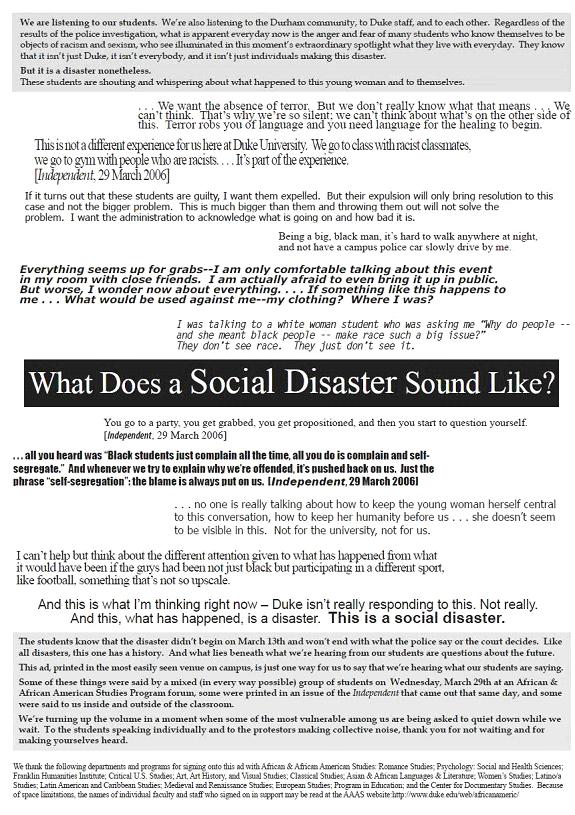
In the Carrington rulings, Duke’s most clear-cut victory also represented a tremendous setback to student rights throughout the 4th Circuit. Citing the precedent of Love (which involved a far, far narrower set of allegations), Beaty dismissed a breach of contract claim to hold Duke liable for failing to enforce the terms of its faculty handbook (all students must be treated with respect) and student bulletin (harassment against students won’t be tolerated). He argued that, under Love, documents like the bulletin and handbook aren’t contracts. In other words: universities can use them to enforce judgments against students, but when universities don’t live up to their provisions, students have no legal recourse. And since it would be hard to imagine a more clear-cut case of lack of respect (the Group of 88 statement with false assertions of departmental endorsements, the Houston Baker letter, Tim Tyson protesting outside the captains' house) or harassment (both in-class and on campus) than the lacrosse case, Beaty’s ruling fortifies and expands the Love precedent, and essentially means that students anywhere in the 4th circuit are out of luck on this line of response when activist faculty or favored elements in the student body go after them.
(By the way, historians aren’t supposed to make predictions, but I’ll offer one here: Duke won’t amend its student bulletin or faculty handbook to make clear to current and prospective parents that the university can violate these documents at will, if enforcing their provisions would require the administration to alienate activist faculty members on campus.)
Two other aspects of Beaty’s ruling reflected current law, but his findings seemed intellectually counterintuitive. First, he dismissed one claim against Duke on grounds that in North Carolina “no basis to support the contention that a sexual assault nurse examiner owes a duty to the general public, or to individuals who are members of the public who may subsequently be targeted during a police investigation,” on grounds that the SANE nurse has a “primary duty to the patient.” Yet in our legal system, the SANE essentially functions as an agent of the state, with a job of collecting and interpreting evidence for possible use in trial. If, in fact, such a figure owes no duty to the general public, then perhaps the general public should assign to SANEs a less significant role in criminal prosecutions.
Second, Beaty dismissed another claim against Duke on grounds that, under relevant case law, students have no expectation of privacy regarding their keycard information. This finding reflects the Supreme Court’s strained interpretation of privacy rights, but my sense is that most students would find it jarring to discover that they have no privacy rights regarding the electronic record of when they come and go from their dorms.
Duke’s Defeats
Duke’s defeats outweighed their victories—in what senior administrators must have regarded as a premature April Fool’s joke, Beaty allowed multiple claims of conspiracy and obstruction of justice, fraud, and negligent supervision to proceed against the University and its employees. His ruling also offered a rather . . . negative . . . review of how the Duke faculty approached the case.
On one fraud claim—which comes out of Duke’s having given the DPD access to its students’ keycard information without a warrant, in apparent violation of FERPA; and then lying about it when Nifong subsequently requested a court order for the information, which Judge Titus denied—Duke seems extremely vulnerable. (Duke has never explained why it didn’t notify the lacrosse players that the university had improperly shared their student data with the DPD.) And whether the university being held civilly liable for violating FERPA would prompt some federal accompanying actions remains an open question.
On the medical front, Beaty’s rulings clearly focused attention on former SANE-nurse-in-training Tara Levicy, whose willingness to constantly alter her story to fit Nifong’s needs played such an important role in keeping the case alive. He dismissed claims against Levicy’s supervisors—but they weren’t the figures who obviously committed misconduct in this case. And, perhaps most troublingly for Duke, his ruling invited the plaintiffs to establish a connection between Duke and Levicy’s unusual behavior.
Administratively, Duke itself and President Richard Brodhead as an individual remain potentially liable for fraud and negligent supervision—meaning that depositions and discovery will commence, presumably to include Brodhead’s emails. And Beaty suggested that the negligent supervision claim could provide the avenue he seemingly blocked by dismissing the breach of contract claim to examine why the administration stood aside meekly as activist faculty members chose to exploit their students’ difficulties.
A final point: in dismissing a claim for intrusion upon seclusion against Duke administrators, Beaty offered this appraisal of activist members of the Duke faculty: “The Amended Complaint alleges conduct by faculty members [which was based on information that is entirely in the public record] that is certainly questionable.” Another prediction: Duke won’t be broadcasting this evaluation to prospective parents anytime soon.
What Discovery Should Reveal
The path laid out by Beaty’s rulings strongly suggested that—one way or the other—the discovery process will provide answers to a few lingering questions from the case, namely:
(1) When, precisely, did senior members of the Durham Police Department (and City Manager Patrick Baker) elect to allow Mike Nifong to assume personal command of the police investigation? Why did they do so? And why did they not step back in to establish normal processes when Nifong ordered the DPD to violate its own procedures and run a suspects-only lineup?
(2) When, precisely, did senior members of the Duke administration, including Brodhead and former BOT chairman Bob Steel, learn of former SANE nurse-in-training Tara Levicy’s involvement in the case? And why did they not step in to establish normal processes when Levicy started violating regular SANE procedures by changing her story to fit Nifong’s tale and providing the police with information not contained in her written report?
(3) When, precisely, and for what reason did Duke establish its students’ presumption of innocence as one of the two pillars of the university’s policy, as Brodhead subsequently, and misleadingly, claimed? We know that one senior administrator, Larry Moneta, told Samantha Ekstrand on tape that he did not believe the players were innocent; and we know that in his April 5, 2006 open letter, Brodhead made no mention of a presumption of innocence. By June, he would do so: had university counsel grown concerned with the possibility of civil suits?
Linwood Wilson
Proving yet again the aphorism that a man who represents himself has a fool for a client, Counselor Linwood Wilson’s filings failed to persuade: between the three lawsuits, Wilson is still facing nine separate claims.
Duke’s Defenders
Perhaps the most revealing—and, unintentionally, critical of Duke’s position—reaction to Judge Beaty’s rulings came from Duke’s official spokesperson and a Duke apologist.
Duke spokesperson Michael Schoenfeld commented, "The few claims remaining are substantially narrowed, as we had hoped." [emphasis added] It’s quite true that Beaty “narrowed” claims against Duke. But the “narrowing” consisted of his eliminating mid-level (or in one case all) administrators, while leaving the university itself still potentially liable and the overall claim entirely unaffected; or his eliminating Durham but not Duke from one fraud claim.
Duke, as we learned from the AIG lawsuit, has already spent millions of dollars on attorneys. If a ruling that kept the university potentially liable for multiple claims of conspiracy and obstruction of justice, fraud, and negligent supervision is the outcome for which the university leadership “hoped,” what kind of outcome had these high-priced lawyers predicted to Brodhead and the Duke Trustees?
Duke alumnus and apologist Beau Dure, meanwhile, produced a post establishing “fair and balanced” bonafides that would make Glenn Beck proud. After a token expression of sympathy with the falsely accused players, Dure asserted that “the people you’d typically meet as an undergraduate have little left to face in court other than Count 11”—an odd formulation, since virtually none of the claims involved people “you’d typically meet as an undergraduate.” The post incorrectly implied (but didn’t state outright) that my initial area of interest was in exposing the media’s rush to judgment on the criminal case—whereas, obviously, my initial focus in the case was exclusively in exploring the motivations for what Judge Beaty termed the “questionable” behavior of the Duke faculty. The post also minimized the Group of 88 statement with this almost hilarious line of argument: “I did show the ad once to a neutral party, who wondered what the fuss was all about.” (Adopting this approach, allow me to pass along the following: I showed Brodhead’s April 5, 2006 statement to a fellow rider on the G-train, who wondered what the fuss was all about.) Some might think that a former Duke student would be troubled by his university affirming that Duke should have no legal obligation to ensure that faculty treat all Duke students with “respect” and that all Duke students shouldn’t be harassed, even though the faculty handbook and the student bulletin appear to promise such a standard. But Dure—as, I suppose, a good Duke apologist must—seemed almost giddy about this development.
Dure focused, however, on a peculiar claim: after implying but not quite stating explicitly that Duke’s activist faculty suffer from the effects of groupthink, Dure offered the unsurprising observation that the DIW commentariat (which he darkly described as a “mob”) exhibits symptoms of groupthink. (Dure also, oddly, claimed to have commented at DIW “back in the day” only to have been “shouted down” by DIW commenters, though a blogger.com DIW search, and a Google search for “'Beau Dure’ Durham Wonderland” revealed no comments by Dure on DIW.) In any event, as anyone even remotely familiar with the blogosphere knows, blogs do a lot of good things, but providing comments sections that feature all points of view in significant numbers generally isn’t one of them. University faculties, on the other hand, purport to have higher standards than blog commentariats, especially in ensuring diverse viewpoints among the professoriate.
So is this what it’s come to in this case? The university’s spokesperson says Duke “hoped” for an outcome in which multiple claims of conspiracy and obstruction of justice, fraud, and negligent supervision would go forward; and a Duke apologist compares the intellectual diversity of his former university’s activist faculty to that of a blog’s commentariat.