MEET THE AUTHOR: KARLA FC HOLLOWAY
Sunday, July 17, 3 p.m. - 4:30 p.m.
Main Library, 300 N. Roxboro St.
Dr. Karla FC Holloway, James B. Duke professor of English at Duke University, will read from her book, Private Bodies, Public Text: Race, Gender and a Cultural Bioethics. Using historical examples, from the Tuskegee Study and Henrietta Lack to the more contemporary examples of Terri Schiavo and those hospitalized during Hurricane Katrina, Dr. Holloway demonstrates how [of course--ed.] race and gender play pivotal roles in medical research and treatment. A book signing will follow the reading.
Saturday, July 16, 2011
Holloway & The Potbangers, Together Again
Wednesday, July 13, 2011
Updates
Wednesday, July 06, 2011
A Few Items
Friday, July 01, 2011
Rushing to Judgment
[Updates, 4 July, 5.22pm: Two Daily Beast pieces worth noting. The first, from Harvard Law professor Alan Dershowitz, uses the DSK case to analyze the problems with the public's response to rape allegations in general. Virtually Dershowitz's entire essay could apply to the lacrosse case, none more so than the following: "Special sex prosecutors and special rape prosecutors are often agenda driven. Too often they believe they’re on a mission and treat the alleged victim in a way that’s different from how they handle any other crime. They’re zealots; I call them Nancy Grace prosecutors. She behaves on her TV talk show as if there’s no such thing as innocence; everybody arrested is guilty. I believe there’s been a Nancy Grace aspect to this case. The prosecution presented its case in public as if there were no doubt about the alleged victim’s credibility or the complete guilt of the alleged offender."
Second, from DSK defender Bernard Henri-Levy. I'm dubious about the more general defense of DSK's character associated with Henri-Levy's earlier comments on the case. But his essay contains one very important item, in his reflection upon a letter by Bill Keller, the retired executive editor of The New York Times, in which "he said he was 'struck' and 'puzzled' by the fact that '57 percent of the French public' and, in particular, '70 percent of the Socialists' seemed to embrace the cause of Dominique Strauss-Kahn, whereas 'one might expect' them 'to be ideologically empathetic to an African hotel maid.'"
That comment unintentionally offers insight into the Times' decision to so heavily slant its lacrosse case coverage in favor of Mike Nifong and Crystal Mangum. It's no secret that the non-Murdoch media leans to the left, to such an extent that "one might expect" them "to be ideologically empathetic to an African"-American alleged student. Perhaps this is why, early in the case (see UPI, p. 120), Times editors made the conscious decision to downplay evidence of innocence in the paper's coverage.
[Updates, 2 July, 1.40pm: The Times today--showing an intent to explore the news that was sadly lacking in its Duke case coverage--brings more information, suggesting that the Nifong/Vance comparison might be more apt. Today's article reveals that a debate occurred as to how fast to press for an indictment, with the ultimate decision to rush ahead with an indictment (and to make public comments about the reliability of the "victim") before the investigation was anywhere near complete. That decision, obviously, was a grave mistake. See Ann Althouse's post for more on the effects of these actions; but also this counter-intuitive post from Feministe observing that, at the least, Vance's office turned over exculpatory information promptly to the defense, in sharp contrast to Nifong's handling of the Meehan report.
Two other matters: One, a question from the previous thread, asking me for what I considered Nifong's chances to be of his regaining his law license in 2012. My answer: his chances are very, very, very remote.
Two, see the comment in this thread from an "Edward G. Nilges" for evidence of how the unethical actions of Nifong and the DPD continue to harm the falsely accused players, and thus why the civil suit continues to matter. Even if only 1% of the American public is as ignorant as Nilges, we're talking about more than 3m people.]
The New York Times appears to have suddenly discovered the importance of evaluating the accuser’s credibility when reporting on sexual assault cases. Last night, the paper broke the story that the rape case against former IMF head Dominique Strauss-Kahn has been badly weakened (fatally undermined?) by enormous gaps in the accuser’s credibility. To get a sense of just how enormous, here’s the prosecutors’ letter on some of the problems.
One can imagine how the Times’ Duff Wilson (who was promoted after his coverage of the lacrosse case) would have reported the news: “Although DA Cyrus Vance, Jr. discovered big holes in the case, including the fact that his accuser is a serial fabricator, there is also a body of evidence to support his decision to take the matter to a jury.”
Vance’s decision to affirm for the cameras a stronger case than he actually possessed was Nifongesque. And comparisons to the lacrosse case, which have appeared frequently in the last 24 hours, are hard to avoid.
That said, the comparison can be overdrawn, in at least two respects. First: while the decision to arrest clearly was made before anything resembling a comprehensive police investigation occurred, there’s no evidence (to date) that DA Vance personally corrupted the inquiry, as occurred with Nifong and the DPD. Second, and perhaps more important: the media critique of DSK’s personal characteristics seems largely correct. Regardless of the legal demerits of the case, this affair doesn’t seem to have been a case of character assassination, in sharp contrast to the lacrosse case.
In this respect, the more appropriate comparison might be the Garrett Wittels case. In late December, to widespread national coverage, the FIU baseball star was arrested in the Bahamas, charged with rape. To their credit, unlike the Duke administration, the FIU administration upheld the presumption of innocence and didn’t suspend Wittels; and, unlike the Group of 88, “activist” faculty at FIU didn’t choose to publicly go after one of their students. (A handful of hacks did try to exploit the case, offering bizarre arguments in the process.)
Wittels always maintained his innocence, and his accusers’ story always seemed less than plausible. Last week, all charges against the player and his two friends were dismissed, amidst signs that his accusers had lied as part of a scheme to exploit money. Yet the turn of events generated far less coverage than the initial allegations against Wittels; and the false charges had an effect—Wittels went undrafted in the MLB draft, apparently because of “character” concerns.
The Wittels and DSK cases do serve as reminders that the lacrosse case isn’t the only evidence against the “women-never-lie” claim of sexual assault.
Monday, June 13, 2011
Accountability
The lack of accountability is a major theme of the lacrosse case and its aftermath. Whatever else could be said about rogue ex-DA Mike Nifong, the State Bar eventually held him accountable, and stripped him of his law license. That action, in turn, triggered an accountability session for the ethically challenged Linwood Wilson, who was fired from his job as DA investigator as soon as Nifong lost his position. And, with the company he founded facing a loss of accreditation, Dr. Brian Meehan eventually lost his job as well.
Compare that record to the academy and to the media. In the academy, if anything, participation in the witch-hunt is a career advancer. Several prominent members of the Group of 88 either left Duke for better jobs (Farred, Baker, Payne) or were promoted within Duke to deanships. The administration even forked over a large legal settlement to the falsely accused players in part to shield individual faculty members from legal liability.
And then there’s the media. Bob Ashley stayed on as the Herald-Sun’s editor until his retirement this past January. Likewise with the Times’ Bill Keller, who kept his position for years until recently stepping down. Duff Wilson is still at the Times, where he was promoted to cover the tobacco and pharmaceutical industries. His on-line bio adds that he’s “currently a member of the board of directors and executive committee of the nonprofit group Investigative Reporters and Editors,” and has taught investigative reporting.” (The site doesn’t feature his syllabus, but based on his Duke reporting, presumably Lesson Plan One is, “Always Trust Whatever the Prosecutor Tells You.”)
But none of these figures can compare to Nancy Grace, subject of a glowing profile (coupled with a photo of Grace in a stylish black leather jacket) in Sunday’s Times. The article, by Brian Stelter, noted that Grace’s current network, HLN (the successor to Headline News), has reoriented itself (and boosted its ratings) around Grace’s guilt-presuming coverage of high-profile trials. It doesn’t mention just how wrong-headed Grace’s trial coverage has been in the past.
And the MSM wonders why younger people increasingly trust The Daily Show for hard news?
Friday, June 10, 2011
Beaty's Levicy Dilemma
More than five years after rogue ex-DA Mike Nifong and his subordinates in the DPD obtained indictments, the discovery process has begun in the civil suits. Ironically, however, only some of the Duke defendants are currently subject to that discovery.
The reason? Durham is appealing Judge Beaty’s ruling allowing the lawsuit to proceed, on the grounds that the city has governmental immunity against the lacrosse players’ claims. In other words: the city can violate its own procedures to frame innocent citizens, and should have no civil liability for its actions.
Very broadly reading the terms of the 2009 Ashcroft v. Iqbal decision, and citing a host of other cases of which the only absolutely on-point was a 2002 holding from the Middle District of Alabama that obviously isn’t binding precedent in North Carolina, Judge Beaty granted Durham’s request to delay discovery for (at the very least) many months, as Durham’s longshot appeal winds its way through the federal court system.
On the surface, Durham’s legal strategy makes no sense, especially given its political leaders’ constantly complaining about the cost of the lawsuit to them. But at a practical level, the Durham approach is unsurprising. First, the more time that elapses before discovery, the more opportunity for the DPD to “lose” evidence, or for DPD officers to claim that they don’t recall what happened in spring 2006. Perhaps more important, dragging the case out for as long as possible means that the political enablers of the hoax (such as Diane Catotti, the Nifong-supporting city councilor who strove mightily to neuter the commission intended to investigate the DPD) will get more time before having to justify their conduct to the electorate.
One element of Beaty’s discovery order, however, provides some insight into how he (at this very preliminary stage) views the case. In his rulings on the motion to dismiss, Beaty dismissed claims of malpractice against Duke and former SANE nurse-in-training Tara Levicy on the grounds that Levicy had no legal obligations relating to care to the public. (Her only legal obligations in this regard, Beaty asserted, were to false accuser Crystal Mangum.) This finding struck me as odd, since Levicy’s primary role in this case was not to provide medical care of any type to Mangum, but rather to gather evidence and offer analysis that the state might use in any prosecution.
In his discovery order, Beaty backtracked—at least intellectually—from this finding, and has now decided to lump Levicy in with the Durham defendants. The allegations against Levicy, he wrote, are "so intertwined with the claims against the city” that no discovery relating to Levicy or Duke Hospital can proceed.
In the short term, this finding is a tremendous victory for Duke: if Durham succeeds in its longshot appeal, and either the 4th Circuit or the Supreme Court holds that qualified immunity applies even when city employees attempt to frame innocent people, then Tara Levicy or records relating to her dubious conduct will never face the plaintiffs’ attorneys.
In the long term, however, this finding poses terrific risks for Duke, since Beaty appears to be conceding that the allegations on the table (before, it’s worth reiterating, any discovery has occurred) demonstrate that a Duke employee was inextricably “intertwined” with the hoax. If he’s consistent with that finding, it will be much harder down the road for Duke to separate itself from the misconduct of Durham employees.
Wednesday, June 08, 2011
Durham: Don't Let Lacrosse Players Appeal
Both the city of Durham and attorneys representing the falsely accused lacrosse players have appealed portions of Judge Beaty’s ruling in the Evans case. The two sides, however, have exhibited differing strategies of appeal. Durham is claiming that not only was Beaty’s ruling incorrect, but also that the city should be allowed to indefinitely delay the discovery process as its (longshot) appeal works its way through the court system. As for the lacrosse players’ appeal? In a filing from yesterday, Durham is claiming that they shouldn’t be allowed to appeal at all.
The issue involves Durham’s late March 2006 decision, as documented by former Sgt. Mark Gottlieb, to ignore the police department’s command structure and instead to turn over command of the police investigation to rogue DA Mike Nifong. In his ruling, Beaty said that the city had no legal authority to have done so, and therefore the city can’t be held liable for punitive damages. (Nifong was a state employee; states can’t be held liable for punitive damages in federal lawsuits under the 11th amendment.) Attorneys for the lacrosse players are seeking to appeal this portion of the ruling, noting correctly that this interpretation amounts to a get-out-of-jail-free card for unethical entities like the DPD—they could simply turn over future police investigations to Nifong’s ethically-challenged successor, Tracey Cline, and thereby shield the city from punitive liability.
Durham wants Beaty to refuse to certify the lacrosse players’ appeal, thereby ensuring that no higher court even would hear it. In its filing, Durham concedes that the DPD violated state law by allowing Nifong to take over the investigation: “North Carolina law clearly does not permit a City to delegate its final policymaking authority to a state official, and bars a state official from acting on behalf of any governmental entity other than the state.” But, the city muses, as it couldn’t legally have taken the action that it did, in fact Nifong wasn’t really in charge of the investigation after all—the DPD, and the rogue ex-DA himself, were essentially just pretending that he was running things.
Beaty accepted this line of reasoning in his ruling—in part, it would seem, because the facts of this case were so unusual and because he permitted the falsely accused players’ civil rights lawsuit against the city to move forward on other grounds.
It’s worth remembering—as Ray Gronberg pointed out in today’s H-S—that former city manager (and current city attorney) Patrick Baker is on record claiming that the command-structure procedures employed in the lacrosse case is normal for Durham. He wrote in 2007 that “the police are a part of the prosecution team and as such it is not unusual for the investigators to work closely and coordinate their [work] with the prosecutor.” Of course, in this instance, the prosecutor was running the police investigation, well before any indictments were obtained.
Friday, June 03, 2011
Edwards Indictment
Saturday, May 28, 2011
Catalino Hat Trick Propels Maryland
Tuesday, May 17, 2011
The Power of False Accusations
In this Sunday’s Washington Post, reporter Tom Jackman relayed the horrific tale of what happened to Sean Lanigan, a teacher in the Fairfax County Public School System. A 12-year-old girl in one of his classes falsely accused Lanigan of sexual misconduct, and his life has never been the same.
The affair read as an almost textbook case of a false accusation. The girl, who appears to have serious emotional problems, had troubles with Lanigan before the allegation. (She had bullied students, and Lanigan had called her on it.) She made the charge—resulting in Lanigan’s arrest—without the lead detective, Nicole Christian, ever interviewing her. Nor did the police determine whether her claims were even physically possible. The story that produced Lanigan’s arrest involved a claim of sexual misconduct on tumbling mats in the equipment room, but Jackman reports that “several witnesses said the tumbling mats couldn’t even fit in the equipment room.”
The girl at least partially recanted her tall tale on facebook, and at a preliminary hearing, but the prosecutors decided to go forward anyway. After the state presented a case that could charitably be described as lacking in evidence, jurors acquitted Lanigan in 47 minutes; one of the jurors was crying in outrage that the case had been allowed to proceed. Jackman portrays Detective Christian as a latter-day Inspector Javert—and also points out that, in a highly unusual move, the local prosecutor chose to dismiss another case that she investigated as it was going to trial.
Yet despite the acquittal, the Fairfax schools have treated Lanigan as if he were guilty. The school district couldn’t fire him, but it did prevent him from returning to his old school, and in the 2010-11 academic year, he was only allowed to teach half-time. Administrators drew up a lengthy behavior contract for him, seemingly based on an assumption that the girl’s allegations had some merit. And the school district has thus far refused to pay his $125,000 legal expenses, even though Virginia law allows public employees who are falsely accused on the job to have the state cover their attorneys’ fees.
Apart from the obvious—that a false allegation of sexual assault, once made, can never truly be undone—what’s the relevance of the Lanigan case to the lacrosse case? In a column yesterday, Jackman commented on the Post’s refusal to identify the false accuser. The decision seemed eminently reasonable: the United States has a long tradition of sealing juvenile records, and the idea of identifying a minor would seem consistent with this philosophy.
But then Jackman broadened his comment, to examine the issue of the media identifying adults who level unsubstantiated allegations of sexual assault. Here’s what he had to say:
This issue has long been batted around in journalism, most recently in the case of the woman who accused the Duke University lacrosse players of raping her. Even after the case against the players was dropped, the mainstream media mostly did not name her. She came to prominence as a sex crimes victim, the media automatically protects such victims’ anonymity, and just because suspects weren’t convicted (for a variety of reasons) doesn’t always mean the crime didn’t happen.
[Then the Duke accuser, Crystal Mangum, was arrested recently for murder, and all bets were off.]
This passage is highly problematic, for three reasons.
First, it inaccurately relates how the media handled identifying Mangum. It’s quite true that the two newspapers whose pro-Nifong handling of the case was widely discredited—the Herald-Sun and the New York Times—declined to identify Mangum after the attorney general exonerated the players. But, of course, the N&O, leading paper in the Triangle (and on the case itself) immediately identified Mangum after the exoneration. So too did the New York Post, in a front-page photo and story. So too did local TV stations. So too did at least some newspapers that carried the AP.
Second, the passage illuminates the illogical nature of the media’s generally refusing to name false (adult) accusers. Victims’ rights advocates contend that naming sexual assault accusers will discourage real victims from coming forward. Even assuming that the media should withhold information to accommodate the assertions of victims’ rights advocates, it would seem that their argument would demand that all newspapers publish the names of false accusers. After all, if publicizing names will discourage people from coming forward, shouldn’t everyone want to discourage false accusers from making their false claims?
Third, and by far the most important, is Jackman’s assertion—in a clause bracketed by explicit reference to Crystal Mangum—that “just because suspects weren’t convicted (for a variety of reasons) doesn’t always mean the crime didn’t happen.” It’s the height of irony to see a reporter who sensitively and comprehensively relayed the story of a false accusation’s poisonous effects toss in a line that suggests—without any evidence to back it up—that maybe, just maybe, the attorney general’s report was wrong, and that what was publicly revealed about the Duke case doesn’t “mean the crime didn’t happen.”
It seems that, despite the best efforts of so many people, the meme of “something happened” persists.
-----------------
On another note entirely: I have a piece up at MTC on how two faculty members at the UVA Law School responded to a politically correct false accusation. Upholding due process was not first on their minds.
Thursday, April 21, 2011
Known Unknowns
Former defense secretary Donald Rumsfeld defined the concept as “things that we now know we don’t know.” It didn’t help him much in planning the Iraq war, but I thought I would more usefully apply it to the items raised by Duke’s factual response, the first time the University has gone on record regarding the specific allegations against it.
FERPA
(1) When did senior administrators become aware that—in violation of FERPA—Duke Police Officer Gary Smith provided the lacrosse players’ keycard information to the Durham Police?
(2) What was the rationale employed by Duke’s senior administrators in electing not to inform dozens of their own students that a Duke employee had violated their FERPA rights? Is this “wall of silence” (to borrow a phrase) the normal approach Duke takes when its employees violate the FERPA rights of its students?
(3) As to why Duke remained silent when a court proceeding took place regarding Mike Nifong’s attempt to subpoena the keycard information he already possessed, the Duke filing suggests the University’s reasoning (substitute “FERPA-protected material” for “NTO application”): “Duke University Defendants . . . further deny that they had any authority or obligation to rebut or correct any assertions in any NTO application regardless of the truth of the allegations.”
Former SANE-nurse-in-training Tara Levicy
(1) When did senior administrators at Duke learn—as they concede in their filing—that Levicy had examined Mangum even though Levicy was not yet credentialed as a SANE?
(2) When did Levicy’s supervisors first realize that Levicy’s stories constantly shifted, always in ways convenient to Nifong and contrary to the written record of her exam? Why did they not take steps at the time to properly supervise their rogue employee?
(3) What transpired at the June 2006 meeting between Levicy and Nifong? Were any other Duke employees (perhaps Levicy’s immediate supervisor, Theresa Arico?) present?
(4) Is it normal practice at Duke Hospital to allow someone (like Levicy) who hadn’t even been a nurse for a year to enter the SANE program?
The Duke Administration
(1) What steps, if any, did former BOT chairman Bob Steel take to correct the record regarding something the Duke filing implies he never said—his statement to the New Yorker that the season was cancelled not to protect the lacrosse players or to punish them for their alleged misdeeds, but because “we had to stop those pictures. It doesn’t mean that it’s fair, but we had to stop it. It doesn’t necessarily mean I think it was right—it just had to be done”?
(2) During his tenure as president, how many other athletic events had President Brodhead canceled because members of the team had engaged in underage drinking—which the filing suggests was (contrary to Steel’s “Kinsley gaffe”) one of the two reasons Duke cancelled the March 25, 2006 lacrosse game?
(3) What contemporaneous evidence exists to sustain the second proffered explanation for this extraordinary decision—Brodhead’s alleged concern with the safety of the lacrosse players? Why didn’t he mention this alleged concern in his statement announcing the cancellation?
(4) Duke’s filing concedes that a Duke employee (Sam Hummel) likely used Duke equipment to photocopy a “wanted” poster containing the lacrosse players’ photos, while at the same time maintaining that this action constituted protected speech and not harassment. Would Duke have adopted the same conception of its anti-harassment code if the photographs xeroxed by Hummel were of minorities?
The Group of 88
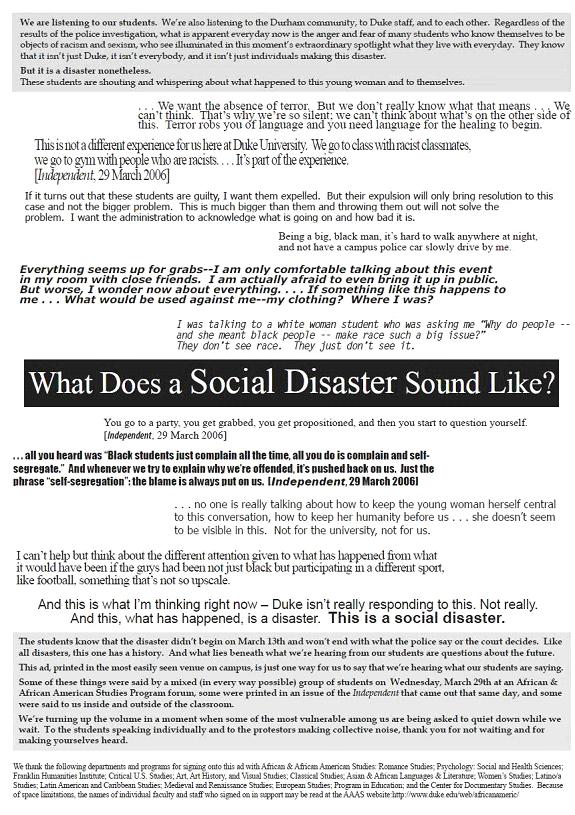
(1) When did Brodhead and other Duke senior administrators learn that—in violation of Duke rules—official university funds had been used to pay for an advertisement denouncing Duke students? What steps, if any, did the university take to discipline the sponsors of the advertisement, the African-American Studies program?
(2) Given that Duke administrators surely knew of AAAS’ unprofessional behavior by December 2006, why nonetheless did the Trustees (unanimously!) elevate the program to departmental status?
Officer Christopher Day
(1) What pressure, if any, did his supervisors or Duke administrators place on Day to “modify” (as he eventually did) his March 14, 2006 operations report, which (accurately) portrayed false accuser Crystal Mangum as spinning fantastic, mutually contradictory tales?
(2) Why is the Duke filing so coy about exactly who might have interacted with Day between March 14 and March 30, and what reasons he might have had to have “modified” his operations report?
Duke’s Legal Strategy
(1) In its defense of Tara Levicy’s going rogue, how aggressively will Duke’s attorneys attack the integrity of the AG’s investigation? In particular, will they continue down the path offered in their filing of portraying Levicy as an objective truth-teller, even as the AG’s report established that “the SANE based her opinion that the exam was consistent with what the accusing witness was reporting largely on the accusing witness’s demeanor and complaints of pain rather than on objective evidence”?
Tuesday, April 19, 2011
Joe Neff Honored
Monday, April 18, 2011
Friday, April 15, 2011
Duke's Factual, Semi-Factual, & Non-Factual Response
After the failure of the university’s efforts to have the civil rights lawsuit against it dismissed, Duke has filed its lengthy factual response to the unindicted lacrosse players’ complaint. Its general approach: deny anything for which there’s no open record; blame others (Nifong, the Durham Police) by inference regarding areas in which the facts can’t be denied.
Two general points: first, this response wasn’t due until June 14. I’m sure the fact that Pres. Brodhead is currently in China, and therefore unreachable by the local media, had nothing to do with Duke’s decision to file its response a bit early.
Second, it’s important to remember on what issue—thanks to Judge Beaty’s ruling—Duke doesn’t have to deny or shift blame: the university’s failure to enforce its own written policies regarding treatment of the lacrosse players. On this question, the university can breathe a sigh of relief that it’s not located 247 miles to the southwest—since, if it were so located, it would fall within the jurisdiction of the 11th Circuit. And, as this recent filing from FIRE points out, in the 11th Circuit, universities are legally obligated to enforce their own student bulletins and faculty handbooks, rather than treat them as mere scraps of paper.
As if to reiterate the point, Duke’s filing notes (in an oddly-worded passage), “Duke University denies that the language from the Faculty Handbook . . . sets forth Duke University’s policy regarding policy.”
When, if ever, will the university communicate this information to prospective parents?
A summary of the major elements from the University’s 252-page filing:
The Group of 88 Statement
“Duke University denies that the full-page, paid announcement that ran in The Chronicle, and that identified 88 individuals and contained unattributed quotations, made anything ‘clear’ about what its authors or sponsors believed about the evidence of rape. Duke University admits that the cost of running the announcement was paid, in part, with funds from departments within Duke University.”
For the first time, Duke has officially admitted that University funds paid for the Group of 88’s ad. The use of “in part” is intriguing: is Duke suggesting that private individuals partly financed the ad? If so, who were these people?
In any event, consider the significance of this admission. Not all the lacrosse players were on full scholarships. So Duke has now affirmed that some of the players’ own tuition moneys were used to produce an ad that publicly condemned them—an ad placed in violation of Duke rules, moreover. When considering where to send your son to college, what parent could ever even conceive of such behavior from an institution that gladly accepted your tuition check?
Tellingly, the university can’t bring itself to accurately describe the ad. It’s true that the ad did contain “unattributed quotations” that allegedly came from Duke students. But the statement also contained thirteen sentences in the voices of the signatories, not in the form of “unattributed quotations,” as well as an additional sentence falsely claiming that five academic departments at Duke endorsed the ad. What’s the purpose of describing the statement in a misleading fashion? To elide over the fact that those 13 sentences included a clear, unequivocal statement that something “happened”—not “allegedly happened”—to false accuser Crystal Mangum?
In any event, this mis-description continues Duke’s legal strategy of misrepresenting the lacrosse players’ claims to such a wild extent that it would have to undermine the university’s credibility with Judge Beaty.
Former SANE-nurse-in-training Tara Levicy
The university’s response concedes that Levicy had not, in fact, received her “certificate of completion” from her SANE training course until after she conducted her examination of Crystal Mangum—and that, therefore, she was a SANE-in-training when the botched exam occurred. Indeed, on p. 34, the University, for the first time, states it explicitly: “Tara Levicy was a registered nurse who was working as a staff nurse and as a SANE in training in the Emergency Department at Duke University Hospital.” [emphasis added] So why did the hospital allow her, without supervision from a credentialed SANE, to examine Mangum? Imagine how this case might have differed if the hospital had followed established procedures on this matter.
Moreover, the Duke response concedes how woefully inexperienced Levicy actually was at the time she examined Mangum: “DUHS and Nurse Levicy admit that Nurse Levicy began working in the Emergency Department at Duke University Hospital in February 2005. DUHS and Nurse Levicy further admit that this job was Nurse Levicy’s first nursing job following receipt of her nursing degree in December 2004. DUHS and Nurse Levicy also admit that Nurse Levicy began her SANE training in August 2005, and that her certificate of completion was effective on March 2, 2006, although she did not receive the certificate until the late afternoon of March 14, 2006 [which, of course, was after she examined Mangum].” Again, imagine how this case might have differed if Duke Hospital had a competent, professional SANE nurse instead of an inexperienced, ultra-feminist SANE nurse-in-training examine Mangum.
As to other allegations, the university affirms, over and over and over again, that “Nurse Levicy likewise denies that she made any statements to members of the Durham Police Department or to investigators working with then District Attorney Nifong that were inconsistent with the examination of Ms. Mangum.”
Based on the record of the case, Levicy’s stories undoubtedly shifted, always in ways convenient to Nifong and contrary to the written record of her exam. This passage would seem to represent an effort by Duke to shift the blame, setting up a claim that Levicy told the truth to Sgt. Mark Gottlieb and ex-Nifong investigator Linwood Wilson, but that they, in turn, lied (blunt force trauma, Mangum wasn’t sure about whether her attackers used condoms) about what she told them. Given that the Gottlieb/Wilson version of what Levicy told them was completely consistent with what Levicy told the defense attorneys in their interview with her, this strikes me as a difficult argument to make.
One other point: the university’s filing confirms for the first time the long-rumored extent of Levicy’s cooperation with the investigation. “Nurse Levicy admits that she met with or conversed with members of the Durham Police Department on a limited number of occasions and responded to questions from investigators . . . Nurse Levicy further admits that she met with former District Attorney Nifong in June 2006 and responded to his questions about the sexual assault examination.” The university’s filing contains no details about what transpired at this mysterious meeting, during which Nifong (it seems) took no notes. Nor does the university’s filing reveal how many the “limited number of occasions” were in which Levicy chatted with DPD officers—chats that do not appear to have been recorded in the official case discovery file.
Beyond these blanket, and almost comical, denials, Duke appears to be using an element of Beaty’s ruling (that Levicy owed a duty only to Mangum, and not to the public) to shield Levicy’s examination from any meaningful inquiry: “It is a violation of the Health Insurance Portability and Accountability Act for the Duke SANE Defendants to disclose any of Ms. Mangum’s protected health information. Absent a court order authorizing such disclosure, the Duke SANE Defendants are unable to respond. Therefore, the allegations seeking information relating to Ms. Mangum’s protected health information are denied.”
Under this conception of the law, a SANE nurse could lie at will about an exam, and there would be no way to challenge her in a civil suit.
Levicy was Right, and the AG’s Investigation Was Wrong
Perhaps the most bracing element of Duke’s filing comes in repeated claims that the Attorney General’s investigation—upon which the declaration of innocence was based—improperly characterized the medical evidence, and that, as a result, objective medical evidence did exist that Mangum was raped. These assertions are nothing short of astonishing.
Two examples:
The Attorney General’s report stated, “No medical evidence confirmed [Mangum’s] stories. The SANE based her opinion that the exam was consistent with what the accusing witness was reporting largely on the accusing witness’s demeanor and complaints of pain rather than on objective evidence.” [emphasis added] But Duke now claims that “Nurse Levicy specifically admits that she remains both objective and neutral during such examinations.” [emphasis added]
“Nurse Levicy further admits that she told Investigator Himan that there were signs during the sexual assault examination that were consistent with sexual assault. Nurse Levicy specifically denies that she made any statements to members of the Durham Police Department that were inconsistent with the examination of Ms. Mangum.” Once again, the AG’s report stated, “The SANE based her opinion that the exam was consistent with what the accusing witness was reporting largely on the accusing witness’s demeanor and complaints of pain rather than on objective evidence.” Duke claims that Levicy was right, and the AG was wrong.
The FERPA Claim
The filing represents the first time that Duke offered any explanation as to the area of the lawsuit where it seems extremely vulnerable—that it provided keycard information, in violation of FERPA, to the DPD; and then it stood idly by as Nifong tried and failed to get (retroactive) court approval for that information.
“Duke University specifically denies that DukeCard reports were ‘illegally’ supplied by Duke University.” Why? Because “Duke University, Deputy Counsel Hendricks and former Director Drummond specifically deny that they had any knowledge that DukeCard information had been provided to members of the Durham Police Department.” As I understand FERPA law, willful ignorance doesn’t count as a defense.
Who at Duke improperly supplied the information? “Duke University admits that on or about March 31, Gary Smith provided DukeCard information to Sergeant Gottlieb for some of the members of the 2005-2006 Duke University men’s lacrosse team for the period of time from March 13, 2006 until March 14, 2006.” And “Duke University admits that it did not notify the lacrosse players, their families, or their lawyers of the disclosure.” Nor did Duke notify the Court, as it considered (and rejected) Nifong’s subpoena for the information. Why not? The University’s filing doesn’t say.
Odd Denials & Legal Niceties
“The Duke University Defendants and the Duke SANE Defendants further deny that President Brodhead or anyone else at Duke University suppressed or concealed any exculpatory information.”
The emphasis here would be on the word “any.” Of course Duke “concealed” some exculpatory information—to take an obvious example: the knowledge that, as Nifong and the DPD were waging their p.r. campaign accusing Duke students of having constructed a “wall of silence,” Duke knew that the captains (including one of the Carrington plaintiffs, Dan Flannery) had voluntarily given statements and DNA evidence to Durham. Yet the university remained silent. It might very well be that Duke considers this concealment legally irrelevant (and the university might be right). But to deny that the university “concealed any exculpatory information” is absurd.
“President Brodhead denies that he took no steps to enforce Duke’s anti-harassment policy and further denies that he condoned harassment of the players.”
The key words in this sentence are “no” and “condoned.” Duke’s statements could be legally true if (hypothetically) Brodhead placed an e-mail in his draft file, but never sent it, urging faculty and students not to harass the players—he would have taken a “step” to enforce the anti-harassment policy, but the “step” would have been a useless one. It’s pretty obvious that Brodhead didn’t actually do anything to stop either the in-class or on-campus harassment of the players, and it’s quite striking that even Duke doesn’t claim that its president acted in any meaningful way to stop the harassment of dozens of the university’s own students.
The remainder of the passage depends on how duke defines “condoned.” Take an obvious example—the Group of 88’s statement, through which dozens of Duke faculty members, basing their opinion solely on what Mike Nifong provided them, publicly affirmed in what they considered the highest-profile venue on campus that something “happened” to Crystal Mangum. That statement falsely claimed, in violation of Duke policy, that five academic departments had officially endorsed it. Yet Brodhead never compelled a retraction, nor did he order the African-American Studies Department to take the statement off its official duke.edu webpage. Duke appears to be claiming that Brodhead’s in the clear as long as he didn’t himself sign the statement, thereby “condoning” its contents, and that his administration’s failure to do its job didn’t constitute “condoning.”
“President Brodhead denies that any statements from him were designed to ‘impute guilt’ to the players or to ‘inflame’ public opinion against them.”
The key word in this sentence is “designed.” Brodhead’s April 5, 2006 statement—which didn’t even contain a token mention of the presumption of innocence—clearly “imputed guilt,” since it urged people to withhold judgment only until arrests occurred. The presumption, therefore, was that the arrested parties were guilty.
As to the claim that the statement wasn’t designed to “inflame” public opinion against the players: is the University really going to claim that its president, an English professor, didn’t understand how this statement would play in public opinion?
Obvious, but Damning, Admissions
“President Richard Brodhead admits that he played an active role in Duke University’s response to the rape allegations against members of the lacrosse team, and that he consulted with former Chairman Steel and members of the Duke University Board of Trustees in connection with the controversy. “
This admission was all but mandated by former BOT chairman Bob Steel’s ill-considered April 2007 e-mail, which affirmed, “Throughout the past year President Richard Brodhead consulted regularly with the trustees and has had our continuing support. He made considered and thoughtful decisions in a volatile and uncertain situation. Each step of the way, the board agreed with the principles that he established and the actions he took. As we look back and with the benefit of what we now know there is no question that there are some things that might have been done differently. However, anyone critical of President Brodhead should be similarly critical of the entire board.”
“Duke University admits that officers of the Durham Police Department informed officers of the Duke University Police Department that Ms. Roberts made a 911 call.”
This statement is damning for what it doesn’t say. One of Mike Nifong’s most dastardly deeds came in his late March 2006 (false) assertion that the DPD didn’t know Roberts made the 911 call. That left the impression that the lacrosse players were virulent racists, since two innocent black women, walking past the house, had been subjected to racial slurs. By the time the truth came out about Roberts, the damage was done. For the first time, this filing states that Duke knew that Roberts made the call. Tellingly, the filing does not reveal when Duke knew about Roberts. Did the university know before March 29, 2006, when Nifong made his false statement to the press? And if so, why did the knowledge that the DA was lying both about the players not cooperating with the police investigation and about the source of the 911 call not influence how the university approached the issue?
“Dean Wasiolek further admits that she had reason to believe that the accuser was not credible.”
No neutral party observing the Duke administration’s actions between March 25, 2006 and April 18, 2006 would ever believe that a key figure in formulating the administration’s response “had reason to believe that the accuser was not credible.”
“Duke University admits that the quote [‘We had to stop those pictures. It doesn’t mean that it’s fair, but we had to stop it. It doesn’t necessarily mean I think it was right—it just had to be done’] attributed to former Chairman Steel appeared in the New Yorker. Duke University denies that the quote accurately conveys former Chairman Steel’s statement.“
Why, then, didn’t Steel, at the time, write a letter to the editor, or issue a press release to make this point? Or could it be that former BOT chairman Steel only came to the conclusion that he was misquoted after Nifong’s case imploded? It strains credulity to believe that the New Yorker misquoted Steel and he did nothing to correct the record.
“Dean Wasiolek admits that she gave the name of Wes Covington to then Senior Associate Director of Athletics Kennedy as a name of a local attorney that players could contact. Dean Wasiolek further admits that she was complimentary of Mr. Covington and referred to his experience as a former Assistant District Attorney.”
Covington, of course, was the “fixer” whose intent appeared to be to end the case quickly and quietly, by giving Gottlieb access to any and all the players. The university’s filing repeatedly denies that any connection existed between Covington (who has since died) and Duke.
“Duke University, President Brodhead, and Deputy Counsel Hendricks admit that on March 28, 2006, the four lacrosse co-captains met with President Brodhead. Duke University, President Brodhead, and Deputy Counsel Hendricks further admit that other representatives of Duke University, including Deputy Counsel Hendricks, were present, as well as the co-captains’ own attorney. Duke University still further admits that some representatives of Duke University were interviewed by members of the Durham Police Department as part of the Durham Police Department’s investigation into the rape allegations, and they answered questions posed by the members of the Durham Police Department.”
This is Duke’s description of the meeting at which Brodhead blandly—and, obviously, falsely—assured the captains that anything they told him would stay within the walls of the room.
“Nurse Levicy, the Duke University Defendants, and the remaining Duke SANE Defendants further deny that they had any authority or obligation to rebut or correct any assertions in any NTO application regardless of the truth of the allegations.” [emphasis added]
Wow.
When There’s No Written Record (Yet), Duke Denies
“Dean Wasiolek denies that she advised the members of the team that they should not consult with an attorney. Dean Wasiolek further denies that she advised the members of the team that they should not tell their parents about the rape allegations.”
“Duke University and Executive Vice President Trask deny that they ever claimed the existence of a ‘student-administrator privilege’ and further deny that they misled the plaintiffs into providing statements that were contrary to their attorney’s advice.”
To my knowledge, no tape recordings exist of any of the discussions that Duke denies above. But the problem with these denials is obvious: contemporaneous witnesses with whom the lacrosse players spoke verify the players’ version of events. (If the lacrosse players had first mentioned any of these conversations not right after they occurred but instead in, say, March 2007, that would be a very different matter.) So Duke will have to ask the court to believe that in March 2006, the lacrosse players made up—for no apparent reason—versions of conversations that would prove damning to Duke once the case imploded.
Odd Clauses
“President Brodhead admits that he did not meet with the lacrosse players’ lawyers to review ‘evidence.’”
The use of “scare quotes” in this sentence is bizarre. Is Duke really intending to suggest that the lacrosse players’ attorneys—some of the most highly-regarded attorneys in the state—were offering to share tainted “evidence” with Duke? If not, why use the quotation marks?
“Duke University and Richard Brodhead admit that Richard Brodhead has served as President of Duke University, including during the period from March 13, 2006 (the date of Plaintiffs’ party) to the present.”
This description of March 13, 2006—which the university’s attorneys repeat over and over again in their filing—appears to be a not-so-subtle dig to suggest that the lacrosse players were to blame for what happened to them for attending the party in the first place. Yet by not qualifying the remark with “some of,” the statement is legally inaccurate and therefore inflammatory. Several plaintiffs, most notably Brad Ross, did not attend the party. In what way could the event be described as Ross’ party?
“Duke University denies that it has no rules or policies ‘with respect to the hiring of exotic dancers to perform at student parties.’”
This statement is particularly odd—first, because no such rule appears to have existed in the Duke Student Bulletin of 2005-6 (a document, of course, which Duke maintains it didn’t have to follow anyway); and second, because having made the claim, the university’s filing doesn’t even attempt to identify the previously unknown rule and/or policy it claims existed.
Here’s how the Duke filing describes the DNA evidence improperly withheld in Brian Meehan’s report: “The Duke University Defendants and the Duke SANE Defendants further admit that evidence has also been presented at those legal proceedings that would tend to show that Ms. Mangum had engaged in sexual activity with multiple males.” [emphasis added] “Tend to show”? Does the University have another explanation for the DNA findings?
“Duke University further admits that on March 25, President Brodhead decided to forfeit the next two lacrosse games, in part as punishment for the wrongdoing [‘which at a minimum included unlawful underage drinking and the provision of alcohol to minors’] which the players admitted, and in part because of concerns for the safety of the players.” He did? If so, why didn’t he mention the latter point in his cancellation statement? And with regard to the former, why did he begin his statement not with the (now-alleged) reason for the cancellation but instead with the following: “Physical coercion and sexual assault are unacceptable in any setting and have no place at Duke. The criminal allegations against three members of our men’s lacrosse team, if verified, will warrant very serious penalties.
(A note for the record: Brodhead’s March 25, 2006 statement was his most due-process friendly one until the late fall of 2006.)
Regarding the potbangers’ rally: “The Duke University Defendants admit that some individuals who were employed by Duke University engaged in their constitutional right of free speech by participating in gatherings such as the one that occurred on Sunday, March 26, 2006.” Regarding the “wanted” poster: “Duke University admits on information and belief that a poster with the photographs of the Duke University men’s lacrosse team was created and distributed by Sam Hummel, who is a former employee of Duke University.” And regarding the more general anti-lacrosse players’ attitude on campus: “Duke University admits that it follows a practice of academic freedom and that faculty and students are free to exercise their individual First Amendment right to free speech.”
Duke’s affirmation of “constitutional right of free speech” would ring a little less hollow if such a clause were contained in the university’s anti-harassment code. But no such qualifier exists. Imagine if, for instance, “some individuals who were employed by Duke University” chanted the N-word outside a house rented by black Duke students. Does anyone really believe the University would suggest that such behavior didn’t fall under its anti-harassment code, and instead was an example of the “constitutional right of free speech”?
Unexplained
Duke’s response essentially makes no explanation to the allegations that higher-ups pressured Duke officer Christopher Day to modify his March 14, 2006 report, which correctly stressed the evidence of Mangum’s unreliability. Duke concedes that at least three administrators, however, knew of Day’s report by March 15, 2006.
----------------
So we have learned that: University funds paid for the Group of 88’s ad; Duke believes the AG’s conclusions about the medical evidence were wrong; senior administrators knew of Officer Day’s report almost instantaneously but did nothing to disseminate it either publicly or to the lacrosse players’ attorneys; and Duke as an institution, along with its senior administrators, believe they have no obligation to act when they know of factually erroneous legal filings regarding their students. And all of this has come before any discovery has occurred.
No wonder Duke was so desperate to have this case dismissed.
Wednesday, April 13, 2011
Mangum's Alleged Victim Dies
Mangum will presumably face new charges next week. She is currently being represented by none other than an old friend of Mike Nifong's, Woody Vann, who had previously labeled Mangum "a very credible, believable person." Of course, this is the same Vann who in June 2006 dismissed Jim Coleman's (accurate) critique of Nifong and bizarrely claimed that the defense attorneys were "satisfied" with Nifong's performance as prosecutor.
Monday, April 11, 2011
Words from Wahneema
A while back, I did a series on the Group of 88’s scholarship—or, in some cases, lack thereof—pointing out the usually-extreme, often-comical ways in which Group members interpreted events through the race/class/gender prism. At the time, I pointed out that the author of the Group’s statement, Wahneema Lubiano, had an . . . unusual . . . approach to publishing, in that she had received a tenured position on the Duke faculty without having produced a scholarly monograph. Instead, she listed two monographs as “forthcoming” (which means that a professor has completed the work and has a contract with a press). These manuscripts have now been “forthcoming” for a breathtaking 14 years, and still have yet to see the light of day.
Lubiano has published a handful of articles, though—in a great irony—her career’s most influential work probably is the Group of 88 statement itself. Nonetheless, while Duke appears to have bent its rules to give her tenure, even Lubiano had to produce a dissertation to receive a Ph.D. degree (from Stanford). A reader recently sent me a copy of the document. It’s short for a dissertation (a little over 200 pages of typewritten, double-spaced text, with generous margins), and ideologically exactly what you’d expect from Lubiano. The dissertation, prepared for the Department of English, analyzes a handful of African-American novels, the best-known of which include Ellison’s Invisible Man and Morrison’s Song of Solomon.
Lubiano’s dissertation advisor was an English professor named Sandra Drake. Remarkably, Drake obtained a position from Stanford’s English Department even though she doesn’t have a Ph.D.—her most advanced degree is an M.A. from San Francisco State University, an institution that few would consider a first-tier graduate school. (Drake's Stanford bio doesn't list a Ph.D. degree, though I have been told she received one after she began teaching at Stanford.*) Nor was she a publishing powerhouse—her first (and, according to her on-line bio, only) monograph appeared ten years after Stanford hired her, or after she would have received tenure. Drake specializes in literature of the Black Diaspora, with a particular focus on “women’s writing and comparative feminist studies.” In other words: race, class, and gender, all rolled into one.
Lubiano’s dissertation—“Messing with the Machine: Four Afro-American Novels and the Nexus of Vernacular, Historical Constraint, and Narrative Strategy”—features the combination of only-in-academia beliefs and impenetrable prose that would characterize the few publications she would pen over the next quarter century. Here’s an excerpt from the opening paragraph of the dissertation, with the run-on structure as in the original:
And it does seem easy to give into the temptation to think that one “knows” or understands already books about people who live, as the narrator in Invisible Man puts it, a “public life,” and in many ways anyone part of the Afro-American culture does lead a public life, is part of a group “known” (to the public’s gaze) more in the mass than in the particular, the idiosyncratic. Consideration of the “literariness” of these texts might seem, to some readers, almost superfluous because knowledge of the oppression imposed on the culture which forms the (con)text seems to make closer scrutiny of form, of structure, frivolous.
Yet, Lubiano maintains, her chosen texts of study “make a form of political weapon.” (Invisible Man as a politically-oriented text? Who knew?!) She criticizes the “dominant vision of reality” (which she asserts is “colored by racism,” and which leaves African-American culture “marginalized”). And she notes how her own views on reality have been informed by “post-structuralist theorizing,” although, she adds, she doesn’t intend to use post-structuralism in her own analysis, but instead would focus on her own preferred approach of “meta-realism.” That would allow her to expose how “the deconstructive potential of that vernacular lies in its use as textual strategy and in the attitude toward language that it embodies.”
For Lubiano, “altering reality within the sphere of influence of a dominant culture instead of simply representing it complicates the discourse.” But, of course, “altering reality” allows the scholar to read into the text whatever preconceptions (about the pervasiveness of racism, in the case of Lubiano’s dissertation) he or she brings. Who needs evidence when you can simply “alter[] reality”? Lubiano isn’t worried about such a problem, in any case, because her dissertation’s approach allows her to move beyond the great enemy of the contemporary academy: “assumptions that hide their dependence upon white, European and American, middle-class contexts.”
Much of the dissertation consists of the type of literary criticism that has come to dominate contemporary English Departments. But occasionally, Lubiano overtly and more clearly editorializes. She seems to chastise the black middle class for not doing enough to “talk [with] and understand” the black lower-class. And she excludes from her study “Afro-Americans who deliberately and self-consciously choose to live their lives totally within the cultural matrices or another or other group(s).” (Some people might call that “assimilation.”) Lubiano also praises the work of two of her future colleagues among the Group of 88—Houston Baker and Frank Lentricchia. The dissertation’s title, in fact, is taken from a Lentricchia essay that attacks liberals for their allegedly insufficient radicalism.
In her analysis of Song of Solomon, Lubiano writes that among the questions she will examine is, “What is going on?” What, indeed.
*--correction
Monday, April 04, 2011
Reflections on the Beaty Rulings
[Update, 2.07pm, Monday: Zach Tracer has an excellent summary in the Chronicle, with quotes from a Durham spokesperson and Duke Law prof Thomas Metzloff. The analysis of Metzloff (someone who I know a little & respect a lot) on the Durham aspect of the lawsuit, in light of the Beaty rulings: “This is still, even without punitive damages, potentially high-stakes litigation for the city."]
A few comments about last week’s rulings from Judge Beaty. In general, the rulings seemed like very good news for the falsely accused students and a very bad development for the triumvirate of Durham, Nifong, and DNA Security. For Duke and the unindicted lacrosse players, the results were more of a mixed bag. Given that Duke’s pre-March 31 strategy of avoiding good-faith negotiations was based on an apparent confidence in achieving total victory at the motion to dismiss stage, this outcome wasn’t good news for the university. A final broad point: though I disagree strongly with one aspect of Judge Beaty’s ruling (regarding his broadening of the Love precedent), his three memoranda were remarkably thorough and well-reasoned, and suggested he understands the case well.
Durham’s Setbacks
The basic facts of the criminal case aren’t much in dispute. A woman with a history of criminal behavior and severe mental problems made wild allegations against some Duke students. The Durham police, after improperly turning their investigation over to Mike Nifong, obtained indictments under dubious pretenses (a wildly flawed photo lineup, withholding exculpatory DNA tests from the defense and the court, misleading or outright false testimony to the grand jury). The case eventually collapsed under its own weight, as the false accuser, Crystal Mangum, repeatedly changed her story, and the unethical Nifong desperately tried to alter his timeline and charges to fit whatever story Mangum happened to be offering. The AG’s inquiry eventually concluded that the accused students were innocent, that no objective medical evidence existed to sustain any criminal charges, and that Mangum was an unreliable witness.
Those facts come close to a textbook case of malicious prosecution, and considerable available evidence already confirms this narrative. So Durham’s filings focused on three other arguments: (1) Even if true, these facts can’t sustain a civil suit, because a grand jury indicted the lacrosse players; (2) Even if true, these facts can’t sustain a civil suit, because Nifong ran the investigation, and he’s an employee of the state, not the city, and under the 11th amendment, the state can’t be sued in federal court; (3) Even if true, these facts can’t sustain a civil suit, because someone else (Duke employees, Dr. Meehan) is to blame.
Argument (3), as Judge Beaty pointed out, isn’t relevant for the motion to dismiss stage. Argument (2) he rejected out of hand, pointing out that while he functioned as a de facto police detective, Mike Nifong (and his underling, Linwood Wilson) didn’t enjoy absolute immunity. And Argument (1) prompted the most passionate section of last week’s rulings:
Defendants in this case essentially contend that this Court should take the most restrictive view of the applicable doctrines and should conclude that no provision of the Constitution has been violated, and that no redressable claim can be stated, when government officials intentionally fabricate evidence to frame innocent citizens, even if the evidence is used to indict and arrest those citizens without probable cause. This Court cannot take such a restrictive view of the protections afforded by the Constitution.
Durham/Nifong/DSI will have another bite at the apple, of course, when Beaty considers motions for summary judgment, but it seems—having lost the constitutional arguments—highly unlikely that they’ll prevail at that stage.
Duke’s Victories
Duke already has settled with the three falsely accused players for, according to Raleigh Metro, an eight-figure amount—not exactly an approach a university that doesn’t fear legal liability takes. That said, there’s no evidence that the institution has made any changes to address the kind of problems that mandated this massive settlement.
In the Carrington rulings, Duke’s most clear-cut victory also represented a tremendous setback to student rights throughout the 4th Circuit. Citing the precedent of Love (which involved a far, far narrower set of allegations), Beaty dismissed a breach of contract claim to hold Duke liable for failing to enforce the terms of its faculty handbook (all students must be treated with respect) and student bulletin (harassment against students won’t be tolerated). He argued that, under Love, documents like the bulletin and handbook aren’t contracts. In other words: universities can use them to enforce judgments against students, but when universities don’t live up to their provisions, students have no legal recourse. And since it would be hard to imagine a more clear-cut case of lack of respect (the Group of 88 statement with false assertions of departmental endorsements, the Houston Baker letter, Tim Tyson protesting outside the captains' house) or harassment (both in-class and on campus) than the lacrosse case, Beaty’s ruling fortifies and expands the Love precedent, and essentially means that students anywhere in the 4th circuit are out of luck on this line of response when activist faculty or favored elements in the student body go after them.
(By the way, historians aren’t supposed to make predictions, but I’ll offer one here: Duke won’t amend its student bulletin or faculty handbook to make clear to current and prospective parents that the university can violate these documents at will, if enforcing their provisions would require the administration to alienate activist faculty members on campus.)
Two other aspects of Beaty’s ruling reflected current law, but his findings seemed intellectually counterintuitive. First, he dismissed one claim against Duke on grounds that in North Carolina “no basis to support the contention that a sexual assault nurse examiner owes a duty to the general public, or to individuals who are members of the public who may subsequently be targeted during a police investigation,” on grounds that the SANE nurse has a “primary duty to the patient.” Yet in our legal system, the SANE essentially functions as an agent of the state, with a job of collecting and interpreting evidence for possible use in trial. If, in fact, such a figure owes no duty to the general public, then perhaps the general public should assign to SANEs a less significant role in criminal prosecutions.
Second, Beaty dismissed another claim against Duke on grounds that, under relevant case law, students have no expectation of privacy regarding their keycard information. This finding reflects the Supreme Court’s strained interpretation of privacy rights, but my sense is that most students would find it jarring to discover that they have no privacy rights regarding the electronic record of when they come and go from their dorms.
Duke’s Defeats
Duke’s defeats outweighed their victories—in what senior administrators must have regarded as a premature April Fool’s joke, Beaty allowed multiple claims of conspiracy and obstruction of justice, fraud, and negligent supervision to proceed against the University and its employees. His ruling also offered a rather . . . negative . . . review of how the Duke faculty approached the case.
On one fraud claim—which comes out of Duke’s having given the DPD access to its students’ keycard information without a warrant, in apparent violation of FERPA; and then lying about it when Nifong subsequently requested a court order for the information, which Judge Titus denied—Duke seems extremely vulnerable. (Duke has never explained why it didn’t notify the lacrosse players that the university had improperly shared their student data with the DPD.) And whether the university being held civilly liable for violating FERPA would prompt some federal accompanying actions remains an open question.
On the medical front, Beaty’s rulings clearly focused attention on former SANE-nurse-in-training Tara Levicy, whose willingness to constantly alter her story to fit Nifong’s needs played such an important role in keeping the case alive. He dismissed claims against Levicy’s supervisors—but they weren’t the figures who obviously committed misconduct in this case. And, perhaps most troublingly for Duke, his ruling invited the plaintiffs to establish a connection between Duke and Levicy’s unusual behavior.
Administratively, Duke itself and President Richard Brodhead as an individual remain potentially liable for fraud and negligent supervision—meaning that depositions and discovery will commence, presumably to include Brodhead’s emails. And Beaty suggested that the negligent supervision claim could provide the avenue he seemingly blocked by dismissing the breach of contract claim to examine why the administration stood aside meekly as activist faculty members chose to exploit their students’ difficulties.
A final point: in dismissing a claim for intrusion upon seclusion against Duke administrators, Beaty offered this appraisal of activist members of the Duke faculty: “The Amended Complaint alleges conduct by faculty members [which was based on information that is entirely in the public record] that is certainly questionable.” Another prediction: Duke won’t be broadcasting this evaluation to prospective parents anytime soon.
What Discovery Should Reveal
The path laid out by Beaty’s rulings strongly suggested that—one way or the other—the discovery process will provide answers to a few lingering questions from the case, namely:
(1) When, precisely, did senior members of the Durham Police Department (and City Manager Patrick Baker) elect to allow Mike Nifong to assume personal command of the police investigation? Why did they do so? And why did they not step back in to establish normal processes when Nifong ordered the DPD to violate its own procedures and run a suspects-only lineup?
(2) When, precisely, did senior members of the Duke administration, including Brodhead and former BOT chairman Bob Steel, learn of former SANE nurse-in-training Tara Levicy’s involvement in the case? And why did they not step in to establish normal processes when Levicy started violating regular SANE procedures by changing her story to fit Nifong’s tale and providing the police with information not contained in her written report?
(3) When, precisely, and for what reason did Duke establish its students’ presumption of innocence as one of the two pillars of the university’s policy, as Brodhead subsequently, and misleadingly, claimed? We know that one senior administrator, Larry Moneta, told Samantha Ekstrand on tape that he did not believe the players were innocent; and we know that in his April 5, 2006 open letter, Brodhead made no mention of a presumption of innocence. By June, he would do so: had university counsel grown concerned with the possibility of civil suits?
Linwood Wilson
Proving yet again the aphorism that a man who represents himself has a fool for a client, Counselor Linwood Wilson’s filings failed to persuade: between the three lawsuits, Wilson is still facing nine separate claims.
Duke’s Defenders
Perhaps the most revealing—and, unintentionally, critical of Duke’s position—reaction to Judge Beaty’s rulings came from Duke’s official spokesperson and a Duke apologist.
Duke spokesperson Michael Schoenfeld commented, "The few claims remaining are substantially narrowed, as we had hoped." [emphasis added] It’s quite true that Beaty “narrowed” claims against Duke. But the “narrowing” consisted of his eliminating mid-level (or in one case all) administrators, while leaving the university itself still potentially liable and the overall claim entirely unaffected; or his eliminating Durham but not Duke from one fraud claim.
Duke, as we learned from the AIG lawsuit, has already spent millions of dollars on attorneys. If a ruling that kept the university potentially liable for multiple claims of conspiracy and obstruction of justice, fraud, and negligent supervision is the outcome for which the university leadership “hoped,” what kind of outcome had these high-priced lawyers predicted to Brodhead and the Duke Trustees?
Duke alumnus and apologist Beau Dure, meanwhile, produced a post establishing “fair and balanced” bonafides that would make Glenn Beck proud. After a token expression of sympathy with the falsely accused players, Dure asserted that “the people you’d typically meet as an undergraduate have little left to face in court other than Count 11”—an odd formulation, since virtually none of the claims involved people “you’d typically meet as an undergraduate.” The post incorrectly implied (but didn’t state outright) that my initial area of interest was in exposing the media’s rush to judgment on the criminal case—whereas, obviously, my initial focus in the case was exclusively in exploring the motivations for what Judge Beaty termed the “questionable” behavior of the Duke faculty. The post also minimized the Group of 88 statement with this almost hilarious line of argument: “I did show the ad once to a neutral party, who wondered what the fuss was all about.” (Adopting this approach, allow me to pass along the following: I showed Brodhead’s April 5, 2006 statement to a fellow rider on the G-train, who wondered what the fuss was all about.) Some might think that a former Duke student would be troubled by his university affirming that Duke should have no legal obligation to ensure that faculty treat all Duke students with “respect” and that all Duke students shouldn’t be harassed, even though the faculty handbook and the student bulletin appear to promise such a standard. But Dure—as, I suppose, a good Duke apologist must—seemed almost giddy about this development.
Dure focused, however, on a peculiar claim: after implying but not quite stating explicitly that Duke’s activist faculty suffer from the effects of groupthink, Dure offered the unsurprising observation that the DIW commentariat (which he darkly described as a “mob”) exhibits symptoms of groupthink. (Dure also, oddly, claimed to have commented at DIW “back in the day” only to have been “shouted down” by DIW commenters, though a blogger.com DIW search, and a Google search for “'Beau Dure’ Durham Wonderland” revealed no comments by Dure on DIW.) In any event, as anyone even remotely familiar with the blogosphere knows, blogs do a lot of good things, but providing comments sections that feature all points of view in significant numbers generally isn’t one of them. University faculties, on the other hand, purport to have higher standards than blog commentariats, especially in ensuring diverse viewpoints among the professoriate.
So is this what it’s come to in this case? The university’s spokesperson says Duke “hoped” for an outcome in which multiple claims of conspiracy and obstruction of justice, fraud, and negligent supervision would go forward; and a Duke apologist compares the intellectual diversity of his former university’s activist faculty to that of a blog’s commentariat.