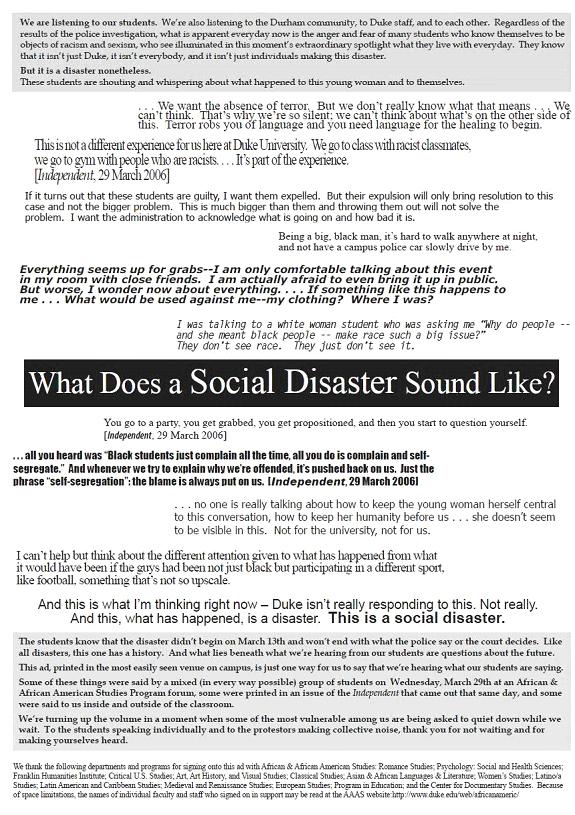
A few more items, from both sides of the question, regarding themes from the post below.
Reade Seligmann and Collin Finnerty were both named to the 2010 Scholar All-America Team.
Finnerty’s individual awards were listed in the post below; Seligmann received the IMLCA Boston Market Humanitarian Award in 2008; in 2010, he was named first team All-Ivy, All-New England, and a USILA Scholar All-American.
---------------
As to the Group of 88: Emory professor Mark Bauerlein did a post at the Chronicle for Higher Education blog noting how my survey of the Group’s post-case activity—which found that many Group members had either been named to deanships or been hired away from Duke for more lucrative opportunities at other institutions—seemed to conflict with the typical victimization narrative of the academy’s far-left fringe. Indeed, that so many of the Group members have been rewarded despite (or perhaps because of?) their behavior is nothing short of astonishing.
Bauerlein noted, “Johnson doesn't mention any signer of the document who has suffered one bit from its publication. If readers of Brainstorm know of anybody who did sign it and has been called to account for it, please add a comment.”
Several commenters expressed outrage at Bauerlein’s post. Wrote Sandy Thatcher,
Mark conveniently ignores the fact that the Duke lacrosse team had a reputation for bad behavior before the incident occurred that gave rise to the “rush to judgment.” It is not as though all these Duke lacrosse players were paragons of virtue. I recall one particularly scurrilous e-mail that was uncovered during the investigation. The players who were named as defendants by the district attorney may have been innocent of the crimes alleged, but there is a history here that helps explain why so many people did assume the worst when this incident happened. The players were no moral saints.
First of all, of course, the players were innocent, not “may have been innocent.” Second, as Bauerlein appropriately comments, “do you really think that ‘a reputation for bad behavior’ is an excuse for the rush to judgment at Duke?” Apparently Ms. Thatcher does.
Several readers suggested that the Group didn’t or probably didn’t do anything much wrong. Opined one, “The ad was premature and made all sorts of bad assumptions, but the same could be said of nearly every op-ed article ever published. Did newspapers and magazines fire all their political commentators who went along with the Iraq WMD claims? (And no, this isn't a tu quoque argument – it’s an analogy. And I don’t think those commentators should have been fired for being wrong.)”
This argument is a rather peculiar one. Most newspapers—to the best of my knowledge—do not sign contracts with their op-ed writers that contain clauses like this one, from Duke’s Faculty Handbook: “Members of the faculty expect Duke students to meet high standards of performance and behavior. It is only appropriate, therefore, that the faculty adheres to comparably high standards in dealing with students . . . Students are fellow members of the university community, deserving of respect and consideration in their dealings with the faculty.”
But perhaps this Bauerlein reader considers dozens of professors signing a statement asserting unequivocally that something “happened” to Crystal Mangum, falsely asserting that the statement contained endorsements from five academic departments, and thanking protesters who had (among other things) urged castration of the lacrosse captains to constitute treating Duke students with “respect” as “fellow members of the university community.”
Moreover, the Group’s behavior contributed to Duke’s (wise) decision to reach a sizable out-of-court settlement with the falsely accused players. I’m no expert in the newspaper industry, but I suspect that few newspapers would willingly keep on staff an op-ed writer whose columns had exposed the paper to massive legal liability.
Then, there’s the typical taunter: “And where oh where is Mark Bauerlein today? Still stuck in the same old job at Emory, still neglecting his students while he does his daily ‘Dumpster Diving,’ digging and digging ever so deeper to find any and all trash and garbage he can get his hands on - either to discredit someone or something or to vent his own frustration at being seen as not professionally worthy of being elevated in his own career.
The last I looked, the average SAT score of incoming Emory freshmen is about the same as that of Duke freshmen (or, for that matter, as that of freshmen at Williams, where I used to teach). But in the world of this (anonymous) commenter, Bauerlein apparently spends his days consumed with jealousy about colleagues at another institution, because he just can’t take his fate in life: that is, teaching at one of the top liberal arts colleges in the country.
Such ad hominem attacks, it seems to me, are not only rarely logical, but are also revealing of the attacker’s character.