- Horst asked Harris to come to her dorm room and spend the night;
- After the alleged assault (which Harris maintains was consensual intercourse), Horst left her room to go to the bathroom, but then returned to her room voluntarily, where she and Harris then spent the night;
- Horst did not seek a medical examination after the incident;
- Horst did not report the incident to police.
Friday, August 16, 2013
An Update from St. Joe's
Over at Minding the Campus, I’ve analyzed two federal
lawsuits filed by male students found culpable of sexual assault after college
procedures (at St. Joe’s and Vassar) that failed to provide much, if any, due
process. Today is the deadline for the defendants in the first suit, filed
by Brian Harris against St.
Joe’s and his accuser, Lindsay Horst. Horst’s attorney, Daniel Rucket,
filed a reply yesterday urging dismissal of all claims in Harris’ lawsuit. (You
can read the filing here;
I’ll be analyzing the St. Joe’s reply when it comes in, at Minding the Campus.)
Rucket does not deny that Harris’ complaint accurately
described the (wildly tilted) judicial “process” that St. Joe’s employs, which is
“based on guidance from
the United States Department of Education, Office for Civil Rights (‘OCR’).”
(This guidance, of course, came from the 2011 “Dear Colleague” letter, which
asserted that federal law requires universities to change their procedures in
various ways to make it easier to find students culpable of committing sexual
assault.) Rucket concedes
that St. Joe’s policies prohibited Harris, like all accused students,
from having an attorney represent him at the disciplinary hearing, or attend
the hearing in any way. And Rucket observes that, as Harris’ complaint noted, St.
Joe’s has structured a procedure in which“[c]ivil or criminal rules of procedure and evidence do not
apply,” while allowing the school to consider hearsay.
But according to Rucket’s filing, these are all unobjectionable
things, beyond the scope of the federal courts to review. It’s quite remarkable
to see a private lawyer—much less a “Pennsylvania Super Lawyer,” as Rucket’s website notes
he has been every year since 2010—celebrating the fairness of a process in
which the accused is denied the right to counsel.
Intriguingly, seeking to protect
Horst against a claim of defamation, Rucket subsequently claims that in Pennsylvania “quasi-judicial
proceedings . . . include school administrative hearings and statements made
that lead to such hearings.” In other words: the St. Joe’s disciplinary
tribunal should be viewed as “quasi-judicial,” even though it denies accused
students the right to counsel, doesn’t guarantee them the right to cross-examine
their accuser, doesn’t follow civil or criminal rules or procedure, and allows
hearsay.
Rucket argues that Harris has no legal claim to challenge
the judgments made by St. Joe’s, no matter how unfair the university’s procedures.
“Harris is attempting
improperly to relitigate the finding of the [St. Joe’s tribunal] that Harris
sexually assaulted Jane Doe, in Federal Court, which is not allowed.” Why?
In part, because “there is a presumption of fairness in administrative
proceedings which favors administrators.” Moreover, according to Rucket, federal courts should respect
an assertion in the St. Joe’s handbook that “[s]ubsequent reviewers shall not determine anew whether there was a
Community Standards violation.” How convenient as a way to shield any university
from challenges to potentially unconstitutional behavior.
This line of argument, if upheld by the court, would render beyond
judicial review the assault on due process for all college students accused of
sexual assault, and Rucket asserts as much. At least with regard to students at
private colleges, he claims that as “Harris’ guilt for the sexual assault has therefore
been conclusively and finally decided by SJU at the [disciplinary] hearing,” a federal jury “cannot reconsider or alter that
decision.” The power this line of interpretation gives to college disciplinary
processes is extraordinary: once a private college brands a student a rapist,
no matter how unfair the process the college utilizes, the student can never
challenge the finding, as long as the college followed whatever unfair
procedures it utilizes in sexual assault cases.
Absurdly, Rucket claims that the power he gives to
the St. Joe’s process to avoid court challenge is equal opportunity: If, he
notes, St. Joe’s had found that Horst hadn’t been sexually assaulted, and she
had then filed a
“lawsuit against Harris and SJU, Harris certainly would be making this exact
same argument, that the findings of the [disciplinary tribunal] cannot be relitigated.” First: this
claim will certainly come as news to the anti-due process “activists” glowingly
profiled in the New York Times and Inside
Higher Ed’s Allie Grasgreen, who
have urged federal intervention to effectively relitigate a variety of campus
decisions they opposed. Second: as Rucket well knows, even if Harris had been
cleared by St. Joe’s, Horst still could have filed a criminal complaint with the police. Harris
then could have been tried and, if convicted, sued.
In any event, the filing notes, even without the specific
wording in the St. Joe’s handbook, Harris would have no case. Before choosing
to attend St. Joe’s, Harris knew (or should have known) the university’s
procedures for handling sexual assaults. Courts, Rucket suggests, can’t now
intervene. (Oddly, the only two cases that Rucket cites to bolster his point
come from Pennsylvania state courts; he doesn’t explain why these
decisions should be treated as precedential in a federal lawsuit.) If Harris
didn’t want to subject himself to the anti-due process approach used in his
case, he shouldn’t have matriculated at St. Joe’s. But given that the “Dear
Colleague” letter applies to virtually every university in the country, under
Rucket’s viewpoint, the only realistic choice for a male student who wants to
ensure that he has due process if accused of sexual assault would be not to
attend college at all.
Finally, Rucket challenges Harris’ claim that he lacked an
opportunity to cross-examine Horst, but, in any case, deems the matter
irrelevant—in part because St. Joe’s doesn’t promise such a right and in part
because the “Dear Colleague” letter “strongly” discourages granting such a right.
To the best of my knowledge, this is the first time perhaps the most
objectionable aspect of the “Dear Colleague” letter—its urging schools to set
up procedures that deny an accused student the right to confront his accuser—has
been cited, positively, in a legal filing.
Beyond legal arguments, the filing also provides Horst’s
version of the evening in question, in which she alleges that she was assaulted
while incapacitated. Rucket’s writings, however, corroborate several points
from Harris’ filing, chiefly that:
Rucket does challenge the version of events presented in
Harris’ complaint in one significant way. While he concedes that Horst invited
Harris to come to her room for “cuddling” and to spend the night, according to the
filing, this invitation had no sexual connotation.
Two final notes: (1) This is not the lacrosse case, in which
overwhelming and unimpeachable evidence of actual innocence existed. Instead,
the Harris case is an excellent demonstration of how due process-unfriendly
college procedures—coupled with the newly-mandated preponderance-of-evidence
(50.01%) standard—all but ensure that college structures can’t discover the
truth in close or even somewhat close cases. And in a campus environment that’s
overwhelmingly favorable ideologically to accusers, this is a dangerous thing.
(2) In his brief, Rucket asserts that Harris “was found
guilty of (1) sexual assault.” [emphasis in original] Technically, colleges
and universities can’t find anyone “guilty
of sexual assault”: only the criminal justice process can do so. But in the
real world, that’s a distinction that’s easily elided, since the stigma of
being branded a rapist comes just as easily from a college process as from a
jury verdict. That Horst’s own attorney—in a legal filing, no less—conflates the
result of the St. Joe’s disciplinary process with that of a criminal trial illustrates
why universities, when they consider issues that also qualify as criminal matters, need to provide due
process to accused students. And if federal courts are the only mechanism for
forcing universities to do so, then so be it.
Tuesday, August 13, 2013
Brodhead, Colbert, and Questions
Richard Brodhead will be appearing Thursday night on Comedy
Central’s Colbert Report. Let’s set
aside the obvious: why would a group
that wants to promote increased public support for the humanities select as
its spokesperson a figure best known outside the academy for this disastrous appearance on 60 Minutes?
Instead, since Brodhead himself has said that he sees
the interview as “a good chance to show off Duke,” perhaps Colbert could
find the time to ask him why, in his first
public appearance after their arrest, he said that even if
Reade Seligmann and Collin Finnerty were innocent, whatever they did was “bad
enough.” Does he continue to believe what he told the Durham Chamber of Commerce
in April 2006, and if not, why did he never retract or apologize for his
remarks?
Some other items that remain unanswered:
(1) Why specifically did Brodhead and the Duke Board of
Trustees demand Mike Pressler’s resignation in early April 2006? What did they
expect the public reaction to their move to be? Did they recognize at the time that
the forced resignation would likely be interpreted as a sign of the players’
likely guilt?
(2) When did Brodhead and the trustees first learn of the
conduct of former SANE-nurse-in-training Tara Levicy? After so learning, what
steps did the Duke leadership take to ensure that Levicy would not affect any
additional sexual assault cases?
(3) What steps, if any, did the Duke administration take
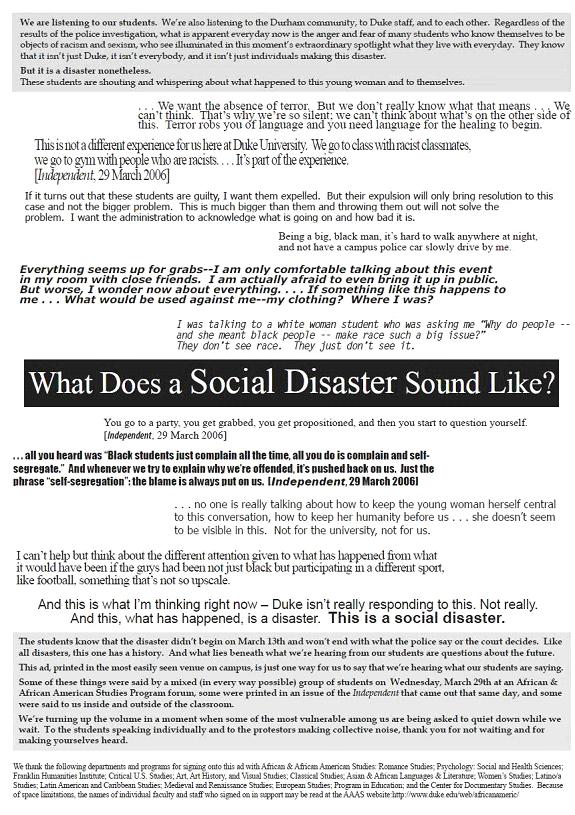
against either Wahneema
Lubiano or the African-American Studies Department for their decision to improperly
use Duke funds to pay for an ad denouncing the school’s students, and for their
falsely claiming that numerous Duke departments officially endorsed the ad? If,
as is widely believed, the university took no disciplinary steps on the matter,
should Duke professors interpret this inaction as an implicit statement that
Lubiano and her department really didn’t do anything wrong?
(4) Why didn’t Duke administrators reveal to the Coleman
Committee the university’s
then-secret arrangement with the city for Duke students—and only Duke
students—to be prosecuted to the maximum for alcohol-related offenses?
(5) Does the university continue to stand by the Bowen/Chambers
report as the best analysis for how the administration should have handled
the case? If so, how can the university explain the millions of dollars in
settlements and legal fees for administrators’ conduct that Bowen and Chambers
ignored? If not, why did the university never elect to commission a Freeh
Report-style white paper for Duke?
Somehow, I doubt any of these questions will get asked. And in
the unlikely event they were asked, I can all but guarantee they would generate
a non-responsive reply.
Monday, August 05, 2013
Litigation Issues
As a reader of TheShadow University shortly after it was published, I understood well the due
process difficulties in campus judicial systems. But until the lacrosse case, I
simply assumed that because sexual assault is a crime, such matters were
handled by police, not by a campus judiciary. In any event, how campuses
handled sexual assault complaints couldn’t be more troubling than the manner in
which they handled other allegations.
That, obviously, isn’t the case. One of the most troubling
counterfactuals of the lacrosse case is to wonder what might have occurred if
Crystal Mangum had simultaneously filed a complaint through the Duke campus judicial process. If—and
it’s not entirely clear—she had standing to have done so, there’s little doubt
that a finding of guilty would have occurred. Procedurally, the accused
students would have lacked the right to attorneys, been unable to access the
critical DNA evidence, and would have faced severe evidentiary and time
restrictions in presenting their case. Ideologically, the accused students
would have been operating in an environment heavily influenced by the Group of
88 and their race/class/gender agenda. For a less explosive example, consider
the case of Caleb Warner, a former University of North Dakota student whose school found him guilty of
sexual assault—even as the local police filed charges against his accuser for filing a false police
report.
(As an aside, note that the police saying the accuser was
lying wasn’t
enough for the AP to identify the accuser, since “AP’s policy is not to identify alleged sexual assault
victims,” even those the police have formally concluded made a false
allegation.)
The basic unfairness of campus sexual assault procedures was
intensified by the 2011 “Dear Colleague” letter, about which I’ve written
extensively at Minding the Campus, which dramatically lowered the burden of
proof in campus sexual assault cases.
In the last two months, however, two students convicted
under their school’s wildly biased procedures filed suits in federal court. One
lawsuit targeted Vassar College, which handles sexual assault claims through an
“Interpersonal Violence Panel” whose procedures the college refuses to make
publicly available. The second suit targeted St. Joseph’s University, after a process that appeared to ignore exculpatory text messages sent from the accuser to
the student she accused. You can read my Vassar post here,
and my St. Joe’s post here.
In the aftermath of the “Dear Colleague” letter, and with
administrators responsive to their school’s version of the Group of 88, it’s
all but inconceivable to imagine many, or any, residential colleges restoring
due process on their own. In the end, only intervention by federal courts—as occurred
a generation ago with speech codes—will bring a measure of due process to how
campuses handle allegations of sexual assaults.
-------------------
Former NCCU chancellor Julius Chambers recently passed away.
The most comprehensive obituary came in the Charlotte
Observer, which recounted his myriad contributions to the causes of
civil rights and due process over the course of his career.
Obituaries, obviously, tend to stress the positive in a
career, and it’s hard to find any positive in Chambers’ conduct in the lacrosse
case, where he teamed with William Bowen to pen a whitewash
report that supposedly represented a critical analysis of how the administration responded to the case. Yet the report didn’t even address the issues that ultimately would cost Duke
millions of dollars in legal fees and settlements, largely because Bowen and Chambers operated under an ill-concealed assumptions that the rape allegations were likely true. The Observer didn’t reference Chambers’ conduct in the lacrosse case,
which contradicted his career-long support for civil rights and due process.
-----------
The Supreme Court has requested a formal response from
Durham to the longshot appeal in the McFadyen
case. While this move means the appeal hasn’t been rejected out of hand, the question doesn’t
seem to be the type that’s likely to generate interest from the Court.
Wednesday, July 24, 2013
The Perils of Political Correctness
Two items showing the continuing failure in the academic
world to learn the lessons of the lacrosse case.
The first comes from the Chesterfield
(VA) Observer, which ran
an article on the status of African-Americans in the sport of lacrosse. The
Observer interviewed Jay Coakley, professor emeritus of
sociology and sport at the University of Colorado-Colorado Springs. According
to the Observer:
In the aftermath of the 2006 Duke lacrosse rape scandal,
Coakley was invited to speak to a national lacrosse convention in Philadelphia.
His message – that the sport desperately needed diversity – wasn’t well
received. “When I gave my presentation, probably about 100 white men walked
out,” Coakley recalled.
He offered up slides of photos culled from college websites,
which showed a preponderance of white men playing the game. “I was accused on
local talk radio of pushing political correctness and not understanding what
lacrosse is all about,” he said.
The address to which Coakley referred occurred at the 2007 US Lacrosse
convention, which was held January 12-14 in Philadelphia. It’s worth noting
the context: by this point, disciplinary charges had been announced against
Mike Nifong; Crystal Mangum’s story had been changed to claim that no actual
rape had occurred; and even Richard Brodhead (though not the Group of 88) had
been moved to denounce Nifong. In short, the version of events to which so many
politically correct figures on campus had attached themselves had been revealed
as an utter fraud. Yet Coakley’s remarks appear to have ignored the jarring
transformation of the case between March 2006 and January 2007; he spoke,
instead, as if all events were as commonly understood in early April 2006.
Since there was no record of Coakley’s remarks online, I
e-mailed him. He graciously summarized his main points, which—to put it mildly—were
stronger than the Observer article
entailed. That wasn’t too surprising, since it was all but impossible to
imagine that a banal call for more racial diversity in lacrosse could have
triggered the mass walkout that he alleged.
A few items: (1) Ignoring any of the new developments
between early April 2006 and January 2007, Coakley linked the case to a call
that (paraphrased) the “sport desperately needed diversity” because it had
(paraphrased) “a preponderance of white men playing the game.” (Whites were, of
course, a preponderance of all college-aged men in January 2007.) Even if some
sort of racial balancing in college men’s lacrosse was or is desirable, how,
precisely, could this goal be linked to the Duke lacrosse case in a way that
would reflect well on Coakley?
It’s true that, if the accused students were
African-American rather than white, the lacrosse case would have differed. Neither
Nifong nor the Group of 88 would have had any reason to have exploited the
case, and therefore it likely would have never moved forward or received much
campus or media attention. But suggesting that a sport having more black
athletes minimizes the possibility of a local prosecutor or a school’s faculty
engaging in race-baiting behavior doesn’t strike me as a . . . progressive . . . argument.
Coakley seems to be insinuating, instead, that if more African-Americans
were on the 2006 lacrosse team, the team would have treated the strippers more
sensitively. That strikes me as a highly implausible conclusion.
In general, his view of events seemed then, and still seems,
frozen in time, as if no additional facts about what occurred at the party came
out after early April 2006. He suggested to me that racial epithets were
directed at false accuser Crystal Mangum (there’s no evidence of this, since
Mangum was passed out during the racially charged argument between Kim Roberts
and a lacrosse player that concluded the evening) and that other lacrosse
players somehow should have intervened to stop the exchange between Roberts and
their teammate. But it’s not clear how they could have done so, since all
accounts of the evening suggested that Roberts then immediately called the
police claiming a “hate crime,” and then drove off, while the captains told the
remaining handful of players to go home. Coakley’s comment about intervention
only makes sense if he believes that racial epithets occurred during the party
itself—yet the only figures connected to the case to ever have made such a
claim were Mangum and Mike Nifong. That he still seems to view the duo as
credible speaks volumes as to the biases he brings to the case.
(2) In his e-mail to me, Coakley linked his criticism of the
lacrosse team in part to the hiring of strippers—an act that I, too, find distasteful.
Yet it’s hard to see any connection between his critical comments about the team’s
(or, more generally, lacrosse’s) racial makeup and the hiring of strippers. After
all, a few weeks before the party, the majority African-American basketball
team had hired strippers for a team party.
More broadly, his basic approach in the 2007 talk—on which he doubled down in his Observer interview—suggests that the hiring of the strippers, and Coakley's seemingly inaccurate view of the development of the party, was such a grave character flaw that it overcomes all that we subsequently learned about members of the lacrosse team, whether in the Coleman Committee report, or in their post-case behavior in the 2006-7 academic year. Much like the Group of 88, it’s as if, for Coakley, the team’s character is frozen in time, as of early April 2006, and nothing that came after was allowed to disturb the preconceived ideological notions that he brought to the case.
(3) In his interview with the Observer, Coakley said that he “was accused on local talk radio of pushing political
correctness.” (Coakley didn’t cite which local talk radio leveled the
accusation against him; it’s intriguing that he’s evidently a talk-radio
listener.) In the event, at least based on what he shared with the Observer and later with me, the
accusation seems to be a valid one.
It’s unclear how many people share Coakley’s
perspective; in society as a whole, it’s almost certainly a minority, and
perhaps a small minority indeed. On campus, however, his politically correct
approach is very much mainstream—as we saw, yet again, in a recent event at
Duke.
Of all the campuses in the country, it would seem as if Duke—whose
students were the victims of the highest-profile rape hoax in modern American
history—would bend over backwards to protect due process in sexual assault cases.
The reverse was true: in
2009, the university implemented a new sexual assault definition, in which
students could be found guilty of rape on the following criteria: “Real or perceived power
differentials between individuals may create an unintentional atmosphere of coercion.” Why a
student could be deemed a rapist based on unintentional actions that any
accuser happened to perceive Duke never said, and amidst an outcry from alumni
and from national groups, especially FIRE, Duke quietly dropped the new
criteria in 2010.
But otherwise, a due
process-unfriendly sexual assault policy remained in place—until earlier
this month, when Duke announced an adjustment. Students found guilty by the
university now will face a presumed penalty of expulsion. Remarked Larry
Moneta to the Herald-Sun, “This is not like the
measles; there’s no vaccine . . . This is a very complicated issue that is not
unique to us that just requires persistence and a multi-varied approach.”
Moneta did not mention the importance of due process for sexual assault
allegations.
Students properly deemed
rapists certainly should be expelled. Actually, of course, they should be sent
to jail—but university activists tend to strongly oppose the idea of allowing
the criminal justice system, rather than university bureaucracies, to address
allegations of sexual assault.
In the event, the heightening
of the punishment has to shine the spotlight on the procedures the university
employs, since the error resulting from a procedurally flawed decision is now so much greater. Duke’s policy is for a university administrator or a hired outside
investigator to examine the allegations. The investigation is almost guaranteed
to be slipshod: “Allegations of sexual misconduct will be investigated
in a thorough and timely manner, typically within 15 business days of receipt
of a complaint.” (Imagine if the police had such a requirement, amidst a
bureaucracy that’s strongly predisposed, for ideological reasons, to believe
all allegations of sexual assault, as is the case at Duke and many other
universities.) The accused student doesn’t have the right to be represented by
outside counsel, only a “member of the university community,” and even the role
of this advocate is severely restricted: “He/she may only confer quietly or
through notes with the complainant and may not address the panel.” And a
finding of guilt occurs at the lowest possible threshold—a preponderance of
evidence, or 50.01 percent.
In explaining the new penalties, Moneta didn’t reference the
lacrosse case, or explain why a campus that witnessed such an extraordinary
violation of due process wouldn’t be vigilant about due process on such matters
in the future. But Bob Ashley’s Herald-Sun
filled the void. In an unsigned editorial celebrating Duke’s action (there’s
a surprise!!), the H-S reflected
in the following manner: “One legitimate debate fueled by the infamously false rape
allegations against Duke lacrosse players in 2006 concerned the overall culture
of gender relations on Duke and other campuses.” It’s easy to see how “legitimately
false rape allegations” might have triggered a debate about why so many on Duke
faculty members were willing to rush to judgment against three of the
university’s male students. But somehow I doubt that’s the sort of “legitimate
debate” about “gender relations” on the Duke campus that Ashley had in mind.
Beyond
the rare admission from Ashley that the charges his paper so consistently
framed as true were actually false, it’s as if for the H-S editor, much like Professor Coakley, events in time are frozen
as of April 2006.
Monday, July 15, 2013
The Brodhead Commission Report
That any commission, of any type, could consider Richard Brodhead as a
vehicle to build public support for anything related to higher education
is nothing short of astonishing. That a figure who presided over one of the
highest-profile university scandals of recent years—a scandal in which his
school’s humanities professors played an outsized role—would seem like a good
choice to improve public backing for the humanities is almost comical.
Yet a 53-person commission of the American Academy of Arts and
Sciences, which produced a lengthy report at the behest of a bipartisan groupof legislators, did just that. The Brodhead commission report is a combination
of the banal with the wonderfully self-unaware. (By the way, the 53-person
committee included Ken Burns; perhaps his work on the project suggests theorigins of filmmaker Burns’ . . . unusual . . . interpretation of the lacrossecase.) The commission featured not only Brodhead but several other paragons of
campus political correctness, Harvard president Drew Faust, Amherst president
Carolyn Martin, and Penn president Amy Guttmann.
Some of the report’s conclusions were almost caricatures of the banal.
For instance, who could disagree with the following statement, which appears on
page 16? “Our need for a broadly literate population is more urgent than
ever. As citizens, we need to absorb an ever-growing body of information and to
assess the sources of that information. As workers, we need to adapt to an
ever-accelerating rate of technological change and to reflect on the implications
of these changes. As members of a global community, we need to look beyond
our borders to communicate and interact with individuals from societies and cultures
different from our own. As a nation, we need to provide an educational foundation
for our future stability and prosperity— drawing on all areas of knowledge.”
Or consider this item, from the study’s acknowledgements: the report “identifies
three overarching goals: 1) to educate Americans in the knowledge, skills, and
understanding they will need to thrive in a twenty-first-century democracy;
2) to foster a society that is innovative, competitive, and strong; and 3)
to equip the nation for leadership in an interconnected world. These goals
cannot be achieved by science alone.” Do those who oppose the study’s
recommendations favor a society that is luddite, uncompetitive, and weak?
The report also champions such public policy goals as strengthening
support for teachers, enhancing access to material available online, supporting
study abroad programs, boosting funding for NEH, and promoting the learning of
foreign languages. Of course, all of these proposals (each of which seems to me
an excellent idea) take money, and the Brodhead commission doesn’t quite
explain how or why more tax revenue will find its way into higher education.
And there’s one funding-related question that the Brodhead commission
dare not touch. We live in a society that’s deeply polarized along ideological
and partisan lines. And yet the humanities skews—wildly—in one direction, to
such an extent that it seems almost certain that today the ideological median
of humanities professors is further away from the ideological median of society
at large than at any other point in American history. Is it possible—just possible—that
this ideological chasm, a general sense among most politicians that today’s
humanities departments aren’t exactly the most intellectually diverse entities
around, has caused a reluctance to fund? The Brodhead commission doesn’t ask
that question—perhaps because it doesn’t want to know the answer.
In at least three other respects, the commission is almost blissfully
self-unaware in its commentary. First, the commission expresses grave concern
about the state of affairs in high school history and social studies
instruction. We need more high school civics classes, the report declares,
and the quality of teacher preparation is dangerously low. The report (p. 19) foresees “grave
consequences for the nation” that “humanities teachers, particularly in k-12
history, are less well-trained than teachers in other subject areas.”
It’s not hard, however, to detect at least one importance reason
for this problem. Public school curricula continue to be set by state boards of
education—which are responsible to the public, and which generally mandate
curricula that would be deemed somewhat “traditional.” Students in high school
history classes are supposed to learn about, among other things, Presidents,
and wars, and key court decisions, and major elections.
Yet Brodhead and the many other college presidents who were
part of the commission have presided over universities that have emphasized
“diversity” and the hiring of specialists in areas related to race, class, or
gender over the study of more traditional aspects of the American past. I most
recently discussed
this issue
in a multi-part
series at Minding
the Campus. As a result, most public school teachers can go through college
and M.A. programs with little—or in the case of U.S. military or constitutional
history, almost certainly no—exposure to specialists in the fields that they
then have to teach to the nation’s public school students.
And so the report urges an expansion of “education in
international affairs” (p. 12)—without mentioning the massive decline in the
past generation in faculty positions devoted to U.S. diplomatic or military
history, the result of hiring decisions that these very same presidents (or
their predecessors) have ultimately approved.
The nation’s founders, the report intones (p. 15),
understood that the country’s well-being depended on citizens who “understand
their own history,” and it’s particularly important to study “jurisprudence.” Yet
the report makes no mention that the field of U.S. constitutional history has
been all but eliminated in the nation’s history departments, the result of
hiring decisions that these very same presidents (or their predecessors) have
ultimately approved.
Indeed, virtually the only high-profile president in recent
years who was concerned about such matters was Harvard’s Larry Summers. And he
was deposed via a faculty revolt.
Second, the commission’s report veers into territory that it would seem
to want to avoid—in that it calls into question the ideological imbalances in
the contemporary academy. For instance, on page 10, the report asserts that “humanists
and social scientists are critical in providing cultural, historical, and
ethical expertise and empirical analysis to efforts that address issues such as
the provision of clean air and water, food, health, energy, and universal
education.”
Health, environmental, and energy policies are among the
most contentious in our current political climate. What incentive would GOP
legislators or conservative donors—two groups ostensibly targeted by the report—have
to boost humanities funding if the result is increased attention to policy proposals
where 90 percent or more of today’s humanities professors are on the other side
from the targeted funders? I find it hard to believe, for instance, that this line
of argument would persuade the Kochs that it’s a good idea for them to start making
more donations to college humanities programs.
Finally, the commission itself was blissfully self-unaware in allowing
Brodhead to function as its public face. In its
section analyzing the problems facing higher education, the report’s first
footnote is none other than an item from Brodhead, entitled, “Rebuilding
the Public’s Confidence in Higher Ed.” This would be the same Brodhead whose
highest-profile off-campus appearance came in a widely-panned 60 Minutes appearance in which he tried,
in vain, to defend his university’s rush to judgment in the lacrosse case. Or
whose highest-profile off-campus reputation dealing with the humanities came in
his presiding over a school that had dozens of humanities professors sign a
public declaration affirming that something had “happened” to false accuser
Crystal Mangum, and thanking protesters who had urged among other things the
castration of the lacrosse captains.
The Brodhead commission report seeks
to build off-campus support for the humanities—from legislators, from donors,
and ultimately from the public. Yet Brodhead’s record in the lacrosse case is
merely a click away for any of these target audiences. Could the commission not
have found someone less compromised than Brodhead to serve as its public face?
The commission’s selection of the
Duke president as its member most likely to persuade legislators or the public would be a
little like trying to persuade a gay rights group by turning to a high-ranking
figure in the Catholic Church; or seeking to solicit financial contributions
from a mining organization by soliciting a report penned by a prominent Sierra
Club lobbyist. After his performance in the lacrosse case, why should any
public official accept Richard Brodhead’s advice about anything?
Friday, July 12, 2013
Supreme Court Update
For those expecting an analysis of Durham's reply to the cert petition, which originally was due today, the city has obtained an extension from the Supreme Court. The new deadline is August 23.
Friday, July 05, 2013
Updates: Mangum, Academic Freedom
First, Crystal Mangum’s long-delayed murder trial—the false
accuser has gone through several attorneys, slowing down the process—is now
scheduled, for mid-November. Mangum, who is supposedly financially destitute, posted
bond several months ago, and is currently free awaiting the proceedings.
Here’s
how the Herald-Sun described
Mangum’s infamy: “Mangum became nationally known in 2006 after she accused some
Duke lacrosse players of sexually assaulting her after they hired her as a
stripper for their party. Those charges were later dropped.”
No mention of the charges being “false.” No mention that the
state’s attorney general declared the players “innocent”—not merely that the
charges were “dropped.” And a bizarre description of Reade Seligmann’s and
Collin Finnerty’s role in the case, given that the quoted sentence—literally interpreted—suggests
that “they” hired Mangum for “their” party, even though neither of them played
any role in the organization of the party.
Such
slanting in hard-news items has become increasingly common in the H-S since Bob Ashley’s return as editor.
It’s almost as if Ashley wants to subtly shade post-case news coverage to make
up for the discredited manner in which his newspaper covered the case itself.
Along those lines: the H-S
applied its normal biases in covering Duke’s unsuccessful efforts to force me
to turn over confidential, unpublished exchanges with sources for the book and
the blog. The paper sympathetically portrayed Duke’s legal filings, triumphantly
reported on Duke’s short-term victory before the magistrate judge in Maine, and
mentioned my appeal. And then the paper suddenly lost interest—no analysis of
major Maine newspapers and TV stations filing an amicus brief portraying one of the
nation’s major research universities as hostile to the First Amendment; no
coverage of the hearing before Judge Brock Hornby in which Duke’s high-priced
attorneys found themselves immediately on the defensive, and in which they made
extraordinary claims about the future standards to which Duke’s own professors
should be held; no discussion of the collapse of Duke’s efforts and the
ultimate vacating of the magistrate judge’s order. As far as readers of the H-S know, Duke now has access to my
e-mail files.
The transcript of the January hearing is now publicly
available, and I thought it might be worth highlighting two exchanges that the H-S did not deem newsworthy—since Duke’s
attorneys, speaking (they said) for the university, articulated an approach to
academic freedom that I’m not sure any other research university in the country
holds.
The first exchange occurred less than a minute into Duke’s
oral argument:
THE COURT: Well, I do have two questions. One
is this, and this may be a rhetorical question, but Duke University obviously
has a lot of researchers and academics of its own who write books, and whatever
you’re seeking here may come back to affect Duke. So I take it this is the
institutional posture of Duke University in terms of the academic freedom
interests of its researchers and faculty members; is that right?
MR. SEGARS: Your Honor, I think Duke University
would be happy with the rule that it’s asking this Court to impose on the facts
of this case.
I expect
that the next time a Duke faculty member receives a third-party subpoena demanding
that he or she be deposed and turn over confidential, unpublished correspondence
with sources, this exchange will be cited.
The second
exchange came near the end of the proceedings, after Duke’s attorneys attempted
to mischaracterize my arguments:
THE COURT: I understand the argument [presented
by my attorney, Patrick Strawbridge] to be slightly different than that. I don’t
think there’s any claim that the plaintiffs cannot waive their own rights or
should not perhaps expect that they can be explored, but what does this do to
future academic researchers, and future journalists as they decide to publish a
book or decide to write something else? Do they know they’re thereby opening
themselves to considerable expense and time involvement in responding to lawsuit
discovery?
MR. SEGARS: That’s a good question, Your Honor.
I think that the rule we’re seeking would tell those researchers academicians,
journalists that, A, I need to be clear about the confidentiality I promised to
my sources, and B, if I’m ever subpoenaed I need to make a record of that confidentiality
with respect to the communications that I’m intending to withhold.
THE COURT: But it also says if I write a book I’d
better expect to spend a lot of time dealing with lawyers in terms of producing
all of the research work that I did and distract me from the next book I want
to write because I’m responding to what lawyers want for an earlier lawsuit,
right?
MR. SEGARS: That’s a fair question, Your Honor.
On the facts of this case where the subpoenaing party has literally gone out
and deposed 41 plaintiffs, we’ve subpoenaed the attorneys, we’ve tried to get
what we could, and I hear what Mr. Strawbridge says, that I am unable to point
to a particular document that Dr. Johnson has that I don’t.
To reiterate:
Duke’s attorneys said they’re entirely comfortable with this standard being
applied to Duke faculty in future cases. I wonder how many Duke professors are
actually aware of the new academic freedom rules under which their institution
operates.
Monday, July 01, 2013
W. Murphy, Hypocrite
During her myriad
media appearances commenting on the Duke lacrosse case, adjunct law
professor Wendy Murphy came up with virtually everything bad she could possibly
say about the three falsely accused players. She wondered whether one of them
had been abused as a child. She wildly claimed that false accuser Crystal
Mangum had been bribed, that exculpatory photographs had been doctored, and
that neighbors had claimed the lacrosse players were involved in other sexual
offenses. She even managed to work in an oblique Hitler comparison.
(A reminder: These
erroneous statements and bizarre comparisons did not trouble Poynter, the
supposedly good-journalism organization which brought in Murphy to lecture to journalists.)
But in all of her media appearances, one area that the
adjunct law professor did not explore was a claim that the case was receiving too much attention from journalists. There
was no Murphy denunciation of Newsweek for
placing the falsely accused players’ mugshots on its cover, under the equally
false headline of “Sex, Lies, and Duke.” Nor did the adjunct law professor criticize Nancy Grace for the extraordinary amount of time the HLN host personally devoted to the case (except, of course, on the evening of the exoneration).
Imagine my surprise, then, to read a Murphy
op-ed in this morning’s Boston Herald,
in which she lambasted the media coverage of murder charges against former
Patriots tight end Aaron Hernandez. “Like a lot of people who don’t follow
sports,” Murphy confesses, she hadn’t
known much about Hernandez until a couple of weeks ago—just as she hadn’t heard
much of other athletes charged with violent crimes, such as Kobe Bryant, Rae
Carruth, and Michael Vick. Why does her ignorance about sports matter? Because “it’s
hard for people like me to appreciate the wall-to-wall coverage of a story that
seems no different than any other gang-banger murders of late.” Curiosity about
athletes allegedly committing crimes, Murphy continues, “doesn’t make its
answer news.”
Murphy’s conclusion? “If sports were better understood as simply entertainment, the
prosecution of Hernandez would be correctly framed as a run-of-the-mill alleged
gang murder in the news section — and sports writers could spill all the ink
they want on how people feel about the
guy in their section. With angles firmly separated, nobody would
misapprehend the story as proof that some murders are more important than
others, or that some people’s lives are more valuable than others. We’ve seen
enough violence perpetrated by people of wealth, power and influence to know
that crime happens in all communities and at all points along the economic
spectrum. It’s time for the news media to start conducting itself in a manner
that reflects this reality.”
Where was this
Wendy Murphy during the lacrosse case, denouncing the media for spending far too much time covering claims against a group of college athletes? It appears as if there’s an
exception to this new Murphy rule: crimes allegedly committed by athletes in
which members of the media interview Murphy for her opinions deserve
wall-to-wall coverage. But if Murphy isn’t
seen as an expert, than excess coverage leaves the message that “that some
people’s lives are more valuable than others.”
Your daily dose of hypocrisy (and media criticism),
courtesy of Poynter’s favorite adjunct law professor.
Wednesday, June 19, 2013
Astonishing
The liberal arts are “endangered,” according to a new report. The New York Times describes
the document’s high profile: “Requested by a
bipartisan group of legislators and scheduled to be distributed to every member
of Congress, it is intended as a rallying cry against the entrenched idea that
the humanities and social sciences are luxuries that employment-minded students
can ill afford.”
And who was the co-chairman of the commission that produced the report? None other than . . . Richard Brodhead.
In what other profession would a figure as utterly discredited by his actions—at least to anyone outside the profession—as Brodhead then be tasked with writing a major policy document justifying the existence of a key portion of that same profession?
Perhaps, it might be surmised, a reason why the liberal arts
are “endangered” is that they embody a profession in which accountability seems
like a dirty word.
Monday, June 17, 2013
The Cert Petition
Now
that Supreme Court has at least forced Durham to respond, I thought it
might be worthwhile to analyze the falsely accused players’ petition, written
by Williams & Connolly attorney Kannon Shanmugam. A couple of general
points:
(1) The petition doesn’t even bother to respond to JudgeGregory’s race-based opinion in the 4th Circuit—perhaps presuming,
correctly, that any Justice who would find even one word of Gregory’s rant
persuasive would never vote to grant cert anyway.
(2) The petition frames the question for the Court in a narrow
manner: “Whether police officers who conspire with a prosecutor to fabricate
evidence for subsequent use are immune from liability as a matter of law by
virtue of the conspiring prosecutor’s decision to use the evidence.” This framing
accomplishes two purposes: first, to preemptively meet at least some of the
concerns expressed by Judge Wilkinson in the 4th Circuit; and
second, to more clearly distinguish the Evans
case from the McFadyen case,
which might also still be appealed to the Supreme Court.
The petition opens by pointing to a 2009 case, Pottawamie
County, which revolved around the question of whether a prosecutor had absolute immunity if he
conspired with police to procure false evidence, and then used that evidence at
trial. The case was ultimately settled before the Supreme Court decided it, but
the cert petition notes that the Solicitor General and (at oral argument) five
justices argued that the police in
such a circumstance could be held
civilly liable. On this point, of course, the 4th Circuit disagreed;
and since Pottawamie County was
settled before resolution, these sentiments didn’t form a clear precedent.
The petition’s description of the lacrosse case facts pulls
no punches. Noting that although Mangum “provided wildly inconsistent and patently implausible statements
concerning the circumstances of the alleged rape to Durham police officers and
to personnel at the Duke Medical Center,” Durham authorities elected to turn
the case over to Sgt. Gottlieb, “an officer with a known history of malicious
prosecution, false arrest, excessive use of force, fabrication of evidence, and
filing of false police reports directed against students at Duke University.” (Keep
in mind that news of Gottlieb’s past was initially broken not by defense
attorneys but by the N&O and
then in greater detail by the Chronicle.)
Gottlieb and Himan, in turn, were instructed to take orders from Mike Nifong,
who despite acknowledging that the lack of evidence left the trio “fucked” made
dozens of inflammatory statements to the media. Those “false statements
inflamed the Durham community” to such an extent that on “March 29, Durham police
supervisors . . . ordered them to expedite the identifications and arrests of
Duke lacrosse players.” Misconduct continued through the rigged photo array to
the meeting with Dr. Meehan, and directly led to the indictments of the falsely
accused players.
But the misconduct did not end when Nifong achieved his twin goals: indictments, coupled with his successful nomination.
In
a clever and important point, the petition notes that Nifong, Gottlieb, and
Himan continued their wayward behavior—whether overseeing the arrest of cab
driver Moezeldin Elmostafa, or through Gottlieb’s production of an “after-the-fact
‘report’ of his purported activities in the investigation.” Even by the 4th
Circuit’s claim that indictments broke a chain of misconduct, this behavior
occurred after indictments. As the
petition notes, the 4th Circuit opinion did not explain how these
examples of post-indictment misconduct were shielded by “an independent
intervening act—i.e., (p)rosecutor Nifong’s decision to
seek the indictments,” between the arrests on false causes and the untoward
pre-indictment behavior of Gottlieb and Himan. The 4th Circuit
nonetheless dismissed the federal civil rights claims against the duo, which in
turn provided grounds for the dismissal of the suit against the city of Durham.
The petition
invites the Court to determine that the 4th Circuit erred on any of
several different grounds. First, several courts of
appeals have taken much different approaches than did the prosecution-friendly
4th Circuit panel on what sort of intervening conduct can shield
police officers, and the city that employs them, from a federal civil rights
suit. The 2nd and 6th Circuits, for instance, “have held
that police officers may be liable for the ‘natural consequence’ or ‘reasonably
foreseeable result’ of their investigative misconduct, despite a prosecutor’s
subsequent action that contributes to the injury.” The 9th Circuit
wasn’t quite as broad, but did render an opinion that would seem to allow suits
for clear cases of police misconduct leading to indictments. And while, the
petition asserts, the 5th, 7th, and 11th Circuits
have adopted standards that an intervening indictment “breaks the causal chain
absent evidence that the officers misled or pressured the prosecutor,” their
specific guidelines would not have shielded Gottlieb and Himan.
The petition
also explains that the breadth of the 4th Circuit’s opinion “implicitly
took sides in another Circuit conflict, on an issue that stands as a logical
antecedent to the causation issue: . . . whether the fabrication of evidence at
the investigation stage, standing alone, gives rise to a constitutional
violation.” The 1st and 8th Circuits have said it does;
the 2nd Circuit said it does not. Obviously the 4th
Circuit panel agreed with the 2nd Circuit.
Finally,
and in perhaps the document’s most interesting section, the petition forcefully
takes on Judge Wilkinson’s absurd arguments that allowing the case to go
forward would initiate a floor of lawsuits from other figures, or that somehow
we should see Durham police employees as victimized figures in the process. The
petition argues that Supreme Court holdings dating back nearly 80 years have
established that “prosecutorial action undertaken as part of a conspiracy to
fabricate evidence with investigating officers does not absolve the officers of
liability for their improper investigative acts in furtherance of the
conspiracy.”
And yet, “in
reaching a contrary decision, the Fourth Circuit heavily relied on the concern
that recognizing liability in the circumstances presented here would open the floodgates
to similar claims that officers conspired with prosecutors ‘render(ing) the
officers’ qualified immunity from suit effectively lost and mak(ing) discovery
the rule, rather than the exception.”
This fear, the petition correctly notes, is absurd. First of all, “one would hope that there are few, if any, cases in the pipeline even remotely similar to this one.” Second, judges already have more than sufficient tools to toss out weak or implausible cases under relevant Supreme Court precedent. Durham, of course, tried and failed at that task—an indication of just how strong the plaintiffs’ case is on a factual basis. Finally, and contrary to Judge Wilkinson’s concerns, the petition observes that the Supreme Court “has consistently declined the invitation to insulate officials entirely from liability in the face of similar ‘floodgates’ arguments.”
As I’ve
noted previously, from a factual standpoint, the case made in the petition is
extremely strong. Indeed, in light of the 4th Circuit’s ruling, the
standard in Maryland, North and South Carolina, and Virginia and West Virginia
is that (to
quote Judge Beaty) “no provision of the Constitution has been
violated, and that no redressable claim can be stated, when government
officials intentionally fabricate evidence to frame innocent citizens, even if
the evidence is used to indict and arrest those citizens without probable
cause.”
Will four
justices be willing to evaluate the case individually, on its own merits—in a
manner that Judge Wilkinson in particular did not?
Wednesday, June 12, 2013
Supreme Court Update
A minor item from the Supreme Court docket.
Yesterday, the Justices formally requested that Durham provide a response to the falsely accused players' cert. petition. Durham, by contrast, had sought to waive its right to respond, suggesting that it viewed the players' claims as so weak that they should be rejected out of hand. The procedural move is a very minor one, but at the least suggests that some members of the Court did not consider the question an open-and-shut one. But it should not be interpreted as anything more than that.
Durham's reply was originally due next Tuesday, but the new deadline is 11 July.
Wednesday, June 05, 2013
Litigation Issues
Three litigation matters that have tangential relationships
to the blog’s themes.
First, this morning’s New
York Times reports
that Yale (undisclosed amount) and New Haven ($200,000) have reached a
settlement with James Van de Velde, a former Yale lecturer falsely accused of
murdering a Yale student named Suzanne Jovin,
whose thesis Van de Velde had supervised. Both New Haven and Yale denied any
wrongdoing, though it’s safe to assume that they didn’t fork over six-figure
amounts out of the goodness of their hearts.
In 1998, Van de Velde was a popular
lecturer, but after the allegations was transformed—as the Times notes today—into a “pariah.” Even though
he was never charged with any crime, he was removed from the classroom by
then-Yale dean Richard Brodhead. Justifying his decision in a 1999
interview with New York Times Magazine, Brodhead remarked, “The presumption of innocence is
not a trivial thing.”
Indeed.
Brodhead
demonstrated his commitment to the presumption of innocence not merely by
removing Van de Velde from the classroom, but by informing him that any letter
from Yale would have to mention “the intervening controversy.”
-------------
Second,
as part of its (mercifully unsuccessful) crusade to weaken the First Amendment
protections of all newsgatherers in Maine by forcing me to turn over
confidential, unpublished exchanges with sources, Duke sought to neuter a First
Circuit case called Cusumano
v. Microsoft. The ruling provides substantial protections—along the
lines afforded to journalists—for professors in the First Circuit.
Acting at
the behest of treaty-related demands from Britain, a U.S. government filing
against Boston College threatened to do what Duke could not—undermine Cusumano. The case, which involved oral
histories of former IRA members, began when the professors who conducted the
oral histories did not retain possession of them (such a move isn’t necessarily
uncommon), and instead deposited them in the Boston College library. But initially
BC (unlike
my experience in the Duke case,
or most journalists who receive such subpoenas) didn’t resist a government
subpoena to other oral histories in the collection, which complicated the
case. A district court ordered BC to turn over 85 of the oral histories to the
British government.
On
Monday, the First
Circuit ruled that the district court “abused its discretion in ordering
the production of a significant number of interviews that only contain
information that is in fact irrelevant to the subject matter of the subpoena.”
It substantially narrowed the scope of the subpoena (to 11 oral histories), and
made clear that Cusumano remained
good law in the circuit.
---------------
Finally,
last week came the latest in the Paterno family’s effort to restore the
tarnished reputation of the late Penn State football coach. The family, along
with some family-aligned trustees and former football players, filed suit
against the NCAA. As Yahoo’s Dan Wetzel perceptively
observed, although the NCAA is the named defendant in the lawsuit, a better
title would be “Paterno v. Penn State,” since the suit appears
to flow from the Paterno family’s rage that the current Penn State
administration launched the Freeh Report and then accepted the report’s
findings.
The suit
itself offers no new information, contending instead (as the family and its
representatives have before) that the university should have adopted wildly
counterintuitive interpretations of the evidence that Freeh recovered, or that
the NCAA’s decision to accept the university’s investigation rather than to
conduct its own inquiry violated the late Paterno’s due process.
From an
academic standpoint, however, the lawsuit’s most interesting item is that four
Penn State professors—Associate
professor of hospitality management Peter Bordi, Professor of geosciences Terry Engelder,
Professor of education
Spencer Niles, and Assistant
professor of hospitality management John O’Donnell—signed on as plaintiffs.
Federal
courts have strict rules regarding standing. In cases such as the Paterno
lawsuit, plaintiffs must be able to demonstrate some sort of injury that the
courts can redress.
The lawsuit
itself makes two such standing claims. First, that “the Consent Decree [between the
NCAA and Penn State] has interfered with the administration of Penn State, and
limited the faculty’s ability to attract
and retain high-caliber faculty, administrators, staff, and students, which has reduced the value of the faculty’s own positions
and their ability to compete within their
fields.” I’m sure everyone
is eager to hear how NCAA sanctions against the football program have prevented
the school from attracting “high-caliber” professors of hospitality management.
Second,
that “the imposed
Consent Decree is an indictment of the entire Penn State community, including individual institutional leaders,
members of the Board of Trustees, those responsible
for and participants in athletic programs, the faculty, and the student body.
The Consent Decree charges that
every level of the Penn State community created and maintained a culture of reverence for, fear of, and deference to the
football program.”
I’d say
the participation of Professors Bordi, Engelder, Niles, and O’Donnell in this
lawsuit provides a pretty good sign of how at least the academic “level of the
Penn State community created and maintained a culture
of reverence for, fear of, and deference to the football program.”
Monday, June 03, 2013
Classless
[Update, Tuesday, 2.32: I just received the following comment from Kevin Best, UNC's assistant athletic director for communications:
"We have spoken with Alec and he would like to apologize to Duke and the men’s lacrosse team for his inappropriate tweet. It was in poor taste and should not have been made. He removed it shortly after it was posted.
The University of North Carolina congratulates Duke on winning the NCAA men's lacrosse title."
I am grateful to Mr. Best for his reply.]
The on-campus crusade against the 2006 Duke lacrosse team was something of a perfect storm. The critical element was the race/class/gender-obsessed faculty that made up the bulk of the Group of 88. A president unable or unwilling to confront the faculty mob was a necessary ingredient. But the anti-lacrosse contingent also included professors who sought to exploit the affair as part of a longstanding campaign to downgrade the role of athletics at Duke. Figures such as anti-lacrosse fanatic Orin Starn and Peter Wood, whose CCI recommendations for Duke sports were far too extreme even for the Brodhead administration, typified this faction.
Not all universities, then or now, have presidents as
cowardly as Richard Brodhead. Unlike Duke, most other universities would have
had at least a few voices willing to speak up against the mob from the start.
And, perhaps, “activist” faculty at some other universities might have been
savvy enough to once reference the presumption of innocence in their public
statements, even if they didn’t really mean it. Otherwise, however, I suspect
that if the Duke lacrosse case had occurred at Harvard or Cornell or Georgetown
or UNC, we would have seen a similar faculty reaction—race/class/gender
professors combining with anti-athletics faculty members to exploit the crisis
for their own campus agendas.
Perhaps this recognition that their own school’s faculty mob
just as easily could have turned against them prompted a degree of empathy from
college athletes and coaches at other schools. Stray comments like this
one from Dom Starsia stood out from the crowd in this respect.
So too—to a much greater extent—does a recent comment from UNC
football player Alec Petrocelli. After this year’s Duke lacrosse team captured
the 2013 NCAA championship, Petrocelli tweeted the following item (captured
by Jeff Quinton):
I e-mailed UNC athletic director Bubba Cunningham to ask if
UNC had a social media policy for its athletes and whether Petrocelli’s words
reflected the athletic department’s values. Cunningham did not reply at the time of this post (I had e-mailed him more than 100 hours before the post went live), but the athletic department has since issued a statement, which I included above, in its entirety.*
Given that his e-mail makes sense only if he believed a rape occurred in 2006, Petrocelli is, to put it mildly, classless; he subsequently deleted
his Twitter account. But
the statement provides only the latest reminder that there will always be a
segment of society that believes the version of events offered by Mike Nifong
and the Durham Police Department, regardless of evidence.
As things stand now, the DPD will likely never be held
accountable. The 4th Circuit decision, which largely neutered the
lawsuit against Durham, has been appealed to the Supreme Court. (The cert
petition filing notice is here.) From a practical standpoint, it’s hard to
imagine four justices granting cert: Justices Ginsburg and Sotomayor would seem
to sympathize with Judge Gregory’s race-based perspective of U.S. law, and Justices Roberts and Alito
tend to adopt reflexively pro-government positions on criminal justices issues.
Assuming (a big assumption) that Justices Scalia and Thomas would vote to grant
cert, the falsely accused players would then need the votes of Justices Kennedy
and one Democratic appointee just to get the case before the Court.
*--edited post to reflect UNC athletic department statement
Wednesday, May 29, 2013
Updates
Two follow-ups on recent posts.
First, an interesting column in the Chronicle from Andrew Beaton, reflecting on the Duke lacrosse team’s
recent national championship victory over Syracuse. Speaking to both current
coach John Danowski and two of the team’s star players, Beaton learned that
from recruiting to current media coverage, the legacy of 2006-7 remains.
“The scandal may never go away,” wrote Beaton, “and it may
always be among the first few results for ‘Duke lacrosse’ in a Google search.
(Even after Monday’s 16-10 national championship win against Syracuse, it’s in
the top three). And it’s a shame that a set of lies, a district attorney’s
ambitions and presumptions of guilt have made it that way.”
Current Duke students who solely read the Chronicle must have been puzzled,
however, by Beaton’s final sentence. A “set of lies”? A “district attorney’s ambitions”?
“Presumption of guilt”—including from dozens of faculty on campus, amplified by
a president too cowardly to stand up for due process?
Isn’t this the same paper that only
a few months ago informed readers that the
legacy of the lacrosse case was “a stifling effect on our administration” leading
to “the administration’s ability to comment on Duke’s social culture”? The
“enduring narrative” of the case was not, according to the authors of this
unsigned editorial, a “presumption of guilt” by those who ran the school, but
instead “of rowdy, belligerent parties—with sexist and racist overtones—and the
entitled students who attend them.”
Perhaps the authors of that
unsigned editorial might want to take a look at Beaton’s column. I should note that the column’s title—that Coach Danowski changed the “meaning” of Duke lacrosse is far more reflective of the “enduring narrative” editorial than of Beaton’s column itself.
--------------
Second, regarding the North Carolina “right to counsel” I bloggedabout below. Given the current state of affairs on college campuses, action
from state legislatures to ensure due process in campus disciplinary procedures
is about the only chance for reform. The likelihood that colleges themselves
will enhance due process is about as high as Michelle Bachmann being chosen
next year’s commencement speaker at Harvard.
The original House bill could, and should, serve as a model
for other states to follow—a clear, unequivocal assertion that accused students
have the right to a lawyer. It’s my hope that as the measure moves through the
Senate, there will be greater clarity provided to at least one of the House
modifications—namely, the provision adding “non-attorney advocate” to the bill.
(“Any student enrolled at a constituent
institution who is accused of a violation of the disciplinary or conduct rules
of the constituent institution shall have the right to be represented by a
licensed attorney or non-attorney advocate who may fully participate during any
disciplinary procedure or other procedure adopted and used by the constituent
institution regarding the alleged violation.”)
Since all universities
currently ensure “non-attorney advocates”—a toothless position—the bill’s
effects would be meaningless. If, however, the bill is clarified to ensure that
the student should have the choice
between a lawyer and a non-attorney advocate, then the bill’s promise of a
right to counsel could be significant indeed.
One other item from the bill,
which fortunately was not modified by the House. The bill calls for a “licensed
attorney or non-attorney advocate who
may fully participate during any disciplinary procedure or other procedure
adopted and used by the constituent institution regarding the alleged violation.”
One key element of the “Dear Colleague” letter (and changes demanded by “activists”
at Stanford, Yale, and elsewhere as those schools have modified their campus
disciplinary processes) has been significant structural restrictions on the
process itself—severe limitations on the ability of accused students (or their “advocates”)
to cross-examine witnesses, or to receive evidence in a timely fashion, or to
present evidence of their innocence.
A legislative commitment to
full participation might remedy some of those problems—but only, again, if the
full participation came from an attorney, not a university-approved “non-attorney
advocate.”
We’ll see what the Senate
does.
Saturday, May 25, 2013
In North Carolina's "Right to Counsel" Bill, Far Less Than Meets the Eye
The “Dear Colleague” letter (about which I’ve frequently written over at MTC) featured a three-pronged assault on the due process rights
of college students accused of sexual assault. First, it ordered colleges to
adjudicate such matters through a “preponderance of evidence” (50.01%)
standard, thereby dramatically increasing the likelihood that innocent students
will be branded rapists by their schools. Second, it forced colleges to institute
a double jeopardy scheme that allows accusers to appeal not-guilty findings even
under the reduced threshold. Finally, it strongly encouraged colleges to deny
accused students the right to cross-examine their accusers—even though in
claims of acquaintance rape, the accuser might be the only witness against the
accused.
As hostile to due process as the “Dear Colleague” scheme is,
however, the document at the very least didn’t explicitly deny the right of
accused students to be represented by counsel in disciplinary proceedings. A cynic
might say the letter didn’t have to
issue such a mandate, since most colleges already
bar lawyers from their disciplinary processes.
This oversight, however, provides an opening (at least at
public universities) for state legislatures to restore some semblance of due
process for students accused of sexual misconduct. Nothing in the “Dear
Colleague” letter prevents state legislatures from passing laws ordering public
universities to let accused students have full, robust legal representation. And given
the sudden, bipartisan interest in due process amidst the IRS and AP subpoena “scandals,”
the political environment is unusually suitable for politicians to act.
In April, seeking to safeguard student rights on campus, four
North Carolina state representatives (Republicans John
Bell and Jonathan
Jordan, Democrats Rick
Glazier and Nathan
Baskerville,) served as lead sponsors for a measure called the Students
& Administration Equality Act.
The bill contained only one clause, entitled “Student disciplinary
proceedings – student’s right to counsel,” and provided a much-needed reform on
behalf of due process. It held that “any student enrolled at a constituent
institution or student organization at a constituent institution that is
accused of a violation of the disciplinary or conduct rules of the constituent institution
and that wants legal representation may be represented by an attorney during
any formal stage of any disciplinary procedure or other procedure adopted and
used by the constituent institution regarding the charge of misconduct against
the student or student organization.”
The bill was referred to the House Education Committee,
where it languished for a month. Last week, it was withdrawn from the committee
and referred instead to the Rules Committee, which substantially rewrote the
bill. Though still promising a “right to counsel for students and organizations”
in disciplinary proceedings, the measure actually does no such thing.
Here’s the
new text, with the relevant sections gutting due process in bold:
“Any student enrolled at a constituent institution who is
accused of a violation of the disciplinary or conduct rules of the constituent
institution shall have the right to be represented by a licensed attorney or non-attorney advocate who may fully
participate during any disciplinary procedure or other procedure adopted and
used by the constituent institution regarding the alleged violation. However, a
student shall not have the right to be
represented by a licensed attorney or
non-attorney advocate in either of the following circumstances:
(1) If the
constituent institution has implemented a ‘Student Honor Court’ which is fully
staffed by students to address such violations.
(2) For any allegation of ‘academic dishonesty’ as defined
by the constituent institution.”
The amendments to the bill have so altered the original
measure to render it meaningless.
First, the bill no longer provides a “right
to counsel,” at least as the word is commonly understood (an attorney). Instead,
the bill requires colleges to allow students to be represented by an attorney or
by a “non-attorney advocate.” In short, all the bill envisions is codifying the
ways in which universities give a phony sense of due process by suggesting that
an “advocate” (a faculty member, a fellow student, even a family member) can
safeguard a student’s rights even if lawyers are excluded from the disciplinary proceedings. Despite the
now-misleading title, no student facing charges before a college disciplinary
tribunal in North Carolina will gain the “right to counsel” if the amended bill
passes.
Second, even the gutted “right to counsel” doesn’t apply if
the school “has implemented a ‘Student Honor Court’ which is fully staffed by
students to address such violations.” This provision, if construed broadly, would seem to exempt
every disciplinary proceeding at a North Carolina public university except for
one—the University of North Carolina’s recently-adopted
sexual misconduct procedure, one of the earliest responses to the “Dear
Colleague” letter. (UNC formally set up a two-tier system of campus justice in
which students accused of sexual assault would both be judged by a lower
standard than students accused of other offenses on campus, and would have
their cases heard not by students but by a specially “trained” panel of . . .
sensitive . . . administrators and students.)
Even at UNC, however, the law wouldn’t require students
accused of sexual misconduct to be represented by a lawyer, only by a “non-attorney
advocate.” And that “right” already exists: an accused student receives an “advisor”to assist “with pre-hearing procedures and the presentation of witnesses and
evidence at the hearing or at any subsequent proceedings. Only currently
enrolled students or employed staff members of the University shall serve as
advisors to the parties.” And that “advisor”—or “non-attorney advocate,” in the
bill’s language—can’t do much once the hearing begins, since a student accused
of sexual assault, or his “advisor,” “shall not have the right to question
another party; however, each party may submit proposed questions to the panel
for panel members to ask of the other party if the panel members determine, in their
sole discretion, that the proposed questions are designed to elicit relevant
information.”
To review: the amended bill won’t provide any accused
student in North Carolina a right to counsel; it won’t even apply to most
disciplinary processes at North Carolina’s public colleges and universities;
and it will have no effect on the one procedure (UNC’s new sexual assault
standards) to which it clearly would apply.
Last week, the North Carolina House of Representatives
passed the bill by a margin of 112-1, with only Wake County Republican Jim Fulghum
voting no. The measure currently awaits action in the Senate.
The upper chamber should reject the bill, and if the bill
passes, Governor McCrory should veto it. Not only is the measure, as currently constituted,
meaningless, a strong case could be made that the bill is harmful, because it
creates the false impression that a “right to counsel” exists when, in fact, no
such right is present.
Saturday, May 11, 2013
"We Are Not Radicals"
. . . writes proud, defiant member of the Group of 88.
In his co-authored op-ed, and after implying that his conduct might somehow be comparable to the brave civil rights activists who participated in the Greensboro sit-ins, Group leader William Chafe runs through a litany of policies that prompted him to violate the law. A couple of the issues that Chafe raises--dealing with efforts of the North Carolina state legislature to restrict the right of predominantly Democratic constituencies (students, minorities) to vote--might rise to the level of potential subjects for civil disobedience, dealing as they do with fundamental rights.
But Chafe comes across as the work of a figure more interested in play-acting as a 1960s radical than in actually influencing policy. He suggests that he was protesting not merely these voting rights issues, but North Carolina's political leadership's decision to reduce taxes on the wealthy. He also decided to break the law because North Carolina leaders made a policy choice that Associate Justice Elena Kagan deemed constitutional and declining federal funds to expand Medicaid. And he believed that he could place himself above the law because he knows better than North Carolina's elected government on whether to make a policy choice that former associate justice David Souter deemed constitutional and imposing some restrictions on abortion. A . . . distinguished . . . professor deems these policy choices to be grounds for civil disobedience?
The Chafe argument, summarized: unless a government elected by a majority of the voters enacts the policy agenda of the minority party (with which he happens to agree), he will engage in civil disobedience.
We live in a representative democracy. The state's Republican governor and GOP-led legislature ran on a platform of lowering taxes on the wealthy. If Chafe considers this policy so unappealing, perhaps he should devote himself to using his way with words to persuade a majority of his state's fellow citizens, rather than resort to breaking the law.
And imagine how Prof. Chafe would have reacted if Tea Party types had engaged in civil disobedience to demand higher taxes on the poor, or had screamed at women trying to access an abortion clinic. Somehow I doubt that he would have compared the Tea Partiers to a modern-day version of the Greensboro Four.
An aside: in what way does Chafe's past status as a president of the Organization of American Historians argue against deeming him a "radical"?
Tuesday, May 07, 2013
More on Penn State & Accountability
I’ve written extensively on the contrasting
approaches to accountability between Penn State and Duke. The Penn State
trustees, although they remained asleep at the switch for years, at the very
least acted aggressively once the Sandusky allegations came to light. In
contrast to Duke, which has done everything possible for several years to
prevent a full-scale investigation of why the administration and so many
“activist” faculty members so badly botched the lacrosse case, Penn State’s
trustees gave an outside investigator full access to all university documents,
including e-mails, involving the Sandusky cover-up. The resulting Freeh Report,
of course, exposed some troubling things about Penn State’s campus culture and
past decisionmaking process—but the willingness to commission the report
suggested an acceptance of accountability that’s been totally lacking at Duke.
The Freeh Report, however, has produced a ferocious backlash
on campus and, to a lesser extent, elsewhere in Pennsylvania. A handful of
elected PSU trustees, led by
Anthony Lubrano, have challenged the report’s validity, raising dark hints
of denial of due process. PSU faculty leaders embarrassed
themselves by challenging Freeh’s conclusions while failing to produce even
one piece of evidence to corroborate their assertions. The state’s governor,
Tom Corbett, initially accepted the Freeh Report, but then backtracked and sued
the NCAA. (That Corbett, one
of the nation’s most unpopular governors, faces re-election next year
appears to have figured into his thinking.) And various state legislators criticized
the NCAA for not spending the entire fine to which Penn State’s leadership
agreed on matters in Pennsylvania.
The backlash raises some serious questions as to whether
Penn State leaders, and the Pennsylvania politicians that they serve, are abandoning
their initial, admirable acceptance of accountability for the Sandusky
cover-up. This question has resurfaced in a different
form in a bill currently before the Pennsylvania state legislature.
The bill seeks
to extend the statute of limitations for victims of the Sandusky scandal,
so as to allow them to file civil claims against Penn State and Sandusky’s
charity organizations. In many states, such measures have generated opposition
from the Catholic Church, since they threatened to expand the Church’s legal
liability from the sexual abuse scandal. But in past cases, invariably a
combination of public outrage, an understanding that many victims of child
sexual abuse take years or even decades before coming forward, and a simple
desire to do the right thing have led legislatures to extend the time period
for filing suits.
Extending the statute of limitations beyond 30-year-olds, of
course, poses potentially problematic questions for Penn State. In general, the
narrative around the Sandusky scandal has focused on events of 1998 (when a
local prosecutor elected not to file charges against Sandusky, after an
investigation of which the PSU leadership was aware) and 2001 (when then-graduate
assistant saw Sandusky sexually assaulting a boy in the football building’s
showers, told Joe Paterno and then two senior administrators, only to see the
PSU leadership decline to report the matter to the police).
Given its charge, the Freeh Report focused exclusively on
these events and their aftermath. It thus never explored exactly when Sandusky started his pattern of
abuse. If, as seems entirely plausible, he was engaging in abuse throughout his
time at Penn State, that would mean at least some of his victims might need the
law to pass in order to file a claim.
What, then, will Pennsylvania legislators do? Both state
politicians and the PSU leadership have repeatedly expressed a willingness to
treat all of Sandusky’s victims fairly—which would suggest that the bill should
sail through to passage. Yet conceding that Sandusky might well have engaged in
abuse throughout his Penn State tenure would undermine all but the most fanatic
apologists for the Paterno football program; the (preposterous) claim that
Paterno was too old or out-of-touch to effectively move against Sandusky would be
entirely untenable as an explanation for any inaction by Paterno in the 1980s.
Far better, from the perspective of any ultra-Penn State
loyalists in the legislature, to not look too far back into the past. But if
they abandon accountability by declining to support the current legislation,
they’ll effectively contribute, in their own way, to the cover-up that brought
down the former PSU administration.
Subscribe to:
Posts (Atom)