Tuesday, September 25, 2007

A Crisis for Peter Wood?

In the April 1, 2006 New York Times, anti-lacrosse extremist Peter Wood offered an interpretation of athletics at Duke dripping with the condescension of a figure safely ensconced in the upper middle class. While stereotyping all lacrosse players as bad people, he mused that “the football players here are often rural white boys with baseball caps or hard-working black students who are proud to be at Duke.”

It turned out that Wood’s allegations against the lacrosse players were baseless: (1) He claimed they had cut one of his classes to attend a practice, even though the absence was travel-related and had been cleared by the appropriate dean; (2) He claimed that one of them advocated genocide against Native Americans—on the basis, as he admitted to the New Yorker, of an anonymous student evaluation in a class of 65.

This morning’s Chronicle brings news that Wood’s stereotype might be shattered from another direction. With his team’s kicking game in disarray, football coach Ted Roof and his assistants held open tryouts for a placekicker. The star of the tryouts? Lacrosse player Bo Carrington, who was invited to try out at practice.

Carrington was a placekicker in high school. He told the Chronicle, “It’s been a long time. If there’s anything we can do to help out... if it’s kicking the ball or doing anything else, and we can help the team win, then, absolutely, I’ll do it.”

[It’s worth noting that in the photo of him trying out, Carrington was not wearing a baseball cap. He is, however, one of the hardest working Duke students I have encountered over the past 18 months.]

If Carrington makes the team, perhaps Wood can issue a press release modifying his remarks to the Times by announcing that his stereotypes of the football team do not apply to placekickers.

Hat tip: D.D.

Memo to: Editor Ashley

In an interview last week with Boston’s Public Radio station, Herald-Sun editor Bob Ashley launched a new defense of his paper’s embarrassing performance in the lacrosse case. After declining to affirm that he wasn’t afraid of a lawsuit because of the many H-S errors over the course of the past 18 months, he offered a new party line: those criticizing the H-S are engaged in after-the-fact attacks.

Ashley was, on occasion, almost comical in his remarks. For instance, at 21.41 of the link, he asserted, “I think we were skeptical in many instances.”

Really? When? This was a paper whose editorial page and chief reporter covering the case (John Stevenson) demonstrated not one iota of skepticism about anything Mike Nifong said or did between March and December 2006.

Ashley and Stevenson might have displayed a little more skepticism had they seen fit to quote Jim Coleman in any of their stories in the months after Coleman publicly criticized Nifong. The Duke Law professor first went public in mid-June 2006, in comments that have stood the test of time. Yet Ashley and Stevenson ignored Coleman’s remarks when he made them. And they ignored Coleman in July 2006. And in August 2006. And in September 2006. And in October 2006.

NAACP “case monitor” Irving Joyner, meanwhile, seemed to be on Herald-Sun speed dial, always ready to offer flaccid pro-Nifong commentary.

Even Ashley didn’t seem to believe his claims that the paper was often skeptical about the Durham establishment. At 17.27 of the link, he reasoned, “I think it’s easy to look back from a distance, many months removed from what was going on at the time, and take shots. Certainly, we’ve been criticized for our coverage of this, and newspapers are often criticized for their coverage.”

Ashley returned to the theme later in the interview, at 21.57 of the link: “Some of the editorial comments that Stuart [Taylor] cites, looked at from the vantage point of 18 months later, probably have proven to be mistaken. But they were based on the best available evidence and judgment at the time . . . We don’t have the luxury of waiting several months before we wade into the fray.”

The insinuation: the paper’s coverage wasn’t biased; it did the best it could have under the circumstances; and its critics are Monday morning quarterbacks.

(Ashley added, by the way, that he hadn’t read UPI, even as he conceded that many people in Durham were talking about it.)

It’s not clear how Ashley’s explanation would account for the coverage of the Chronicle, which broke several stories and whose editorial and op-ed columns have stood the test of time. Nor is it clear how Ashley’s explanation would account for the coverage of the N&O—which badly misfired in its March 25, 2006 story, but was breaking news on the case as early as April 22, 2006, en route to a pattern of exposé after exposé.

A listener to Ashley’s interview, meanwhile, would have concluded that no criticism of the Herald-Sun existed until Stuart and I published our book.

Ashley must have missed posts such as those of Craig Henry at Lead and Gold. On July 5, 2006, the blog correctly noted that the H-S “still spins for Nifong even when it tries to take a bold, forthright position. Like most of the MSM, it refuses to confront all the disturbing facts in the case when it issues its agonizing reappraisals of the mess that is Durham justice . . . The Herald-Sun is still dissembling as it calls for a speedy trial and it is shirking its duty. Instead of waiting for he truth, the paper should start digging into the mistakes made by the media, Nifong, and Duke. Isn’t that what a watchdog press is supposed to do? The paper has no appetite for such work. Like most local media, they are loyal lapdogs for prosecutors. This is made clear by the gentle way they handle the questions about Nifong’s handling of the case . . .

“The DA gets the benefit of the doubt. From the beginning, the lax players were presumed guilty; their presumption of innocence went out the window back in March. But Nifong—he “must have some evidence.” The Herald-Sun does not tell us what it might be, but they are sure he must have something. It is a touching to see the media place such childlike faith in a politician. It is a faith that is contradicted by the facts we know—no DNA, no severe injuries, no date rape drug, no viable timeline, multiple false statements by the DA, absurdly contradictory accounts by the accuser and the second dancer. Why, then, does the Herald-Sun cut him so much slack?”

It didn't take Craig Henry 18 months to see through Editor Ashley's biased coverage.

And it doesn't seem that John in Carolina is on the editor’s reading list, either. JinC had an August 1, 2006 offering that Ashley might have wanted to have read. The post appeared only hours—not 18 months—after John Stevenson’s deeply flawed article of the same date. Stevenson had claimed to have uncovered “previously undisclosed” DNA evidence that might help Nifong’s case—or at least, of course, Irving Joyner so contended. In fact, the findings had been revealed months before, and even Nifong deemed them irrelevant.

JinC asked whether the H-S had offered a “fake news story . . . a sham repackaging of material previously disclosed.” His post posed a question: “Did the Herald-Sun today give us a genuine story about previously undisclosed DNA matches, or did it give us a sham repackaged "old news" story intended to prop up sagging public support for a case most people know has been nothing so much as a series of injustices?”

John in Carolina wasn’t the only blog to offer contemporaneous criticism of the Herald-Sun. Posts about Ashley’s bias formed regular fare at Liestoppers, which derisively spoke of the H-S “snooze room.”

In August 2006, indeed, Liestoppers’ Joan Foster composed a poem for Ashley, entitled, “In Search of One Courageous Editor.”

He asks if we've gone "insane?"
For Nifong there's no blame
Bob's hoping that the boys will go to trial
How very debonair
Oh, my...so laissez-faire!
It's easy when the accused is not your child!

Of course, DIW also regularly offered contemporaneous criticism of Ashley’s handiwork, whether from his personal op-ed column; on the editorial page; or in the efforts of John Stevenson. And when Ashley OK’d an article featuring Travis Mangum claiming that Crystal was beaten and bruised, with swollen eyes, after the “attack,” DIW published an official police showing the claim was false. The H-S never ran a correction.

[And for other examples of contemporaneous or near-contemporaneous criticism of the H-S from this blog, Editor Ashley could have checked here; or here; or here; or here; or here; or here; or here; or here; or here; or here; or here; or here; or here; or here; or here.]

Indeed, virtually anyone who commented on the Herald-Sun’s coverage during the course of the case criticized it. The paper might have been spared additional criticism, as the Chronicle’s Adam Eaglin discovered, only because so many commentators didn’t read the H-S.

Since April, while the paper’s editorial coverage has remained as slanted as ever, the news performance has improved dramatically. John Stevenson’s byline largely has disappeared from articles related to the case, replaced by the work of William West or Ray Gronberg. Both have produced first-rate articles. So the H-S clearly has people capable of quality work. Why, then, did Ashley have kept the reliably pro-Nifong Stevenson on the case for so long, unless he found the Stevenson message appealing?

So, in the end, Ashley continues to deny reality. The insinuation that serious criticisms of the H-S did not occur throughout the case is absurd.

Monday, September 24, 2007

The Hypocrisy of Durham "Activists"

In yesterday's N&O, Group of 88 stalwart William Chafe clucked that the American people are excessively obsessed with hypocrisy.

"Generally speaking, Europeans and people in other parts of the world are less intent on having people be completely consistent," he said. "They don't see anything wrong with a French foreign minister or a French president defending family values and having an affair."

Americans, Chafe said, are more influenced by a cocktail of Puritanism and anti-intellectualism that leads us to embrace the moral argument while "detesting" what seems like "hair-splitting and seeming contradictions. We tend to favor the simple truth over arguments full of nuance."

Over the past 18 months, observers of events in Durham would have been hard pressed to discern "arguments full of nuance" from either the Group of 88 or like-minded local figures. Both have displayed, on the other hand, a potent "cocktail of Puritanism and anti-intellectualism," none more so than Chafe himself, who alternated between suggesting the whites who beat, kidnapped, and murdered Emmett Till provided the appropriate historical context through which to interpret the lacrosse players' behavior and positioning himself as a neo-Prohibitionist crusader, eager to rid the world (or at least Duke students of the wrong race, class, or gender) of Demon Rum.

In one way, however, Chafe's analysis rings true: both the Group of 88 and its ideological comrades in Durham certainly have appeared hypocritical, provided that doing so will advance their ideological agenda.

Last week, for instance, the city was abuzz with protests about the “Jena 6.” (For a relatively neutral summary of the Jena case, see this AP column.) Group of 88 stalwart Karla Holloway issued a statement on the case, asserting that the two nooses hung from a tree at the school were “unambiguous symbols of a vicious racial threat, linked inextricably to the ways in which white violence has historically followed blacks who sought their constitutional rights . . . The students who hung the nooses worked from their presumptions of how to maintain separate and racially distinct access. They worked from their knowledge of how to signal that authority. The nooses are absolute indicators of the racial place of this story.”

Holloway certainly is expert in understanding “indicators of the racial place of [a] story.” This is, after all, the same Karla Holloway who:


  • In apparent violation of the Faculty Handbook, sent a January 2007 mass e-mail containing uncorroborated (false) rumors that a witness existed who would testify that racial slurs were used during the lacrosse party;

  • Declared that in analyzing the lacrosse case, “white innocence means black guilt. Men’s innocence means women’s guilt”;

  • Publicly criticized the women’s lacrosse players for having the audacity to wear armbands sympathizing with the targets of Mike Nifong’s crusade;

  • Proclaimed that she would sign the Group of 88 statement again in a “heartbeat.”

Indeed, given her reaction to the women’s lacrosse players, it appears as if Holloway has undergone a 180 degree reversal on the appropriateness of publicly standing up for victims of injustice.

All this came after six busloads of people departed Durham to attend protests in Jena. The protest’s organizers? The Durham NAACP and the Durham Committee on the Affairs of Black People. The Durham NAACP, according to the N&O, also “has set out to raise a $1 million legal-defense fund for the black youths facing trial for aggravated battery.”

This is the same Committee on the Affairs of Black People that formally endorsed Victoria Peterson—a vicious homophobe who urged burning down the lacrosse house, appeared on the platform with the leader of a hate group, and suggested that Duke Hospital had tampered with DNA evidence. Peterson’s last public act before the endorsement? Accompanying the public face of prosecutorial misconduct, Mike Nifong, to and from jail, carrying a sign testifying to Nifong’s “goodness” and “integrity.”

And this is the same Durham NAACP whose state organization sided repeatedly, over a months-long process, with the prosecution in the lacrosse case. There were no efforts to raise funds for the victims of prosecutorial misconduct in a case in their own community. No one associated with the state NAACP has ever explained this wildly disparate reaction.

Perhaps, it could be argued, the lacrosse case made activist Durham residents unusually sensitive to the issue of prosecutorial misconduct. Perhaps we’ll see press releases from Group of 88 members every week on the topic; and busloads of Durhamites to engage in a kind of national traveling show to protest the concept.

Not exactly, if the reaction to the proposed settlement between the city and the three falsely accused players is any reaction. Indeed, a good portion of the Durham community seems willing—even eager—to continue to defend the prosecutorial and police misconduct of their hometown. (Since Holloway doesn’t live in Durham, she doesn’t have to worry about the costs of any settlement.) Perhaps their new slogan can be, “Justice for Jena; Injustice for Our Fellow Durham Residents.”

Take, for instance, Sandy Ogburn, a former member of the City Council, unsuccessful candidate for Durham’s state House seat, and favorite of the Durham “progressive” community. An Ogburn e-mail quoted in the Herald-Sun declared, “While a court case would be costly, it would be worth the money to me as a taxpayer. At least then we will be able to hear the entire case — and have the evidence in the public view. All we know right now is what the defense attorneys have parsed out — oh, as well as their million-dollar PR campaign.” Then, with a Nifongesque “something happened” touch, she added that “the last thing” the families want “is for the evidence to be heard.”

Ogburn appears to have confused the North Carolina State Bar and the Attorney General of North Carolina (both of which released copious amounts on the case) with “defense attorneys.” She also has uncovered a previously unrevealed “million-dollar PR campaign” that worked on behalf of the falsely accused players.

Ogburn also appears unaware that remarks such as hers—with their continued, public insinuation that a crime occurred, in this case coming from a former city officeholder—only increase Durham’s legal liability. Ogburn’s e-mail provides concrete proof that some people continue to believe the false charges that resulted from the misconduct of Nifong and the DPD.

(When the H-S asked her for clarification about her sentiments, Ogburn dismissed the possibility of a suit as “harassment” against Durham, suggesting that she belongs to what Jon Ham has termed the “not-reality-based crowd.”)

Former Duke professor Bob Healy, meanwhile, offered a Group of 88-ish reason for opposing the settlement: “I think that this extravagant financial claim is consistent with the general Duke student belief that ‘we’re special’ and ‘don’t mess with us.’ I don’t think this should be encouraged, and certainly not at the expense of the population of Durham.”

Unfortunately for Healy, while the Group of 88 might exercise vise-like control over campus, their standing in a court of law is minimal. Like Ogburn, the former professor appears to be living in some sort of fantasy world, believing that Durham’s political leadership would fork over millions of dollars to the falsely accused players out of the goodness of their own hearts. He appears unaware of the massive police and prosecutorial misconduct—the violation of procedures to frame innocent people, and the approval of those actions both as they were occurring and thereafter by the DPD leadership—that took place in Durham over the past 18 months. There is no record of Healy speaking out against that misconduct as it was occurring, as he chose to speak out against the possible civil suit settlement.

Then there’s Herald-Sun columnist John McCann, who lauded a protest movement to block all civil suit payments led by Donna Tanzi—“who’s no Nifong apologist, but believes those Duke lacrosse boys brought it all on themselves by hosting what she says amounted to a drunken orgy that fateful March 2006 night at 610 N. Buchanan Blvd.”

Added McCann, “Which I’ve said in the past. And City Councilman Howard Clement acknowledged as much at a recent City Council meeting—that liquor led to the licentiousness.”

(McCann cleverly didn’t reveal for whom Tanzi voted in November 2006; nor how he defines the term “Nifong apologist.”)

So, as Durham becomes the hotbed of the new national Prohibitionist movement, McCann and Tanzi suggest that any college student who drinks (according to most studies, around 75%) or attends a tasteless spring break party (hardly an unknown occurrence) bring upon themselves massive police and prosecutorial misconduct.

Unfortunately, as much as McCann or Tanzi or Healy or Ogburn might wish it were so, federal civil rights law does not say that its provisions apply to all Americans except college students who drink and attend tasteless spring break parties.

Rather than engaging in these after-the-fact character assaults, there was an easy way for the likes of McCann or Ogburn or Healy or Tanzi—or even figures such as Holloway or Herald-Sun editor Bob Ashley—to avoid the prospect of massive civil suit damages against their city: to do what they could, as citizens, to protest the police and prosecutorial misconduct as it was occurring.

They might not have succeeded in holding the city’s political leadership accountable. But, of course, the fact is that they didn’t even try. Indeed, they indicated no sign of any problem with the way either Nifong or the DPD were behaving in the case.

And now, after the fact, they complain, and act as if federal law need not apply to Durham. Some might call such behavior hypocritical.

[The comment thread for this post is closed.]

Sunday, September 23, 2007

Sunday Roundup

Stuart Taylor and I were guest-blogging last week at the Volokh Conspiracy. Here’s a full list of our posts for the week.


---------

Considerable media coverage greeted the welcome news last week that Duke has pledged $1.25 million over five years to expand the Law School’s Wrongful Convictions Clinic and Innocence Project.

Said Jim Coleman, the driving force behind the project and the voice of moral clarity in the lacrosse affair, “The lacrosse case attracted a lot of publicity, but is not the only case in which innocent people have suffered harm through the state’s legal system.”

Associate Dean Theresa Newman added, “What we hope to be able to do is certainly educate more of our students on the causes of wrongful convictions and other aspects of the criminal justice system. We're also hoping to reach out beyond the walls of the law school to the Durham community, the Piedmont region, the state of North Carolina, the Southeast and even beyond that.”

Intriguingly, the program envisions an undergraduate component as well. Based on events of the past 18 months, this initiative should be housed in the Economics Department.

---------

For those who haven’t yet seen it, Johnsville News has a new feature, “The Duke Saga in Pictures,” that takes the case from start to finish in a visual form.

---------

Friday and Saturday, I will be in Durham to participate in Duke Law School’s “Court of Public Opinion” conference. Former federal judge David F. Levi, now dean of Duke Law School, noted, “All of these cases raise fundamental questions about the proper balance between the rights of the individual and the public, and about appropriate conduct by members of the bench, bar and media in response to intense public interest.”

I’m presenting at a panel on the new media and high-profile cases; and will have several posts on the other panels as the conference proceeds.

---------

More than one week after the Durham Committee on the Affairs of Black People formally endorsed Victoria Peterson—a vicious homophobe who urged burning down the lacrosse house, appeared on the platform with the leader of a hate group, and suggested that Duke Hospital had tampered with DNA evidence—the Herald-Sun editorial pages have had nothing to say about the move.

Imagine if, say, Friends of Durham had endorsed a white candidate who appeared with the KKK; suggested that all gay people were cross-dressers who would die of AIDS; and had advocated burning down Crystal Mangum’s house. Does anyone believe that Bob Ashley would have been silent?

The silence speaks volumes about the paper’s more general philosophy.

---------

So, what does concern Editor Ashley and his colleagues on the editorial page? Resurrecting the Campus Culture Initiative report, which was produced by a committee spearheaded by anti-lacrosse extremists Peter Wood, Anne Allison, and Karla Holloway; and which included Chauncey Nartey, the Duke student who sent an e-mail the Presslers considered threatening to their daughter.

Unsurprisingly, given this composition, the CCI produced a report that appeared to indulge the wildest fantasies of the Group of 88.

Last week, Ashley and his board expressed displeasure that Duke provost Peter Lange appeared unwilling to endorse the CCI’s extremist proposals.

“We hope the university will keep focusing on some of the worthy goals contained in the initial report. It said that the stereotype of Duke students as hard-working and hard-partying should be challenged. The campus should become ‘a more inclusive academic community . . . in which openness and engagement with difference of all types . . . are expected and supported.’ It also suggested reevaluating the university's policies on alcohol use and athletics. All of those analyses should continue.”

Ashley, et al., continued, “There are those who will say that because the lacrosse charges were found to be bogus, any concerns or issues raised by the case are also bogus. We don’t buy that, and we don’t think the university does either.”

The latter statement could well be true. But it’s equally true that those who so misjudged lacrosse events—such as the Group of 88 or Ashley’s Herald-Sun—have lost any and all credibility to lecture others on the appropriate lessons to draw from the case.

---------

Last week, in an interview with Boston’s public radio station, Ashley was asked, given the repeated inaccuracies in his paper’s editorials, whether he feared a libel suit against the Herald-Sun.

His quite astonishing response? “That’s probably the sort of thing that’s best for me not to comment on, one way or the other, quite frankly.” (The quoted item appears at 21.21 of the linked interview.)

Not exactly a ringing endorsement of his own work. I’ll have much more on this interview in Tuesday’s post.

---------

The N&O reports that the Durham DA’s office has dropped trespassing charges against Group of 88 stalwart Anne Allison and anti-lacrosse extremist Orin Starn. (The duo had been cited for trespassing as part of their latest ideological crusade.)

The decision, at least, spared the office the burden of prosecuting two people who did so much to bolster the DA office’s basic storyline over the past 18 months.

---------

Camille Paglia has an incisive and delightfully written review of three new gender studies books in this week's Chronicle of Higher Education. Her essay serves as a reminder that the one-sided response in the lacrosse case from advocates of the race/class/gender trinity is a commonplace occurrence on academic issues that attract little or no outside attention.

Her concluding passage: “When any field becomes a closed circle, the result is groupthink and cant. The stultifying clichés of gender studies must end. But in the meantime, all faculty members should vow, through their own scholarly idealism rather than by external coercion, not to impose their political or sexual ideology on impressionable students, who deserve better.”

--------

Delaware attorney general Beau Biden (son of the senator and presidential candidate) had a powerful editorial last week explaining why Mike Nifong’s actions were so harmful. He wrote that prosecutors playing to the media “further erode[s] the public’s confidence in the fair administration of justice.

“One such extreme example is Mike Nifong, the former district attorney, who falsely prosecuted three members of the Duke University lacrosse team and conducted more than 50 newspaper and television interviews before any indictments.

“As The Los Angeles Times observed, Mr. Nifong ‘lost control of his tongue and participated in the transformation of this incident from a case into a cause—usually an ominous development for the administration of justice.’

“Rogue prosecutors like Nifong use the media for strategic advantage in criminal cases. They have been known to conduct perp walks, hold ‘over-the-top’ press conferences, issue inflammatory press releases and leak opportunistic information to favored journalists, all in the name of obtaining a conviction and furthering their own careers.

“At the same time, such conduct has helped sell newspapers and boosted television ratings. This conduct has created an unholy alliance between the media and the few prosecutors who engage in such behavior.

“This is simply unacceptable.

“Win-at-all-cost practices violate a prosecutor’s sacred and ethical duty to protect the accused’s right to a fair and impartial trial.

“Moreover, they are inconsistent with the fundamental constitutional principle that all defendants are presumed innocent until proven guilty.

“As the American Bar Association’s standards for criminal justice advise, a prosecutor should not make any public statement he or she ‘knows or reasonably should know ... will have a substantial likelihood of prejudicing a criminal proceeding.’

“The rush to judgment—or to comment—on the part of prosecutors like Nifong and the media understandably erodes people’s confidence in the administration of justice. Such conduct makes it harder for the vast majority of honorable and committed prosecutors to do their jobs.”

---------

Finally, a scheduling announcement. In the past few weeks, it has become increasingly clear that some case-related events (the civil suit against Durham, the possible launch of a federal criminal inquiry, the fate of the Whichard Committee, perhaps a few other matters) will extend beyond the blog’s scheduled closing date of October 1.

As a result, I am planning weekly posts, every Monday, for October and probably into November. This handful of posts will be limited in nature—along the lines of several recent posts that summarized key events, quotes, or people in the case. They will, in essence, be an afterword to the blog.

I didn’t want to leave the blog in an incomplete state, and, since most case-related matters are either winding down or (as with a possible criminal inquiry) transitioning into events beyond the scope of this blog, this approach seemed to me the most sensible one.

Saturday, September 22, 2007

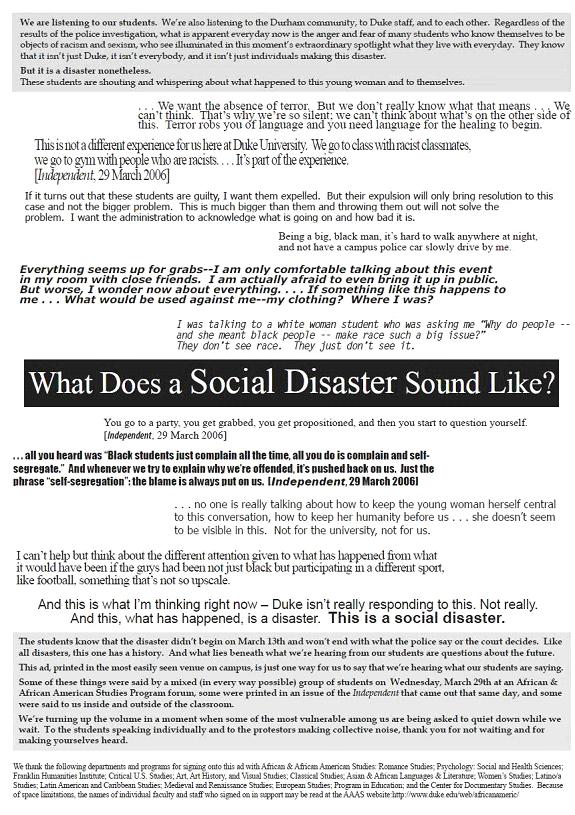
Lubiano's Cover E-Mail

A question from today's comment thread:
KC...Just wondering. Have you ever seen the cover email (I assume there was one) that Wahneema Lubiano sent to the faculty with the solicitation to sign the "We're Listening" ad. If this email exists do you think it will ever see the light of day? I can't ask Professor Lubiano myself since I've been summarily sentenced to her email filter.

A: Yes. Here it is.
African & African-American Studies is placing an ad in The Chronicle about the lacrosse team incident. We’re trying for Thursday (04/05) if we can do it; if not, then next Monday (04/10). I’ve attached a draft of the ad to this email. The attachment is just a draft of the text; we’re still working on design elements. The ad is built around student articulations.

AAAS is sending the ad draft to Cultural Anthropology, Literature, and History, but we don't have an email list of all department and programs chairs, and I don't have time to put one together, so if you are willing to spam this to other individual faculty or to your chairs to see if they're interested in supporting the ad and so that as many faculty as possible have a chance to see it and sign on, we would appreciate it.

If you would like to be a signatory to the ad, please send your names to me at [Lubiano's e-mail]. PLEASE DO NOT HIT REPLY–DO NOT RESPOND TO THE ENTIRE LIST IF YOU ARE SIMPLY ASKING THAT YOUR NAME BE ADDED.

We will not be listing the names on the ad itself (only the supporting departments and program units) because we’re trying to make the material quoted from the students the major focus of the ad (as you will see in the draft). We’ll list the individual names on the AAAS website and indicate on the ad itself that people may go to the website to read individual faculty names.

If you have any questions, please contact me.

Wahneema

[Update, 10.34pm: Both emphases added. The first emphasis notes that the ad came from official Duke funds--in violation of Duke policy. The second emphasis calls into grave doubts the repeated suggestions of President Richard Brodhead that the ad was about generalized social or racial issues in society, and not about, to quote the statement's author herself, the "lacrosse team incident."]

From the Quotes File

DIW readers had quite a few additional suggestions for quotes that could have made the Top 32 Countdown of most outrageous lacrosse case statements.

First, three items for which I should have found room:

1.) “‘It’s the same old story. Duke up, Central down.’ Hall said he wanted to see the Duke students prosecuted ‘whether it happened or not. It would be justice for things that happened in the past.’”

--NCCU student government leader Chan Hall, to Newsweek reporter Susannah Meadows, April 2006.

2.) “Yeah, I’d love to see it [the document].”

--Linwood Wilson, interrupting defense attorney Joe Cheshire’s press conference, June 22, 2006, to deny Cheshire’s claim that a document in the just-handed over discovery material had Crystal Mangum telling inconsistent stories and suggesting she was raped by other than three men.

The next day, Cheshire faxed Wilson a police report from Officer Gwen Sutton, who recorded Mangum’s inconsistent assertions (including a claim that there were five, not three, rapists). Cheshire noted, “Since you are the District Attorney’s Investigator, the press could have assumed—falsely, as it turns out—that you had actually read your file. I can only assume your motivation in questioning my assertion was simply ignorance. A simple reading of your file might solve that problem in the future.”

3.) “I always thought that [Mike Nifong] was a very ethical person.”

--Linwood Wilson, in State Bar deposition, April 2007. This is the same Linwood Wilson who gave up his PI’s license after myriad ethics complaints against him.

---------

Other memorable quotes, in no particular order of ranking:

4.) “This goes to show that justice can’t be bought by a bunch of rich white boys from New York.”

--Former Durham Democratic Party official Harris Johnson, celebrating Mike Nifong’s victory, Election Night 2006. As with Chan Hall’s statement, no one from the city’s political, academic, or media leadership rebuked Johnson for his comment.

5.) “Quite a number of people have assured me that the ad said the students were guilty, but if you go back and look, that’s not what the ad says.”

--Richard Brodhead, on the Group of 88’s statement, January 2007.

No, the ad (described by its author, Wahneema Lubiano, as about the “lacrosse incident”), just unequivocally stated that something happened to Mangum; and thanked people who had declared the players guilty.

6.) “I don’t know why counsel for the defense would think there was anything of evidentiary value on that cell phone.”

--Mike Nifong, in court, May 2006. The ex-DA, obviously, had no interest in this information.

7.) “There was evidence of DNA of Seligmann [sic] who lived in that house [sic].”

--”Commentator” Georgia Goslee, MSNBC, 7 August 2006. Of course, there were never any DNA matches to Reade Seligmann, and he did not live at 610 N. Buchanan.

8.) “I’m very comfortable with our coverage. From the beginning, we’ve felt this story had two main elements: one was the allegation of rape; the other was the general behavior of a high-level sports team at a prestigious university.”

--New York Times sports editor Tom Jolly, April 23, 2006. Jolly oversaw the paper's first month-plus of guilt-presuming coverage.

9.) “If the rape and kidnapping charges do not hold up, the story doesn’t end. The Times should be prepared to continue covering what is done about the racial-insult allegations, given the prominence of the team and the university.”

--Former Times “public editor” Byron Calame, April 23, 2006. Prosecutorial misconduct? The media’s rush to judgment? Professors betraying their profession? Not the story if the charges collapsed, according to Calame.

10.) “She was black, they were white, and race and sex were in the air.”

--Washington Post columnist Lynne Duke, May 24, 2006.

11.) “It’s impossible to avoid thinking of all the black women who were violated by drunken white men in the American South over the centuries. The master-slave relationship, the tradition of droit du seigneur , the use of sexual possession as an instrument of domination—all this ugliness floods the mind, unbidden, and refuses to leave.”

--Washington Post columnist Eugene Robinson, April 25, 2006.

12.) “Having said something other than ‘no comment’ in the first place, it’s kind of like going into Iraq. It’s not a question of if you’re right to go in there. It’s a question of is it right to leave things a mess at this point in time?”

--Mike Nifong, April 2006, battling Bill (“Emmett Till”) Chafe for inappropriate analogies.

13.) “When the children of privilege feel vividly alive only while victimizing, even torturing, we must all ask why . . . The imperative to win, and damn all collateral costs, is not peculiar to Durham—and it is killing us.”

--Allan Gurganus, April 9, 2006, New York Times.

14.) “The lacrosse gals, 30 of 31 of whom are white, are apparently free to martyr their male lax mates . . . Does cross-team friendship and university pride negate common sense at a college as difficult to gain admission to as Duke? Has anyone—from the women’s lacrosse coach, Kerstin Kimel, to the Duke president, Richard H. Brodhead—reminded the players of the kind of behavior they are staking their own reputations on?”

--Times columnist Harvey Araton, May 2006. After the case ended, Araton refused to apologize.

15.) “Something happened on the night of March 13th—something so compelling that Durham District Attorney Michael Nifong was prompted to say, 'This case is not going away’ . . . We know that the two women were abused . . . The Duke scandal should lead colleges across the country to hold searching discussions about racial and sexual stereotypes, exposing the myths that entrap so many. But it shouldn’t take the brutalizing of a mother of two to raise these issues.”

--Former two-time presidential candidate Jesse Jackson, April 2006.

Friday, September 21, 2007

Top 32 Countdown, IV

As the blog winds down, I thought it might be worthwhile to recall the most outrageous quotes of the case.

The last three days’ posts featured #32 through #9; today’s takes the countdown from #8 through #1 on the list of most outrageous:

8) "I don’t think I’ve been proven wrong, because . . . I said, I think they’re probably guilty of everything but rape."


--“Journalist” John Feinstein, after the AG’s declaration of actual innocence, discussing Reade Seligmann, Collin Finnerty, and Dave Evans.

7) “By disclosing pieces of evidence favorable to the defendants, the defense has created an image of a case heading for the rocks. But an examination of the entire 1,850 pages of evidence gathered by the prosecution in the four months after the accusation yields a more ambiguous picture. It shows that while there are big weaknesses in Mr. Nifong’s case, there is also a body of evidence to support his decision to take the matter to a jury.

--Duff Wilson, New York Times, August 25, 2006. Attorney General Roy Cooper himself would later give the lie to these sentences, when he remarked that no credible evidence existed of any crime, much less sufficient evidence to take a case to a jury.

6) “DNA results can often be helpful, but, you know, I’ve been doing this for a long time, and most of the years I’ve been doing this, we didn’t have DNA. We had to deal with sexual assault cases the good old-fashioned way.”

--DA Mike Nifong, at the April 11, 2006 NCCU forum, dismissing the DNA results that his office a mere three weeks previously had promised would exonerate the innocent.

5) “Is this drive to register as putative, enfranchised citizens of the good city of Durham, this drive to impact the Durham political [process], driven by innocence, one wonders—the most widespread mobilization of the Duke campus since the campaign against Nike sweatshop labor. To vote against Mike Nifong. To make the oldest “X,” the sign of the white male franchise, itself overridden with the mark of privilege, oppression, slavery, racism, utter contempt for black and native bodies. [emphasis added] To make that sign in the history of this country, to extend into the presence the deeply troubled past, to make the “X”—whether it is acknowledged as such or not—against women and, more specifically, against black female bodies. All that, one presumes, all that written into the “X” to ensure that the secret is kept secret, that the secret is kept in-house, where it belongs.”


--Group of 88 stalwart Grant Farred, articulating the thesis of his Herald-Sun op-ed, in which he accused all Duke students who registered to vote in Durham of harboring a “secret racism.” Farred recently left Duke for a tenured, full professorship at Cornell. Stated English Department chair Molly Hite, author of Class Porn, “We are very enthusiastic about Professor Farred, whose work everyone in this department has long admired.”

4.) “I think something happened in that bathroom.”

--DA Mike Nifong, asked by Lane Williamson for his theory of the crime, June 2007

3.) “White innocence means black guilt. Men’s innocence means women’s guilt.”

--Group of 88 stalwart Karla Holloway, offering her insights on the lacrosse case. In the fall 2007 semester, Holloway is offering a class at Duke Law School.

2.) “If our students did what is alleged, it is appalling to the worst degree. If they didn’t do it, whatever they did is bad enough.”

--Richard Brodhead, April 20, 2006, to Durham Chamber of Commerce, in his first public appearance after the arrests of Reade Seligmann and Collin Finnerty. We know now “whatever” Finnerty and Seligmann did: they attended a party they played no role in organizing and they drank some beer.

1.) “I mean, if I were one of those [defense] attorneys, I wouldn’t really want to try a case against me either.”

--“Mike Nifong, following his primary victory, May 2006.

The statement speaks for itself.

Thursday, September 20, 2007

Top 32 Countdown, III

As the blog winds down, I thought it might be worthwhile to recall the most outrageous quotes of the case. The countdown will culminate on Friday.

The last two days’ posts featured #32 through #17; today’s takes the countdown from #16 through #9 on the list of most outrageous:

16) “In the moment when the ad came out, I did not hear from one colleague that there was something wrong with the ad.”

-- Statement author Wahneema Lubiano, discussing the origins of the Group of 88’s ad—and unintentionally revealing the groupthink that plagues some quarters of the Duke campus.

---------


15) “I’m not going to allow Durham’s view in the minds of the world to be a bunch of lacrosse players at Duke raping a black girl from Durham.”

--Mike Nifong, at a candidate’s forum, April 12, 2006. At a similar forum, he added that people should vote for him because he’d rather do what’s right than what would get him elected.

---------

14) “We are eager for our students to be proved innocent . . . which is all the more reason why we require the legal system to proceed in a fair-minded, even-handed, and speedy fashion.”

--Duke president Richard Brodhead, response to Friends of Duke’s summer 2006 letter, inverting the American system of justice on its head.

---------

13) “The best course for all concerned is to continue down the current path to trial and, we hope, to justice . . . It would be better for the players to have an opportunity to prove their innocence at trial.”

--Bob Ashley’s Herald-Sun, editorial, Nov. 10, 2006, inverting the American system of justice on its head. After the case ended, Ashley claimed that his paper’s editorials always stressed the presumption of innocence.

---------

12) “There is no rush to judgment here about the crime—neither the violent racial epithets reported in a 911 call to Durham police, nor the harms to body and soul allegedly perpetrated by white males at 610 Buchanan Boulevard . . . How soon will confidence be restored to our university as a place where minds, souls, and bodies can feel safe from agents, perpetrators, and abettors of white privilege, irresponsibility, debauchery and violence? Surely the answer to the question must come in the form of immediate dismissals of those principally responsible for the horrors of this spring moment at Duke. Coaches of the lacrosse team, the team itself and its players, and any other agents who silenced or lied about the real nature of events at 610 Buchanan on the evening of March 13, 2006.”

--Houston Baker open letter, March 29, 2006. Baker subsequently would be welcomed by Vanderbilt University, which described him as “one of the most wide-ranging intellectuals in America.”

---------


11) “I bet one or more of the players was, you know, molested or something as a child.”

--Adjunct law professor Wendy Murphy, “CNN Live,” May 3, 2006. Murphy later explained that she viewed her role on cable talk shows not as presenting the truth. “You have to appreciate my role as a pundit is to draw inferences and make arguments on behalf of the side which I'm assigned," she stated. “So of course it's going to sound like I'm arguing in favor of 'guilty.'”

---------


10) “This episode has touched off angers, fears, resentments, and suspicions that range far beyond this immediate cause. It has done so because the episode has brought to glaring visibility underlying issues that have been of concern on this campus and in this town for some time—issues that are not unique to Duke or Durham but that have been brought to the fore in our midst. They include concerns of women about sexual coercion and assault. They include concerns about the culture of certain student groups that regularly abuse alcohol and the attitudes these groups promote. They include concerns about the survival of the legacy of racism, the most hateful feature American history has produced. Compounding and intensifying these issues of race and gender, they include concerns about the deep structures of inequality in our society—inequalities of wealth, privilege, and opportunity (including educational opportunity), and the attitudes of superiority those inequalities breed. And they include concerns that, whether they intend to or not, universities like Duke participate in this inequality and supply a home for a culture of privilege. The objection of our East Campus neighbors was a reaction to an attitude of arrogant inconsiderateness that reached its peak in the alleged event but that had long preceded it.”

--Richard Brodhead, April 5, 2006, “Letter to the Duke Community.” This document—the president’s last major public statement on the case before the first two arrests—could easily have served as a campaign flyer for Nifong’s primary campaign. In his 2,377 words, he never once mentioned the presumption of innocence; or that the lacrosse captains had voluntarily given statements, DNA, and their e-mail passwords; or that the team members and their attorneys wholly denied all allegations.

---------


9)


--Det. Ben Himan, recalling Mike Nifong’s reaction after the DA’s initial briefing on the case, when the officers involved relayed to the DA the myriad weaknesses of the case. A few minutes after this meeting, Nifong began the first of his 50-70 media appearances expressing his certainty that a heinous rape had occurred.

----------


Tomorrow: the countdown concludes, with quotes #8 through #1.

Wednesday, September 19, 2007

Top 32 Countdown, II

As the blog winds down, I thought it might be worthwhile to recall the most outrageous quotes of the case. The countdown will culminate on Friday.

Yesterday’s post featured #32 through #25; today’s takes the countdown from #24 through #17 on the list of most outrageous:

24) “The season is over, but the paradox lives on in Duke’s lacrosse team, a group of privileged players of fine pedigree entangled in a night that threatens to belie their social standing as human beings. Something happened March 13, when a woman, hired to dance at a private party, alleged that three lacrosse players sexually assaulted her in a bathroom for 30 minutes . . . Players have been forced to give up their DNA, but to the dismay of investigators, none have come forward to reveal an eyewitness account.”

--Selena Roberts’ guilt-presuming New York Times column, March 31, 2006. She has never apologized for, or even acknowledged, her rush to judgment.

---------

23) “The ad said that we faculty were listening to the anguish of students who felt demeaned by racist and sexist remarks swirling around in the media and on the campus quad in the aftermath of what happened on March 13 in the lacrosse house. The insults, at that time, were rampant. It was as if defending David Evans, Collin Finnerty and Reade Seligmann necessitated reverting to pernicious stereotypes about African-Americans, especially poor black women.”

--Group of 88 member Cathy Davidson, January 5, 2007, imagining a world that never existed as she rationalized her decision to sign the rush-to-judgment statement.

---------

22) “Somebody had an arm around her like this [demonstrating a chokehold], which she then had to struggle with in order to be able to breathe, and it was in the course of that struggle that the fingernails—the artificial fingernails broke off. Now as you can see from my arm, if I were wearing a shirt, a long-sleeved shirt or a Jacket of some sort, even if there were enough force used to press down, to break my skin through the clothing, there might not be any way that anything from my arm could get on to those fingernails.”

--Mike Nifong, on MSNBC, March 31, 2006, with the accompanying visual demonstration.


--------

21) “I have a board in my office, it’s a, dry-erase board. And, for example, Investigator Himan would say, ‘I need to have someone look at different things, how we can get a hair analysis done.’ And I would put my name next to that. And then he’d say, ‘I need a background done for this person.’ I would assign someone to do that if he wasn’t going to do it. He’d say, ‘I need a court order to get e-mail records,’ put his name next to that, et cetera, et cetera, et cetera. I had asked him and was under the impression that he was taking photographs of the board, and when we finished that we would clear it. That wasn’t done. And I apologize for that."

--Sgt. Mark Gottlieb, April 19, 2007, explaining how he could have produced a 32-page typewritten report with contemporaneous notes for only one afternoon in late April 2006.

---------

20) “To suggest [the indicted players] were well-behaved: Hitler never beat his wife either. So what?”

--Adjunct law professor Wendy Murphy, MSNBC, June 5, 2006, dismissing the findings of the Coleman Committee report.

--------

19) “When police officers arrived at the house with a search warrant on March 16, none of the players would cooperate with the investigation [sic] . . . The allegations of rape bring the students’ arrogant frat-boy culture to a whole new, sickening level. ‘Get a conscience, not a lawyer,’ read [potbangers’] signs waved in front of the house on Sunday. We agree that the alleged crime isn’t the only outrage. It’s also outrageous that not a single person who was in the house felt compelled to step forward and tell the truth about what happened [sic].”

--Herald-Sun, editorial, March 28, 2006. Much like Selena Roberts, the Bob Ashley-led paper managed to get major facts wrong and to celebrate the potbangers’ protests. And much like Roberts, Ashley has not only never acknowledged his rush to judgment but preposterously asserted that the paper's editorials always upheld the presumption of innocence.

---------

18) One would wonder why one needs an attorney if one was not charged and had not done anything wrong.

--Mike Nifong, explaining his conception of due process to ESPN, March 31, 2006. It’s worth noting, for the record, that Nifong hired attorneys for both his ethics hearing and his criminal contempt trial.

---------

17) “You know, I don’t want to hear any ifs, and, or buts. These kids have acted disgracefully, just by the fact that not one of them—I don’t want to hear about the code, among buddies and among teams. A crime was committed. There were witnesses to the crime. They need to come forward and say what they saw . . . They won’t, and that’s why I’m saying the hell with them—strip their scholarships.”

--“Journalist” John Feinstein, imagining himself in the role of the Duke president, lecturing the players, March 30, 2006.


--------

Tomorrow: the countdown continues, with quotes #16 through #9.

Tuesday, September 18, 2007

Butler, Again

Another great column by Kristin Butler in today's Chronicle--on the civil suit settlement; and ending with the astonishing Committee on the Affairs of Black People endorsement of Victoria Peterson.

How can there be no outrage in the N&O and Herald-Sun that a major city PAC had endorsed a bigot who claimed that Duke Hospital tampered with the DNA evidence and who advocated burning down the lacrosse players' house?

Top 32 Countdown, I

As the blog winds down, I thought it might be worthwhile to recall the most outrageous quotes of the case. The countdown will culminate on Friday.

Today’s post features #32 through #25:

32) “Under my leadership, the District Attorney’s office is an institution of unquestioned integrity.”

--Mike Nifong, “Letter to Durham Voters,” fall 2006; in one of the many examples of doublespeak that emanated from the Nifong campaign.

--------

31) “Burn it down!”

--Nifong citizens committee co-chair Victoria Peterson, outside the lacrosse players’ house, during the New Black Panthers’ visit to Durham. Last week, Peterson was endorsed for City Council by the Durham Committee on the Affairs of Black People.

--------

30) “Mr. Rosenberg said he did so because he was concerned with the prevalence of alcohol on campus and bothered by ‘affluent kids violating the law to get exploited women to take their clothes off when they could get as much hookup as they wanted from rich and attractive Duke coeds.’”

--Group of 88 member Alex Rosenberg, explaining why he signed the Group’s statement, as quoted by Eliana Johnson in the New York Sun, October 27, 2006. Rosenberg is currently director of the A.B. Duke Scholarship Program—to which, presumably, some of those “rich and attractive Duke coeds” apply.

---------

29) “There was phone calls being made between the detective and Nifong to determine if they would want us to do the work and if the price was right and dah, dah, dah, dah, dah, dah, dah, back and forth.”

--Dr. Brian Meehan, in his State Bar deposition, explaining how his lab was hired to work on the highest-profile case in Durham history.

---------

28) “If I publish something like this . . . my voice won’t count for much in my world.”

--Group of 88 member Susan Thorne, explaining why she could not fulfill her commitment to a lacrosse player to publish a statement of regret about signing the Group of 88’s ad—and instead signed the January 2007 “clarifying” statement, whose signatories expressly refused to apologize for the Group of 88’s ad.

---------

27) “We had to stop those pictures [of the players practicing]. It doesn’t mean that it’s fair, but we had to stop it. It doesn’t necessarily mean I think it was right—it just had to be done.”

--Board of Trustees chairman Bob Steel, explaining to the New Yorker why Duke canceled the 2006 men’s lacrosse season.

---------

26) “Regardless of what happened inside of 610 N. Buchanan Blvd, the young men were hoping to consume something that they felt that a black woman uniquely possessed. If these young men did in fact rape, sodomize, rob, and beat this young women [sic], it wasn’t simply because she was a women [sic], but because she was a black woman.”

--Group of 88 member Mark Anthony (“thugniggaintellectual”) Neal, “analyzing” the case, April 13, 2006.

------------

25) “I don’t feel I’m part of the problem. I feel that I have assisted in revealing the problem . . . Durham has some healing to do, and I need to be part of that healing process.”

--DA Mike Nifong, at his 2007 inauguration ceremony, January 2, 2007.

-----------

Tomorrow’s post: #24 through #17.

Monday, September 17, 2007

Duke Talk

Ken Larrey has graciously posted the video on my talk at Duke last week.

While there, it's worth checking out the site for Duke Students for an Ethical Duke.

Volokh Guest-Blogging

For those interested, Stuart Taylor and I are guest-blogging this week at the Volokh Conspiracy, a prominent legal blog. We will have two posts up each weekday this week.

Civil Suit Watch, III

Today’s primary post discusses the transparent biases of some critics of the civil suit settlement. It also raises an obvious, if largely overlooked, point: it’s fanciful to believe that everything bad about the DPD’s performance has already come to light.

For instance, Cpl. David Addison has yet to be deposed. This is the same David Addison who, in his capacity as official spokesperson of the DPD, stated:

  • “You are looking at one victim brutally raped. If that was someone else’s daughter, child, I don’t think 46 (tests) would be a large enough number to figure out exactly who did it.” (WRAL, March 24)
  • “Addison said police approached the lacrosse team with the five-page search warrant on March 16, but that all of the members refused to cooperate with the investigation.” (Herald-Sun, March 25)
  • “We’re asking someone from the lacrosse team to step forward . . . We will be relentless in finding out who committed this crime.” (N&O, March 25)
  • “Addison said police can’t force samples from anyone they believe to be implicated in a crime. But he said that, in this situation, there was ‘really, really strong physical evidence.’” (Herald-Sun, March 25)
  • “We’re not saying that all 46 were involved. But we do know that some of the players inside that house on that evening knew what transpired and we need them to come forward.” (ABC, March 26)

As we know now, all of those statements were either outright false or misleading.

Only two explanations exist for Addison’s actions: (1) in the highest-profile case in the city’s history, he allowed fellow officers to mislead him, causing him to mislead the public—calling into question his competence; or (2) he willfully misled the public—calling into question his ethics.

Under oath, what explanation would Addison provide?

Civil Suit Watch, II

Today’s primary post discusses the transparent biases of some critics of the civil suit settlement. It also raises an obvious, if largely overlooked, point: it’s fanciful to believe that everything bad about the DPD’s performance has already come to light.

For instance, Deputy Police Chief Ron Hodge has yet to be deposed. This is the same Ron Hodge who, April 11, 2006, stated to MSNBC that “I don’t think we would be here if it wasn’t (a strong case)”?

As we know now, the case not only wasn’t strong; there was no case at all; Hodge’s portrayal of the evidence was, therefore, false.

Only two explanations exist for his statement: (1) in the highest-profile case in the city’s history, he allowed his fellow officers to mislead him, causing him to mislead the public—calling into question his competence; or (2) he willfully misled the public—calling into question his ethics.

Under oath, what explanation would Hodge provide?

Civil Suit Watch, I

Today’s primary post discusses the transparent biases of some critics of the civil suit settlement. It also raises an obvious, if largely overlooked, point: it’s fanciful to believe that everything bad about the DPD’s performance has already come to light.

For instance, City Manager Patrick Baker has yet to be deposed. This is the same Patrick Baker who, on May 10, 2006, gave an interview to the N&O, in which he asserted, “I’ve had a lot of conversations with the investigators in this case and with officials at Duke, and at no time did anyone indicate [Crystal Mangum] changed her story. If that were true, I’m sure someone would have mentioned it to me.”

As we know now, Mangum never told law enforcement the same story twice; Baker’s portrayal of the evidence was, therefore, false.

Only two explanations exist for his statement: (1) in the highest-profile case in the city’s history, he allowed police to mislead him, causing him to mislead the public—calling into question his competence; or (2) he willfully misled the public—calling into question his ethics.

Under oath, what explanation would Baker provide?

Weidlich Clarification

I have received several e-mails from legal reporter Thom Weidlich suggesting that my two sentences about his review accused him of "intellectual dishonesty," having "some sort of vendetta," and working in "cahoots" with other people at CUNY; Weidlich denies such a connection. To the extent that Weidlich or anyone else interpreted the sentences in that fashion, I apologize.

Since the issue at hand is the clarification of Weidlich's intellectual honesty, I should point out that in writing the final line of his review ("Once again, the players are being used for political ends"), Weidlich appeared unaware of the public statements by two of the falsely accused players (at their post-exoneration press conference) and several of their attorneys (subsequently) presenting a wholly opposite view of my work and motivations on the case. Additionally, in writing the above line, reporter Weidlich contacted neither any of the falsely accused players; nor their families; nor their attorneys.

I hope that the above information is useful in assessing reporter Weidlich's intellectual honesty, and I apologize again if anyone considered my earlier remarks to be either an attack on his intellectual honesty or a suggestion that he was working in "cahoots" as part of a "vendetta."

The Civil Suit

The last week or so has featured widespread local discussions about the prospect of a civil settlement between the falsely accused lacrosse players and the city of Durham. The AP reported that attorneys for the three players demanded a payment of $30 million—plus Durham’s enactment of meaningful criminal justice reforms. The attorneys have made it clear that there would be no deal if Durham were interested in a financial payoff alone.

The reaction from some quarters was predictable. The N&O’s Barry Saunders penned a race-baiting column falsely asserting that Reade Seligmann and Collin Finnerty had “hired themselves a stripper.” This false claim, and Saunders’ other taunts, only bolstered the falsely accused students’ case against Durham, by showing the continuing harm to their reputations—something Saunders might have wanted to consider before he wrote. And Saunders, hyper-sensitive to the slightest of perceived slights against African-Americans, appeared to be unconcerned with his own perceived slight against the religion of the falsely accused players.

But, of course, this is the same Barry Saunders who previously eviscerated media coverage of a gang-rape allegation—when the defendants were black NCCU students. Their accuser (whom Saunders mocked) didn’t show up for a probable cause hearing, prompting dismissal of charges. But the mere filing of charges, according to Saunders, caused long-term damage to the students’ reputation: “I saw the two dudes’ pictures in the paper. I’m not saying they looked guilty, but let’s face it. It’s hard to look innocent when your mug shot is splashed on television or in the paper in connection with some horrific story.” (To remind Saunders, the mugshots of Seligmann and Finnerty were “splashed”—over and over and over again—on national television and on the cover of Newsweek.)

Also attacking the proposed settlement is NCCU law professor Irving Joyner, who opined, “I don’t think the alleged harm, if it was caused by the city, would rise to that level. It’s the difference between helping the needy and helping the greedy.”

But, of course, this is the same Irving Joyner who spent months publicly asserting that Mike Nifong had done nothing wrong—indeed, who in late December 2006 even ridiculously claimed that Nifong’s decision to drop the rape charges would help the ex-DA’s case and that the State Bar would not move for disbarment. Since Joyner seemed to have no problem with Nifong’s behavior at the time, why should it surprise anyone that he’s baffled as to why the city should have to fork out money in a civil suit?

Trinity Park resident Ellen Dagenhart joined Saunders and Joyner in expressing outrage over the prospect of a civil suit settlement. “Take it to court, let it be heard,” she exclaimed to the N&O. “I don’t know how you decide that one life is worth more than another.” Since every other falsely accused person victimized by massive prosecutorial and police misconduct in the history of North Carolina hasn’t received a $10 million settlement, in Dagenhart’s logic, Durham should refuse the settlement offers.

But, of course, this is the same Ellen Dagenhart who, according to the N&O, “praised Gottlieb’s get-tough tactics” with Duke students and enthusiastically endorsed the DPD’s policy of treating Duke students according to procedures different than those used with all other Durham residents. Given that such behavior forms a key element of the civil suit claims, why should it surprise anyone that she’s baffled as to why the city should have to fork out money in a civil suit?

The Bob Ashley-led Herald-Sun made its contribution to the chorus, clucking, “It seems clear that the police department made serious errors. On the other hand, $30 million is too much. Much too much.”

But, of course, this is the same Herald-Sun that bent over backwards to ignore those “serious errors” as the case was occurring. Instead of seeking to hold the powerful accountable, Ashley, et al. advocated giving Nifong and the DPD a free pass. A few days after the November election, the H-S editorial page breezily recommended that “the best course for all concerned is to continue down the current path to trial,” since “it would be better for the players to have an opportunity to prove their innocence at trial.” [emphasis added] Given that Ashley failed to see anything wrong the the behavior of Nifong or DPD while the case was occurring, why should it surprise anyone that he’s reluctant to see the city fork out money in a civil suit?

Barry Buffaloe, a senior accounting clerk at Duke who says he’s worked at the school for the past 25 years, also was outraged at the proposed settlement. He conceded that “a district attorney got a little(!) overzealous(!).” But what was the real problem? “This group of young men wanted adult entertainment at their party.” (Buffaloe used the phrase eight times in a nine-paragraph letter.)

Buffaloe, it seems, wants to amend federal civil rights statutes to prevent their application to any and all people who have watched “adult entertainment at [a] party.” (This, perhaps, can be the newest crusade for the Group of 88.) For those who have watched “adult entertainment at [a] party,” the police can make knowingly false public statements accusing you of a racially motivated gang rape. The police can run a lineup confined to suspects, in violation of their own procedures, so an accuser can pick someone that can be charged. The police can even manufacture evidence like the Gottlieb report to try and railroad three innocent people into a 30-year jail sentence.

Fortunately, since Mr. Buffaloe has never watched adult entertainment, he’ll still have the right to file a federal lawsuit if the police do any of the above to him. As for his neighbors who have watched adult entertainment . . . here’s hoping they steer clear of Sgt. Mark Gottlieb.

A more serious critique of the proposed settlement came from the Chronicle. The editors suggested that the settlement “seems somewhat bizarre,” since “the 'bad guys' in this case are not the Durham citizens who will be paying the lion’s share of that settlement, but rather Nifong and certain members of the Durham Police Department.”

The editorial continued,

At the end of the day, however, it only makes sense that money should go into—and not be taken from—the coffers that supported the infrastructure that supported Nifong’s clear miscarriage of justice. Plus, the families already have money coming in from other sources.

It is, moreover, laudable that the families and their attorneys are using the injustice they experienced as a catalyst for change . . . but it also seems out of place and perhaps even a bit heavy-handed to attach such stipulations to a request for $30 million with the city.

The latter point is not persuasive: civil rights suits frequently are used to achieve meaningful procedural reforms, especially regarding cities or agencies that have proven reluctant to initiate these reforms on their own. That might be “heavy-handed,” I suppose, but it’s also not at all uncommon.

That the families have money coming in from other sources is irrelevant to the justness of a cause of action against Durham. And I disagree strongly that it “only makes sense” for money to go into the Durham city coffers, given the performance we have witnessed from Durham over the past 18 months. As to whether taxpayers should be held responsible for the misconduct of their police department acting as a unit—on this point, the editors’ objection appears to be more with federal law, which allows such suits, than with the players and their families.

Most critics of the proposed settlement appear to have overlooked both the purpose of the law under which the suit would be brought and some of the basic facts of this case. In a recent N&O article, Jim Coleman explained,

how much the lacrosse players suffered is just one factor in determining an appropriate amount to seek. Coleman said he thinks Durham police failed to adequately explore evidence that could have exonerated the players, a charge the city denies. He said other falsely accused people have suffered more, but they often were the victims of negligence rather than an intentional effort to bring charges without evidence.

The question of intent—whether police willfully railroaded the lacrosse players—will be a key factor if the civil case goes to trial, Coleman and Largess said. If police and city officials are found to have maliciously pursued the case knowing the evidence wasn’t there, they should pay until it hurts, Coleman said. “There’s an element of punitive action involved in lawsuits like this,” he said.

The next day, Coleman added that deterrence can be a critical action of such suits: “When the city acts in ways that are so totally outrageous and could have been prevented, I think the damages ought to be sufficient to deter that kind of behavior in the future and also to send a message to other cities and prosecutors across the state. I have no idea the damage they suffered. There’s no way for us to say $30 million is low or high.”

As so often has occurred on this case, it’s difficult to argue with Coleman’s reasoning. Indeed, the Baker/Chalmers report maintained that the behavior of the Durham Police Department in the lacrosse case was “typical” of how it approaches all of its cases. If that claim isn’t grounds for a punitive finding against Durham, then nothing would be.

It is worth remembering exactly what happened here: A district attorney, at least two police officers (Gottlieb and Addison), a forensic nurse, a DA’s investigator, and a lab director (along with, possibly, others) seemed to work together to manufacture inculpatory evidence to implicate three people for a crime that never occurred. All the while, superiors in Durham’s law enforcement and political structure either looked the other way or actively supported the conspiracy. That is about as serious a level of misconduct by local government officials as can be imagined.

A pragmatic point is also worth considering. Critics of the settlement appear to assume that we know everything there is to know about the DPD’s misconduct. Yet, to date, neither City Manager Baker, nor former Chief Chalmers, nor Capt. Lamb, nor Deputy Chief Hodge, nor Sgt. Shelton, nor Inv. Soucie, nor Inv. Clayton have been deposed. The depositions of Sgt. Gottlieb, Det. Himan, Intimidator Wilson, and Lt. Ripberger were conducted for the limited purpose of the Nifong disbarment hearing—and even there, much embarrassing emerged (the dry-eraser board, Gottlieb’s false testimony to the grand jury, and the continued defenses, by all concerned, of the procedurally improper April 4 lineup). If those damning revelations came out of the limited depositions that have occurred to date, imagine what would shake free after Barry Scheck and Brendan Sullivan get through with the above list.

After such a deposition process, I suspect that $30 million will look like a bargain.

Sunday, September 16, 2007

Weidlich Correction

Thom Weidlich, author of the review of UPI in Bloomberg News, is, in fact, a "legal reporter" for Bloomberg News, and not a freelancer. I improperly identified him, and apologize for doing so.

For different interpretations of the book than that offered by Weidlich, see:

The Group & Friends

Having milked all they could from their anti-lacrosse jihad—and refusing, of course, to engage in any critical self-reflection about their actions—extremists among the Group of 88 and their allies are moving on to other protesting endeavors.

Today’s N&O reveals that Anne (“Group of 88 for Credit”) Allison and Orin Starn were recently cited for trespassing and given a court date on the misdemeanor charge. They allegedly planted protest signs in the landscaping outside an exhibition at the Southpoint Mall. (Yes, this is the same Orin Starn who suggested that the lacrosse players’ citations for underage drinking implied some sort of moral flaw.) Their new cause? Opposition to “Bodies ... The Exhibition.”

Several other protesters, including Starn’s wife, Robin Kirk, were quoted in the N&O article as celebrating the professors’ flouting of the law. It’s good to see that—as in their dealings with the Duke Faculty Handbook—the anti-lacrosse extremists continue to believe that they don’t need to follow the rules when engaged in politically correct crusades.

[Update, 5.28pm: At a previous protest, Kirk, whose webpage states that she "teaches at Duke University and coordinates the Duke Human Rights Initiative," responded in the following way:

When the guard asked for my name to write a citation, I refused to give it. At the time, I was seated at one of the pleasant outdoor tables reading Marshall Meyer’s “You Are My Witness,” a book of this famous Argentine rabbi’s thoughts on human rights and the Argentine dirty war.

Believe me, nothing could have been more fun or satisfying!

Once he trotted off for reinforcements, I collected the teens who were the cause of my delay and skedaddled. ]

Meanwhile, people at Vanderbilt are awakening to the realities of Houston Baker’s performance in the case, thanks to a piece by Justin Offermann. Offermann asks an unanswerable question: how could Vanderbilt describe the person who called lacrosse players “farm animals” and penned the racist March 2006 open letter “one of the most wide-ranging intellectuals in America”?

Hat tip: T.K.