Monday, August 22, 2011

Durham & NYC

[Update, Tuesday, 3.45pm: On the Atlantic site, Andrew Cohen praises Vance's decision. His conclusion: "No one ever said the criminal justice system is pretty, or perfect, or capable of always delivering a narrative that has a clear beginning, middle, and end. There is no legal right to a happy ending -- or even a dispositive one. The leavening truth here is that the Constitution worked pretty much the way it is supposed to work in these circumstances. Under the Supreme Court's precedent in Brady v. Maryland, prosecutors have a duty to share with defense attorneys any exculpatory evidence they find. This the prosecutors did, to their eternal credit. Moreover, a district attorney has an ethical obligation not to try a case he or she doesn't believe can be won. This, too, the district attorney considered."

Cohen had a far different take, however, on the lacrosse case, writing in June 2006 that discussion about Mike Nifong's procedural misconduct meant that, in the media, “there is no balanced coverage in the Duke case. There is just one defense-themed story after another.” The lacrosse players, he claimed in apparent ignorance of the first month of the case, benefited from “race and money and access to the media.” And when the victims of a rush to judgment were college students rather than the former IMF head, Cohen's interpretation of legal ethics went as follows: “We haven’t seen all of the evidence, haven’t examined all of the testimony; haven’t had the privilege of seeing the case unfold at trial the way it is supposed to.”]

As I’ve noted previously, there were significant differences between the lacrosse case and the allegations against French politician Dominique Straus-Kahn: in the DSK case some type of sexual contact occurred; and even his version of events reflected poorly on the former IMF head's character.

It turned out, however, that the most significant difference between the two cases involved the office of district attorney. With the exception of an ill-timed public statement early in the case, Manhattan DA Cyrus Vance, Jr., followed both ethical guidelines and normal investigative procedures. Mike Nifong, of course, did not. A few items from the dismissal motion filed by Vance’s office:

Prosecutor’s Duty

Vance's office spelled it out in the dismissal motion:


Nifong, by contrast, spoke of false accuser Crystal Mangum as “my victim,” and as late as Dec. 2006 ignored basic ethics and described his role as purely a gatekeeper: “If she says, yes, it’s them, or one or two of them, I have an obligation to put that to a jury.” These comments came several weeks after what was perhaps his most chilling remark of the entire case, when he claimed that not the evidence nor even his beliefs but instead divisions within the community sufficed as a cause to bring the case to trial.

Continuing the Investigation

Consider these passages from the motion, describing the Manhattan DA office’s continuing investigation:

This investigation included a critical analysis of the medical evidence:

Nifong, by contrast, preferred willful ignorance; he claimed that, until his case imploded with the Dec. 2006 Meehan hearing, neither he nor anyone from his office asked Mangum anything about the case. And neither he nor his office appear to have challenged the ever-changing testimony of former SANE-in-training Tara Levicy.

If Vance and Nifong differed, some elements of the political and intellectual community evident in Durham carried over into New York.

Sunday's New York Times reported that "Bill Perkins, a state senator from Harlem, who like Mr. Vance, is a Democrat, stood alongside black and female leaders and urged Mr. Vance to press forward with the case . . . Mr. Perkins and others framed the case as a possible instance of a powerful white man getting off for something he did to a poor immigrant woman. . . . Councilwoman [Letitia] James said that if the case was dismissed over credibility issues,'it would have a chilling effect on all rape victims, and it would send a message to all rape victims that unless you are a perfect rape victim, you should not even bother to come forward.'"

There’s little reason to believe that James or Perkins will suffer any political repercussions for their indifference to due process; but if they do, they could discuss survival strategies with one of the most vociferous apologists for the DPD’s procedural shenanigans, City Councilor Diane Catotti, who remains in office, and seems likely to win re-election this fall.

Alas, the Durham Democrats have removed from their website the 2006 photograph of a beaming Catotti standing by her endorsed candidate for her city’s minister of justice, Mike Nifong. But even without the photo, based on her record in the lacrosse case, those who presume guilt in sexual assault cases and are indifferent to procedural misconduct by authorities have no better friend than Catotti.

Wednesday, August 17, 2011

Durham "Justice"

An explosive story in today's N&O, suggesting that the familiar patterns--concealment of evidence, lax ethics in the police and prosecutor's office--remain firmly in place in Durham. In this case, the behavior had a deeply unfortunate consequence: for the second time in nine months, a murder charge was dismissed on procedural grounds. Judge Orlando Hudson found "that the state and/or its agents have destroyed the evidence," violating the terms of the Brady decision.

Read the entire story, by J. Andrew Curliss, here.

A few noteworthy items:

--Durham County's "minister of justice," the ethically-challenged Tracey Cline, declined to comment, or offer any explanation to the public as to how her office has repeatedly run afoul of basic procedural guidelines.

--Hudson has promised "a very interesting order" outlining his findings.

--Cline couldn't even manage to get the small lies correct, as seen in this vignette regarding the victim's sister, Latifah White. From Curliss' article:
White had been testifying while wearing sunglasses, an accommodation allowed because Cline said she was legally blind. But in the midst of her testimony, the sister told the judge she was removing her glasses.

"Dorman is looking at me," [the supposedly blind White] said. She removed the glasses and stared at Dorman from the witness box.
Can anyone really be surprised that DA Cline isn't overseeing an ethically pristine office?

Thursday, August 11, 2011

Moneta & Holloway

The contemporary academic majority worships the trinity of race, class, and gender. Class is clearly the third wheel—unsurprisingly given that most tenured professors are well-off financially and secure in employment, and therefore don’t have a personal connection to the preferred ideological viewpoints on the issue.

The competition for primacy between race and gender, however, is less clear-cut. In a matter like the lacrosse case, where the preferred viewpoint on class, race, and gender all dictated a rush to embrace false accuser Crystal Mangum’s wild claims, the result—as we all saw with the Group of 88’s activities—can be vicious. But the rape of Katie Rouse, a white Duke student, by a local black man was met with utter silence from the Group. As I noted at the time, they seemed desperate to avoid making a politically difficult choice.
One Duke administrator, on the other hand, seemed positively eager to demonstrate that when push comes to shove, race trumps even gender. Larry Moneta responded to the attack on Rouse by issuing a statement casting blame on the victim. As he informed a local TV station, according to Liestoppers,"The situation was “part of the reality of collegiate life and of experimentation and some of the consequences of students not necessarily always being in the right place at the right time. This happens around the country. Duke is no different in that respect.”* 

Rouse has filed a federal lawsuit against Duke, claiming that the administration’s actions created for her a hostile educational environment. She took a leave from Duke shortly after the attack, and eventually left the university altogether, though under disputed circumstances. The initial complaint, filed by Bob Ekstrand, and Duke’s response go over the events of the case, but the two documents feature several notable items:

(1) Ekstrand claims that Duke administration never sanctioned the (African-American) fraternity at whose event Rouse was sexually assaulted.

(2) Both sides concede that Duke’s Stephen Bryan e-mailed senior administrators after Rouse was attacked—and highlighted the race of her attacker. In its response, Duke declines to explain what motivated Bryan.

(3) Ekstrand’s complaint alleges—and Duke’s response doesn’t seem to dispute—that Duke maneuvered (a cynical person might say manipulated) its internal procedures in fall 2007 to get Rouse out of the university. Then-dean Diane McKay (who’s now at Princeton) met with Rouse at the time to discuss Rouse’s desire to take some time off, and encouraged Rouse to write an e-mail stating a desire to transfer. Duke then took this e-mail as an indication that Rouse had voluntarily withdrawn from the university, rather than (as Rouse seems to have intended) a desire for additional voluntary leave as she recovered from the rape.

(4) Ekstrand tries to claim that university administrators had a legal obligation to follow the student handbook—a losing argument in light of Judge Beaty’s unfortunate decision in Carrington. Duke makes clear the documents have no legal weight at all, instead asserting “that Duke University published and made available its Undergraduate Student Bulletin and its Community Standards publications.” The bulletin, in short, isn’t worth the paper upon which it’s printed.

(5) Duke claims that deciding in Rouse’s favor would constitute a “denial of due process”(!) to defendants such as Moneta.

(6) One item in Duke’s response raised eyebrows: “Defendants admit that Crystal Mangum is an African-American Durham woman who falsely accused Duke lacrosse team members of rape.” [emphasis added] This admission appears to contradict a key element from the filings of former Duke attorney Jamie Gorelick, whose departure as the university’s lead counsel in the civil suits continues to lack credible explanation. Gorelick’s filings, it’s worth remembering, strongly implied that the judgment of former SANE nurse-in-training Tara Levicy was correct, and the findings of the AG’s report were wrong.
Duke, therefore, is simultaneously claiming that Mangum’s claims were false and that Levicy’s “medical” findings that corroborated Mangum’s rape claim were true.
-------------

During the lacrosse case, English professor (and a Duke. law faculty member who lacks a J.D.) Karla Holloway demonstrated an . . . unusual . . . conception of ethics in the legal arena. Abandoning the academy’s traditional fealty to presumption of innocence, she signed a statement affirming that something “happened” to false accuser Mangum. She then publicly criticized the Duke women’s lacrosse players who did stand up for presumption of innocence. And, after Mike Nifong’s case imploded, she penned a mass e-mail passing along wild sixth-hand gossip designed to make the falsely accused players look bad.
And yet the NIH has invited this same Karla Holloway to participate in a forum on . . . ethics.

Was Larry Moneta unavailable?

*--This section quoted from a Bob Ekstrand filing that he subsequently withdrew; I have modified the post for accuracy.

Friday, August 05, 2011

Tuesday, August 02, 2011

Legal Filings

In perhaps the least surprising legal development of the case, a unanimous three-judge panel from the North Carolina Court of Appeals affirmed a lower court's judgment that DNA Security had cause to fire former lab director Brian Meehan.

The court's description of Meehan's activity was blunt. Though his lab's tests indicated not one but two vital findings: "(1) there was no match between any of the specimens provided by the lacrosse players and the alleged victim; and (2) the alleged victim had recent sexual contact with multiple men who were not among the specimens provided," Meehan's "report obscured findings that exculpated the charged players." By using "opaque" language "instead of explicitly stating both conclusions," Meehan produced a report that "obscured the actual test results"--not even mentioning the critical second finding, and mixing in the first finding with additional irrelevant details.

The appeals court found that Meehan had no grounds to dispute his dismissal for just cause, given that he had, under oath, "explicitly stated that he knowingly violated his company's protocol and procedures." Meehan's dubious conduct, in turn, directly harmed his company's bottom line, since "DSI's business model depended on the reliability of the scientific research and its reports used by courts or law enforcement personnel for determining the probable guilt or likely innocence of those being tested." The contract between DSI and Meehan stated that the lab director could be fired for misconduct, and Meehan's behavior fit the bill: "Plaintiff's misconduct involves intentionally obscuring evidence and submitting an incomplete report in a court of law when clear explanation of the test results would have exculpated individuals wrongly charged."

The opinion also quotes at length from Brad Bannon's brutal examination of Meehan at the Dec. 15, 2006 hearing, and includes the following classic Meehan rationalization of his report: "I don't have a legal justification for it or a reason, okay."

-----------

In a partial setback to the three falsely accused players, Judge Beaty declined to certify their appeal of one aspect of his March ruling, namely his finding that as the City could not have delegated its policymaking authority to Nifong, the claims against Nifong in his “official capacity” are claims against the State (forbidden by the 11th amendment), not the City, and therefore "the City cannot be liable under § 1983 for 'official capacity' claims against Defendant Nifong or for alleged conduct by Nifong as a 'policymaker.’" In other words, Beaty found in a bit of torturous reasoning, Nifong had no lawful authority to take over personal command of the police investigation, and even though the city allowed him to do so, no legal claims can be filed against the city for its improper behavior.

Yet Beaty's ruling was something of a mixed bag on this point. He noted that: (1) the players would have an opportunity to appeal this aspect of his decision after the trial; (2) civil rights claims against the city continue to go forward on other grounds; and (3) perhaps most importantly, repeating an item from his March ruling, "the City is still responsible for its own policies that result in Constitutional violations by City employees, even if the City employees were acting in coordination with or at the direction of Nifong." In other words: unless the city can establish that its police officers refused to follow Nifong's unconstitutional orders (which, at least in the case of Sgt. Gottlieb, clearly was not the case), Durham is still on the hook.

---------------

Beaty's ruling also took note of a lengthy filing by Durham to the 4th Circuit, in which the "defendants have attempted to raise additional issues on appeal, beyond the limited denial of qualified immunity." (In a debatable ruling in June, Beaty delayed discovery for the city defendants while this appeal goes forward.) That filing, as reported in the H-S, featured little more than the city's fantastical interpretation of the case, in which city officials did nothing much wrong and the case was handled pretty well.

Also, in the only-in-Durham world: the head of Durham's Department of Social Services director was fired, in part--according to the H-S--because she did not vigorously contest a judge's decision to award temporary custody of two of false accuser/accused murderer Crystal Mangum's children to their biological father.

Remarkable.

Saturday, July 16, 2011

Holloway & The Potbangers, Together Again

So many different groups demagogued the lacrosse case to advance their own particular, and not necessarily otherwise complementary, agendas. Mike Nifong could use the case to consolidate his primary and general election victories. Bob Ashley could use the case to boost the Herald-Sun's appeal to Durham African-Americans. Sgt. Gottlieb could use the case to further his dislike for Duke students. The Times sports page could use the case as exhibit A of dangerous male athletes. The Group of 88 could use the case to demand curricular and personnel concessions for their race/class/gender agenda. Trinity Park activists (whose list-serv helped facilitate the infamous potbanger protests) could use the case to hammer Duke for alleged negligence in curbing student partying in their neighborhood.

These differing groups all took the same basic approach to the lacrosse case. But there's scant evidence that most members of the Group of 88 cared much about student partying. And the Trinity Park activists--while perhaps ideologically sympathetic to the Group's curricular beliefs--didn't go to bed at night worrying about new faculty lines, or finding ways to require Duke students to take more required race/class/gender courses.

With each of these groups, however, having made common cause in bolstering the tall tales of Crystal Mangum (and taking a hit to their reputations in the process), it appears as if the lacrosse case has created new alliances. How else to explain the following announcement on the Trinity Park list-serv, regarding an event tomorrow from Group of 88 extremist Karla Holloway:
MEET THE AUTHOR: KARLA FC HOLLOWAY
Sunday, July 17, 3 p.m. - 4:30 p.m.
Main Library, 300 N. Roxboro St.

Dr. Karla FC Holloway, James B. Duke professor of English at Duke University, will read from her book, Private Bodies, Public Text: Race, Gender and a Cultural Bioethics. Using historical examples, from the Tuskegee Study and Henrietta Lack to the more contemporary examples of Terri Schiavo and those hospitalized during Hurricane Katrina, Dr. Holloway demonstrates how [of course--ed.] race and gender play pivotal roles in medical research and treatment. A book signing will follow the reading.
One outside member of the list-serv caustically responded, "Be sure to bang your pots and pans in support of the presumption of innocence." (This suggestion is a good one, given that Holloway has never made a public appearance defending her extremism throughout the lacrosse case.) Trinity Park resident Sue Jerrell, however, would brook no condemnation of Holloway. "Move on," declared she. "There are so many truly horrific injustices out there that could really use a champion."

Given Holloway's . . . unusual . . . interpretation of due process and the presumption of innocence, I'm not exactly sure how she qualifies as a "champion" in fighting injustice.

hat tip--G.M.

Wednesday, July 13, 2011

Updates

A few items of note:

1.) Jamie Gorelick and her Washington law firm, Wilmer Cutler Pickering Hale and Dorr, have withdrawn from representing Duke, after garnering millions in fees from Duke or its insurers.

All things considered, this development is probably a victory for the unindicted lacrosse players. Several people I know worked for the 9/11 Commission, and I teach US diplomatic history, so I followed the affair quite closely, and was consistently impressed with Gorelick. While her civil case filings weren't intellectually compelling, that had more to do with the difficulties of her client than her legal acumen.

Gorelick's oddly-timed departure also triggered an odd public accounting. In a response to a request from the H-S, the university's spokesman declined to explain what happened. But Gorelick herself gave a statement to American Lawyer. It reported, "Several motions filed on behalf of defendants Duke University and Duke University Health System Inc. have successfully narrowed the focus of the case to the point it makes sense for the two North Carolina firms that have been part of the defense team to assume control of the matter, says Wilmer public policy and strategy chair Jamie Gorelick."

The significant "narrowing" occurred with the court's accepting Gorelick's argument that the Duke student bulletin and faculty handbook aren't worth the paper on which they're printed, and in no way should be construed as legally binding on the university. But the university is still on the hook, of course, for myriad other matters (FERPA, the escapades of Tara Levicy, a failure to supervise its employees).

The combination of Duke's non-response to the withdrawal and Gorelick's bizarre talking-point response has to raise a few eyebrows.

2.) One very minor case mystery--the identity of the father of false accuser Crystal Mangum's two children--has been revealed. He's Richard Ramseier, who has petitioned a Durham court for custody of the children. The judge not unreasonably quizzed Ramseier on where he's been for the last decade. (The father said he was in the Navy and then had spent some time in California, where he had some financial problems.)

Given that Mangum is currently in jail for a murder charge, it's hard to imagine that a court could find her the fitter parent. But, then again, this is the Durham justice system we're talking about.

3.) U.S. Rep. David Price--Durham's congressman, a former Duke poli-sci prof, and the man who pointedly refused to criticize Mike Nifong at the height of Nifong's misdeeds--will receive the 2011 John Tyler Caldwell Award for the Humanities, awarded by the North Carolina Humanities Council.

Joining Price on the dais is none other than Richard Brodhead, who will deliver the Caldwell Lecture in the Humanities.

4.) I barely followed the Casey Anthony trial, but based on Ms. Grace's past work, wholly endorse this judgment from Frank Bruni on Nancy Grace: "She doesn’t serve the cause of victims with such histrionics. She serves the cause of Nancy Grace. And she succeeds only in trivializing everything — and getting ratings. A record 5.2 million viewers turned to HLN on the judgment day. Apparently many of us share her appetite for gross caricatures of good and evil, and come out of this as graceless as she."

5.) Finally, a couple of long-term correspondents passed along to me news of Yao Ming's likely retirement. I'm sure that former Group of 88 extremist and current Cornell lightning rod Grant Farred is puzzled by the lack of attention paid to Yao's departure. After all, as Farred noted, Yao represented "the most profound threat to American empire.” Perhaps we'll soon see Pres. Obama and the House Republicans squabbling over which side deserves credit for ridding the nation of such a profound threat.

Wednesday, July 06, 2011

A Few Items

Duke has just announced a new batch of trustees, including a judge on the 4th circuit--Allyson Duncan (Duke Law '75). The appointment presumably will require a double recusal--not only will Duncan need to recuse herself from any and all lacrosse case appeals, but I would assume she'd have to recuse herself, within the BOT itself, from any and all discussions of the lacrosse case. She was a Bush nominee.

Commenting on the DSK case in the Washington Post, Paul Farhi notes how the mainstream media has refused to name his accuser--even as she files a lawsuit against the New York Post. Alan Dershowitz (correctly) comments on the unfairness of this approach, and the article also (correctly) observes how, in an internet era, accusers' names can generally be easily found, making the anonymity policy even less defensible.

And then there's this absurd analysis from June Cross, in The Root: "Even in 2011, it seems, black women who accuse powerful men of rape have to lead lives above reproach. The Duke University lacrosse-team rape case from 2006, and the St. John's College case before that, bear witness to what happens when a young black woman of questionable repute charges rape against privileged men. But the life circumstances of marginalized women force them to make different life choices.

Crystal Mangum's problem wasn't her "marginalized" status--it was the fact that the physical evidence, in myriad ways, contradicted each and every one of her various tall tales.

Finally, the incomparable Dorothy Rabinowitz in the Wall Street Journal praises Manhattan DA Cyrus Vance for his willingness to reconsider the DSK case in light of the accuser's credibility falling apart. She correctly notes that Vance's open-mindedness came as "no small shock in a society accustomed to prosecutors whose instant response to the discovery of facts that undermine their case is to dig in all the more aggressively—recall the Duke University lacrosse case, or the notorious child abuse cases of the 1980s—with assurances that the case against the accused is stronger than ever."

Friday, July 01, 2011

Rushing to Judgment

[Updates, 4 July, 5.22pm: Two Daily Beast pieces worth noting. The first, from Harvard Law professor Alan Dershowitz, uses the DSK case to analyze the problems with the public's response to rape allegations in general. Virtually Dershowitz's entire essay could apply to the lacrosse case, none more so than the following: "Special sex prosecutors and special rape prosecutors are often agenda driven. Too often they believe they’re on a mission and treat the alleged victim in a way that’s different from how they handle any other crime. They’re zealots; I call them Nancy Grace prosecutors. She behaves on her TV talk show as if there’s no such thing as innocence; everybody arrested is guilty. I believe there’s been a Nancy Grace aspect to this case. The prosecution presented its case in public as if there were no doubt about the alleged victim’s credibility or the complete guilt of the alleged offender."

Second, from DSK defender Bernard Henri-Levy. I'm dubious about the more general defense of DSK's character associated with Henri-Levy's earlier comments on the case. But his essay contains one very important item, in his reflection upon a letter by Bill Keller, the retired executive editor of The New York Times, in which "he said he was 'struck' and 'puzzled' by the fact that '57 percent of the French public' and, in particular, '70 percent of the Socialists' seemed to embrace the cause of Dominique Strauss-Kahn, whereas 'one might expect' them 'to be ideologically empathetic to an African hotel maid.'"

That comment unintentionally offers insight into the Times' decision to so heavily slant its lacrosse case coverage in favor of Mike Nifong and Crystal Mangum. It's no secret that the non-Murdoch media leans to the left, to such an extent that "one might expect" them "to be ideologically empathetic to an African"-American alleged student. Perhaps this is why, early in the case (see UPI, p. 120), Times editors made the conscious decision to downplay evidence of innocence in the paper's coverage.

[Updates, 2 July, 1.40pm: The Times today--showing an intent to explore the news that was sadly lacking in its Duke case coverage--brings more information, suggesting that the Nifong/Vance comparison might be more apt. Today's article reveals that a debate occurred as to how fast to press for an indictment, with the ultimate decision to rush ahead with an indictment (and to make public comments about the reliability of the "victim") before the investigation was anywhere near complete. That decision, obviously, was a grave mistake. See Ann Althouse's post for more on the effects of these actions; but also this counter-intuitive post from Feministe observing that, at the least, Vance's office turned over exculpatory information promptly to the defense, in sharp contrast to Nifong's handling of the Meehan report.

Two other matters: One, a question from the previous thread, asking me for what I considered Nifong's chances to be of his regaining his law license in 2012. My answer: his chances are very, very, very remote.

Two, see the comment in this thread from an "Edward G. Nilges" for evidence of how the unethical actions of Nifong and the DPD continue to harm the falsely accused players, and thus why the civil suit continues to matter. Even if only 1% of the American public is as ignorant as Nilges, we're talking about more than 3m people.]

The New York Times appears to have suddenly discovered the importance of evaluating the accuser’s credibility when reporting on sexual assault cases. Last night, the paper broke the story that the rape case against former IMF head Dominique Strauss-Kahn has been badly weakened (fatally undermined?) by enormous gaps in the accuser’s credibility. To get a sense of just how enormous, here’s the prosecutors’ letter on some of the problems.

One can imagine how the Times’ Duff Wilson (who was promoted after his coverage of the lacrosse case) would have reported the news: “Although DA Cyrus Vance, Jr. discovered big holes in the case, including the fact that his accuser is a serial fabricator, there is also a body of evidence to support his decision to take the matter to a jury.”

Vance’s decision to affirm for the cameras a stronger case than he actually possessed was Nifongesque. And comparisons to the lacrosse case, which have appeared frequently in the last 24 hours, are hard to avoid.

That said, the comparison can be overdrawn, in at least two respects. First: while the decision to arrest clearly was made before anything resembling a comprehensive police investigation occurred, there’s no evidence (to date) that DA Vance personally corrupted the inquiry, as occurred with Nifong and the DPD. Second, and perhaps more important: the media critique of DSK’s personal characteristics seems largely correct. Regardless of the legal demerits of the case, this affair doesn’t seem to have been a case of character assassination, in sharp contrast to the lacrosse case.

In this respect, the more appropriate comparison might be the Garrett Wittels case. In late December, to widespread national coverage, the FIU baseball star was arrested in the Bahamas, charged with rape. To their credit, unlike the Duke administration, the FIU administration upheld the presumption of innocence and didn’t suspend Wittels; and, unlike the Group of 88, “activist” faculty at FIU didn’t choose to publicly go after one of their students. (A handful of hacks did try to exploit the case, offering bizarre arguments in the process.)

Wittels always maintained his innocence, and his accusers’ story always seemed less than plausible. Last week, all charges against the player and his two friends were dismissed, amidst signs that his accusers had lied as part of a scheme to exploit money. Yet the turn of events generated far less coverage than the initial allegations against Wittels; and the false charges had an effect—Wittels went undrafted in the MLB draft, apparently because of “character” concerns.

The Wittels and DSK cases do serve as reminders that the lacrosse case isn’t the only evidence against the “women-never-lie” claim of sexual assault.

Monday, June 13, 2011

Accountability

The lack of accountability is a major theme of the lacrosse case and its aftermath. Whatever else could be said about rogue ex-DA Mike Nifong, the State Bar eventually held him accountable, and stripped him of his law license. That action, in turn, triggered an accountability session for the ethically challenged Linwood Wilson, who was fired from his job as DA investigator as soon as Nifong lost his position. And, with the company he founded facing a loss of accreditation, Dr. Brian Meehan eventually lost his job as well.

Compare that record to the academy and to the media. In the academy, if anything, participation in the witch-hunt is a career advancer. Several prominent members of the Group of 88 either left Duke for better jobs (Farred, Baker, Payne) or were promoted within Duke to deanships. The administration even forked over a large legal settlement to the falsely accused players in part to shield individual faculty members from legal liability.

And then there’s the media. Bob Ashley stayed on as the Herald-Sun’s editor until his retirement this past January. Likewise with the Times’ Bill Keller, who kept his position for years until recently stepping down. Duff Wilson is still at the Times, where he was promoted to cover the tobacco and pharmaceutical industries. His on-line bio adds that he’s “currently a member of the board of directors and executive committee of the nonprofit group Investigative Reporters and Editors,” and has taught investigative reporting.” (The site doesn’t feature his syllabus, but based on his Duke reporting, presumably Lesson Plan One is, “Always Trust Whatever the Prosecutor Tells You.”)

But none of these figures can compare to Nancy Grace, subject of a glowing profile (coupled with a photo of Grace in a stylish black leather jacket) in Sunday’s Times. The article, by Brian Stelter, noted that Grace’s current network, HLN (the successor to Headline News), has reoriented itself (and boosted its ratings) around Grace’s guilt-presuming coverage of high-profile trials. It doesn’t mention just how wrong-headed Grace’s trial coverage has been in the past.

And the MSM wonders why younger people increasingly trust The Daily Show for hard news?


Friday, June 10, 2011

Beaty's Levicy Dilemma

More than five years after rogue ex-DA Mike Nifong and his subordinates in the DPD obtained indictments, the discovery process has begun in the civil suits. Ironically, however, only some of the Duke defendants are currently subject to that discovery.

The reason? Durham is appealing Judge Beaty’s ruling allowing the lawsuit to proceed, on the grounds that the city has governmental immunity against the lacrosse players’ claims. In other words: the city can violate its own procedures to frame innocent citizens, and should have no civil liability for its actions.

Very broadly reading the terms of the 2009 Ashcroft v. Iqbal decision, and citing a host of other cases of which the only absolutely on-point was a 2002 holding from the Middle District of Alabama that obviously isn’t binding precedent in North Carolina, Judge Beaty granted Durham’s request to delay discovery for (at the very least) many months, as Durham’s longshot appeal winds its way through the federal court system.

On the surface, Durham’s legal strategy makes no sense, especially given its political leaders’ constantly complaining about the cost of the lawsuit to them. But at a practical level, the Durham approach is unsurprising. First, the more time that elapses before discovery, the more opportunity for the DPD to “lose” evidence, or for DPD officers to claim that they don’t recall what happened in spring 2006. Perhaps more important, dragging the case out for as long as possible means that the political enablers of the hoax (such as Diane Catotti, the Nifong-supporting city councilor who strove mightily to neuter the commission intended to investigate the DPD) will get more time before having to justify their conduct to the electorate.

One element of Beaty’s discovery order, however, provides some insight into how he (at this very preliminary stage) views the case. In his rulings on the motion to dismiss, Beaty dismissed claims of malpractice against Duke and former SANE nurse-in-training Tara Levicy on the grounds that Levicy had no legal obligations relating to care to the public. (Her only legal obligations in this regard, Beaty asserted, were to false accuser Crystal Mangum.) This finding struck me as odd, since Levicy’s primary role in this case was not to provide medical care of any type to Mangum, but rather to gather evidence and offer analysis that the state might use in any prosecution.

In his discovery order, Beaty backtracked—at least intellectually—from this finding, and has now decided to lump Levicy in with the Durham defendants. The allegations against Levicy, he wrote, are "so intertwined with the claims against the city” that no discovery relating to Levicy or Duke Hospital can proceed.

In the short term, this finding is a tremendous victory for Duke: if Durham succeeds in its longshot appeal, and either the 4th Circuit or the Supreme Court holds that qualified immunity applies even when city employees attempt to frame innocent people, then Tara Levicy or records relating to her dubious conduct will never face the plaintiffs’ attorneys.

In the long term, however, this finding poses terrific risks for Duke, since Beaty appears to be conceding that the allegations on the table (before, it’s worth reiterating, any discovery has occurred) demonstrate that a Duke employee was inextricably “intertwined” with the hoax. If he’s consistent with that finding, it will be much harder down the road for Duke to separate itself from the misconduct of Durham employees.

Wednesday, June 08, 2011

Durham: Don't Let Lacrosse Players Appeal

Both the city of Durham and attorneys representing the falsely accused lacrosse players have appealed portions of Judge Beaty’s ruling in the Evans case. The two sides, however, have exhibited differing strategies of appeal. Durham is claiming that not only was Beaty’s ruling incorrect, but also that the city should be allowed to indefinitely delay the discovery process as its (longshot) appeal works its way through the court system. As for the lacrosse players’ appeal? In a filing from yesterday, Durham is claiming that they shouldn’t be allowed to appeal at all.

The issue involves Durham’s late March 2006 decision, as documented by former Sgt. Mark Gottlieb, to ignore the police department’s command structure and instead to turn over command of the police investigation to rogue DA Mike Nifong. In his ruling, Beaty said that the city had no legal authority to have done so, and therefore the city can’t be held liable for punitive damages. (Nifong was a state employee; states can’t be held liable for punitive damages in federal lawsuits under the 11th amendment.) Attorneys for the lacrosse players are seeking to appeal this portion of the ruling, noting correctly that this interpretation amounts to a get-out-of-jail-free card for unethical entities like the DPD—they could simply turn over future police investigations to Nifong’s ethically-challenged successor, Tracey Cline, and thereby shield the city from punitive liability.

Durham wants Beaty to refuse to certify the lacrosse players’ appeal, thereby ensuring that no higher court even would hear it. In its filing, Durham concedes that the DPD violated state law by allowing Nifong to take over the investigation: “North Carolina law clearly does not permit a City to delegate its final policymaking authority to a state official, and bars a state official from acting on behalf of any governmental entity other than the state.” But, the city muses, as it couldn’t legally have taken the action that it did, in fact Nifong wasn’t really in charge of the investigation after all—the DPD, and the rogue ex-DA himself, were essentially just pretending that he was running things.

Beaty accepted this line of reasoning in his ruling—in part, it would seem, because the facts of this case were so unusual and because he permitted the falsely accused players’ civil rights lawsuit against the city to move forward on other grounds.

It’s worth remembering—as Ray Gronberg pointed out in today’s H-S—that former city manager (and current city attorney) Patrick Baker is on record claiming that the command-structure procedures employed in the lacrosse case is normal for Durham. He wrote in 2007 that “the police are a part of the prosecution team and as such it is not unusual for the investigators to work closely and coordinate their [work] with the prosecutor.” Of course, in this instance, the prosecutor was running the police investigation, well before any indictments were obtained.

Friday, June 03, 2011

Edwards Indictment

[Update, 6 June. 4.40pm: And, in another intersection between the Edwards affair and the fringes of the lacrosse case, check out this sensational co-authored piece by Joe Neff, detailing the plea bargain negotiations between the Edwards team and the Justice Department.]

Former North Carolina senator and two-time presidential candidate John Edwards was indicted today, on six counts related to his cover-up of an affair with a campaign aide. The charges were filed in the Middle District of North Carolina, and so it's little surprise that Edwards has reached out to the area's best criminal defense attorneys: both Wade Smith and Jim Cooney are members of the Edwards defense team. Cooney told American Lawyer that he took the case in part because of his longstanding ties to Edwards, dating from the time when Edwards was among the state's leading plaintiffs' attorneys.

Though Edwards' behavior was undeniably unethical (he arranged for massive payments from a 96-year-old wealthy friend and donor to his mistress, all while publicly denying the affair and the woman's resulting pregnancy), it might not have been illegal. In any event, the prosecution will be a precedent-setter, one way or the other.

This is, by the way, the second occasion in which the Edwards campaign intersected with the fringes of the lacrosse case. In 2004, during his first presidential bid, Edwards ran as a Southern moderate. But in 2008, he reinvented himself as a far-left, anti-poverty crusader. As part of this effort, in early 2007, the Edwards campaign hired as its official blogger Amanda Marcotte, known for her intemperate rhetoric and extremist views.

Though Edwards, a North Carolinian and former law partner of Wade Smith, had remained silent on the lacrosse case, Marcotte had lots to say. Among her insights: "Can’t a few white boys sexually assault a black woman anymore without people getting all wound up about it?"

Once her words attracted public attention, Marcotte deleted them from her blog.

Marcotte eventually departed the Edwards campaign after an outcry over her anti-religious rants. And, of course, Edwards eventually departed the presidential race, after losing in Iowa and New Hampshire, and then getting crushed in Nevada and South Carolina.

Saturday, May 28, 2011

Catalino Hat Trick Propels Maryland

Maryland upset Duke, 9-4, in this evening's national semi-final; the list of the Terps' top stars included senior Grant Catalino, who scored three goals, including goal that broke the game open in the third quarter, when Maryland led 5-3.

The last name should be somewhat familiar to those who followed the lacrosse case closely. Grant is the younger brother of Mike Catalino--a freshman on the 2006 Duke team who revealed his enormously high-quality character after Crystal Mangum voiced her false accusations. In fall 2006, Mike played a leadership role in trying to register Duke students to vote (despite the opposition of the Duke administration), and then gave considerable time to the Recall Nifong-Vote Cheek effort. In short, he did exactly what professors (outside of the Group of 88, of course) would have wanted from the unindicted lacrosse players--work for positive change within the system.

Congratulations to the Catalino family, which (with Duke's win last year) now has the potential to have sons on back-to-back national championship squads.

Tuesday, May 17, 2011

The Power of False Accusations

In this Sunday’s Washington Post, reporter Tom Jackman relayed the horrific tale of what happened to Sean Lanigan, a teacher in the Fairfax County Public School System. A 12-year-old girl in one of his classes falsely accused Lanigan of sexual misconduct, and his life has never been the same.

The affair read as an almost textbook case of a false accusation. The girl, who appears to have serious emotional problems, had troubles with Lanigan before the allegation. (She had bullied students, and Lanigan had called her on it.) She made the charge—resulting in Lanigan’s arrest—without the lead detective, Nicole Christian, ever interviewing her. Nor did the police determine whether her claims were even physically possible. The story that produced Lanigan’s arrest involved a claim of sexual misconduct on tumbling mats in the equipment room, but Jackman reports that “several witnesses said the tumbling mats couldn’t even fit in the equipment room.”

The girl at least partially recanted her tall tale on facebook, and at a preliminary hearing, but the prosecutors decided to go forward anyway. After the state presented a case that could charitably be described as lacking in evidence, jurors acquitted Lanigan in 47 minutes; one of the jurors was crying in outrage that the case had been allowed to proceed. Jackman portrays Detective Christian as a latter-day Inspector Javert—and also points out that, in a highly unusual move, the local prosecutor chose to dismiss another case that she investigated as it was going to trial.

Yet despite the acquittal, the Fairfax schools have treated Lanigan as if he were guilty. The school district couldn’t fire him, but it did prevent him from returning to his old school, and in the 2010-11 academic year, he was only allowed to teach half-time. Administrators drew up a lengthy behavior contract for him, seemingly based on an assumption that the girl’s allegations had some merit. And the school district has thus far refused to pay his $125,000 legal expenses, even though Virginia law allows public employees who are falsely accused on the job to have the state cover their attorneys’ fees.

Apart from the obvious—that a false allegation of sexual assault, once made, can never truly be undone—what’s the relevance of the Lanigan case to the lacrosse case? In a column yesterday, Jackman commented on the Post’s refusal to identify the false accuser. The decision seemed eminently reasonable: the United States has a long tradition of sealing juvenile records, and the idea of identifying a minor would seem consistent with this philosophy.

But then Jackman broadened his comment, to examine the issue of the media identifying adults who level unsubstantiated allegations of sexual assault. Here’s what he had to say:

This issue has long been batted around in journalism, most recently in the case of the woman who accused the Duke University lacrosse players of raping her. Even after the case against the players was dropped, the mainstream media mostly did not name her. She came to prominence as a sex crimes victim, the media automatically protects such victims’ anonymity, and just because suspects weren’t convicted (for a variety of reasons) doesn’t always mean the crime didn’t happen.

[Then the Duke accuser, Crystal Mangum, was arrested recently for murder, and all bets were off.]


This passage is highly problematic, for three reasons.

First, it inaccurately relates how the media handled identifying Mangum. It’s quite true that the two newspapers whose pro-Nifong handling of the case was widely discredited—the Herald-Sun and the New York Times—declined to identify Mangum after the attorney general exonerated the players. But, of course, the N&O, leading paper in the Triangle (and on the case itself) immediately identified Mangum after the exoneration. So too did the New York Post, in a front-page photo and story. So too did local TV stations. So too did at least some newspapers that carried the AP.

Second, the passage illuminates the illogical nature of the media’s generally refusing to name false (adult) accusers. Victims’ rights advocates contend that naming sexual assault accusers will discourage real victims from coming forward. Even assuming that the media should withhold information to accommodate the assertions of victims’ rights advocates, it would seem that their argument would demand that all newspapers publish the names of false accusers. After all, if publicizing names will discourage people from coming forward, shouldn’t everyone want to discourage false accusers from making their false claims?

Third, and by far the most important, is Jackman’s assertion—in a clause bracketed by explicit reference to Crystal Mangum—that “just because suspects weren’t convicted (for a variety of reasons) doesn’t always mean the crime didn’t happen.” It’s the height of irony to see a reporter who sensitively and comprehensively relayed the story of a false accusation’s poisonous effects toss in a line that suggests—without any evidence to back it up—that maybe, just maybe, the attorney general’s report was wrong, and that what was publicly revealed about the Duke case doesn’t “mean the crime didn’t happen.”

It seems that, despite the best efforts of so many people, the meme of “something happened” persists.

-----------------

On another note entirely: I have a piece up at MTC on how two faculty members at the UVA Law School responded to a politically correct false accusation. Upholding due process was not first on their minds.

Thursday, April 21, 2011

Known Unknowns

Former defense secretary Donald Rumsfeld defined the concept as “things that we now know we don’t know.” It didn’t help him much in planning the Iraq war, but I thought I would more usefully apply it to the items raised by Duke’s factual response, the first time the University has gone on record regarding the specific allegations against it.

FERPA

(1) When did senior administrators become aware that—in violation of FERPA—Duke Police Officer Gary Smith provided the lacrosse players’ keycard information to the Durham Police?

(2) What was the rationale employed by Duke’s senior administrators in electing not to inform dozens of their own students that a Duke employee had violated their FERPA rights? Is this “wall of silence” (to borrow a phrase) the normal approach Duke takes when its employees violate the FERPA rights of its students?

(3) As to why Duke remained silent when a court proceeding took place regarding Mike Nifong’s attempt to subpoena the keycard information he already possessed, the Duke filing suggests the University’s reasoning (substitute “FERPA-protected material” for “NTO application”): “Duke University Defendants . . . further deny that they had any authority or obligation to rebut or correct any assertions in any NTO application regardless of the truth of the allegations.”

Former SANE-nurse-in-training Tara Levicy

(1) When did senior administrators at Duke learn—as they concede in their filing—that Levicy had examined Mangum even though Levicy was not yet credentialed as a SANE?

(2) When did Levicy’s supervisors first realize that Levicy’s stories constantly shifted, always in ways convenient to Nifong and contrary to the written record of her exam? Why did they not take steps at the time to properly supervise their rogue employee?

(3) What transpired at the June 2006 meeting between Levicy and Nifong? Were any other Duke employees (perhaps Levicy’s immediate supervisor, Theresa Arico?) present?

(4) Is it normal practice at Duke Hospital to allow someone (like Levicy) who hadn’t even been a nurse for a year to enter the SANE program?

The Duke Administration

(1) What steps, if any, did former BOT chairman Bob Steel take to correct the record regarding something the Duke filing implies he never said—his statement to the New Yorker that the season was cancelled not to protect the lacrosse players or to punish them for their alleged misdeeds, but because “we had to stop those pictures. It doesn’t mean that it’s fair, but we had to stop it. It doesn’t necessarily mean I think it was right—it just had to be done”?

(2) During his tenure as president, how many other athletic events had President Brodhead canceled because members of the team had engaged in underage drinking—which the filing suggests was (contrary to Steel’s “Kinsley gaffe”) one of the two reasons Duke cancelled the March 25, 2006 lacrosse game?

(3) What contemporaneous evidence exists to sustain the second proffered explanation for this extraordinary decision—Brodhead’s alleged concern with the safety of the lacrosse players? Why didn’t he mention this alleged concern in his statement announcing the cancellation?

(4) Duke’s filing concedes that a Duke employee (Sam Hummel) likely used Duke equipment to photocopy a “wanted” poster containing the lacrosse players’ photos, while at the same time maintaining that this action constituted protected speech and not harassment. Would Duke have adopted the same conception of its anti-harassment code if the photographs xeroxed by Hummel were of minorities?

The Group of 88

(1) When did Brodhead and other Duke senior administrators learn that—in violation of Duke rules—official university funds had been used to pay for an advertisement denouncing Duke students? What steps, if any, did the university take to discipline the sponsors of the advertisement, the African-American Studies program?

(2) Given that Duke administrators surely knew of AAAS’ unprofessional behavior by December 2006, why nonetheless did the Trustees (unanimously!) elevate the program to departmental status?

Officer Christopher Day

(1) What pressure, if any, did his supervisors or Duke administrators place on Day to “modify” (as he eventually did) his March 14, 2006 operations report, which (accurately) portrayed false accuser Crystal Mangum as spinning fantastic, mutually contradictory tales?

(2) Why is the Duke filing so coy about exactly who might have interacted with Day between March 14 and March 30, and what reasons he might have had to have “modified” his operations report?

Duke’s Legal Strategy

(1) In its defense of Tara Levicy’s going rogue, how aggressively will Duke’s attorneys attack the integrity of the AG’s investigation? In particular, will they continue down the path offered in their filing of portraying Levicy as an objective truth-teller, even as the AG’s report established that “the SANE based her opinion that the exam was consistent with what the accusing witness was reporting largely on the accusing witness’s demeanor and complaints of pain rather than on objective evidence”?

Tuesday, April 19, 2011

Joe Neff Honored

Along with the N&O's Mandy Locke, Neff was named recipient of the 2011 Michael Kelly Award.

Friday, April 15, 2011

Duke's Factual, Semi-Factual, & Non-Factual Response

After the failure of the university’s efforts to have the civil rights lawsuit against it dismissed, Duke has filed its lengthy factual response to the unindicted lacrosse players’ complaint. Its general approach: deny anything for which there’s no open record; blame others (Nifong, the Durham Police) by inference regarding areas in which the facts can’t be denied.

Two general points: first, this response wasn’t due until June 14. I’m sure the fact that Pres. Brodhead is currently in China, and therefore unreachable by the local media, had nothing to do with Duke’s decision to file its response a bit early.

Second, it’s important to remember on what issue—thanks to Judge Beaty’s ruling—Duke doesn’t have to deny or shift blame: the university’s failure to enforce its own written policies regarding treatment of the lacrosse players. On this question, the university can breathe a sigh of relief that it’s not located 247 miles to the southwest—since, if it were so located, it would fall within the jurisdiction of the 11th Circuit. And, as this recent filing from FIRE points out, in the 11th Circuit, universities are legally obligated to enforce their own student bulletins and faculty handbooks, rather than treat them as mere scraps of paper.

As if to reiterate the point, Duke’s filing notes (in an oddly-worded passage), “Duke University denies that the language from the Faculty Handbook . . . sets forth Duke University’s policy regarding policy.”

When, if ever, will the university communicate this information to prospective parents?

A summary of the major elements from the University’s 252-page filing:

The Group of 88 Statement

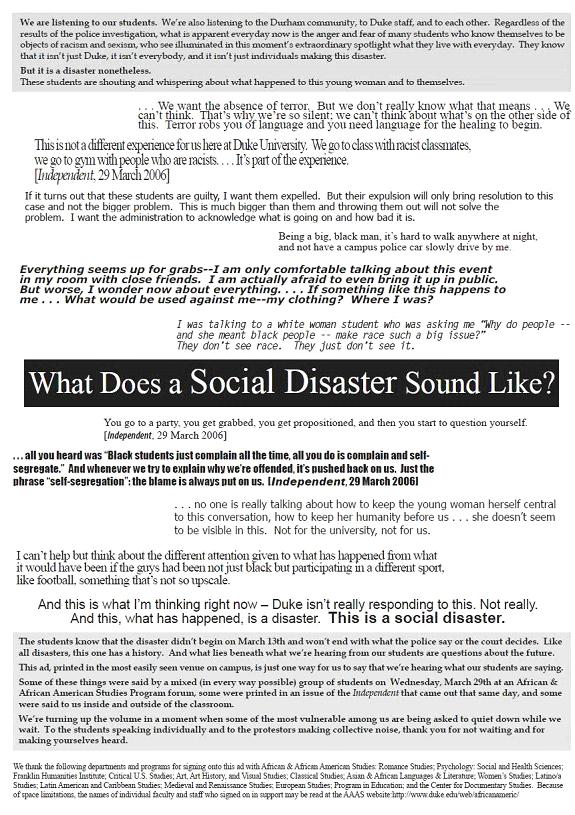
“Duke University denies that the full-page, paid announcement that ran in The Chronicle, and that identified 88 individuals and contained unattributed quotations, made anything ‘clear’ about what its authors or sponsors believed about the evidence of rape. Duke University admits that the cost of running the announcement was paid, in part, with funds from departments within Duke University.”

For the first time, Duke has officially admitted that University funds paid for the Group of 88’s ad. The use of “in part” is intriguing: is Duke suggesting that private individuals partly financed the ad? If so, who were these people?

In any event, consider the significance of this admission. Not all the lacrosse players were on full scholarships. So Duke has now affirmed that some of the players’ own tuition moneys were used to produce an ad that publicly condemned them—an ad placed in violation of Duke rules, moreover. When considering where to send your son to college, what parent could ever even conceive of such behavior from an institution that gladly accepted your tuition check?

Tellingly, the university can’t bring itself to accurately describe the ad. It’s true that the ad did contain “unattributed quotations” that allegedly came from Duke students. But the statement also contained thirteen sentences in the voices of the signatories, not in the form of “unattributed quotations,” as well as an additional sentence falsely claiming that five academic departments at Duke endorsed the ad. What’s the purpose of describing the statement in a misleading fashion? To elide over the fact that those 13 sentences included a clear, unequivocal statement that something “happened”—not “allegedly happened”—to false accuser Crystal Mangum?

In any event, this mis-description continues Duke’s legal strategy of misrepresenting the lacrosse players’ claims to such a wild extent that it would have to undermine the university’s credibility with Judge Beaty.

Former SANE-nurse-in-training Tara Levicy

The university’s response concedes that Levicy had not, in fact, received her “certificate of completion” from her SANE training course until after she conducted her examination of Crystal Mangum—and that, therefore, she was a SANE-in-training when the botched exam occurred. Indeed, on p. 34, the University, for the first time, states it explicitly: “Tara Levicy was a registered nurse who was working as a staff nurse and as a SANE in training in the Emergency Department at Duke University Hospital.” [emphasis added] So why did the hospital allow her, without supervision from a credentialed SANE, to examine Mangum? Imagine how this case might have differed if the hospital had followed established procedures on this matter.

Moreover, the Duke response concedes how woefully inexperienced Levicy actually was at the time she examined Mangum: “DUHS and Nurse Levicy admit that Nurse Levicy began working in the Emergency Department at Duke University Hospital in February 2005. DUHS and Nurse Levicy further admit that this job was Nurse Levicy’s first nursing job following receipt of her nursing degree in December 2004. DUHS and Nurse Levicy also admit that Nurse Levicy began her SANE training in August 2005, and that her certificate of completion was effective on March 2, 2006, although she did not receive the certificate until the late afternoon of March 14, 2006 [which, of course, was after she examined Mangum].” Again, imagine how this case might have differed if Duke Hospital had a competent, professional SANE nurse instead of an inexperienced, ultra-feminist SANE nurse-in-training examine Mangum.

As to other allegations, the university affirms, over and over and over again, that “Nurse Levicy likewise denies that she made any statements to members of the Durham Police Department or to investigators working with then District Attorney Nifong that were inconsistent with the examination of Ms. Mangum.”

Based on the record of the case, Levicy’s stories undoubtedly shifted, always in ways convenient to Nifong and contrary to the written record of her exam. This passage would seem to represent an effort by Duke to shift the blame, setting up a claim that Levicy told the truth to Sgt. Mark Gottlieb and ex-Nifong investigator Linwood Wilson, but that they, in turn, lied (blunt force trauma, Mangum wasn’t sure about whether her attackers used condoms) about what she told them. Given that the Gottlieb/Wilson version of what Levicy told them was completely consistent with what Levicy told the defense attorneys in their interview with her, this strikes me as a difficult argument to make.

One other point: the university’s filing confirms for the first time the long-rumored extent of Levicy’s cooperation with the investigation. “Nurse Levicy admits that she met with or conversed with members of the Durham Police Department on a limited number of occasions and responded to questions from investigators . . . Nurse Levicy further admits that she met with former District Attorney Nifong in June 2006 and responded to his questions about the sexual assault examination.” The university’s filing contains no details about what transpired at this mysterious meeting, during which Nifong (it seems) took no notes. Nor does the university’s filing reveal how many the “limited number of occasions” were in which Levicy chatted with DPD officers—chats that do not appear to have been recorded in the official case discovery file.

Beyond these blanket, and almost comical, denials, Duke appears to be using an element of Beaty’s ruling (that Levicy owed a duty only to Mangum, and not to the public) to shield Levicy’s examination from any meaningful inquiry: “It is a violation of the Health Insurance Portability and Accountability Act for the Duke SANE Defendants to disclose any of Ms. Mangum’s protected health information. Absent a court order authorizing such disclosure, the Duke SANE Defendants are unable to respond. Therefore, the allegations seeking information relating to Ms. Mangum’s protected health information are denied.”

Under this conception of the law, a SANE nurse could lie at will about an exam, and there would be no way to challenge her in a civil suit.

Levicy was Right, and the AG’s Investigation Was Wrong

Perhaps the most bracing element of Duke’s filing comes in repeated claims that the Attorney General’s investigation—upon which the declaration of innocence was based—improperly characterized the medical evidence, and that, as a result, objective medical evidence did exist that Mangum was raped. These assertions are nothing short of astonishing.

Two examples:

The Attorney General’s report stated, “No medical evidence confirmed [Mangum’s] stories. The SANE based her opinion that the exam was consistent with what the accusing witness was reporting largely on the accusing witness’s demeanor and complaints of pain rather than on objective evidence.” [emphasis added] But Duke now claims that “Nurse Levicy specifically admits that she remains both objective and neutral during such examinations.” [emphasis added]

“Nurse Levicy further admits that she told Investigator Himan that there were signs during the sexual assault examination that were consistent with sexual assault. Nurse Levicy specifically denies that she made any statements to members of the Durham Police Department that were inconsistent with the examination of Ms. Mangum.” Once again, the AG’s report stated, “The SANE based her opinion that the exam was consistent with what the accusing witness was reporting largely on the accusing witness’s demeanor and complaints of pain rather than on objective evidence.” Duke claims that Levicy was right, and the AG was wrong.

The FERPA Claim

The filing represents the first time that Duke offered any explanation as to the area of the lawsuit where it seems extremely vulnerable—that it provided keycard information, in violation of FERPA, to the DPD; and then it stood idly by as Nifong tried and failed to get (retroactive) court approval for that information.

“Duke University specifically denies that DukeCard reports were ‘illegally’ supplied by Duke University.” Why? Because “Duke University, Deputy Counsel Hendricks and former Director Drummond specifically deny that they had any knowledge that DukeCard information had been provided to members of the Durham Police Department.” As I understand FERPA law, willful ignorance doesn’t count as a defense.

Who at Duke improperly supplied the information? “Duke University admits that on or about March 31, Gary Smith provided DukeCard information to Sergeant Gottlieb for some of the members of the 2005-2006 Duke University men’s lacrosse team for the period of time from March 13, 2006 until March 14, 2006.” And “Duke University admits that it did not notify the lacrosse players, their families, or their lawyers of the disclosure.” Nor did Duke notify the Court, as it considered (and rejected) Nifong’s subpoena for the information. Why not? The University’s filing doesn’t say.

Odd Denials & Legal Niceties

“The Duke University Defendants and the Duke SANE Defendants further deny that President Brodhead or anyone else at Duke University suppressed or concealed any exculpatory information.”

The emphasis here would be on the word “any.” Of course Duke “concealed” some exculpatory information—to take an obvious example: the knowledge that, as Nifong and the DPD were waging their p.r. campaign accusing Duke students of having constructed a “wall of silence,” Duke knew that the captains (including one of the Carrington plaintiffs, Dan Flannery) had voluntarily given statements and DNA evidence to Durham. Yet the university remained silent. It might very well be that Duke considers this concealment legally irrelevant (and the university might be right). But to deny that the university “concealed any exculpatory information” is absurd.

“President Brodhead denies that he took no steps to enforce Duke’s anti-harassment policy and further denies that he condoned harassment of the players.”

The key words in this sentence are “no” and “condoned.” Duke’s statements could be legally true if (hypothetically) Brodhead placed an e-mail in his draft file, but never sent it, urging faculty and students not to harass the players—he would have taken a “step” to enforce the anti-harassment policy, but the “step” would have been a useless one. It’s pretty obvious that Brodhead didn’t actually do anything to stop either the in-class or on-campus harassment of the players, and it’s quite striking that even Duke doesn’t claim that its president acted in any meaningful way to stop the harassment of dozens of the university’s own students.

The remainder of the passage depends on how duke defines “condoned.” Take an obvious example—the Group of 88’s statement, through which dozens of Duke faculty members, basing their opinion solely on what Mike Nifong provided them, publicly affirmed in what they considered the highest-profile venue on campus that something “happened” to Crystal Mangum. That statement falsely claimed, in violation of Duke policy, that five academic departments had officially endorsed it. Yet Brodhead never compelled a retraction, nor did he order the African-American Studies Department to take the statement off its official duke.edu webpage. Duke appears to be claiming that Brodhead’s in the clear as long as he didn’t himself sign the statement, thereby “condoning” its contents, and that his administration’s failure to do its job didn’t constitute “condoning.”

“President Brodhead denies that any statements from him were designed to ‘impute guilt’ to the players or to ‘inflame’ public opinion against them.”

The key word in this sentence is “designed.” Brodhead’s April 5, 2006 statement—which didn’t even contain a token mention of the presumption of innocence—clearly “imputed guilt,” since it urged people to withhold judgment only until arrests occurred. The presumption, therefore, was that the arrested parties were guilty.

As to the claim that the statement wasn’t designed to “inflame” public opinion against the players: is the University really going to claim that its president, an English professor, didn’t understand how this statement would play in public opinion?

Obvious, but Damning, Admissions

“President Richard Brodhead admits that he played an active role in Duke University’s response to the rape allegations against members of the lacrosse team, and that he consulted with former Chairman Steel and members of the Duke University Board of Trustees in connection with the controversy. “

This admission was all but mandated by former BOT chairman Bob Steel’s ill-considered April 2007 e-mail, which affirmed, “Throughout the past year President Richard Brodhead consulted regularly with the trustees and has had our continuing support. He made considered and thoughtful decisions in a volatile and uncertain situation. Each step of the way, the board agreed with the principles that he established and the actions he took. As we look back and with the benefit of what we now know there is no question that there are some things that might have been done differently. However, anyone critical of President Brodhead should be similarly critical of the entire board.”

“Duke University admits that officers of the Durham Police Department informed officers of the Duke University Police Department that Ms. Roberts made a 911 call.”

This statement is damning for what it doesn’t say. One of Mike Nifong’s most dastardly deeds came in his late March 2006 (false) assertion that the DPD didn’t know Roberts made the 911 call. That left the impression that the lacrosse players were virulent racists, since two innocent black women, walking past the house, had been subjected to racial slurs. By the time the truth came out about Roberts, the damage was done. For the first time, this filing states that Duke knew that Roberts made the call. Tellingly, the filing does not reveal when Duke knew about Roberts. Did the university know before March 29, 2006, when Nifong made his false statement to the press? And if so, why did the knowledge that the DA was lying both about the players not cooperating with the police investigation and about the source of the 911 call not influence how the university approached the issue?

“Dean Wasiolek further admits that she had reason to believe that the accuser was not credible.”

No neutral party observing the Duke administration’s actions between March 25, 2006 and April 18, 2006 would ever believe that a key figure in formulating the administration’s response “had reason to believe that the accuser was not credible.”

“Duke University admits that the quote [‘We had to stop those pictures. It doesn’t mean that it’s fair, but we had to stop it. It doesn’t necessarily mean I think it was right—it just had to be done’] attributed to former Chairman Steel appeared in the New Yorker. Duke University denies that the quote accurately conveys former Chairman Steel’s statement.“

Why, then, didn’t Steel, at the time, write a letter to the editor, or issue a press release to make this point? Or could it be that former BOT chairman Steel only came to the conclusion that he was misquoted after Nifong’s case imploded? It strains credulity to believe that the New Yorker misquoted Steel and he did nothing to correct the record.

“Dean Wasiolek admits that she gave the name of Wes Covington to then Senior Associate Director of Athletics Kennedy as a name of a local attorney that players could contact. Dean Wasiolek further admits that she was complimentary of Mr. Covington and referred to his experience as a former Assistant District Attorney.”

Covington, of course, was the “fixer” whose intent appeared to be to end the case quickly and quietly, by giving Gottlieb access to any and all the players. The university’s filing repeatedly denies that any connection existed between Covington (who has since died) and Duke.

“Duke University, President Brodhead, and Deputy Counsel Hendricks admit that on March 28, 2006, the four lacrosse co-captains met with President Brodhead. Duke University, President Brodhead, and Deputy Counsel Hendricks further admit that other representatives of Duke University, including Deputy Counsel Hendricks, were present, as well as the co-captains’ own attorney. Duke University still further admits that some representatives of Duke University were interviewed by members of the Durham Police Department as part of the Durham Police Department’s investigation into the rape allegations, and they answered questions posed by the members of the Durham Police Department.”

This is Duke’s description of the meeting at which Brodhead blandly—and, obviously, falsely—assured the captains that anything they told him would stay within the walls of the room.

“Nurse Levicy, the Duke University Defendants, and the remaining Duke SANE Defendants further deny that they had any authority or obligation to rebut or correct any assertions in any NTO application regardless of the truth of the allegations.” [emphasis added]

Wow.

When There’s No Written Record (Yet), Duke Denies

“Dean Wasiolek denies that she advised the members of the team that they should not consult with an attorney. Dean Wasiolek further denies that she advised the members of the team that they should not tell their parents about the rape allegations.”

“Duke University and Executive Vice President Trask deny that they ever claimed the existence of a ‘student-administrator privilege’ and further deny that they misled the plaintiffs into providing statements that were contrary to their attorney’s advice.”

To my knowledge, no tape recordings exist of any of the discussions that Duke denies above. But the problem with these denials is obvious: contemporaneous witnesses with whom the lacrosse players spoke verify the players’ version of events. (If the lacrosse players had first mentioned any of these conversations not right after they occurred but instead in, say, March 2007, that would be a very different matter.) So Duke will have to ask the court to believe that in March 2006, the lacrosse players made up—for no apparent reason—versions of conversations that would prove damning to Duke once the case imploded.

Odd Clauses

“President Brodhead admits that he did not meet with the lacrosse players’ lawyers to review ‘evidence.’”

The use of “scare quotes” in this sentence is bizarre. Is Duke really intending to suggest that the lacrosse players’ attorneys—some of the most highly-regarded attorneys in the state—were offering to share tainted “evidence” with Duke? If not, why use the quotation marks?

“Duke University and Richard Brodhead admit that Richard Brodhead has served as President of Duke University, including during the period from March 13, 2006 (the date of Plaintiffs’ party) to the present.”

This description of March 13, 2006—which the university’s attorneys repeat over and over again in their filing—appears to be a not-so-subtle dig to suggest that the lacrosse players were to blame for what happened to them for attending the party in the first place. Yet by not qualifying the remark with “some of,” the statement is legally inaccurate and therefore inflammatory. Several plaintiffs, most notably Brad Ross, did not attend the party. In what way could the event be described as Ross’ party?

“Duke University denies that it has no rules or policies ‘with respect to the hiring of exotic dancers to perform at student parties.’”

This statement is particularly odd—first, because no such rule appears to have existed in the Duke Student Bulletin of 2005-6 (a document, of course, which Duke maintains it didn’t have to follow anyway); and second, because having made the claim, the university’s filing doesn’t even attempt to identify the previously unknown rule and/or policy it claims existed.

Here’s how the Duke filing describes the DNA evidence improperly withheld in Brian Meehan’s report: “The Duke University Defendants and the Duke SANE Defendants further admit that evidence has also been presented at those legal proceedings that would tend to show that Ms. Mangum had engaged in sexual activity with multiple males.” [emphasis added] “Tend to show”? Does the University have another explanation for the DNA findings?

“Duke University further admits that on March 25, President Brodhead decided to forfeit the next two lacrosse games, in part as punishment for the wrongdoing [‘which at a minimum included unlawful underage drinking and the provision of alcohol to minors’] which the players admitted, and in part because of concerns for the safety of the players.” He did? If so, why didn’t he mention the latter point in his cancellation statement? And with regard to the former, why did he begin his statement not with the (now-alleged) reason for the cancellation but instead with the following: “Physical coercion and sexual assault are unacceptable in any setting and have no place at Duke. The criminal allegations against three members of our men’s lacrosse team, if verified, will warrant very serious penalties.

(A note for the record: Brodhead’s March 25, 2006 statement was his most due-process friendly one until the late fall of 2006.)

Regarding the potbangers’ rally: “The Duke University Defendants admit that some individuals who were employed by Duke University engaged in their constitutional right of free speech by participating in gatherings such as the one that occurred on Sunday, March 26, 2006.” Regarding the “wanted” poster: “Duke University admits on information and belief that a poster with the photographs of the Duke University men’s lacrosse team was created and distributed by Sam Hummel, who is a former employee of Duke University.” And regarding the more general anti-lacrosse players’ attitude on campus: “Duke University admits that it follows a practice of academic freedom and that faculty and students are free to exercise their individual First Amendment right to free speech.”

Duke’s affirmation of “constitutional right of free speech” would ring a little less hollow if such a clause were contained in the university’s anti-harassment code. But no such qualifier exists. Imagine if, for instance, “some individuals who were employed by Duke University” chanted the N-word outside a house rented by black Duke students. Does anyone really believe the University would suggest that such behavior didn’t fall under its anti-harassment code, and instead was an example of the “constitutional right of free speech”?

Unexplained

Duke’s response essentially makes no explanation to the allegations that higher-ups pressured Duke officer Christopher Day to modify his March 14, 2006 report, which correctly stressed the evidence of Mangum’s unreliability. Duke concedes that at least three administrators, however, knew of Day’s report by March 15, 2006.

----------------

So we have learned that: University funds paid for the Group of 88’s ad; Duke believes the AG’s conclusions about the medical evidence were wrong; senior administrators knew of Officer Day’s report almost instantaneously but did nothing to disseminate it either publicly or to the lacrosse players’ attorneys; and Duke as an institution, along with its senior administrators, believe they have no obligation to act when they know of factually erroneous legal filings regarding their students. And all of this has come before any discovery has occurred.

No wonder Duke was so desperate to have this case dismissed.