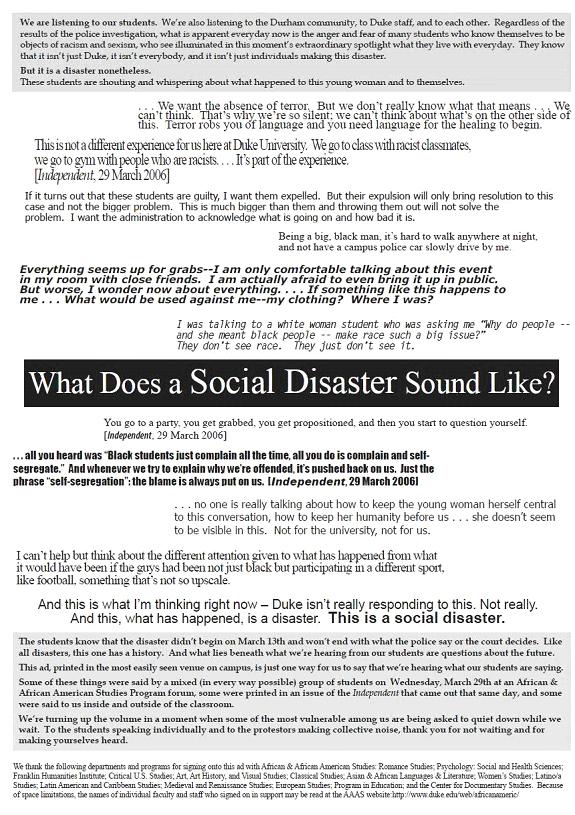
At Duke, on "diversity" issues, no explanation is necessary.
Saturday, March 31, 2012
"Politic$ of Grievance" Pricetag: $13K
This decision should come as no surprise, but nonetheless is appalling. The Chronicle: "Rather than engaging in an inclusive dialogue and drawing input from across campus on a sensitive issue, the administration seemingly capitulated to a set of demands without really explaining why."


Friday, March 30, 2012
Durham "Progressives" Again Stand Up for Prosecutorial Misconduct
In most of the country, “progressive” activists are known for their defenses of civil liberties and their (sometimes reflexive and overheated) criticism of alleged police and/or prosecutorial misconduct. This record often has led to “progressives” being attacked as soft on crime. But there is, also, an intellectual consistency in their positions on such matters that deserves acknowledgement.
In Durham, of course, everything is upside down, and in recent years, the “progressive” establishment—represented by the People’s Alliance—has emerged as a consistent, vociferous apologist for police and prosecutorial misconduct. The PA enthusiastically supported Mike Nifong’s election in 2006. The group’s closest ally on the City Council, Diane Catotti, did everything she could to squelch and then neuter the investigation into police misconduct in the lacrosse case. And the PA was in Tracey Cline’s corner in 2008.
So few should be surprised that in the Democratic primary for superior court judge, the PA has spurned Orlando Hudson in favor of ex-DA Cline’s chief deputy, Jim Dornfried.
The PA made its choice even though in their respective questionnaires, Hudson took a consistently more liberal position than did Dornfried. In responding to a question about a pending state constitutional amendment to make same-sex marriages, civil unions, and domestic partnerships of any type illegal, Hudson stated that the federal constitution should grant gay and lesbian couples a right to marry; Dornfried didn't mention the federal constitutional issue. In responding to a question about North Carolina's Racial Justice Act, Hudson strongly defended the law, citing North Carolina's Jim Crow heritage; Dornfried deferred comment on the matter. In a question about their respective backgrounds, Hudson spoke of his earlier work as an assistant public defender; Dornfried had been in private practice before joining the DA's office. Hudson also detailed his willingness to volunteer his legal skills to local law schools; Dornfried mentioned no such volunteer work.
But the PA ignored Hudson's seemingly “progressive” credentials, instead explaining its endorsement by hailing Dornfried’s work as Cline’s deputy. In his questionnaire to the PA, Dornfried cited the testimony of Durham’s resident ethics apologist, Judge Marcia Morey, to argue that Cline’s deeds did not harm the administration of justice--and thereby to implicitly challenge the decision to remove her from office.
(Dornfried, I should note, was answering a question that was framed in such a way to suggest the PA's fury at the decision to remove Cline: “District attorneys are elected by the people. How egregious must a district attorney’s conduct be before a trial judge may interfere with the people’s right to choose or replace their representative in criminal proceedings?”)
The cases in which Hudson and Cline tangled, as the PA understood, involved matters in which Judge Hudson had claimed that the DA's office violated the constitutional rights of accused criminals--usually a point of view that self-styled “progressives” embrace but in Durham is anathema to the “activist” left.
By the way, Dornfried is white, Hudson is African-American. And in his PA questionnaire, Dornfried identified our current President as “Barak [sic] Obama,” a misspelling that often appears on far-right websites. It appears we’ve finally found the issue—defending prosecutorial misconduct—upon which Durham’s “progressives” are willing to abandon their obsession with “diversity.”
Thursday, March 22, 2012
Brodhead's Extraordinary Address
[Update, Friday, 12.45pm: On his own blog, Peter Arcidiacono has responded to Brodhead; I urge people to read the post in full.
Arcidiacono observes that the kind of research Brodhead specifically criticized--"analyzing average differences in choices across demographic groups--race included"--is "standard practice not just in economics but in all quantitative social sciences," and therefore "to suggest that this is insulting disparages the quantitative social sciences as a whole."
Brodhead obviously knows this: indeed, this type of social science research, in a less detailed form than what exists in the academy today, provided the underpinning for many of the civil rights decisions in the 1950s, 1960s, and 1970s. The only possible inference, therefore, to take from Brodhead's criticism is that at least on issues of race, this research strategy is acceptable only when it yields results that conform to the beliefs of the campus majority.
Arcidiacono adds some personal context which makes Brodhead's behavior even more troubling: "This squashing of divergent ideas also shows up in the administration's lack of defense of the study beyond issues of academic freedom and, more importantly, in the administration's lack of a substantive conversation with either myself or my co-authors. Personally, the latter is what I have found most disturbing about the whole controversy. As I have repeatedly made clear, I am happy to talk with anyone who has concerns about my work. I was disappointed when the Black Student Alliance (BSA) chose to go directly to the press rather than engage in a discussion with me--the called-for forum has not happened. But these are undergraduates. This is the president of the university. To publicly disparage my work without engaging in a conversation with me is not something I would have expected from Brodhead. To top it off, the speech alludes to administrators working on the issues raised in the paper with the BSA and yet there still have been no substantive discussions of the issues with the authors. Thank you God for tenure."]
Brodhead obviously knows this: indeed, this type of social science research, in a less detailed form than what exists in the academy today, provided the underpinning for many of the civil rights decisions in the 1950s, 1960s, and 1970s. The only possible inference, therefore, to take from Brodhead's criticism is that at least on issues of race, this research strategy is acceptable only when it yields results that conform to the beliefs of the campus majority.
Arcidiacono adds some personal context which makes Brodhead's behavior even more troubling: "This squashing of divergent ideas also shows up in the administration's lack of defense of the study beyond issues of academic freedom and, more importantly, in the administration's lack of a substantive conversation with either myself or my co-authors. Personally, the latter is what I have found most disturbing about the whole controversy. As I have repeatedly made clear, I am happy to talk with anyone who has concerns about my work. I was disappointed when the Black Student Alliance (BSA) chose to go directly to the press rather than engage in a discussion with me--the called-for forum has not happened. But these are undergraduates. This is the president of the university. To publicly disparage my work without engaging in a conversation with me is not something I would have expected from Brodhead. To top it off, the speech alludes to administrators working on the issues raised in the paper with the BSA and yet there still have been no substantive discussions of the issues with the authors. Thank you God for tenure."]
As a university in the South—and as a university also associated in the past with the upper class—Duke contributed to the Jim Crow system that governed the region (de jure and for some time thereafter de facto) for much of the 20th century. Duke’s greatest president, Terry Sanford, courageously and forcefully confronted the legacy of this past.
Sanford resigned the Duke presidency in 1985 to launch a successful bid for the U.S. Senate. In the last quarter century, Duke—like virtually every elite university in the nation—has aggressively utilized racial preferences in admissions, while just as aggressively seeking certain types of “diversity” in faculty hires. Racial tensions doubtless remain at Duke and at all elite universities; entirely eliminating racism (or sexism or homophobia or ethnic/religious biases) is impossible. But there are few if any employers or institutions anywhere in U.S. society more “anti-racist,” to use the politically correct term, than Duke and the nation’s other elite universities.
Moreover, during the administration of President Richard Brodhead (2005-), the university’s most significant racially-oriented episode involved not racism toward African-American students or professors but a racially-charged crusade directed by members of the school’s African-American Studies Department against a group of falsely accused white Duke students. Apart from a single statement from Provost Peter Lange rebuking an outright racist screed from then-Duke professor Houston Baker—and a vague, tardy, and ultimately toothless apology from Brodhead—there’s no evidence that anyone from Duke’s administration ever addressed this faculty behavior, or ever rebuked those Duke professors whose private biases led them to ignore their obligations to their own institution’s students.
In his March 22 address to the faculty, Brodhead chose to speak about “the issue of race and inclusion in Duke's history, our recent progress, and the nature of the work that lies ahead.”
Those expecting that the choice of this theme meant that Brodhead would critically self-examine his and his administration’s failure to address the shortcomings exposed by the lacrosse case would be sorely disappointed. The race-baiting of spring 2006 wasn’t mentioned, perhaps because doing so would have forced Brodhead to ask uncomfortable questions about how so many Duke faculty members had addressed “the issue of race and inclusion in Duke’s [recent] history.” It would, for instance, have been very difficult for the president to have reconciled his Faculty Address boast that “this university has had a commitment to making Duke a place of access, opportunity and mutual respect for all” [emphasis added] with the conduct of the Group of 88 (or sympathetic faculty such as Orin Starn, Peter Wood, and Tim Tyson) during the lacrosse case.
Nor did the president display any willingness to consider whether the use of racial preferences in admissions or the obsessive emphasis on certain types of “diversity” in faculty hiring remain tactically wise or morally acceptable in the 21st century world. Once again, the posing of uncomfortable questions was not on Brodhead’s agenda, especially if asking such questions might trigger a faculty revolt.
Instead, the president offered a reflexive defense of “diversity” policies as they have been practiced at Duke (and other elite universities) over the past generation. No surprises there. But the stated motivation for his remarks did raise eyebrows. He selected his topic, he claimed, because of three recent events, the first of which was the “controversy over a piece of unpublished faculty research that appeared to disparage the choice of majors by African-American undergraduates.”
Brodhead thus joined Provost Lange and a host of other senior administrators in publicly criticizing (and in the president’s case, willfully misinterpreting) a piece of research from Duke two professors, Peter Arcidiacono and Kenneth Spenner; and Esteban Aucejo, a Duke graduate student. That paper, as I noted before, used Duke’s own data to show how African-American students (whose admissions test scores were far lower than those of whites or Asian-Americans who enrolled at the university) disproportionately migrated, after arriving at Duke, from majors (the hard sciences, engineering) widely considered as more challenging. As with virtually all other critics of the Arcidiacono, et al., paper, Brodhead did not challenge any of the paper’s data.
Brodhead’s discussion of the paper was nothing short of stunning. After an almost apologetic defense of the principle of academic freedom as applied to faculty research, the president all but seethed with rage when discussing the paper: “I can see why students took offense at what was reported of a professor's work. Generalizations about academic choices by racial category can renew the primal insult of the world we are trying to leave behind—the implication that persons can be known through a group identity that associates them with inferior powers. A further insult was that the paper had been included in an amicus brief submitted by opponents of affirmative action urging the Supreme Court to hear the case I mentioned earlier regarding admissions policies at the University of Texas.”
The last sentence is, perhaps, the most extraordinary of Brodhead’s entire address, and, indeed, one of the most extraordinary statements I have ever seen a university president make. The president of a major research university, in a formal address to his university’s faculty, expressed regret—deeming it an “insult”—that research from his own university’s faculty (research whose accuracy he did not challenge) was included in an amicus brief for a critical case before the Supreme Court.
So much for the idea that a central purpose of a research university is the dissemination of knowledge in pursuit of the truth. The president’s message could not have been clearer: those who dare to pursue research that challenges the (campus) majority’s agenda on race can expect a public shaming—regardless of whether the data those researchers uncover is accurate or fairly presented.
Brodhead concluded his address on a more personal level. “The single front,” said he, “where I myself feel the greatest frustration regards senior leadership positions at Duke.” He noted that among his eight senior administration appointments, he had named two African-Americans, one Asian-American, and one woman. But, he lamented, “the number of women on my team . . . is fewer than I would wish.” And he offered his awareness that “including African Americans in the top academic leadership of this university is a piece of unfinished business.”
If Brodhead’s personal pain about the insufficient “diversity” in the upper ranks of Duke’s administration is as genuine as his Faculty Address rhetoric suggests, an immediate step to address the issue is available to him: He could, today, submit his resignation as Duke president. That move would give Duke’s trustees the opportunity to bring more “diversity” to the school by replacing him with a female or minority leader for the university.
But I strongly suspect that Brodhead’s personal commitment to “diversity” doesn’t quite extend that far. Publicly sliming two members of his faculty is, it seems, so much more satisfying.
Sanford resigned the Duke presidency in 1985 to launch a successful bid for the U.S. Senate. In the last quarter century, Duke—like virtually every elite university in the nation—has aggressively utilized racial preferences in admissions, while just as aggressively seeking certain types of “diversity” in faculty hires. Racial tensions doubtless remain at Duke and at all elite universities; entirely eliminating racism (or sexism or homophobia or ethnic/religious biases) is impossible. But there are few if any employers or institutions anywhere in U.S. society more “anti-racist,” to use the politically correct term, than Duke and the nation’s other elite universities.
Moreover, during the administration of President Richard Brodhead (2005-), the university’s most significant racially-oriented episode involved not racism toward African-American students or professors but a racially-charged crusade directed by members of the school’s African-American Studies Department against a group of falsely accused white Duke students. Apart from a single statement from Provost Peter Lange rebuking an outright racist screed from then-Duke professor Houston Baker—and a vague, tardy, and ultimately toothless apology from Brodhead—there’s no evidence that anyone from Duke’s administration ever addressed this faculty behavior, or ever rebuked those Duke professors whose private biases led them to ignore their obligations to their own institution’s students.
-------------
In his March 22 address to the faculty, Brodhead chose to speak about “the issue of race and inclusion in Duke's history, our recent progress, and the nature of the work that lies ahead.”
Those expecting that the choice of this theme meant that Brodhead would critically self-examine his and his administration’s failure to address the shortcomings exposed by the lacrosse case would be sorely disappointed. The race-baiting of spring 2006 wasn’t mentioned, perhaps because doing so would have forced Brodhead to ask uncomfortable questions about how so many Duke faculty members had addressed “the issue of race and inclusion in Duke’s [recent] history.” It would, for instance, have been very difficult for the president to have reconciled his Faculty Address boast that “this university has had a commitment to making Duke a place of access, opportunity and mutual respect for all” [emphasis added] with the conduct of the Group of 88 (or sympathetic faculty such as Orin Starn, Peter Wood, and Tim Tyson) during the lacrosse case.
Nor did the president display any willingness to consider whether the use of racial preferences in admissions or the obsessive emphasis on certain types of “diversity” in faculty hiring remain tactically wise or morally acceptable in the 21st century world. Once again, the posing of uncomfortable questions was not on Brodhead’s agenda, especially if asking such questions might trigger a faculty revolt.
Instead, the president offered a reflexive defense of “diversity” policies as they have been practiced at Duke (and other elite universities) over the past generation. No surprises there. But the stated motivation for his remarks did raise eyebrows. He selected his topic, he claimed, because of three recent events, the first of which was the “controversy over a piece of unpublished faculty research that appeared to disparage the choice of majors by African-American undergraduates.”
Brodhead thus joined Provost Lange and a host of other senior administrators in publicly criticizing (and in the president’s case, willfully misinterpreting) a piece of research from Duke two professors, Peter Arcidiacono and Kenneth Spenner; and Esteban Aucejo, a Duke graduate student. That paper, as I noted before, used Duke’s own data to show how African-American students (whose admissions test scores were far lower than those of whites or Asian-Americans who enrolled at the university) disproportionately migrated, after arriving at Duke, from majors (the hard sciences, engineering) widely considered as more challenging. As with virtually all other critics of the Arcidiacono, et al., paper, Brodhead did not challenge any of the paper’s data.
Brodhead’s discussion of the paper was nothing short of stunning. After an almost apologetic defense of the principle of academic freedom as applied to faculty research, the president all but seethed with rage when discussing the paper: “I can see why students took offense at what was reported of a professor's work. Generalizations about academic choices by racial category can renew the primal insult of the world we are trying to leave behind—the implication that persons can be known through a group identity that associates them with inferior powers. A further insult was that the paper had been included in an amicus brief submitted by opponents of affirmative action urging the Supreme Court to hear the case I mentioned earlier regarding admissions policies at the University of Texas.”
The last sentence is, perhaps, the most extraordinary of Brodhead’s entire address, and, indeed, one of the most extraordinary statements I have ever seen a university president make. The president of a major research university, in a formal address to his university’s faculty, expressed regret—deeming it an “insult”—that research from his own university’s faculty (research whose accuracy he did not challenge) was included in an amicus brief for a critical case before the Supreme Court.
So much for the idea that a central purpose of a research university is the dissemination of knowledge in pursuit of the truth. The president’s message could not have been clearer: those who dare to pursue research that challenges the (campus) majority’s agenda on race can expect a public shaming—regardless of whether the data those researchers uncover is accurate or fairly presented.
Brodhead concluded his address on a more personal level. “The single front,” said he, “where I myself feel the greatest frustration regards senior leadership positions at Duke.” He noted that among his eight senior administration appointments, he had named two African-Americans, one Asian-American, and one woman. But, he lamented, “the number of women on my team . . . is fewer than I would wish.” And he offered his awareness that “including African Americans in the top academic leadership of this university is a piece of unfinished business.”
If Brodhead’s personal pain about the insufficient “diversity” in the upper ranks of Duke’s administration is as genuine as his Faculty Address rhetoric suggests, an immediate step to address the issue is available to him: He could, today, submit his resignation as Duke president. That move would give Duke’s trustees the opportunity to bring more “diversity” to the school by replacing him with a female or minority leader for the university.
But I strongly suspect that Brodhead’s personal commitment to “diversity” doesn’t quite extend that far. Publicly sliming two members of his faculty is, it seems, so much more satisfying.
Monday, March 19, 2012
Seligmann Talk
For DIW readers in Atlanta, Reade Seligmann will be giving a talk tomorrow about the case. Details here.
Wednesday, March 14, 2012
Cline Continues Anti-Hudson Crusade
As seen in the document below, Tracey Cline is continuing her crusade against Judge Orlando Hudson.
In this instance, the former DA has requested mediation to address her demands for full access to "the email of [Hudson's] assistant, Peggy Bullock and himself." [comma splice in original] A Cline FOIA request for some Hudson e-mails had been granted, but (as would seem appropriate) Hudson did not turn over e-mails relating to specifics of pending criminal cases. This, at least, is the version Cline presents of her previous FOIA requests; as her removal proceedings demonstrated, she has only the loosest of attachments with the truth.

In a request that consisted of three paragraphs written by her, the former district attorney managed to include four grammatical errors (such as, "Last week I e-mail Judge Hudson...").
It's hard for me to imagine that a private citizen, as Cline now is, could obtain full access to the e-mail files of a sitting judge (and his assistant).

Tuesday, March 13, 2012
News & Notes
Some recent items that crossed my desk:
Last Sunday’s N&O featured a penetrating piece by Andy Curliss—featuring new reporting about a case about which, it seemed, we knew most everything—analyzing the rise and fall of ex-DA Tracey Cline.
Among other nuggets, Curliss recounts a conversation between Bill Thomas and Cline, just after it was discovered that a central element of Cline’s allegations against Judge Hudson (that he decided a case before hearing all the evidence) was, in fact, based on a faulty timeclock at the Durham court.
Cline, of course, did not stop.
Curliss also had an excellent article summarizing what exists in the public record regarding the former DA’s involvement in the lacrosse case—discussing which she (at best) stretched the truth and (at worst) outright fabricated during her initial 2008 campaign. Cline’s . . . inattention . . . to the truth was not enough to deter The Independent, which hailed her as “a great attorney who has already shown that she can manage a large caseload,” a woman who “could be an excellent role model for the young African Americans caught in the system.” (For good measure, the paper also falsely asserted that Cline had put “to rest questions that she was involved in Nifong's lacrosse prosecution.”) In the same editorial, the paper’s editors reminded readers that they had endorsed Nifong in 2006.
At no point since 2008, even as Cline’s career imploded, did the editorial board see fit to reconsider its judgment, at least in public.
It’s not clear when the next election for Durham DA will be (the timing depends on Cline’s appeals). But whenever it is, one thing is clear: Durham voters should vote for whoever is not endorsed by The Independent.
The N&O also had a somewhat odd story about a play written by Paul Downs Colaizzo, who reveals, “The Duke case was the phenomenally scary and dramatically universal inspiration for my play.” (In the interview, the author does not refer to false accuser Crystal Mangum by name, instead describing her as the “alleged victim,” an early sign of the sort of message his play seems to send.) In the Colaizzo play, the false accuser is white, some sexual contact between the false accuser and the accused occurs, and no reviews that I have seen mention either a demagogic district attorney exploiting the case for re-election or the accused student’s faculty doing to same to advance their on-campus goals—differences that raise questions about what sort of similarities could possibly exist between the lacrosse case and the play. For reasons that are not clear, N&O correspondent Rebecca Ritzel did not appear to question Colaizzo on any of these items.
But here’s Colaizzo explaining the connection between the play and the case to the N&O: "These cases happen where the victims are telling the truth, and athletes get out of control on college campuses. The idea of power goes to their head, and women become objects instead of people. Things may have turned out one way (in Durham), but the ambiguity is where the universality of the Duke case lives."
In other words: the Duke case wholly contradicted his preconceived notions, but Colaizzo appears to have seen no reason to reconsider those preconceived notions. Was Wahneema Lubiano a consultant to the play?
Finally, one important, if underappreciated, theme of the lacrosse case was the importance of judicial independence. As in many states, in North Carolina, judges are elected. And the two judges in the case who had to face Durham voters—Ron Stephens and Kenneth Titus—made rulings that (purely coincidentally, they doubtless would say) looked the other way about Mike Nifong’s abuses. Stephens infamously even testified on Nifong’s behalf as a character witness in the criminal contempt trial, though he didn’t join his colleague Marcia Morey on the witness stand in the ethics hearing. Only when the case moved to a judge—Osmond Smith—who didn’t have to fear the electorate that nominated and elected Mike Nifong (and would subsequently elect his chief assistant) did we see fair rulings from the bench.
The job of judges should be to uphold the law, and the state and federal constitutions, even when doing so (as occurred with Judge Smith’s actions) runs against majority opinion. But too many judges, like Stephens and Titus in the early stages of the lacrosse case, take a different approach to their duties.
The importance of judicial independence amidst a hostile electorate was reaffirmed this week by the Kennedy Library, which announced that former Iowa state supreme court judges Marsha Ternus, David Baker, and Michael Streit will receive the 2012 Profile in Courage awards, "presented annually to public servants who have made courageous decisions of conscience without regard for the personal or professional consequences."
The Library indicated that the judges were chosen for the prestigious award "in recognition of the political courage and judicial independence each demonstrated in setting aside popular opinion to uphold the basic freedoms and security guaranteed to all citizens under the Iowa constitution."
Last Sunday’s N&O featured a penetrating piece by Andy Curliss—featuring new reporting about a case about which, it seemed, we knew most everything—analyzing the rise and fall of ex-DA Tracey Cline.
Among other nuggets, Curliss recounts a conversation between Bill Thomas and Cline, just after it was discovered that a central element of Cline’s allegations against Judge Hudson (that he decided a case before hearing all the evidence) was, in fact, based on a faulty timeclock at the Durham court.
"Tracey, no," Thomas recalled telling her. "This needs to stop. What you need to do is withdraw your motion entirely, and apologize to the judge and end this."
Cline told him she wouldn't.
"I'm totally convinced I'm doing the right thing," she said, according to Thomas.
Thomas: "You are destroying your career. Please stop."
Cline, of course, did not stop.
-----------
Curliss also had an excellent article summarizing what exists in the public record regarding the former DA’s involvement in the lacrosse case—discussing which she (at best) stretched the truth and (at worst) outright fabricated during her initial 2008 campaign. Cline’s . . . inattention . . . to the truth was not enough to deter The Independent, which hailed her as “a great attorney who has already shown that she can manage a large caseload,” a woman who “could be an excellent role model for the young African Americans caught in the system.” (For good measure, the paper also falsely asserted that Cline had put “to rest questions that she was involved in Nifong's lacrosse prosecution.”) In the same editorial, the paper’s editors reminded readers that they had endorsed Nifong in 2006.
At no point since 2008, even as Cline’s career imploded, did the editorial board see fit to reconsider its judgment, at least in public.
It’s not clear when the next election for Durham DA will be (the timing depends on Cline’s appeals). But whenever it is, one thing is clear: Durham voters should vote for whoever is not endorsed by The Independent.
-------------
The N&O also had a somewhat odd story about a play written by Paul Downs Colaizzo, who reveals, “The Duke case was the phenomenally scary and dramatically universal inspiration for my play.” (In the interview, the author does not refer to false accuser Crystal Mangum by name, instead describing her as the “alleged victim,” an early sign of the sort of message his play seems to send.) In the Colaizzo play, the false accuser is white, some sexual contact between the false accuser and the accused occurs, and no reviews that I have seen mention either a demagogic district attorney exploiting the case for re-election or the accused student’s faculty doing to same to advance their on-campus goals—differences that raise questions about what sort of similarities could possibly exist between the lacrosse case and the play. For reasons that are not clear, N&O correspondent Rebecca Ritzel did not appear to question Colaizzo on any of these items.
But here’s Colaizzo explaining the connection between the play and the case to the N&O: "These cases happen where the victims are telling the truth, and athletes get out of control on college campuses. The idea of power goes to their head, and women become objects instead of people. Things may have turned out one way (in Durham), but the ambiguity is where the universality of the Duke case lives."
In other words: the Duke case wholly contradicted his preconceived notions, but Colaizzo appears to have seen no reason to reconsider those preconceived notions. Was Wahneema Lubiano a consultant to the play?
------------
Finally, one important, if underappreciated, theme of the lacrosse case was the importance of judicial independence. As in many states, in North Carolina, judges are elected. And the two judges in the case who had to face Durham voters—Ron Stephens and Kenneth Titus—made rulings that (purely coincidentally, they doubtless would say) looked the other way about Mike Nifong’s abuses. Stephens infamously even testified on Nifong’s behalf as a character witness in the criminal contempt trial, though he didn’t join his colleague Marcia Morey on the witness stand in the ethics hearing. Only when the case moved to a judge—Osmond Smith—who didn’t have to fear the electorate that nominated and elected Mike Nifong (and would subsequently elect his chief assistant) did we see fair rulings from the bench.
The job of judges should be to uphold the law, and the state and federal constitutions, even when doing so (as occurred with Judge Smith’s actions) runs against majority opinion. But too many judges, like Stephens and Titus in the early stages of the lacrosse case, take a different approach to their duties.
The importance of judicial independence amidst a hostile electorate was reaffirmed this week by the Kennedy Library, which announced that former Iowa state supreme court judges Marsha Ternus, David Baker, and Michael Streit will receive the 2012 Profile in Courage awards, "presented annually to public servants who have made courageous decisions of conscience without regard for the personal or professional consequences."
In 2009, the judges joined a unanimous opinion of the Iowa Supreme Court legalizing same-sex marriage--a clear call under the constitution of the state (which has unusually detailed guarantees of individual rights), but a deeply unpopular decision among some segments of the electorate. In response, a local politician named Bob Vander Plaats (last seen facing accusations that he was soliciting money to facilitate his endorsement in the Iowa GOP presidential caucus) organized a campaign to oust the trio from the court; and for the first time in Iowa history, Supreme Court judges were not retained by a popular vote.
The Library indicated that the judges were chosen for the prestigious award "in recognition of the political courage and judicial independence each demonstrated in setting aside popular opinion to uphold the basic freedoms and security guaranteed to all citizens under the Iowa constitution."
Alas, whether it's in Durham or in Des Moines, it's hard to win an election campaigning on the platform of judicial independence for the purpose of upholding basic rights.
Sunday, March 04, 2012
Nifong, Cline, and Durham's Legal Culture
Durham County is the sixth most populous county in the nation’s tenth most populous state. That a county of this size and significance—we’re not talking about Divide County, North Dakota here—has seen its chief prosecutor removed from office for ethical improprieties twice in the past half-decade is appalling. In an ideal world, this development would trigger a grassroots movement demanding a more ethical county prosecutor’s office. But, of course, we don’t live in an ideal world, and there’s little reason to anticipate such a development in Durham.
There were clear differences between the paths taken by Mike Nifong and Tracey Cline to their forced removal from office. Nifong was fundamentally corrupt, unethical to the core. An effective, if sometimes overly blatant, racial demagogue, he was motivated not by ideology but by pure personal advancement. If he had served as Durham DA in the 1950s, it’s easy to imagine him trying to frame innocent black students to appeal to racist sentiments among his white-majority electorate.
As to the performance of his duties: Nifong’s handling of the Mangum allegations could be used as a test for a legal ethics class, since he seemed intent on violating as many distinct ethical procedures as he possibly could in a single case. In this respect, his previous experience was particularly dangerous: he knew the rules well enough to know exactly what procedures needed to be overridden, and he had enough support on the bench (chiefly from Judge Ronald Stephens) to almost get away with it. A caricature of a small-town bully (a trait he ably demonstrated during his tenure at traffic court), he expected that he could live by his own rules, and defied anyone to try and stop him.
The great unknown of Nifong’s career is whether this type of misconduct led to him helping to convict any innocent people during his tenure as an ADA. His supporters never seemed interested in exploring this question.
Ideas did seem to matter to Cline. She made feints to anti-racism (with her seemingly baseless allegation of racism against an earlier employer—good enough to gain Victoria Peterson’s loyalty) and feminism (as ADA, she developed the deeply dangerous policy of allowing sex crimes cases to go to trial, regardless of the evidence, as long as the prosecutor believed the accuser). But as DA, Cline’s seemed mostly animated by an extreme version of victims’ rights, to the extent that she saw her office not as the “minister of justice” but as a victims’ advocate.
In Saturday’s N&O, Barry Saunders wrote that he had been a victim of a crime more than a decade ago, “when Cline as assistant DA, represented ‘me, the people’ after some night-skulking skunk broke into my house while my then 10-year-old son and I were in bed. Cline personified professionalism and commitment—even though she did get angry at me for showing sympathy toward the defendant from the witness stand and possibly causing the jury to go easy on him.”
But Cline was not supposed to have “represented” Saunders, or any victim of crime—as a district attorney, she was supposed to have represented the people. Did her inability to recognize this distinction account for her overly emotional (delusional?) response to Judge Hudson, with her claims that his decisions were “raping” the victims of crime? She certainly wasn’t helped by her obvious intellectual limitations. For a DA of a county Durham’s size to file motion after motion riddled with spelling and grammatical errors was simply embarrassing.
Cline, moreover, almost certainly obtained her position through prevarication. Amidst the 2008 primary campaign, as the N&O delicately put it, “Cline maintain[ed] that she had no involvement in the lacrosse case, although defense lawyers for the exonerated players and testimony from State Bar disciplinary proceedings against Nifong challenge that.”
We likely will never know the full extent of Cline’s involvement in the lacrosse case—she won’t even grant the N&O permission to release a tape of the off-the-record 2007 discussion she had on the case. Nifong, meanwhile, has every incentive to maintain the fiction, lest Cline appear as a witness against him in the civil suits. That Cline’s story strains credulity puts it mildly: to believe her requires accepting that after recommending the constitutionally-suspect NTO against all white lacrosse players, solely on the basis of their group identity, she had no subsequent involvement in the case—even though she was the office expert in sexual assault cases, and even though she worked alongside Nifong throughout the period (when the case was the talk of Durham), and even though she would have served as second chair during the trial.
That move sent quite a message about Cline’s commitment to integrity, but it was sadly consistent with the values of the office she was about to take over. A few months ago, a DIW commenter who said he had tried a few cases against Cline offered the following persuasive insight: “The culture of the Durham DA's office, as shown time and time again, is to win cases at all costs. Nifong and Cline built their careers in that office, and they both treat criminal cases as personal wars.”
This dismissive attitude toward legal ethics—and, indeed, to the truth—best manifested itself in the extraordinarily dubious judgment of Judge (and former Durham ADA) Marcia Morey. This sitting judge testified (not once, not twice, but three times) on behalf of the ethical standards of Nifong and Cline.
In New York, both the Times and the tabloids would have crucified a sitting judge who repeatedly placed the prestige of her office behind unethical prosecutors. In Durham, Morey’s conduct passed without editorial notice, and while such an approach could be expected from the hopelessly biased Independent, what can excuse the silence of the N&O editorial board and that of the post-Ashley H-S? Morey, it seems, represents The Durham Way, a fact so obvious that it appears it doesn’t even deserve a mention.
In a February interview with the Independent, Morey lamented, “Durham needs and deserves a better reputation." "I'm tired,” continued the Nifong/Cline ethics witness, “of going to meetings in other cities where people are saying, ‘There's always something going on in Durham.’”
With a sitting judge repeatedly testifying on behalf of unethical prosecutors, how could anyone in other cities think there's something wrong with what's going on in Durham?
There were clear differences between the paths taken by Mike Nifong and Tracey Cline to their forced removal from office. Nifong was fundamentally corrupt, unethical to the core. An effective, if sometimes overly blatant, racial demagogue, he was motivated not by ideology but by pure personal advancement. If he had served as Durham DA in the 1950s, it’s easy to imagine him trying to frame innocent black students to appeal to racist sentiments among his white-majority electorate.
As to the performance of his duties: Nifong’s handling of the Mangum allegations could be used as a test for a legal ethics class, since he seemed intent on violating as many distinct ethical procedures as he possibly could in a single case. In this respect, his previous experience was particularly dangerous: he knew the rules well enough to know exactly what procedures needed to be overridden, and he had enough support on the bench (chiefly from Judge Ronald Stephens) to almost get away with it. A caricature of a small-town bully (a trait he ably demonstrated during his tenure at traffic court), he expected that he could live by his own rules, and defied anyone to try and stop him.
The great unknown of Nifong’s career is whether this type of misconduct led to him helping to convict any innocent people during his tenure as an ADA. His supporters never seemed interested in exploring this question.
Ideas did seem to matter to Cline. She made feints to anti-racism (with her seemingly baseless allegation of racism against an earlier employer—good enough to gain Victoria Peterson’s loyalty) and feminism (as ADA, she developed the deeply dangerous policy of allowing sex crimes cases to go to trial, regardless of the evidence, as long as the prosecutor believed the accuser). But as DA, Cline’s seemed mostly animated by an extreme version of victims’ rights, to the extent that she saw her office not as the “minister of justice” but as a victims’ advocate.
In Saturday’s N&O, Barry Saunders wrote that he had been a victim of a crime more than a decade ago, “when Cline as assistant DA, represented ‘me, the people’ after some night-skulking skunk broke into my house while my then 10-year-old son and I were in bed. Cline personified professionalism and commitment—even though she did get angry at me for showing sympathy toward the defendant from the witness stand and possibly causing the jury to go easy on him.”
But Cline was not supposed to have “represented” Saunders, or any victim of crime—as a district attorney, she was supposed to have represented the people. Did her inability to recognize this distinction account for her overly emotional (delusional?) response to Judge Hudson, with her claims that his decisions were “raping” the victims of crime? She certainly wasn’t helped by her obvious intellectual limitations. For a DA of a county Durham’s size to file motion after motion riddled with spelling and grammatical errors was simply embarrassing.
--------------
Nifong and Cline did share one important characteristic: a willingness to lie, including in court. Nifong prevaricated so often in the lacrosse case that by the time things came crashing down upon him (in the week of the Dec. 15, 2006 hearing), he couldn’t keep his story straight about why he didn’t turn over all the DNA evidence. In the end, his lying to Judge Smith earned him a night in jail for criminal contempt, while Cline’s penchant for tall tales in the courtroom earned her a public rebuke from Judge Hardin.
Cline, moreover, almost certainly obtained her position through prevarication. Amidst the 2008 primary campaign, as the N&O delicately put it, “Cline maintain[ed] that she had no involvement in the lacrosse case, although defense lawyers for the exonerated players and testimony from State Bar disciplinary proceedings against Nifong challenge that.”
We likely will never know the full extent of Cline’s involvement in the lacrosse case—she won’t even grant the N&O permission to release a tape of the off-the-record 2007 discussion she had on the case. Nifong, meanwhile, has every incentive to maintain the fiction, lest Cline appear as a witness against him in the civil suits. That Cline’s story strains credulity puts it mildly: to believe her requires accepting that after recommending the constitutionally-suspect NTO against all white lacrosse players, solely on the basis of their group identity, she had no subsequent involvement in the case—even though she was the office expert in sexual assault cases, and even though she worked alongside Nifong throughout the period (when the case was the talk of Durham), and even though she would have served as second chair during the trial.
Instead, Cline’s only public commentary on the case was not a statement but a gesture—her decision to invite the disbarred Nifong, as her personal guest, to her inauguration.
That move sent quite a message about Cline’s commitment to integrity, but it was sadly consistent with the values of the office she was about to take over. A few months ago, a DIW commenter who said he had tried a few cases against Cline offered the following persuasive insight: “The culture of the Durham DA's office, as shown time and time again, is to win cases at all costs. Nifong and Cline built their careers in that office, and they both treat criminal cases as personal wars.”
This dismissive attitude toward legal ethics—and, indeed, to the truth—best manifested itself in the extraordinarily dubious judgment of Judge (and former Durham ADA) Marcia Morey. This sitting judge testified (not once, not twice, but three times) on behalf of the ethical standards of Nifong and Cline.
In New York, both the Times and the tabloids would have crucified a sitting judge who repeatedly placed the prestige of her office behind unethical prosecutors. In Durham, Morey’s conduct passed without editorial notice, and while such an approach could be expected from the hopelessly biased Independent, what can excuse the silence of the N&O editorial board and that of the post-Ashley H-S? Morey, it seems, represents The Durham Way, a fact so obvious that it appears it doesn’t even deserve a mention.
In a February interview with the Independent, Morey lamented, “Durham needs and deserves a better reputation." "I'm tired,” continued the Nifong/Cline ethics witness, “of going to meetings in other cities where people are saying, ‘There's always something going on in Durham.’”
With a sitting judge repeatedly testifying on behalf of unethical prosecutors, how could anyone in other cities think there's something wrong with what's going on in Durham?
Friday, March 02, 2012
Analyzing Judge Hobgood's Order
The removal from office of former Durham district attorney Tracey Cline occurred in a tightly-reasoned 14-page (single-spaced) order by Judge Robert Hobgood. The judge took seriously the Cline lawyers’ First Amendment claims—but ultimately rejected them, and in a way that seems almost certain to withstand Cline’s promised appeal.
Hobgood’s findings of fact consisted primarily of two types of material: (a) a recitation of the facts of the Cline-Hudson dispute accepting as true Cline’s version of events (and her recollections of various conversations with Judge Orlando Hudson); and (b) a list of Cline’s 21 most outrageous statements, culled from her various court filings against Hudson.
The 21 statements, Hobgood noted, “are not supported by the facts and have brought the office of the Durham County District Attorney into disrepute.” And Cline’s written assertion that Judge Hudson was “corrupt” was “not only false,” but was “inexcusable” and indicative of “actual malice” in the performance of her duties.
In his conclusions of law, however, Hobgood divided these 21 statements into two types. Sixteen of the twenty-one, he wrote, “may well fall under the umbrella of protected speech under the First Amendment.” [emphasis added] In a damning conclusion for the fate of Cline’s law license, Hobgood added that these 16 statements “unquestionably” violated the State Bar’s Rules of Professional Conduct, and were also “abusive and repetitive.”
But, nonetheless, as in his factual findings regarding closed-door details of exchanges between Cline and Hudson, Judge Hobgood was willing to give Cline (or in this case, her attorneys) the benefit of the doubt. He therefore did not dismiss out of hand the Cline team’s arguments that her “caustic” statements should be viewed through the prism of her First Amendment rights.
That left five Cline statements: that Hudson had committed “misconduct . . . involving moral turpitude, dishonesty, and corruption”; that Hudson was guilty of “kidnapping the rights of victims and their families”; that Hudson had committed “intentional malicious conduct”; that “this Court is in total and complete violation of the North Carolina Code of Judicial Conduct”; and that Hudson needed to “acknowledge that your hands are covered with the blood of justice, and be ashamed.”
Hobgood found, not unreasonably, that these statements constituted a “false, malicious, direct attack” on Hudson, to which Hudson (because of the Code of Judicial Conduct) could not respond. The statements, moreover, were “not supported by any facts in the records or which can be reasonably inferred from the record.” Hobgood noted that the Supreme Court decisions cited by Cline’s attorneys regarding the First Amendment protections for public officials explicitly carved out an exception: that, as Garrison v. Louisiana held, the “knowingly false statement made with reckless disregard of the truth, do[es] not enjoy constitutional protection.” Cline’s First Amendment argument had come up short, and as a result she is out of a job.
Two additional, though implicit, items from Judge Hobgood’s order. First, he appears to have given no serious weight to the argument of Nifong apologist Marcia Morey, who maintained that Cline’s behavior was a mere “distraction to the administration of justice.” Given that Judge Morey had previously claimed that she considered Nifong truthful, she has no credibility on matters of ethics, and Hobgood’s decision not to honor her opinion was appropriate.
Second, Hobgood did include one paragraph that appeared to respond to testimony offered by Durham attorney Bill Cotter (who I know and like) on behalf of Cline. Cotter presented perhaps the most effective defense of Cline offered at the hearing. He didn’t try to defend the truth of Cline’s stories (as Cline’s attorneys did), or even the bizarre nature of her behavior. Instead, he suggested that the Cline-Hudson dispute should be characterized as a personal squabble, rather than something that rises to the level of professional misconduct.
But, as paragraph 42 of the Hobgood order noted, Cline did not confine her squabble to Hudson.

In short, a district attorney, acting in her official capacity through an affidavit filed under her signature, accused a member of the public with having been held in contempt of court—though this accusation was a lie. There was no possible First Amendment protection for this assertion. Nor could it be excused as part of a personal squabble between Cline and Judge Hudson. Instead, the false statement appeared to be part of a pattern of Cline lashing out—the facts be damned—against anyone who she perceived as frustrating her agenda.
In the end, then, neither the First Amendment nor an appeal to personal disputes of courtroom politics could save Cline.
Wednesday, February 29, 2012
Updated: Cline Removed from Office
Former Durham County DA (and ex-Nifong ADA) Tracey Cline has been permanently removed from office, marking the second time in a half-decade in which a Durham County District Attorney has been removed as chief prosecutor for ethical misconduct.
Live commentary: Judge Hobgood is reading his opinion, which consists of running through Cline's most inflammatory statements from her various wild motions.
The judge concludes that a variety of Cline's statements are false, and brought the office of the DA into disrepute. Hobgood adds that Cline "knew the risk" of her actions.
The "knowingly false statement made with reckless disregard for the truth do not enjoy constitutional protection." Cline's statements were "not truthful." Hobgood adds that Cline's statements "unquestionably" violated Bar standards.
Hobgood says some of Cline's statements might be protected by 1st amendment or qualified immunity, but several of her statements "goes far beyond" any constitutional protections--statements made with "actual malice and reckless disregard for the truth."
Cline "has lost the confidence" necessary to continue as DA. "By recklessly making false allegations against Judge Hudson in the public record," Cline "has crossed the line of protected speech under the 1st amendment."
Rejects Judge Morey's claim that Cline's conduct has not impeded the administration of justice. Cline must be removed from office.
Live-stream is below:
Apart from the hearing, just before the filing deadline, and without informing his boss (interim DA Leon Stanback) Cline backer and ass't district attorney Jim Dornfried has filed to run against Judge Hudson.
A few observations on the hearing. The Cline attorneys argued that her remarks were protected by the 1st amendment. Cline attorney Patrick Mincey even cited Marbury v. Madison !!(1803), which he described, erroneously, as the "first" case "that the Supreme Court made after it was created." (It actually was the 12th decision made by the Court.)
This line of attack strikes me as weak--State Bar organizations in all 50 states have restrictions of various types on what can and cannot be said about judges, criminal cases, etc. Upholding the Cline argument would essentially require Judge Hobgood holding that the State Bar codes in all 50 states are unconstitutional.
One point on which I'd agree with Mincey: in his remarks, he claimed that if the court removed Cline, it would have a "chilling" effect on DA's. Such an action would have a chilling effect: that it, is would "chill" DA's from making unsubstantiated charges and inaccurate claims in court filings. Less persuasively, Mincey claimed that "those who live in Durham Co. who wish to speak out against judicial officials" would be chilled from speaking out by a removal of Cline. I don't see how, unless all the citizens of Durham County are somehow subject to N.C.G.S. § 7A-66.
Even more hilariously, Mincey asserted that Cline's behavior has made the administration of justice in Durham County "stronger." And I'm going to be elected the next Pope.
Boiled down to the essence, the Cline defense made two arguments: (1) discipline of her, if it should occur, should be done by the Bar and not through this procedure; (2) since she really believed what she was saying was always true (even though, of course, it wasn't), she had a right to speak out.
Monday, February 27, 2012
Judge Marcia Morey, Roving Character Witness for Wayward Prosecutors
The Cline hearing has come to a conclusion for the day (see below: final argument will occur Wednesday), but the most striking aspect of the day came in the appearance of Durham Chief District Court Judge Marcia Morey as a pro-Cline witness. As the N&O reported, Morey "testified Monday that administration of justice has not been disrupted since suspended District Attorney Tracey Cline began launching attacks on the chief superior court judge in November." She added that "this may be a distraction to the administration of justice, but it has by no means slowed it down or derailed it."
Morey's record as an evaluator of DA's, however, is a bit on the shaky side. This is the same Judge Morey who appeared as a character witness on behalf of Mike Nifong during his ethics proceedings. At the time--and after months of reports showing that Nifong had issued at best misleading statements and at worst outright lies about the lacrosse case, including to Judge Smith--Judge Morey testified, "I have never doubted his truthfulness."
And then, to close her cross-examination in the ethics hearing, the judge gave this extraordinary response:
Courtesy of WRAL, here's a video of Judge Morey at Nifong's 2007 criminal contempt trial, at which she advanced the extraordinary argument that in evaluating the candor of a prosecutor, it "makes a difference" whether a case is at the trial stage or in pre-trial motions.
Given her own willingness to stand up on behalf of not one but two ethically challenged chief prosecutors, it's a wonder that Judge Morey considers herself qualified to opine about the "administration of justice," at least as the term is commonly understood.
Morey's record as an evaluator of DA's, however, is a bit on the shaky side. This is the same Judge Morey who appeared as a character witness on behalf of Mike Nifong during his ethics proceedings. At the time--and after months of reports showing that Nifong had issued at best misleading statements and at worst outright lies about the lacrosse case, including to Judge Smith--Judge Morey testified, "I have never doubted his truthfulness."
And then, to close her cross-examination in the ethics hearing, the judge gave this extraordinary response:
Q: Is it your testimony that Mike Nifong currently [as of June 2007] enjoys a reputation for truthfulness?
Morey: I think he does.
Courtesy of WRAL, here's a video of Judge Morey at Nifong's 2007 criminal contempt trial, at which she advanced the extraordinary argument that in evaluating the candor of a prosecutor, it "makes a difference" whether a case is at the trial stage or in pre-trial motions.
Given her own willingness to stand up on behalf of not one but two ethically challenged chief prosecutors, it's a wonder that Judge Morey considers herself qualified to opine about the "administration of justice," at least as the term is commonly understood.
Thursday, February 23, 2012
Cline Hearing
Update, 4.54pm: The hearing has now come to a close. The judge says there will be no meeting tomorrow; Wednesday will have closing arguments; and the case might be decided by Friday.
Update, 4.23pm: Now on the stand, as a pro-Cline character witness, is Judge Marsha Morey. This is the same Judge Morey who served in his ethics hearing as a character witness for Mike Nifong, about whom she said, on 15 June 2007, "I have never doubted his truthfulness."
And she also had this exchange:
Update, 3.22pm: Cline might have just lost any chance to get hired by a Group of 88-dominated department if she's removed from her position: she suggested that people can claim racism when it's not there, and in so doing can disturb efforts to combat real racism.
That answer, alas, came as part of a give & take in which Cline refused to back down on any of the specific words she used in her anti-Hudson motions.
Update, 3.14pm: Cline continues to insist that everything in all of her filings is true, and says that she has no regrets about her decision to file complaints against Hudson.
The hearing continues:
And she also had this exchange:
Q: Is it your testimony that Mike Nifong currently enjoys a reputation for truthfulness?I'd say that Judge Morey was a particularly appropriate witness on behalf of DA Cline.
A: I think he does.
Update, 3.22pm: Cline might have just lost any chance to get hired by a Group of 88-dominated department if she's removed from her position: she suggested that people can claim racism when it's not there, and in so doing can disturb efforts to combat real racism.
That answer, alas, came as part of a give & take in which Cline refused to back down on any of the specific words she used in her anti-Hudson motions.
Update, 3.14pm: Cline continues to insist that everything in all of her filings is true, and says that she has no regrets about her decision to file complaints against Hudson.
The hearing continues:
Update, 1.22pm: From the N&O's coverage:
Cline insisted this morning that she was unfairly criticized by the News & Observer, repeating complaints she has lodged for months despite evidence that she is wrong in her assertions.
"I’m not saying I disagree with them. I’m saying they were false," Cline said. The N&O stands by its reports.
Editors at the N&O refuted Cline's assertions that it failed to report the district attorney's office provided rough notes from the SBI in a case that has since been dismissed. Last summer, Cline backed down from that after being shown the exact passage in the article that details that information. Use the controls on the right side of this page to listen to audio of that interview.
This morning, Cline again asserts that the N&O left out that piece of information.
Cline also refused to back down from assertions that N&O reporter J. Andrew Curliss was held in contempt of court in the Allen matter, even though an assistant clerk testified last week that there's no evidence of that anywhere in the court file or in the database of criminal charges.
Cline admitted she never checked the file to look for any contempt filings for Curliss. Still, she insists he was charged.
Update, 1.00pm: Cline is now saying that when she attacked Hudson's rulings for raping the community, she wasn't personally attacking Judge Hudson. She adds that she has "stacks and stacks of e-mails" to corroborate her claims. The proceedings are in recess until 2.30pm.
Update, 12.50pm: Cline seems wholly incapable of giving direct answers to simple questions. By the time she gets to the end of most of her responses, no one in the courtroom seems to remember what question was asked.
Update, 12.30pm: After repeatedly accusing Judge Hudson of improperly holding ex parte communications with defense attorneys, Cline has just admitted that she held an ex parte communication with Judge Hudson about the Allen case. But she says she didn't go to the meeting as a "prosecutor."
Update, 12.12pm: Cline is now doubling down regarding her allegations (ultimately disproved by the N&O, based on a broken time-stamp clock) that Hudson filed an order before all the evidence came in. On Friday, the clerk's office employees testified that the time-stamp clock was broken. Cline says she doesn't know if the clerks were telling the truth.
Update, 11.36am: Cline is currently being called upon her . . . incomplete . . . answers on Friday. Her general approach thus far has been to filibuster rather than offer answers, and to assert that it was "impossible" for her to remember every motion that was filed in the cases under discussion. This is an extraordinary line of defense--she's justified in lying on grounds of her not remembering whether motions have been filed.
Cline also has made a bizarre claim that she didn't go through the relevant court files to prepare for this hearing. In other words: in a hearing to decide whether she should be able to keep her job, Cline couldn't be bothered to actually research the cases under dispute.
Update, 4.34pm: Cline has concluded her direct testimony; cross-examination will begin Monday morning at 9.30am. She maintains she did nothing wrong other than use some intemperate language about Hudson's behavior in her motion.
The link to today's hearing is: .
Update, 4.21pm: Cline is now complaining that Judge Hudson was pursuing a vendetta against the DA's office by refusing to schedule cases from the office. She's also suggesting that she had no choice in upholding justice but to file her complaint.
Update, 3.23pm: Cline seems unable to give a 1-minute, concise answer when a rambling 15-minute response will do. She did just say, however, that she wished that her "words had been chosen better" in her anti-Hudson motions, although she continued that she was "morally" obligated to act as she did; and that the content of her motions was "absolutely true."
Update, 3.06pm: Cline is now giving a lengthy, borderline-incoherent, response to the N&O series. She said she wanted to "explain the mental processes I was going through."
Update, 2.45: Cline now is arguing that there was no evidence for Hudson's claims that the DA's office didn't turn over all exculpatory evidence. Her basis for this claim? She says so.
Update, 2.22pm: Cline just resurrected the Mike Nifong line of defense on DNA! (She suggested that negative tests don't necessary mean a negative result.) She also is defending her bizarre town hall meeting, and has now returned to railing against the N&O.
Update, 2.20pm: Cline is now complaining about the N&O series. In what seems an almost certain untruth, she just stated that she hadn't anything heard about the various cases discussed in the Twisted Truth series for several weeks before the articles appeared. Yet the N&O reached out to her for comment at the time.
Update, 12.43pm: The hearing is now on mid-day recess. The Cline defense strategy appears to be that Judge Hudson's order in the Allen case was wrong, and the errors in the order explain (excuse?) Cline's subsequent overheated responses. As I said earlier, this is a curious line of defense, but perhaps it's the best that Cline has.
Update, 11.00am: The live-stream of the hearing is below; to date, Cline has failed to get the hearing suspended; and currently her attorneys are going through, in painstaking details, the specifics of Judge Hudson's order in the Allen case, challenging it here and there. This is a most curious line of defense.
 Suspended Durham DA Tracey Cline gets to defend her record tomorrow before Judge Hobgood. I'll post a link to the hearing when it becomes available, and will have commentary on the proceedings here.
In an even more curious development, Judge Hobgood is allowing DA Cline (a figure whose grasp of the truth is a bit of a stretch) to allow what she claims that Judge Hudson told her in various conversations.
 Suspended Durham DA Tracey Cline gets to defend her record tomorrow before Judge Hobgood. I'll post a link to the hearing when it becomes available, and will have commentary on the proceedings here.
In the meantime, this blast from the past ("David Saacks and the Unethical Duo"), courtesy of the Mike Nifong 2006 website.
Saturday, February 18, 2012
Legal Updates
Cline hearing: While things haven't gone particularly well for the emotionally unstable suspended DA, Kerry Sutton's interrogation style doesn't exactly set the world on fire, either. (At one point, Judge Hobgood said that Sutton's line of questioning--on the inaccurate timestamp machine--didn't "amount to a hill of beans."):
Detecting racial grievances for imagined or non-existent slights? If she is removed from office, perhaps Cline can join the Duke faculty. The Group of 88 doubtless would welcome such an ideological soulmate.
A few legal updates:
Both the Carrington and McFadyen attorneys had additional recent filings. Though they contained nothing as explosive as Brodhead’s implicit comparison of the falsely accused lacrosse players to a sociopath who murdered a corrupt cleric, they offered more reasons why Duke shouldn’t want this case to go to trial.
The Carrington filing, which blasts “Duke’s hyper-compartmentalized approach to relevance,” offers a glimpse into the unindicted players’ litigation strategy. (Duke is trying to prevent virtually all discovery related to the university’s p.r. strategy.) The attorneys want to “establish what (and when) President Brodhead knew about the credibility of the rape allegations,” expecting “information about Duke’s public relations strategy to reveal a fixation on the institution’s public image that eclipsed any interest the university may otherwise have had in vindicating the reputations of its wrongly accused students.”
In particular, Duke has sought to block all inquiries into whether and when senior administrators were informed about the (lack of) evidence relating to false accuser Crystal Mangum’s claims. Why is this relevant? “If Duke continued to undermine Plaintiffs after learning the negative results of Mangum’s rape kit, that information would suggest that Duke’s efforts to bolster Mangum’s allegations were driven by its desire to salvage its own reputation.”
If I were a Duke attorney, I too would do whatever I could to avoid scrutiny as to who came up with the idea for Brodhead to address the Durham Chamber of Commerce shortly after the Seligmann and Finnerty arrests and deliver his infamous “whatever they did was bad enough” line.
The McFadyen filing, meanwhile, offers interesting nuggets regarding the most vulnerable area for Duke: the university’s almost unfathomable decision to turn over FERPA-protected keycard data to the police, and then the school’s decision not to come clean for months about what it had done.
Duke’s approach to defending this claim, at least to date, appears to have been the see-no-evil, hear-no-evil strategy. From the filing: “With respect to the topics relating to Plaintiffs’ fraud claim, Ms. Wasiolek had no personal knowledge of any of the material facts, reviewed a handful of documents, and spoke with only 4 people. Ms. Wasiolek had no clear recollection of the documents she reviewed, and she did not interview any of the individuals named or identified in connection with Plaintiffs’ fraud claim.” This list of four people, incredibly, did not include the Duke police officer who, in violation of FERPA, handed over the keycard data. “And yet, Ms. Wasiolek swore under oath that no one else was more knowledgeable or better able than she to testify about the noticed topics on behalf of Duke University.”
Has Duke elected to pursue willful ignorance as a defense strategy?
----------------
The Tracey Cline hearing remains scheduled for Monday, yet her newly-hired attorney, Jim Van Camp, demanded a delay. This course of action was necessary, wrote he, “because this case is both unique and special, and because of the dramatic, personal tensions inherent to allegations set forth in the Affidavit, an unnecessary and expedient hearing can only risk Ms. Cline being merely prepared to offer a mercurial defense based on emotional rather than a calm, rational defense based on facts."
That her attorneys didn’t have much time to prepare, however, was solely the fault of Cline—her delay in hiring counsel caused the problem. Kerry Sutton opposed the request, terming it “disingenuous,” and yesterday, Judge Hobgood appropriately denied it.
In addition, Sunday's N&O contained a lengthy feature on Cline and her background. Two items jumped out: (1) Cline twice had her law license suspended, because she didn't pay her State Bar fees; (2) An alleged incident in Elizabeth City. Here's how N&O reporter Mandy Locke described it:
In July 1993, she headed to the state's northeast corner to work as a prosecutor in a cluster of counties near Elizabeth City. Her stint there was short-lived, just six months, and unremarkable, according to supervisors.
But years later, when she filled out a questionnaire in 2008 when running for district attorney, Cline said that at work in Elizabeth City, she was "confronted with what I felt was a disparity in justice based solely on race. I refused to be a part of that injustice." She said in an interview last summer that she didn't recall the exact issue.
Both her bosses, former district attorney H.P. Williams and current district attorney Frank Parrish, say they have no idea what Cline is recalling. Both are mystified by her feelings about her time in Elizabeth City, saying it seemed cordial.
"I hated to see her leave," Williams said. "I'm surprised to hear she remembered that time as difficult. I would have given her a good recommendation."
Detecting racial grievances for imagined or non-existent slights? If she is removed from office, perhaps Cline can join the Duke faculty. The Group of 88 doubtless would welcome such an ideological soulmate.
--------------
Friday’s H-S referenced a long-forgotten figure, “Spoiler Steve” Monks, In an article about a petition candidate for county commissioner, reporter Ray Gronberg recalled the last time the petition tactic was used in a high-profile Durham County race—the Lewis Cheek (Recall Nifong) effort.
In that campaign, Gronberg remembered, “Write-in candidate Steve Monks in that race bypassed both the primary and petition routes and wound up getting 11 percent of the vote. That earned him a reputation as a spoiler whose involvement wound up swinging the election to the since-disbarred Nifong.”
Given how the case ended—with Nifong forced by ethics charges to turn matters over to the AG for a fair investigation—it’s easy to assume that this ending was inevitable. Yet the State Bar committee’s vote for immediate ethics charges was 9-8; without that vote, Nifong could have plowed ahead on his unethical course.
If that vote hadn’t occurred, the impact of “Spoiler Steve” would have been considerable indeed.
----
Finally, Sunday's ESPN Outside the Lines had an excellent feature on former FIU baseball player Garrett Wittels, who almost certainly was the target of a false rape accusation (the charges were ultimately dropped; video evidence contradicted the unidentified accusers' tales; the father of one of the accusers was sued by NASCAR for allegedly trying to construct a rape frame against a NASCAR employee). The allegations alone, however, were enough to prevent him from being selected in the MLB draft.
Unlike Duke's handling of the falsely accused lacrosse players, FIU didn't suspend Wittels (nor, obviously, did it cancel the baseball team's season), even though Wittels admitted all along that "something" (sex with one of the accusers) happened. There was no FIU equivalent of the Group of 88. It's worth wondering, however, whether the FIU administration would have been so respectful of due process if Wittels' accusers hadn't been rural Arkansans.
You can see the report here.
Friday, February 10, 2012
Cline Requests (And Receives) Delay
[Update, Monday, 3.23pm: The N&O reports that the beginning of the Cline removal hearing has been moved to next Monday, Feb. 20th; Cline herself will begin her defense a week from Friday. Clarifying the mystifying language from her previous filing, the suspended DA informed the court that she has not hired an attorney, though she hopes to do so.
In today's only-in-Durham moment, Cline was 7 minutes late for the start of the hearing. Here's my favorite N&O photo of the event, subtitled, "Attendees of the Tracey Cline hearing await the arrival of Durham District Attorney Tracey Cline after the hearing was called into order Monday morning."]
[Update, 10.19pm: For those interested, here's a copy of Cline's filing. She claims the complaint against her was filed by "Kerry Sutton" and "Kerrie Sutton." She writes about how "This Honorable Court determined form [sic] the review of court files . . . that there was probable cause." She reminisces about how she claimed that "Judge Orlando F. Hudson Jr. was bias [sic] against Cline." She asserts that as of 30 January, "the respondent / defendant has continued to diligently to [sic] seek counsel for this hearing when physically able to do so and as of this date has not been able to retain counsel for this hearing." (Two lines later, she states that she did find a lawyer. One line after that, she seems to backtrack on whether or not she has a lawyer.) She laments the "time restrains [sic] of the hearing."
And, as Andy Curliss points out, she claims that Judge Hobgood found probable cause regarding one element of Sutton's complaint on which, in fact, he did not find probable cause.
Again, this is a filing in a case that could bring about Cline's removal. And, as is her usual pattern, she couldn't be bothered to run a spell-check, and ensure that her facts were accurate?]
And, as Andy Curliss points out, she claims that Judge Hobgood found probable cause regarding one element of Sutton's complaint on which, in fact, he did not find probable cause.
Again, this is a filing in a case that could bring about Cline's removal. And, as is her usual pattern, she couldn't be bothered to run a spell-check, and ensure that her facts were accurate?]
[Updated, 5.43pm: In a typical only-in-Durham moment, the N&O's Andy Curliss reports that Cline (for reasons that are unclear) decided not to file her motion requesting a delay with the court clerk. (Instead, she e-mailed her request directly to the judge.) Curliss also reports that Cline had been indicating she'd be ready for the hearing, at least to some extent, earlier in the week.]
Citing illness and a seeming difficulty in finding an attorney to represent her, Cline has requested a delay in the hearing regarding her permanent ouster as district attorney. In an e-mail to court officials quoted by the N&O, the grammatically-challenged Cline tossed in this run-on sentence: "I need to move to continue the hearing from Monday because I do not have any attorney and I have been physically sick for over a week and presently I am not physically at my best." This item sounds a bit like a late-term excuse I might receive from an underperforming student demanding an extension for submitting his or her course paper.
In her court filing, Cline claims to have been out of state when the announcement of her suspension occurred; she remained at this undisclosed, out-of-state location for three days, for reasons that she does not disclose. But then she "became physically ill and returned to North Carolina."
Beyond her illness, Cline's filing cites difficulties in securing legal representation. (At least she's not going the Linwood Wilson route and representing herself.) In yet another run-on clause, the suspended DA claims to have "consulted numerous attorneys in this area and did find one attorney who could do the hearing but he will be out of town." The implication is that several lawyers turned Cline down--though, as is the case with so much of her writing, her meaning isn't entirely clear.
It seems likely that Cline's request will be granted. But the motion itself doesn't inspire confidence in the likelihood of her ultimate success.
It seems likely that Cline's request will be granted. But the motion itself doesn't inspire confidence in the likelihood of her ultimate success.
Tuesday, February 07, 2012
Poynter & The Serial Fabricator
I recently did a post at Minding the Campus examining how the media responded to the Times’ Patrick Witt article—a piece of “journalism” that’s looking worse by the day, and which the Times public editor has now repudiated.
The most extraordinary (and counterintuitive) critique came from Poynter’s Kelly McBride—who faulted the Times, which had bent over backwards to frame the case against Witt as negatively as possible, for not doing enough to ensure that Witt’s accuser’s story was represented. To bolster her line of argument, McBride turned to adjunct law professor Wendy Murphy, who had distinguished herself in the lacrosse case for her willingness to fabricate, fabricate again, and fabricate some more.
Poynter describes its mission as promoting “excellence and integrity in the practice of craft.” The organization claims that “we teach . . . ethical decision-making,” with teaching “focused on the highest standards of journalistic value.” How could this type of organization turn to a serial fabricator such as Murphy?
In an e-mail, I provided McBride with a list of many (but not all) of Murphy’s public, factual inaccuracies (as well as her various unsubstantiated opinions and denigrations of due process). McBride replied that she saw no problem at all in her use of Murphy as either a source or a seminar instructor. She even seemed willing to rationalize Murphy’s difficulties with the truth, describing the list in the following manner: “Some of those statements are her opinions. Some of them are statements she made based on her expertise in the subject area. Some of them are taken out of context.” I invited McBride to identify any of the factual errors as items “taken out of context”; she did not reply.
No one would expect McBride to be an expert on Murphy’s record in the lacrosse case (although the media’s failures, and Murphy’s role in them, was explored at great length in the American Journalism Review, which presumably is on every Poynter faculty member’s regular reading list). But it seems as if Murphy’s serial fabrications mattered not to McBride, who affirmed that even after hearing of them, she’d eagerly invite Murphy back to teach at Poynter.
McBride’s response confirms observations from Alex Pareene, who described Murphy’s career as showing that “there are, in the mass media, absolutely no consequences for blatant, constant lying,” and Radley Balko, who came away from his own experience of Murphy inventing facts to ask, “At some point you have to wonder, is it even possible to be too shameless for cable news?” It seems that as long as Murphy still gets quoted by the media and retains the backing of like-minded figures within the “victims’ rights” movement, two alleged Murphy qualifications mentioned by McBride, she’ll receive Poynter’s seal of approval—factual inaccuracies and wildly intemperate, unsubstantiated opinions be damned. Would Poynter be as cavalier if women or minority groups had been the targets of Murphy’s bile?
-------------------
Between April 5, 2006 and December 31, 2006, Murphy made no fewer than 18 factually inaccurate statements in her TV commentary about the lacrosse case. She made at least eight more factually inaccurate statements about the case in December 21, 2006 and January 9, 2007 “talking points” forwarded by “victims’ rights” groups, plus at least one factual error in a late 2006 USA Today op-ed. Twenty-seven outright errors of fact on a single case is quite a tally. And that list, of course, doesn’t include Murphy’s misleading statements that were phrased in the form of questions or speculation, or her use of unsubstantiated rumors.
Facts are facts, and McBride’s insinuation that “context” could somehow transform Murphy’s factual errors into “facts” is absurd. But context does matter in interpreting factual errors. That Murphy’s factual errors weren’t random but almost always tilted against the lacrosse players suggests she wasn’t simply amazingly sloppy (a problem that in and of itself would seem to disqualify someone as a Poynter source or seminar instructor). Instead, Murphy’s fabrications bolstered her preconceived views, suggesting deliberateness to her fabrications.
In this respect, and despite McBride’s implication, the broader context of Murphy’s remarks was even more damning than the myriad factual inaccuracies taken alone. Beyond factually inaccurate descriptions of North Carolina legal procedures or some defense motions, each time in such a way to reinforce the ultimately-disbarred Mike Nifong’s position, Murphy’s serial fabrications tended to fall into one of three general categories:
(1) The April 4, 2006 photo array, which provided the only specific evidence used to indict the three falsely accused players and which Nifong had ordered the DPD to confine to members of the lacrosse team, did not violate DPD procedures, because many lacrosse players didn’t attend the party, and therefore these non-attendees could be deemed fillers. Confirmation for this “fact” came from a neutral source on the criminal case, Duke president Richard Brodhead.
Here was the Poynter source/seminar instructor on May 2, 2006: “According to Durham president, the president of the university, he said March 22 in a press release, many players weren’t there that night. Well, what does that tell us? It tells us the defense motion [on the lineup] is a bunch of nonsense, because if many players weren’t there, it’s a darned good chance if this was a hoax that she could have gotten it wrong.” Murphy returned to the theme in a December 21 e-mail: “The line-ups were not unlawful. According to the president of Duke, ‘many’ players were not at the party—and many NON-players WERE.” [Emphasis added in both instances; capitalization in original.]
Murphy’s description of Durham’s lineup procedures was wrong: Nifong had publicly identified as suspects all 46 white lacrosse players, the only people included in the April 4 photo array, and the Durham Police Department procedures required photos of five non-suspects for each photo of a suspect. Wouldn’t a lawyer understand the definition of a non-suspect?
In the event, the most extraordinary element of these two statements came in Murphy’s invention of a Brodhead statement regarding the party’s composition. John Burness, Duke’s then-P.R. head, confirmed that Brodhead made no statement, of any kind, about the case on March 22, 2006; and that Brodhead never claimed, one way or the other, to possess knowledge on who did or did not attend the party. Murphy simply made up a statement to corroborate her preconceived viewpoint.
(2) Considerable evidence actually bolstered the prosecution’s version of events, although defense attorneys or the media concealed some of this evidence.
Murphy looked to bolster false accuser Crystal Mangum’s credibility to pointing out that “Brett and Matt happen to be the real names of two of the captains who lived in that home.” (At least in some of her myriad stories, Mangum had claimed that her attackers were named Adam, Matt, and Brett.) But Murphy’s statement was factually inaccurate: the first names of the captains who lived at the house were Matt, Dave, and Dan, and their names had been widely reported.
In a May 2, 2006 interview, Murphy pointed to hidden evidence (that, in fact, didn’t exist and that the police and Nifong had never claimed existed). Dismissing test results that indicated no DNA matches to any of the lacrosse players, Murphy asserted that “the broomstick DNA has not yet been revealed.” The only problem: there was no “broomstick DNA,” since even the mentally imbalanced Mangum had never claimed an assault by broomstick.
Turning her concealment argument to the lawyers, Murphy suggested that the defense attorneys had “withheld” 1000 pages of documents (sometimes she said the figure was 1200). In fact, Judge Osborn Smith had ordered the pages to be sealed, because they contained Mangum’s psychological records. That ruling had been made in open court, and was widely reported; defense attorneys releasing the records would have placed them in contempt.
When all else failed, Murphy accused the lacrosse players and their attorneys of criminal obstruction, as in her assertion that “all the photographs showing how really fine [Mangum] was when she left scene [photos frequently cited in various defense motions] were doctored, where the date stamp was actually fraudulent.” [Emphasis added in both instances.] Even the utterly corrupt Mike Nifong never challenged the photos’ veracity, and the subsequent AG’s investigation confirmed the photos’ accuracy by cross-checking various other forms of electronic data.
(3) The lacrosse players behaved as if they were guilty; or had profiles that would lead a fair-minded observer to believe they might be guilty.
In one of her first appearances on the case, on April 19, 2006, Murphy reported some basic, and seemingly troublesome, “facts”: “All of them [the lacrosse players] took the Fifth. All of them refused to cooperate. All of them refused to give a DNA sample, until the court produced an order compelling them to do so.”
Each of these three statements was a lie. No player ever invoked the Fifth Amendment, at any point in the case. The three captains who lived in the house where the party occurred cooperated (foolishly, in retrospect) wholly with police, including voluntarily giving DNA samples and offering to take lie-detector tests. A few days before this parade of falsehoods, the Poynter source/seminar instructor had invented a statement by an unidentified neighbor asserting that members of the 2006 lacrosse team had committed “other sexual offenses.” No such statement existed, and no members of the team had committed “other sexual offenses.”
The pattern of Murphy making up “facts” to portray the lacrosse players as behaving suspiciously continued throughout the case. One of the people picked by Mangum, Reade Seligmann, had an unimpeachable electronic alibi (he had called a cab with his cell phone, and then was shown on a time-stamped ATM video more than a mile away from the captains’ house) for the time of the alleged attack. This was a major problem for Nifong, but not for Murphy; in a December 21, 2006 e-mail, she simply altered “facts” to make Seligmann look guilty. She wrote, “In fact, the guy Seligman [sic] who claims his cell phone calls ‘prove’ his innocence actually lends support to the theory that he was the first guy to assault her—which is what she claims—and that it was oral—because he could have assaulted her for the first few minutes—then thought to himself ‘I’ve got to get out of here’—which explains why he frantically and repeatedly called a cab. who frantically calls a cab to see if they’re coming—in a space of five minutes—especially considering that the guy went to an ATM and a pizza place when he left—no real emergency there. Isn’t it convenient that he just happens to be one of the guys she accused?”
This statement had no relationship with the truth. Though Mangum never told the same story twice, she never claimed that one of her attackers left during the attack, nor that any of her attackers had used a telephone, nor did she ever make any clear claim that Seligmann could be identified as “the first guy to assault her.” Seligmann, whose cell-phone records were posted on the web for Murphy to see, didn’t “frantically and repeatedly call[] a cab”; he called the cab once, and the cab came a few minutes later. And before Murphy’s statement, no one had ever claimed that Seligmann went to “a pizza place when he left.”
--------------
Perhaps the most outrageous thing that Murphy said during the lacrosse case was not, because of the way she framed her remark, a demonstrably untrue statement. On May 3, 2006, in an appearance on “CNN Live,” the Poynter source/seminar instructor mused, “I bet one or more of the players was, you know, molested or something as a child.”
An unsubstantiated insinuation, on national TV, that a college student was sexually molested? That’s a disgusting statement—indicative of a coarse mind and a bullying temperament, not “dynamic and thought-provoking,” which is how McBride describes Murphy. Yet McBride, by her own admission, wasn’t surprised to see the Poynter source/seminar instructor make such an assertion. If insinuating child abuse against people* about whom she knew nothing isn’t enough for disqualify Murphy in McBride’s eyes, what would constitute going too far? And how, possibly, could a figure who made such a remark provide instruction “focused on the highest standards of journalistic value” that would promote “excellence and integrity in the practice of craft”?
In recent months, the departure of Jim Romenesko somewhat tarnished Poynter’s reputation, as has the organization’s uneven (or worse, as SI’s Richard Deitsch might suggest) performance as ESPN ombudsman. But I always had believed that Poynter was committed to journalistic integrity, and never considered that it might be an organization that would use a serial fabricator as both a source and a seminar instructor for guiding journalists’ behavior.
It appears that I was wrong in these beliefs. And unlike Wendy Murphy, I’m willing to admit when I make a mistake.
*--modified for clarity
Subscribe to:
Posts (Atom)