[Change in schedule: With week-in-review posts moving to Friday, the series profiling Group of 88 members will now appear on Mondays.
To date, the series has included posts on Wahneema Lubiano, Pete Sigal, Grant Farred, Sally Deutsch, Joseph Harris, Jocelyn Olcott, Irene Silverblatt, and Kathy Rudy. The posts examine the scholarship and teaching of Group members, trying to delve into the mindset of professors who last spring abandoned both the tenets of Duke’s Faculty Handbook and the academy’s traditional fidelity to due process. An item to keep in mind: in higher education, professors control the hiring process. The people profiled in this series will craft future job descriptions for Duke professors; and then, for positions assigned to their departments, select new hires.]
Group of 88 signatory and “clarifying” faculty member Eduardo Bonilla-Silva teaches in the Sociology Department. He received his Ph.D. from the University of Wisconsin; his academic career has promoted a structural explanation of racism in the United States. In effect, he has argued that a quest for white supremacy is embedded within American society, and can be overcome only through government intervention to create an “equality of outcome” between whites and minorites.
At various points in his teaching or scholarship, Bonilla-Silva has used other names for the country of which he is a citizen. In his most recent book, his preface described the United States as “gringoland.” In a course syllabus used at his previous institution, Texas A&M, he wrote, “We conclude the class with a discussion of some of the solutions that have been proposed to deal with the racial dilemmas plaguing the United States of Amerikkka (I will remove the three Ks from this word when the USA removes racial oppression from this country!).” Without explanation, he dropped two of the “Ks” in a forthcoming essay entitled, “Latinos in the Midst: Where Will Latinos Fit in the Emerging Latin America-Like Racial Order in Amerika.”
Bonilla-Silva has authored two books: White Supremacy & Racism in the Post-Civil Rights Era and Racism without Racists. Here’s how he described the thesis of the latter book shortly after its publication:
Racism without Racists opens with the following claim: “In this country, racial ‘others’ of dark complexion are always viewed as incapable of doing much; we are regarded and treated as secondary actors only good for doing beds in hotels or working in fast-food restaurants.” [emphasis added] Simplistic, overblown claims are normally easy to rebut: in this instance, it’s hard to see how the careers of Condoleeza Rice, Colin Powell, Barack Obama, Oprah Winfrey, or Carol Moseley-Braun (to take five high-profile examples) could be reconciled with Bonilla-Silva’s absolute proclamation.
According to Bonilla-Silva, the United States has scarcely moved beyond the era of legalized segregation. Contemporary America, he has written, features “a rearticulation of some racial practices characteristic of the Jim Crow period of race relations.” This new racialized system, which he calls “colorblind racism,” is upheld in part “through social control (the criminal justice system, arrest rates, etc.).” Few would deny that minorities are, for example, disproportionately the victims of prosecutorial misconduct. Bonilla-Silva appears to believe, however, that Jim Crow-like attitudes among whites provide the only logical explanation for the disparate incarceration rates between whites and African-Americans.
University of Wisconsin sociologist Myra Loveman countered that Bonilla-Silva’s analytical framework “depends on the ‘reification’ of race.” Moreover, for someone who claims a “global” perspective,” Bonilla-Silva is quite U.S.-centered: as Loveman observed, he seems to take “differences that are peculiar to the United States at particular times in its history . . . as bases for conceptual generalization.”
Beyond criminal justice issues, what are some of the negative characteristics of this “racialized system” that Bonilla-Silva has detected? Meritocracy, for one. Whites, the Group of 88 member claims, “justify racial inequality” by supporting merit as an avenue for advancement or admission to school; such color-blind racism only helps whites “justify contemporary white supremacy.”
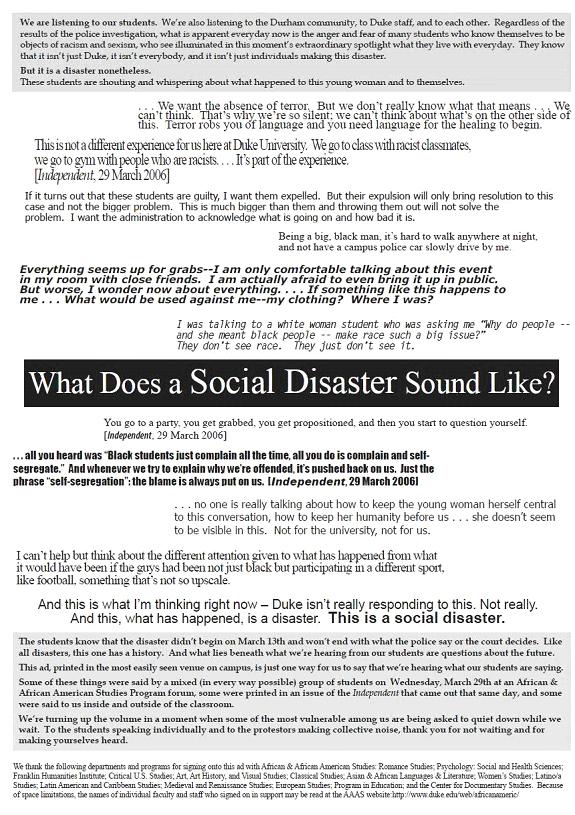
In his writing, Bonilla-Silva regularly employs generic quotes, often invented by him, that he argues typify the “white” viewpoint. (These quotes almost always portray their “white” speaker as transparently racist.) His own style must have made the 88’er particularly amenable to the strategy employed by statement author Wahneema Lubiano, who used anonymous quotes from alleged Duke students to frame the Group’s anti-lacrosse ad.
Bonilla-Silva denies that he seeks “to demonize whites.” After all, he noted, “Historically, many good people supported slavery and Jim Crow”—just like the “good people” in the current environment who “oppose (or have some reservations about) affirmative action.”
I doubt that the majority of voters in California, Washington, and Michigan (all states that have passed referenda banning the use of racial preferences in public jobs) would be comforted knowing that Bonilla-Silva sees them as “good people” even as he compares them to 19th century advocates of slavery. And, of course, branding those who oppose his views as the contemporary equivalent of slavery’s defenders gives a sense of how willingly Bonilla-Silva tolerates dissenting opinions.
When translating his theories into specific policy recommendations, Bonilla-Silva lapses into either the banal or the extreme. (Little else could be expected from someone who claims that “today there is a sanitized color-blind way of calling minorities niggers, Spics, or Chinks.”) For instance, here’s a paean to the race/class/gender worldview:
How, exactly, will this race/class/gender “coalition for humanity” be accomplished? Bonilla-Silva doesn’t say.
The Group of 88 member has urged minorities to “become militant once again” and adopt “a new, in-your-face, fight the power civil rights movement.” The goal? This movement “must have at the core of its agenda the struggle for equality of results.” In other words, the traditional goal of civil rights activists in the United States—equality of opportunity—would be set aside, replaced by implementation of absolute quotas.
Bonilla-Silva has also devoted some thought to the education system—which is, he has claimed, a place to “nurture a large cohort of anti-racist whites.” For students at Duke, he’s had a direct message: “If you are a college student in a historically white college, you must raise hell to change your college” demographically.
But when minority students at his previous position, Texas A&M, didn’t support his agenda, Bonilla-Silva lashed out. After witnessing a panel in which black and Hispanic A&M students downplayed the racism that Bonilla-Silva sees everywhere, the professor dismissed them as racial Uncle Toms:
At Duke, Bonilla-Silva teaches race-based courses such as “Contemporary Analysis of Racism” and “Comparative Race/Ethnic Studies”; the latter explores “the social, legal and cultural construction of racial and ethnic hierarchies in a comparative international context with the United States and the United Kingdom of central analytical concern. Racial formation and racial segregation in specific historical and national contexts including the normative case of the Anglo-Saxon core in the United States and how its dominance has led to patterns of ethnic antagonism and discrimination; the historical context of racial stereotypes and their representation in various mediums.”
He has conceded that “some times[sic] students perceive some of the material” he teaches as “anti-White,” but that those who enroll in his classes needed to keep in mind that “the very mission of the University is to challenge ‘dogmas’ in pursuit of the always elusive ‘truth.’” Of course, Bonilla-Silva’s definition of what constitutes “dogmas” would seem far out of the mainstream. It seems unlikely, for instance, that he would consider the current “diversity” fad in higher education to be a “dogma” worth challenging, despite its overwhelming support from the contemporary professoriate.
Here’s how one student remembered a class with Bonilla-Silva: “Makes fun of you if you answer incorrectly. Hates Duke students (called us ‘spoiled private school kids’). Wastes time in lecture with stupid drawings . . . Is biased.”
Bonilla-Silva didn’t seem to like his students very much at Texas A&M, either. “I am not an Aggie or believe in any of the so-called ‘traditions’ or ‘heritage’ of this institution,” he informed one class at the university he dismissed as “Crackerland.” Here’s his response when asked if white students at A&M were racists:
With typical overstatement, he compared the thematic difficulty of one of his A&M classes, “Sociology of Minorities,” to the intellectual challenges associated with studying “calculus or the second law of thermodynamics.”
The syllabus for the course stated that students needed to control their “body language” and avoid “irresponsible contestation” with his arguments. Bonilla-Silva further asserted that he would “not accept anecdotal ‘data’ (e.g., ‘I know this because Georgino Bushinsky Presidensky said so and he must know’).” The class ended with a lecture on “Amerikkka’s Racial Future and Social Policy Options to deal [sic] with Racial Problems.”
Imagine the appropriate condemnation if a white professor stated on his syllabus that he would “not accept anecdotal ‘data’ (e.g., ‘I know this because Jesserino Jacksoninsky Fakereverendy said so and he must know’),” and accused African-American students in his class of displaying threatening “body language.”
When asked by the Chronicle about the inappropriate language of the syllabus, the Group of 88’er asserted that “his syllabus was tailored to ultra-conservative students at Texas A&M, some of whom use The Bible as the main source in an essay.” (Of course, not all or even most students at A&M would be considered “ultra-conservative”; and there’s little reason to believe that Bonilla-Silva sees the student body at Duke or any other historically white school as fundamentally different ideologically.) Incredibly, the chairman of Duke’s Sociology Department, Philip Morgan, dismissed as irrelevant concerns about Bonilla-Silva’s using his syllabus to score ideological points.
With these research and teaching interests, is it any wonder that Bonilla-Silva rushed to judgment in spring 2006; and then refused to apologize for his actions last January?
---------
In his first book, Bonilla-Silva claimed that “writing about a racial ideology that is alive and well and shapes the views of most whites in the United States is a risky business.” Indeed, for him, it has been so “risky” as to secure a lifetime position with a six-figure salary at an elite university.
Bonilla-Silva is a tenured full professor. A favorite of the American Sociological Association, he arrived at Duke in 2005, as part of a “wish list” of faculty members that the Brodhead administration particularly wanted to bring to Durham.