I've written three posts at Minding the Campus on the topic, one just after the story broke, the second after Witt had issued his side of the story, and the third looking at the extraordinarily poor response to the case by so-called media critics. The worst of the latter was an article from Poynter, which describes itself as an institution "that exists to ensure that our communities have access to excellent journalism—the kind of journalism that enables us to participate fully and effectively in our democracy." To whom did this institution turn for guidance on how the Times should have handled the case? You guessed it: Wendy Murphy.
Tuesday, January 31, 2012
Yale & Witt
Readers of the New York Times might have noticed that the paper has gone after another athlete that fits the negative race/class/gender stereotype, Yale quarterback Patrick Witt. Witt, a Rhodes Scholar finalist, was the subject of an "informal complaint" through Yale's sexual assault/harassment program, which lists an undergraduate male causing "worry" to a female as a legitimate grounds for filing complaints.


Friday, January 27, 2012
Cline Suspended
[Update, Wed., 3.24pm: Retired judge Leon Stanback has been named Durham's interim DA.]
[Update, Sunday, 5.33: Gov. Bev Perdue, who just announced her retirement amidst very poor poll numbers, will appoint Cline's temporary replacement.


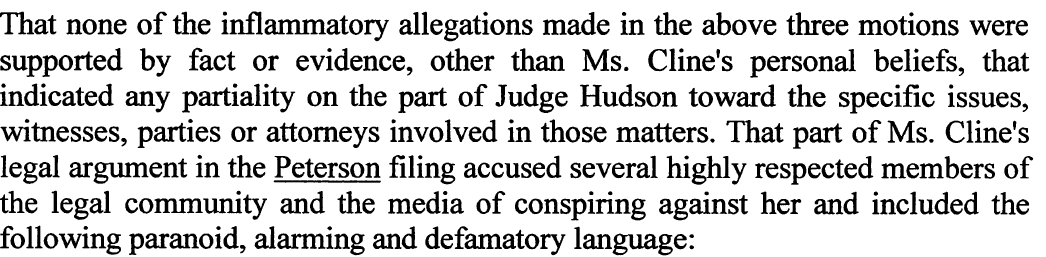
Judge Hobgood's order indicated that probable cause for removing Cline existed for, among others, the following items from Sutton's affidavit:


Will bring news when available on whether WRAL will stream the Feb. 13 hearing.]
The dysfunctional world of the Durham DA's office continues. A hearing on her case will take place on Feb. 13, assuming she does not resign first. Given Cline's delusional approach to affairs over the past several months, I'm not counting on an early resignation.
WRAL has posted Franklin County Judge Robert Hobgood's order; based on his preliminary findings, Cline's chances in the Feb. 13 hearing do not appear good.
Hobgood starts with a summary of the Allen case: he notes that evidence existed for Cline to bring the case to trial, but also finds that Judge Hudson's dismissal of the case (because the state hadn't turned over evidence) was correct. Hobgood reports that it was "apparent" that Cline found this decision "extremely frustrating," and that thereafter, "signals began to appear that Tracey E. Cline was losing her ability to exercise professional restraint and civility toward Judge Hudson."
Hobgood dismissed a couple of elements of Kerry Sutton's affidavit, but found probable cause for 14 paragraphs in her affidavit, and suspended Cline (with pay) until the hearing is held.
[Update, 10.36pm: Ray Gronberg of the H-S reports that as of Friday evening, it was unclear who would serve as acting DA until a final resolution of Cline's case occurs.]
Sunday, January 22, 2012
Politics of Grievance at Duke [Updated: The Group, and Tim Tyson, Strike Back]
[Updated, Friday, 1.07pm: In the race-to-the-bottom among critics of the paper, none other than Tim Tyson--yes, that Tim Tyson--has weighed in on the matter. In virtually any other environment, Tyson would have no credibility to comment on public matters. This was, after all, a figure who so badly misjudged the lacrosse case that he participated, as a "teacher," in a candlelight vigil on behalf of false accuser Crystal Mangum (who he described as somebody's "sweetheart") a couple of hours before Mangum took the stage, in a highly . . . limber . . . fashion, in a local strip club.
But in the race/class/gender-dominated academy, a race-baiter like Tyson speaks pearls of wisdom. And so in yesterday's Chronicle, Tyson goes after Peter Arcidiacono, fuming, "Who appointed [Arcidiacono] to weigh the merits of black folks being allowed into the room?" I was unaware that tenured faculty members like Arcidiacono had to be "appointed" before they could engage in scholarly inquiry.
As with virtually all of Arcidiacono's critics, Tyson does not challenge the data that the paper of Arcidiacono, et al., uncovered. Instead, he resorts to the race-baiting attack lines: after disingenuously suggesting that he's not challenging the academic freedom of people who don't share his world-view, he does just that: "Duke’s treasure, the late Dr. John Hope Franklin, whose legacy Arcidiacono treads upon, provided research for Thurgood Marshall in the Brown v. Board of Education case. But there is no constitutional right to R-E-S-P-E-C-T, as Aretha might put it. BSA members who question 'the research’s intent, methodology, analysis and conclusion, in addition to its validity,' display a generosity and deliberation far exceeding those of this study."
Once again: Tyson does not challenge in any way the data that Arcidiacono, et al., presented, that black students at Duke disproportionately migrate away from more difficult (science and engineering) to easier (liberal arts) majors.
[Updated, Wed., 8.14pm: In what could be deemed the least surprising development of this entire affair, prominent members of the Group of 88 have sharpened their race-baiting credentials to attack the paper.
Karla Holloway, notorious for her decision to pass along fifth-hand, slanderous gossip against Duke students, at least when doing so furthered her on-campus agenda, tweeted that "Duke authors' unpublished study of race + Affirmative Action lacks academic rigor." Nowhere in her twitter feed has Holloway provided any specific criticism of the study's data; indeed, in another tweet, she even elected to use scare quotes when describing the paper as a study.
The existence of the paper, the Group of 88'er wildly implied, indicated that "Duke still struggles w/issues of diversity," as she appeared to demand that Duke administrators publicly speak out about a research study from Duke professors. (This position was particularly rich coming from Holloway, who during the lacrosse case had issued the bizarre demand that Duke administrators had to publicly support her, as a Duke professor, from criticism.) In what could qualify as a textbook case of the politics of grievance in action, Holloway leveled the inflammatory allegation that the paper--a paper, again, whose data she does not appear to have publicly challenged--"re-opens old racial wounds."
The message here was clear: professors willing to provide data--even if that data is accurate--that challenges Holloway's worldview will face ill-concealed accusations of racism.
Holloway also tweeted a link to the blog run by Mark Anthony ("Thugniggaintellectual") Neal, who ran a post by David Leonard criticizing the paper. Imitating Holloway's race-baiting tactics, Leonard asserted that the paper (whose data he, too, did not challenge) "has dangerous implications."
Meanwhile the Black Student Association has upped its pressure, delivering what the Chronicle terms a "list of demands" to the administration. The list includes--of course--hiring more black professors. The almost laughable inference here is that Duke's arts and sciences faculty--a faculty where many departments are dominated by Group of 88 members, and others have strong Group influence--somehow are insufficiently attentive to hiring African-American faculty. Anyone who believes such a claim would have to reside in some sort of fantasy-land.]
Watching the returns from Saturday night’s South Carolina primary, I was struck by a focus group of Florida GOP voters, who had response dials as they listened to Newt Gingrich’s victory speech. Their dials skyrocketed into positive territory when Gingrich spoke of his willingness to stand up to ill-defined anti-Christian bigotry—this in a majority-Christian country where more than six in ten voters say they’d be less likely to support a presidential candidate who was an atheist.
But Gingrich did not need data or factual evidence to bolster his claims. Rather, as the (basically sympathetic) Sheldon Alberts correctly analyzed, the speech was part of a “broader ‘politics of grievance’ strategy that Gingrich is executing — at the moment — better than his rivals.”
As expert as Gingrich might be at practicing the politics of grievance—and he’s a master—the former Speaker can’t hold a candle to campus “diversity” advocates, who all but originated the tactic. An excellent example came last week at Duke.
The affair started with an unpublished paper penned by Peter Arcidiacono, Kenneth Spenner, and Esteban Aucejo. (Arcidiacono and Spenner are professors at Duke.) The paper used Duke’s own data to show that groups of students who receive preferential treatment in the admissions process (African-Americans and “legacy” admittees) disproportionately migrate from more difficult (science and engineering) to easier (liberal arts) majors.
The paper was cited in an amicus brief in the Fisher case. In briefs filed with the Supreme Court, a key, and persuasive, argument of opponents of on-campus preferences—including, as I wrote about at MTC, my UPI co-author Stuart Taylor—is that not only do these preferences violate the 14th amendment’s promise of all people receiving equal treatment under the law regardless of their race, but preferences don’t even benefit the people (minorities, in this instance) they allegedly were designed to serve. In this instance, the paper’s authors concluded that “attempts to increase representation [of minorities] at elite universities through the use of affirmative action may come at a cost of perpetuating underrepresentation of blacks in the natural sciences and engineering.”
As far as I can tell, no one has presented evidence that challenges the accuracy of the data that the trio presented. To reiterate: as far as I can tell, no one has presented evidence that challenges the accuracy of the data that the trio presented.
The paper first generated outrage from Duke’s Black Student Alliance. The H-S revealed that the organization e-mailed the state NAACP to complain that “the implications and intentions of this research at the hands of our very own prestigious faculty, seemingly without a genuine concern for proactively furthering the well-being of the black community is hurtful and alienating.” Newt couldn’t have handled the faux grievance angle better!
The e-mail further noted that the BSA had demanded “a dialogue” with the paper’s authors “that addresses our concerns about research’s intent, methodology, analysis and conclusion, in addition to its validity.” Yet as far as I could tell, the BSA did not challenge the accuracy of the data that the paper presented. I e-mailed BSA president Nana Asante to ask her if, in fact, she had any complaints about the accuracy of the paper’s data. She did not reply.
Even more boldly, the BSA suggested that some type of “acknowledgement or intervention took place, in the best interests of black students” by the Duke administration. I also asked Asante what type of administration “intervention” she and her colleagues envisioned. She did not reply.
To reiterate: as far as I can tell, the BSA did not challenge the accuracy of the data that the paper presented.
According to the H-S, the grievance crusade then moved on from the BSA to a group of black Duke alums. Seventeen alums wrote to the H-S to say that “we are deeply troubled and offended by the recent study emanating from faculty members at our alma mater.” The letter accused Arcidiacono, Spenner, and Aucejo of “slander” and having produced “both flawed and incorrect” research.
Yet, at least according to what was revealed in the H-S article, the letter didn’t actually identify any specific areas in which the paper was “both flawed and incorrect,” much less slanderous. It’s not even clear to me who the paper could have slandered.
To reiterate: as far as I can tell, despite their overheated rhetoric, the alums did not challenge the accuracy of the data that the paper presented.
The grievance demands triggered a joint letter from Duke provost Peter Lange and other Duke administrators (including Group of 88’er Lee Baker, now a Duke dean). The letter gave a generic defense of academic freedom. But it also included this extraordinary sentence: “We understand how the conclusions of the research paper can be interpreted in ways that reinforce negative stereotypes.”
The administrators did not identify which “negative stereotypes” they had detected, nor did they explain how “the conclusions of the research paper” could be “interpreted in ways that reinforce” these unidentified “negative stereotypes.” The administrators’ letter did not challenge, in any way, the accuracy of the data that the paper presented.
Apart from instances of academic fraud or outright racist/sexist/anti-semitic “research” claims by professors (the “work” of Northwestern’s Arthur Butz comes to mind), I can’t recall a single instance of a university’s administrators—much less a leading research university’s administrators—accusing professors at their school of producing scholarship that could “be interpreted in ways that reinforce negative stereotypes."
This administrative outrage, of course, is highly selective. Imagine the following counter-example. A couple of Duke professors pen a research paper noting (correctly) that opposition to marriage equality skews toward under-educated segments of the population. Duke’s Christian student organization, whose members oppose marriage equality but who see an association with poorly educated people as personally offensive to their religious beliefs, pen a letter wailing that “the implications and intentions of this research at the hands of our very own prestigious faculty, seemingly without a genuine concern for proactively furthering the well-being of the Christian community is hurtful and alienating.” The Christian students demand “a dialogue” with the paper’s authors “that addresses our concerns about research’s intent, methodology, analysis and conclusion, in addition to its validity.”
Does anyone believe that Duke administrators would respond to the Christian students with an open letter seeming to validate their complaints about the (accurate) scholarship, or that “we understand how the conclusions of the research paper can be interpreted in ways that reinforce negative stereotypes”? And if such a public letter were penned, does anyone believe that Duke administrators would not be facing a revolt from the Group of 88 and their allies?
To reiterate: as far as I can tell, no no one has presented evidence that challenges the accuracy of the data that Aucejo, Arcidiacono, and Spenner presented. But in the contemporary academy, which worships before the altar of “diversity,” accurate scholarship can be insufficient—and can even, as in this case, generate an implicit rebuke from a university leadership.
Hat tip--O.S.
Sunday, January 15, 2012
Yet Another Cline Embarrassment (Updated)
[Updated, Thurs., 5.56pm: "Ahab" Cline will continue her quixotic quest against Judge Hudson, the N&O reveals. Cline--the person who, it's worth noting, wouldn't recognize the truth if it bopped her in the head--wrote that "it is truth telling time" for Durham County.]
[Updated, Wed., 4.22pm: Durham attorney Kerry Sutton (who played a minor role in the lacrosse case) has filed an affidavit urging the removal of Tracey Cline as Durham DA. In the affidavit, Sutton accuses Cline of "habitual intemperance" and conduct "prejudicial to the administration of justice." Sutton, not unreasonably, characterized Cline's "inflammatory" filings against Judge Orlando Hudson as filled with "venom" and "paranoid" language, lacking in "fact or evidence, other than Ms. Cline's personal beliefs." Sutton goes into considerable length about how Cline's obsession with Hudson has both harmed the Durham DA office's reputation and consumed the Durham legal community's resources. (She also points out that the grammatically-challenged Cline also has a tendency to misspell "affidavit" in her legal filings.)
The N&O's Andrew Curliss reports that the gambit employed by Sutton is rarely used, and is believed to have resulted in the removal of only one DA in North Carolina history.]
Durham County’s minister of justice was last heard from penning a bizarre e-mail to the Herald-Sun in which she misspelled a judge’s name and asserted that “truth should be intimidated by the pressure of the powerful or the fear of failure.” This morning’s N&O exposes as false a central claim made by Tracey Cline in her quixotic crusade against Judge Orlando Hudson—that Hudson had demonstrated his anti-Cline bias by entering an August order before the prosecution even had the chance even to present all of its witnesses.
Reporter Andrew Curliss did what Cline failed to do—he actually investigated the seeming anomaly. And he discovered a benign explanation: “The clock at the courthouse that stamped the document was more than two hours slow that day.” In a situation that would seem more likely in a small town courthouse than in North Carolina’s fifth-largest city, the clock in the county clerk’s office seems to malfunction with some regularity. Curliss spoke to assistant county clerk Angela Kelly, who commented about the clock, “It is a machine that's plugged up in the wall that runs constantly. When things are filed, we stick it in there, and we always hope and pray it's correct. But there have been times when we notice that it's not correct."
Curliss confirmed Kelly’s recollection by checking into legal documents filed the next morning—which the clock erroneously stamped at 7.18am, rather than after 9.00am, when the clerk’s office actually opened. (Times public editor Arthur Brisbane might just call Curliss a “truth vigilante.”) The N&O website has a photo of the relevant filings.
Rather than assuming the worst and thereby leveling wild, unsubstantiated allegations against a sitting judge, Cline might have checked to see if there were problems with the clock in the clerk’s office, something that would have taken her only a few minutes to do. The N&O presented Cline with the information, but she declined comment, and thus did not take the opportunity to say that she would withdraw her charges against Hudson. Jim Coleman summarized the problem to Curliss: "She has made a serious allegation, and it warranted serious review by her before this filing. It is now just more evidence of a lawyer who is barreling down a hill totally oblivious to the damage she is causing to the judicial system. She is undermining confidence in the system. It's disgraceful."
Such cavalier disregard for the truth and professional behavior from his county’s “minister of justice” might be enough to cause “shame” and “anger” even from the likes of Duke professor William Reichert. But I suspect not.
Friday, January 13, 2012
The Reichert Rules
Though Duke’s race/class/gender-dominated humanities faculty members embarrassed themselves in their response to the lacrosse case, faculty in the hard sciences and engineering behaved very differently. Indeed, only one member of the Group of 88, Ronen Plessler, came from any of the sciences or engineering departments.
That said, on the one occasion in which a science professor did try to imitate his “activist” colleagues—when “Counselor” Thomas Crowley hung his shingle for readers of the Herald-Sun—the result was humiliation and a quick backtrack.
Biomedical Engineering professor William Reichert should have learned Crowley’s lesson. In what’s described as a guest “commentary” in today’s Chronicle, Reichert begins by complaining about SportsCenter devoting excessive coverage to the Jerry Sandusky case, thereby disturbing his workout. This situation—not, it seems, Sandusky’s alleged crime, but ESPN’s coverage, from which for unknown reasons he could not avert his eyes—left him “stewing . . . for weeks and weeks,” until, finally, he elected to turn to the pages of the Chronicle. (Did Deadspin, known for its biting ESPN commentary, reject his submission?)
From the Sandusky affair, Reichert moved on to a . . . curious . . . recapitulation of the lacrosse case. He confessed that “senseless behavior,” which he did not specifically define, left him with feelings of “anger” and “shame.” Of what senseless behavior, then, did he speak? His colleagues’ rush to judgment and their abandoning the basic requirements of the Faculty Handbook? The local prosecutor’s violating myriad ethical standards? The Durham newspaper’s decision to turn a blind eye to the abuses?
None of these developments appeared to produce either “shame” or “anger” for Dr. Reichert—in itself a revealing insight into his character. His “shame” or “anger” came from the “behavior of students”—presumably the lacrosse players, rather than the potbangers, though Reichert is careful not to say so (perhaps for legal reasons?). Fortunately, however, there was a hero of the affair: Richard Brodhead, who showed “courage” in prematurely terminating the 2006 lacrosse season, fully aware of “the blow back [sic] that was sure to come.”
This claim is a little bit like Cathy Davidson’s reinvention of spring 2006 as a time of terror for black students on the Duke campus. Brodhead’s canceling the lacrosse season required no courage at all. Faculty “activists” were demanding it, the team itself had virtually no supporters on campus at the time, and then-BOT chairman Bob Steel considered it a necessary sacrifice for public relations purposes.
Brodhead, in short, received virtually no “blow back” for the decision, at least at the time. Indeed, the only way in which Reichert’s “blow back” claim makes any sense would be if he’s suggesting that Brodhead fully believed that the accused students were innocent but cancelled the season anyway, thereby anticipating a “blow back” once outsiders (even the biased New York Times) came to criticize the university for its guilt-presuming action.
A question: could it be that Reichert’s other title—“Associate Dean for Diversity”—accounted for his Group of 88-like interpretation of the lacrosse case?
Thursday, January 12, 2012
Updates: Times, Cline, FERPA, Chafe
[Updated, Friday, 1.03pm: Duke has filed its discovery requests in the McFadyen lawsuit. University lawyers are asking for potentially thousands of documents, including logs of Facebook accounts, e-mails to their teammates and their parents, high school grades, drafts(!) of class papers, tax returns, and medical records since 2001.
The document requests suggest that the university's legal strategy will focus on attempting to blame the lacrosse players for any damages they received, presumably by trying to detect stray items in Facebook posts or e-mails. The strategy is unsurprising: if the Brodhead administration's actions are indefensible, the university has little choice but to go after the plaintiffs. That said, it's still striking that as the same university that wants thousands of documents from its former students has been willing, thus far, to hand over only 27 documents of its own.]
New York Times public editor Arthur Brisbane, last seen searching out Wendy Murphy for guidance about how his newspaper should report sexual assault cases, posted a provocative item this morning asking if the Times should be a “truth vigilante.”
Brisbane said that his post was prompted by reader concerns about the paper’s repeating false candidate claims (such as Mitt Romney’s repeated assertion that Pres. Obama embarked on a tour to “apologize” for the United States) without reporters pointing out that these claims were . . . false.
Of course, it’s hard to give any credibility to someone, like Brisbane, who sees Wendy Murphy as an arbiter of truth. In any case, the Times’ indifference to repeating false items obviously predated the current campaign. The factual errors from Duff Wilson’s reporting remain uncorrected.
-----------
Durham County’s “Minister of Justice” is back in the news this week. Tracey Cline, continuing her quixotic case against Durham judge Orlando Hudson, filed papers demanding Hudson’s removal from a yet another criminal case, on spurious grounds that he is biased against her office.
N&O reporter Andrew Curliss noted that Cline’s filing repeated factual errors that she’s made in previous legal documents (even if the office struggles with basic research, does anyone from the Durham DA’s office bother to read the newspaper?). At least, however, Curliss notes that Cline's 30-page submission was “much smaller than previous filings by her that attacked Hudson.”
BTW: Cline came second for worst prosecutor of the year, 2011, to John Bradley.
------------
I have a post at Minding the Campus using the recent example of former St. Joe’s basketball player Todd O’Brien to point out how universities too often abuse FERPA, using the law not as it was intended (to protect student rights) but instead as a shield to avoid public criticism.
That post suggested (and a browse through FIRE’s archive would confirm) that universities too often interpret FERPA far too rigorously. But the post also acknowledged the one high-profile instance in which a university ignored FERPA so as to serve short-term public relations interests—Duke’s decision to give the DPD keycard information on the lacrosse players—without a subpoena, and without telling the students or their parents. Intriguingly, among the handful of documents turned over to Bob Ekstrand in discovery was an email from Duke falsely claiming that the university had followed FERPA’s terms.
---------
Finally, Politico reports on a new PBS movie focusing on Bill Clinton and the former President's many, many affairs. Among the people quoted in the article--U.S. history's race/class/gender specialist, none other than William Chafe.
The Group of 88'er conclusion: Clinton's lack of control over his behavior was "terrifying." There's no indication whether Chafe will be endorsing a full-page ad in the Chronicle denouncing Clinton.
Hat tip--O.S.
Friday, January 06, 2012
Items from the Ekstrand Filing
A filing by Bob Ekstrand in the McFadyen lawsuit has revealed some interesting material about Duke’s initial response to Crystal Mangum’s false allegations. Ekstrand filed in response to Duke’s . . . miserly . . . approach to discovery—the University has turned over only 27 documents—some of which, according to Ekstrand, were duplicates.
Ekstrand’s brief included examples of material already obtained in discovery—and provides a good sense of why Duke has proven so . . . reluctant . . . to hand over material.
By far the most significant item is a March 17, 2006 e-mail from Dean Sue Wasiolek, sent to an array of top Duke administrators, including John Burness, Larry Moneta, and Tallman Trask:
Here’s the latest update on this situation. Most important is that the students who reside in this house have been fully cooperative and are concerned that their names will be in the press. Since they have not yet been officially charged with anything, they have asked that should the realty company (or anyone else at Duke) be asked for those names, that we not give them out since this is still just an investigation. Scott Selig has called Allenton Realy and alerted them to this.
The Durham police are, in fact, investigating an alleged rape/kidnapping at 610 N. Buchanan. On Monday, March 13, two strippers were hired to perform at 610 N. Buchanan. About 30 men were in attendance, all members of the Duke Lacrosse team. One of the strippers appeared to be on drugs. the men decided to pay the women early, and then asked them to leave. They refused and the men paid them more. The one stripper ended up passing out either on a porch or deck in the back of the house and the men carried her to the other woman’s car. At some point later, the passed out woman interacted with Durham police at the Kroger on Hillsborough Road and made the allegations. I believe she was examined at Duke ED.
Last night the house was searched. The men volunteered to engage in DNA testing and to take lie detector test. I believe the DNA testing was done.
Mike Pressler and Chris Kennedy are well aware of this situation. The men have denied all allegations--they obviously admit to hiring the strippers.
The Wasiolek e-mail confirms that the senior Duke administration knew from the start that the lacrosse players had fully cooperated (even to the extent of the captains volunteering to take lie detector tests) with the police inquiry. Less than two weeks later, when Mike Nifong began his pre-primary publicity crusade, he suggested something else—that, in fact, that players had erected a “wall of silence” to frustrate the investigation.
Duke administrators were under no legal obligation to correct the record. (Whether they had a moral obligation to do so is another story.) But the Wasiolek e-mail confirms that senior Duke administrators knew from the start that not only was the DA violating standard procedure by speaking early and often about the case, but that one key element of his publicity barrage—the lack of cooperation by the players—was demonstrably false.
Yet this knowledge (which, at the time, very few people outside the lacrosse team, their families, and their attorneys possessed) that the DA was publicly lying about Duke students appears to have had no impact in how Duke administrators initially responded to the case. Why was that?
The other intriguing item from the Ekstrand filing is a deposition from Associate AD Chris Kennedy, a consistently first-rate figure throughout the case. (Kennedy was quickly marginalized from discussions about how Duke should respond to Mangum’s allegations.)
Kennedy’s deposition provided an insight into the mindset of senior Duke administrators. For instance, he recalled a March 24 or March 25 conversation with Tallman Trask, in which Trask said “something to the effect of he would be amazed or astounded . . . if there was anything to the allegations.”
Obviously, public statements from Duke administrators near this time—most particularly the Brodhead April 5, 2006 “letter to the Duke community”—appeared to operate from a radically different premise. Why was that?
Kennedy’s deposition also provided useful context on how two particular actions by Duke helped shape public opinion in the case. The first came in the extraordinary decision to cancel the March 25, 2006 Duke-Georgetown game less than two hours before the game was to start. In response to a question from Ekstrand, Kennedy said he couldn’t recall an instance in which Duke had canceled an athletic contest in response to criminal allegations against team members, and added, when questioned again, that “I thought that somebody from the outside—in light of the newspaper article that appeared that morning in the News and Observer,"Dancer Gives Details of Ordeal”—I thought that that would send the message that that was, in fact, an accurate account of what had happened.”
Kennedy was right. Indeed, in their non-apology apology, the New York Times sports editors cited the unprecedented cancellation of the game and then the season as one reason for the paper’s presumption of guilt in its coverage.
The second came in Brodhead’s infamous April 20, 2006 remarks to the Durham Chamber of Commerce, shortly after the arrests of Reade Seligmann and Collin Finnerty, in which the Duke president declared of his students, “If our students did what is alleged, it is appalling to the worst degree. If they didn’t do it, whatever they did is bad enough.”
Kennedy was asked how the Durham community viewed this statement, and he responded, reasonably, "I think that someone without any knowledge of any of the facts, someone on the outside would again draw the conclusion that some kind of crime had been committed and that Brodhead believed they were guilty. And furthermore, I think it was incredibly indiscreet to say ‘whatever they did was bad enough.”
Finally, the deposition offers a revealing vignette. Kennedy spearheaded the (successful) NCAA appeal for the members of the team to obtain an extra year of athletic eligibility. He wrote the appeal document, and passed it along to the Duke counsel’s office for approval. The counsel eliminated items dealing with the on-campus threats to the students and the behavior of the Duke faculty toward their own students.
A bit of revisionist history, perhaps.
Monday, January 02, 2012
Vote for Tracey!
The competition (especially John Bradley) is stiff for worst prosecutor of the year. But Durham's "minister of justice" is definitely in the running.
Housekeeping matters: I tweet all my posts (both here and from Minding the Campus) on my twitter feed; follow me here.
Wednesday, December 28, 2011
Attorney Wilson Approaches the Bench
Again proving that a man who represents himself has a fool for a client, Attorney pro se Linwood Wilson has filed a civil rights lawsuit against Kent (DE) County, Durham County, and no fewer than 31 individuals (ranging from his estranged wife Barbara to Beau Biden(!), the vice president’s son and the current Attorney General of Delaware). The former DA’s chief investigator, Christian singer, and ethical sinkhole alleges that his arrest for possible spousal abuse in fact involved malicious prosecution, concealment of evidence, conspiracy, supervisory violations, and fabrication of false evidence—all matters of which, it goes without saying, his service under Mike Nifong gave him intimate knowledge.
Wilson’s 92-page complaint, filed alongside 10 exhibits (totaling some 355 pages), takes 10 pages just to identify the various people that he’s suing. Attorney Wilson suggests a wide-ranging and multi-layered conspiracy of his wife, her alleged “paramour,” a Delaware police officer with whom she also allegedly was having an affair, his wife’s family, some of his wife’s friends and co-workers, some law enforcement officials in Durham County, and various law enforcement officials in Delaware—all working in concert to deny Linwood Wilson his constitutional rights. Remarkably, until the filing of this complaint, this vast conspiracy went undetected—not by the media, nor by state legislators in Delaware or North Carolina, nor by various watchdog agencies. How could this be?
In the real world, the chief purpose of the complaint seems to be less exposing a previously undetected “conspiracy” than humiliating Wilson’s estranged wife and her alleged “paramour,” Joseph Curtis. Attorney Wilson describes his wife as “a mentally troubled woman who had abandoned her marriage.” Indeed, she had “plenty of Zoloft at home,” yet was caught going to the pharmacy for more. Wilson recounts the following alleged event at a local Mexican restaurant: “Defendant [Barbara] Wilson drank a large double margarita (while taking Zoloft, Clonazepam, and Xanax) and got extremely drunk, telling Plantiff [Linwood] how she wanted to rip his clothes off and have sex with him on the table.” Attorney Wilson describes this evening as “the best [the marriage] had been in months.”
But, alas, Barbara Wilson was leading a double life, according to her husband. She was having an affair with her “paramour” at the workplace, while at their “marital home,” Barbara Wilson “sat next to her husband each night, wanted [sic] him to rub her feet and legs.” The “paramour,” meanwhile, “ran from Wilson’s marital home like a dog with his tail between his legs” when confronted by Linwood.
The gap between Attorney Wilson and Plaintiff Wilson is sometimes difficult to follow. For instance, in paragraph 48 of the complaint, Attorney Wilson speaks of “our marriage” (the marriage between Barbara and Plaintiff Wilson); at other occasions, he uses “I” rather than “plaintiff” to describe his recollections of alleged events.
Attorney Wilson claims that his client has suffered various injuries, including “economic” harm, presumably a result of the marriage’s breakup shattering the “Voiceovers by Wilson” business that the husband and wife planned to start. Attorney Wilson also claims that his client has “suffered irreparable harm to his reputation.” How? After the exposures of the lacrosse case, Linwood Wilson had no reputation to lose.
Attorney Wilson is particularly fond of the phrase “upon information and belief”—an approach used in civil suits when lawyers believe that something occurred but for which they do not, before discovery, possess hard evidence to substantiate. But in the Wilson complaint, virtually every “factual” claim comes not from any evidence he possesses but from his own . . . beliefs. To give a sampling from the complaint:
“Upon information and belief Durham Coca-Cola was already aware of the affair.”
“Upon information and belief . . . Barbara Wilson had been reportedly locking herself in her office at work and crying all the time.”
“Upon information and belief, a display of public affection occurred between Defendants Wilson and Curtis, in Curtis’ car on the way back from NCCU.”
“Upon information and belief, Barbara Wilson was the only one who got a raise in the past 2-3 years.”
“Upon information and belief, the ‘Delaware Conspiracy’ along with co-conspirators . . . from North Carolina, made a ‘rush to judgment’ and manufactured changes.”
“Upon information and belief, Defendant Reimann continued to conspire with Defendants [Barbara] Wilson, Curtis, and Delaware Sgt. Weaver.”
“Upon information and belief Defendants Whitfield and Wilson hacked Plaintiff’s computers at his residence and falsified evidence.”
“Upon information and belief, Defendant Deputy Reimann was the source of information for Defendant Weaver, thus thickening the conspiracy more and more between North Carolina law enforcement and Delaware law enforcement.”
“Upon information and belief, it was common knowledge throughout the legal system in Dover, DE.”
“Upon information and belief, this is when the conspiracy was formed . . . to make it appear that Barbara Wilson was afraid of her husband (Plaintiff) and that he (Plaintiff) was crazy.” [As an aside, Barbara Wilson needn’t have entered into a conspiracy to have accomplished these goals: she simply could have told people to read this complaint.]
The strangest of these “information and belief” structures comes in paragraph 49, when Attorney Wilson writes, “Upon information and belief . . . Beth Greenman called Plaintiff [Linwood Wilson] and advised him that “If you don’t get Barbara away from [her alleged ‘paramour’] Joe he is going to ruin her and destroy your marriage.” The person who wrote these words was a party to the alleged call. This is his complaint. Is Wilson suggesting that he himself doesn’t know if the call occurred (the only reason for an “upon information and belief” construction)?
The anti-Linwood “conspiracy,” Attorney Wilson claims, intensified after his wife discovered that Linwood planned to involuntarily commit her for mental observation. At that point, Barbara Wilson decided to “flea [sic!!] the jurisdiction of North Carolina in order to avoid commitment proceedings.”
Attorney Wilson also appeared to have taken writing lessons from the grammatically-challenged Tracey Cline. Consider, for example, this head-scratching sentence: “Also none of it was relevant to Delaware since, according to Defendant Weaver himself, the fact that all this supposedly occurred in another jurisdiction, North Carolina, which Defendant Weaver had nothing to do with.”
Some of the “evidence” proffered by Attorney Wilson, alas, undermines the position of his client. For instance, Attorney Wilson recounts a conversation between Barbara Wilson and her husband, in which she told Linwood that she wanted the marriage to work, but that she had some “conditions.” That admission might sound damaging to Barbara, until Attorney Wilson reveals the wife’s conditions: that Linwood “was not to call her cell and ask where she was or what she was doing”; and that Linwood was not to “follow” her. If, in fact, the unemployed Linwood Wilson was following his wife around, or frequently calling her up asking her what she was doing, it would seem as if he was engaging in, at the least, emotional abuse; and, at the most, stalking.
In any case, Attorney Wilson says that his client immediately discerned that his wife wasn’t serious in hoping that the marriage would work—a conclusion he based on his “training and experience as a police investigator, private investigator, and District Attorney investigator, for over 38 years.”
Or take this charming anecdote from Attorney Wilson after his wife’s alleged “paramour” visited the “marital home” to check on Barbara Wilson’s well-being. Linwood Wilson admits to screaming at Curtis, “Don’t come into my home, push me out of the way, and disgrace me, my wife, or my home in this way or I’ll blow your f_king head off!” Again: a person charged with spousal abuse is admitting that he threatened to “blow [the] f_king head off” the man he believed was sleeping with his estranged wife.
As the marriage deteriorated, Attorney Wilson admits that his client refused to have sex with his wife, as the “Plantiff knew that would damage his case, if the marriage didn’t work out, from 20 plus years as a private investigator. A field in which Plaintiff had testified as an expert witness over 200 times . . . throughout North Carolina.” Demonstrating his client’s classless nature, Attorney Wilson passes along the fact that his wife “started using dildo’s” to pleasure herself.
The Linwood Wilson who comes through in this complaint is an enraged man, something of a control freak, clearly humiliated by his wife’s apparent infidelity. How he could escape sanctions for filing such a bizarre complaint remains to be seen.
Finally, perhaps the strangest or the many strange clauses from the Wilson filing was the following: “Defendant Eric Campen stated loudly in the lobby of the Durham County Sheriff’s Department and Courthouse in front of Deputy Tom McRae, several unknown deputies, about ten people in the lobby, one [sic] of whom was Victoria Peterson and Richard Porter, “You are a convicted felon! You will never get your guns back! You know better than to even try this!.” “I’ve seen your handy work on the computers, I know how good you are!” The truth is that Plaintiff Wilson has never been convicted of any felony and why was Campen tampering with evidence that he was not authorized to (computer). When Plaintiff Wilson and Richard Porter left the lobby of the Sheriff’s Department several unknown bystanders stated, “We didn’t know you were a convicted felon!” An obvious character assassination and deformation.”
Leaving aside the implausibility that the events occurred even remotely as Wilson described, and further leaving aside Wilson’s hilarious claim that a government official allegedly saying false things about him constitutes “deformation,” the vignette begs the question: what was Durham’s resident bigot and homophobe, Victoria Peterson, doing milling around the sheriff’s office lobby?
Friday, December 23, 2011
'Tis the Season . . . for the "Thugniggaintellectual"
The lacrosse case unintentionally exposed the extent to which shoddy thinking passes for insight in the contemporary academy. Dozens of professors at one of the nation’s finest universities rushed to judgment based on highly incomplete information—and then when evidence emerged that contradicted their preconceived biases, they resolutely clung to their original opinions.
Such behavior had to raise questions about whether Group members—who, after all, represent the dominant pedagogical approaches in most humanities and social sciences departments—also poorly evaluated evidence in their own scholarship. Addressing that question was a central theme of the blog’s series of Group profiles.
Yet a closer look at what passes for scholarship among the Group also revealed some zany (to borrow an adjective from the current presidential campaign) assertions—such as Grant Farred’s claim that former Houston Rockets center Yao Ming represented “the most profound threat to American empire.”
A recent blog post ("'Santa Claus Is Coming to Town': Some Thoughts on Christmas and State Surveillance") from the self-described “thugniggaintellectual,” Group member Mark Anthony Neal, reached Farred-ian levels. Indeed, as one correspondent noted, it read as if it were intended as a caricature of the most ridiculous type of academic discourse.
The post opened with a warm holiday scene—the Neal family getting into the holiday spirit by listening to “Santa Claus is Coming to Town.” (The Temptations’ version, of course, given that in the Group member's “youthful nationalist days, it was easy to reject the idea that some ‘fat white man’ would be honored for providing gifts that hardworking black women and men, like my parents sacrificed to provide for their families.”) And as this happy scene proceeded, Neal’s daughter tossed in a comment: “Santa sounds like a stalker.”
This . . . insight . . . prompted Neal to pause and reflect on “the more troubling aspects of Santa Claus.” He ultimately concluded that his “daughter was on to something. Every holiday season millions of American embrace a seemingly innocuous symbol, that is in truth a powerful reminder of the reality of State surveillance in everyday life.”
Santa as a latter-day J. Edgar Hoover, all courtesy of a professor's child! Who knew?
It also seems that parents who invoke Santa in a desperate attempt to get their kids to behave need to turn in their ACLU cards—for, as Neal explained, “Santa Claus is but a user friendly symbol of the State’s capacity not only to engage in blatant forms of surveillance, but to essentially police behavior in the absence of actual surveillance . . . How many parents have exploited their children’s knowledge that Santa ‘knows when you are bad or good’ as a means of reigning in bad behavior.”
Neal then proceeded to more flights of fancy, moving on from surveillance to a critique of Santa-themed Christmas TV shows, which “portray Santa Claus as a benevolent patriarch. Benevolent, that is, as long as children (and presumably adults) adhere to some State sanctioned notion of normal and legal behavior.”
The “thugniggaintellectual” provided his own unique brand of insight into Santa’s “disruptive outlaw figures.” BurgermeisterMeisterburger in Santa Claus is Coming to Town, according to Neal, “reproduced anxieties” not about Nazism (don’t be fooled by the German-sounding name) but instead “about Soviet-styled Communism.” As usual with the Group, why let evidence get in the way of a good argument, in this case proving American society’s reflexive anti-leftism? Or take two of my favorites—the Miser Brothers of The Year Without a Santa Claus. In Neal’s reality, they “are used to gently chide the kinds of male flamboyance often associated with homosexuality(!!).”
Neal’s post concluded by meandering from his reflections on Santa to commentary about the “State sanctioned assassinations of Black Panther Party leaders Fred Hampton and Mark Clark.” Of course.
It’s easy, and wholly understandable, to laugh at this type of drivel. But it’s worth recalling Neal’s valued place within Duke. Indeed, the revelation of the “thugniggaintellectual” moniker came from Duke's public relations office itself; Duke Magazine published an interview with Neal in which he asserted that “my intellectual alter ego is thugniggaintellectual—one word . . .I wanted to embody this figure that comes into intellectual spaces like a thug, who literally is fearful and menacing. I wanted to use this idea of this intellectual persona to do some real kind of ‘gangster’ scholarship, if you will. All right, just hard, hard-core intellectual thuggery.”
Those remarks appeared in print just after the dean of students, in a public forum on the university’s response to the lacrosse case, worried that Duke students had created a "culture of crassness.” No worries about how a professor who said that he engaged in “hard-core intellectual thuggery” contributed to a “crassness” of discourse on campus.
But why bother confronting the hypocrisy of the academic powers-that-be when we can speculate on Heat Miser's sexual orientation?
Sunday, December 18, 2011
A Few Updates
[Update, Tuesday, 11.51am: The N&O reports that in an unpublished decision, a three-judge panel of the state Court of Appeals has upheld the conviction of Angel Richardson, even though DA Cline didn't turn over to the defense a statement that someone else claimed he had committed the killing until the trial was already underway.
In a remarkable piece of legal reasoning, the panel conceded that the evidence was exculpatory, and acknowledged that the Supreme Court's Brady standard (as well as, of course, North Carolina's seemingly toothless open file discovery law) requires turning over exculpatory material to the defense, but that there's nothing wrong with "the disclosure of evidence at trial, so long as disclosure is made in time for the defendant to make effective use of the evidence."]
A few updates on legal matters from Durham:
False accuser Crystal Mangum has been deemed mentally competent to stand trial for murder. Such a finding, it seems to me, best illustrates how low the bar for competency actually is—if Mangum isn’t seen as mentally imbalanced under the law, it’s hard to see who would be.
That said, the false accuser still has her defenders. Mangum co-author Vincent “Ed” Clark recently offered the following:
"The one thing I would want to add to this is that the story has been reported all wrong from the beginning . . . The narrative that Crystal lied about what happened that night is not true either. I was involved in the case from nearly the start. There are so many things that people don't know . . . the Duke case got used by a lot of people to score points in North Carolina . . . Unfortunately, reporter[s] and the general public are too lazy to do the work it takes to tell the real story. If you could just see, read or hear any of the interviews Crystal did with major media like NBC, CNN and the Daily Beast, you would have a completely different impression of what went on. Unfortunately, the attorneys for the players were very affective [sic] in killing any interviews Crystal did that made her look favorable . . . What I can tell you is that Crystal didn't make up being hurt. There were problems with the case but it didn't have anything to do with the information she provided . . . attorneys for the players[:] Many of them wereon the OJ [Brad Bannon as Johnnie Cochran??], Michael Vick and other similar cases . . . Racists [sic] idiots have no idea that the poor white boys in the case are and their parents have strong connections to the very media the hate[??]. The stress and lack of support for our own community really hurt Crystal. She has struggled to try and have a normal life but can't. Those clowns have hounded her for over five years. It has been said and unnecessary."
It’s worth pointing out: (1) none of the lacrosse players sued Mangum, as they obviously would have done if they had desired to “hound” her; (2) even the Queen of Bias, former SANE-nurse-in-training Tara Levicy, didn’t find any evidence that Mangum was “hurt”; (3) if the lacrosse players’ families had such strong connections to the media, how to explain the guilt-presuming media barrage in the early stages of the case?; (4) given that Mangum went on record with her rape-by-levitation theory, it’s hard to argue that anyone could deem any of her interviews credible.
But such comments offer a sense of the continuing reputational harm to the lacrosse players caused by Mangum’s false accusations and the Nifong/DPD misconduct.
--------------------
The ethically challenged Tracey Cline remains Durham County’s chief prosecutor, even though her behavior prompted this extraordinary in-court remark from her former boss, now-Judge Jim Hardin: “In respect to motions in this court, and any others, please ensure they are factual . . . Consider this a warning and a public admonition as to that.”
That said: despite the public admonition, Hardin allowed Cline to “withdraw” her motions asking for prison-visitor records, apparently as part of an attempt to dig for evidence to prove her wild claims of a “conspiracy” against her. And Hardin chose leniency even though, as Andrew Curliss noted, “Cline offered explanations for why she sought the documents that do not match up with records requests made by her office's investigator or in the motions she presented to Hardin."
Duke has filed a follow-up motion as the university continues its efforts to conceal as much as possible regarding its spring 2006 decisionmaking process. In the McFadyen lawsuit, attorney Bob Ekstrand requested material from the two public relations firms retained by Duke to craft the university’s public response to the lacrosse case. The requested material included items of considerable interest to any student of the case:
Finally, an issue unrelated to the specifics of the lacrosse case but one that touches upon some of the themes of the case.
Meanwhile, the N&O is reporting that a Durham attorney, Scott Cooper, has organized a grassroots legal campaign to remove Cline from office—as the State Bar has requested between 800 and 900 pages of files from five of Cline’s cases.
--------------------
Duke has filed a follow-up motion as the university continues its efforts to conceal as much as possible regarding its spring 2006 decisionmaking process. In the McFadyen lawsuit, attorney Bob Ekstrand requested material from the two public relations firms retained by Duke to craft the university’s public response to the lacrosse case. The requested material included items of considerable interest to any student of the case:
- Burson-Marsteller’s public relations advice and communications with Duke University, its administrators, officials, employees, alumni, board members, regarding both “on” and “off-the record” statements to members of the press;
- Duke University’s actions on April 5, 2006, including but not limited to […] the firing of former Head Coach Mike Pressler, President Brodhead’s television interviews, President Brodhead’s Letter to the Community, setting up a committee to examine the culture of the lacrosse team, setting up a committee to investigate the Duke administration and/or the decision to create any of the 5 committees announced by President Brodhead on April 5, 2006.
In a sometimes overheated reply, Duke’s attorneys described the subpoenas as an attempt to “harass the Duke Defendants” by prying into “confidential commercial information.” Somehow, I doubt that in future letters to prospective donors, Duke will describe itself as a commercial institution.
In the event, I suspect Judge Beaty will side with Duke on this matter—but his reasoning will be intriguing.
------------------
Finally, an issue unrelated to the specifics of the lacrosse case but one that touches upon some of the themes of the case.
A few days ago, the Suffolk (MA) County DA dropped all charges against New England Patriots wide receiver Julian Edelman, who had been accused of indecent assault by a woman he allegedly groped at a Halloween Party. Early press coverage, especially from the tabloid-ish Boston Herald, presumed if not guilt at the least a demonstration of extremely poor character.
When the charges were dropped, the DA’s office also released a video of the alleged “assault,” which the accompanying press release conceded showed what was, at most, “fleeting” contact between Edelman and the accuser—who neither the Globe nor the Herald deigned to name.
Perhaps, as occurred initially when the New York Times refused to identify Mangum after the exoneration, the papers didn’t want to do anything that might deter false-grope accusers from coming forward in the future.
Monday, December 12, 2011
More Words from Wahneema
Followers of the “Duke Events” website and U-stream portal received a rare treat this semester: Group of 88 author Wahneema Lubiano took time away from her two “forthcoming” manuscripts (forthcoming at 14 years and counting) to answer questions on such topics as the “relationship between literature and Marxist theory” in Duke’s online office hours.
In the literature program, explained Lubiano, “we could be attending to the thought of Marx.”

But she also wants to “attend” to the “discourse” of everyday matters, such as a bus schedule. “My students,” revealed she, “wanted to be able to explain to their parents what the Literature program was about that was different from the English Department.” Her example: bus schedules as a text! “People need to know what time is, what durations of time are. You need to think about where it’s going . . . you need to think about what it means to get on a vehicle,” and to move to the relevant section of the bus. The bus schedule allows her students to think about “how we know something.”
To give a related example: my five-year-old nephew is very interested in bus (and subway) schedules for many of the reasons that Lubiano identified. Perhaps he should apply for a position as a tenured position in Duke’s Literature program?
To communicate a thought, Lubiano never uses one word where ten would do. She spends nearly six minutes “analyzing” an Obama speech to the Congressional Black Caucus (at 6.21 of the linked clip). After much verbiage, she comes to a conclusion that anyone looking at a typical political column could receive: that standard black political rhetoric often imitates the cadences and style of the Black church. Lubiano delivers this analysis while taking sure to note that she, herself, is a non-believer.
The host of the program responded to this string of banalities with a breathless reply, “Wow.” Wow, indeed.

In things like an Obama presidential speech, Lubiano continues, “None of these words are accidental choices.” No kidding.
Lubiano also describes her classroom style, where “I would talk about the discourses that come together.” Sports, for instance—which according to Lubiano, is “an incredibly elaborate discourse.” (She admits that she doesn’t “know anything about it,” but has no problem speaking about it in the classroom.) “You could think of football or food or cancer treatment as a collection of social texts”—all of these things, she says, illustrate the “social order.”
Lubiano excitedly recalled that she was “sitting up all night long preparing for class one day, and . . . I just made a sign: ‘I heart Occupy Wall Street.’” It must be nice to teach a class in which the prof’s prep work consists of drawing a sign to place in her “folio.”
The host says that Lubiano has “written quite a bit” about Anita Hill. “Quite a bit” in this respect would be relative—Lubiano has written an essay on the topic. And Lubiano (see at the 20-minute mark) is such an “expert” on this matter that she apparently believes that former Missouri senator John Danforth’s name was actually Danfort. The discussion about Clarence Thomas revolves around two (apparently randomly-selected) photos of Thomas, one with President Bush and one with Senator Danfort [sic].
Amazingly, Lubiano says that she sees part of her work as commenting on “political history”—and yet she appears to know no more about U.S. political history than a typical college student. She certainly has no research background in U.S. political history. But, keep in mind, her student Melissa Harris-Perry has claimed that devotees of "black feminist" scholarship can rely on "experiential knowledge" rather than actual facts. Appropriately, the session concludes with a question submitted from none other than fellow Group stalwart Karla Holloway, asking Lubiano to reflect on the legacy of Derrick Bell—a race-obsessed law professor whose work mirrored the Group of 88’s “discourse” (to borrow a Lubiano term).
Based on these 40 minutes, Lubiano views her job as pontificating about everyday phenomena, in a way that virtually anyone with a pulse could do. Why it’s taken her more than a decade to produce the two books that she claimed were forthcoming is beyond me.
By the way, this “Online Office Hours” program seems to be a regular spot for Group of 88 figures. Below is a screenshot from Group member Kathy Rudy’s September appearance.

It’s worth pointing out, by the way, that the above comments refer to the thoughts of a figure described (by an unnamed professor) as “one of the smartest people in America.”
POSTED BY KC JOHNSON AT 8:19 PM
LABELS: FACULTY
8 COMMENTS:
skwilli said...
I had a conversation with my dog yesterday that was waaaaay more interesting than anything Lubiano could ever say. Can any student taking one of her classes get their money back? Or how do I apply for a position in her department? I'm pretty sure I write just as well as she does, and I have many more interesting stories. How can Duke survive with crap like that?
12/12/11 7:41 AM
Anonymous said...
I hope parents of every kid even thinking about applying to Duke watch this. Before anyone writes a check to Duke Univ. they should know the pap that Duke is "selling."
12/12/11 9:00 AM
Anonymous said...
Almost like looking at "the people of Walmart." Also did you mean to say she has written 2 books?
12/12/11 9:27 AM
Anonymous said...
Just sent Duke my "88 cents" in response to their umteenth fund drive request. They can kiss my experiential backside.
My kid, and my meager funds, go to a real university where intelligence, production, honesty, hard work and integrity are words directly associated with the FACULTY! And taught daily to all the students. They don't harp on the evils of capitalism, the horror of racism, the disgrace of homophobia....they demand, live and teach by example....the value of hard work, the truth of real human rights, and the silliness of discrimination based on sexual preference. Shame on Duke for hiring and retaining these empty suit clowns. Cline would be a great Duke faculty member....she could teach Hooked on Phonics.
12/12/11 10:06 AM
Anonymous said...
I suppose it would politically incorrect to describe the arguments of these people as "fatuous"?
12/12/11 10:14 AM
Anonymous said...
If this is in any way indicative of the humanities and social sciences in American higher education, it's no wonder so many recent college graduates in this country are jobless. Before condemning Duke as an institution, however, it's worth noting that there are many excellent faculty teaching rigorous material in the physical sciences, engineering, economics, public policy, and others.
My son graduated from Duke in 2006 and majored in chemistry and economics. I got my monies worth. But I lament that my Alma mater employs, even promotes, such lunatic fringe. Our nation is experiencing unprecedented global competition. Society cannot afford to waste precious resources on self indulgent tripe masquerading as education.
12/12/11 1:50 PM
Lois Turner said...
The "People of Walmart" comment is spot on, and I suspect these two would take it as a compliment. No one expects middle aged college professors to look like, say, Helen Mirren, but this level of slovenliness and unprofessionalism as to personal appearance gives an awful impression of the university.
I note that the renowned Duke Diet & Fitness Center is "offering extra savings on new client seasonal rates" until December 19. Maybe someone should alert our dynamic duo of pie-loving profs.
http://www.dukehealth.org/services/diet_and_fitness/about/news/promotions
12/12/11 4:12 PM
Anonymous said...
I am ashamed of Duke. Period.
12/12/11 5:59 PM
In the literature program, explained Lubiano, “we could be attending to the thought of Marx.”

But she also wants to “attend” to the “discourse” of everyday matters, such as a bus schedule. “My students,” revealed she, “wanted to be able to explain to their parents what the Literature program was about that was different from the English Department.” Her example: bus schedules as a text! “People need to know what time is, what durations of time are. You need to think about where it’s going . . . you need to think about what it means to get on a vehicle,” and to move to the relevant section of the bus. The bus schedule allows her students to think about “how we know something.”
To give a related example: my five-year-old nephew is very interested in bus (and subway) schedules for many of the reasons that Lubiano identified. Perhaps he should apply for a position as a tenured position in Duke’s Literature program?
To communicate a thought, Lubiano never uses one word where ten would do. She spends nearly six minutes “analyzing” an Obama speech to the Congressional Black Caucus (at 6.21 of the linked clip). After much verbiage, she comes to a conclusion that anyone looking at a typical political column could receive: that standard black political rhetoric often imitates the cadences and style of the Black church. Lubiano delivers this analysis while taking sure to note that she, herself, is a non-believer.
The host of the program responded to this string of banalities with a breathless reply, “Wow.” Wow, indeed.

In things like an Obama presidential speech, Lubiano continues, “None of these words are accidental choices.” No kidding.
Lubiano also describes her classroom style, where “I would talk about the discourses that come together.” Sports, for instance—which according to Lubiano, is “an incredibly elaborate discourse.” (She admits that she doesn’t “know anything about it,” but has no problem speaking about it in the classroom.) “You could think of football or food or cancer treatment as a collection of social texts”—all of these things, she says, illustrate the “social order.”
Lubiano excitedly recalled that she was “sitting up all night long preparing for class one day, and . . . I just made a sign: ‘I heart Occupy Wall Street.’” It must be nice to teach a class in which the prof’s prep work consists of drawing a sign to place in her “folio.”
The host says that Lubiano has “written quite a bit” about Anita Hill. “Quite a bit” in this respect would be relative—Lubiano has written an essay on the topic. And Lubiano (see at the 20-minute mark) is such an “expert” on this matter that she apparently believes that former Missouri senator John Danforth’s name was actually Danfort. The discussion about Clarence Thomas revolves around two (apparently randomly-selected) photos of Thomas, one with President Bush and one with Senator Danfort [sic].
Amazingly, Lubiano says that she sees part of her work as commenting on “political history”—and yet she appears to know no more about U.S. political history than a typical college student. She certainly has no research background in U.S. political history. But, keep in mind, her student Melissa Harris-Perry has claimed that devotees of "black feminist" scholarship can rely on "experiential knowledge" rather than actual facts. Appropriately, the session concludes with a question submitted from none other than fellow Group stalwart Karla Holloway, asking Lubiano to reflect on the legacy of Derrick Bell—a race-obsessed law professor whose work mirrored the Group of 88’s “discourse” (to borrow a Lubiano term).
Based on these 40 minutes, Lubiano views her job as pontificating about everyday phenomena, in a way that virtually anyone with a pulse could do. Why it’s taken her more than a decade to produce the two books that she claimed were forthcoming is beyond me.
By the way, this “Online Office Hours” program seems to be a regular spot for Group of 88 figures. Below is a screenshot from Group member Kathy Rudy’s September appearance.

It’s worth pointing out, by the way, that the above comments refer to the thoughts of a figure described (by an unnamed professor) as “one of the smartest people in America.”
POSTED BY KC JOHNSON AT 8:19 PM
LABELS: FACULTY
8 COMMENTS:
skwilli said...
I had a conversation with my dog yesterday that was waaaaay more interesting than anything Lubiano could ever say. Can any student taking one of her classes get their money back? Or how do I apply for a position in her department? I'm pretty sure I write just as well as she does, and I have many more interesting stories. How can Duke survive with crap like that?
12/12/11 7:41 AM
Anonymous said...
I hope parents of every kid even thinking about applying to Duke watch this. Before anyone writes a check to Duke Univ. they should know the pap that Duke is "selling."
12/12/11 9:00 AM
Anonymous said...
Almost like looking at "the people of Walmart." Also did you mean to say she has written 2 books?
12/12/11 9:27 AM
Anonymous said...
Just sent Duke my "88 cents" in response to their umteenth fund drive request. They can kiss my experiential backside.
My kid, and my meager funds, go to a real university where intelligence, production, honesty, hard work and integrity are words directly associated with the FACULTY! And taught daily to all the students. They don't harp on the evils of capitalism, the horror of racism, the disgrace of homophobia....they demand, live and teach by example....the value of hard work, the truth of real human rights, and the silliness of discrimination based on sexual preference. Shame on Duke for hiring and retaining these empty suit clowns. Cline would be a great Duke faculty member....she could teach Hooked on Phonics.
12/12/11 10:06 AM
Anonymous said...
I suppose it would politically incorrect to describe the arguments of these people as "fatuous"?
12/12/11 10:14 AM
Anonymous said...
If this is in any way indicative of the humanities and social sciences in American higher education, it's no wonder so many recent college graduates in this country are jobless. Before condemning Duke as an institution, however, it's worth noting that there are many excellent faculty teaching rigorous material in the physical sciences, engineering, economics, public policy, and others.
My son graduated from Duke in 2006 and majored in chemistry and economics. I got my monies worth. But I lament that my Alma mater employs, even promotes, such lunatic fringe. Our nation is experiencing unprecedented global competition. Society cannot afford to waste precious resources on self indulgent tripe masquerading as education.
12/12/11 1:50 PM
Lois Turner said...
The "People of Walmart" comment is spot on, and I suspect these two would take it as a compliment. No one expects middle aged college professors to look like, say, Helen Mirren, but this level of slovenliness and unprofessionalism as to personal appearance gives an awful impression of the university.
I note that the renowned Duke Diet & Fitness Center is "offering extra savings on new client seasonal rates" until December 19. Maybe someone should alert our dynamic duo of pie-loving profs.
http://www.dukehealth.org/services/diet_and_fitness/about/news/promotions
12/12/11 4:12 PM
Anonymous said...
I am ashamed of Duke. Period.
12/12/11 5:59 PM
Thursday, December 08, 2011
Rev. Wells Departs Duke
The Rev. Sam Wells, Duke chaplain, is leaving his post to return to England. Wells was a peripheral player in the lacrosse saga, but his performance was a deeply unfortunate one, given his status as a man of the cloth. Throughout the case, Wells implied that he viewed his ministerial functions as confined to students who conformed to the humanities' faculty preferred race, class, and gender status.
On April 2, 2006, Wells (as he later revealed to the H-S) shelved his planned sermon, and instead talked about the lacrosse case. (Many months later, in an e-mail to me, Wells claimed his sermon in fact wasn't about the case, an assertion that not only contradicted what he told the H-S, but made no sense, given the sermon's contents.) In his sermon, Wells implied that the lacrosse players had broken the “law” of the university, and he placed their actions in a “subculture of reckless ‘entitlement’, sexual acquisitiveness and aggressive arrogance goes against every aspect of this law. It commodifies and consumes the bodies of others, with no generosity, no patience, no searching for truth or beauty, and no regard to its social significance. It undermines the university because it corrupts the imagination on which the whole university rests. It breaks the university's law. It debases desire.”
“The last week,” he contended, “has exposed the reality that sexual practices are an area where some male students are accustomed to manipulating, exploiting and terrorizing women all the time—and that this has been accepted by many as a given.”
Such views got Wells a spot on the wildly biased Campus Culture Initiative; and also appear to have prompted him--after Mike Nifong's case imploded--to invite NAACP head William Barber to give a Sunday sermon at Duke. That invitation came despite (or, perhaps, because of?) the NAACP's flagrant biases against the wrongly accused Duke students, and unsurprisingly led to a sermon that tried to rationalize the NAACP's inexcusable handling of the case.
To my knowledge, the Rev. Wells never apologized for his response to the lacrosse case, either to the wider Duke community or to the specific Duke students whose words he (erroneously) targeted. Indeed, in an e-mail to the blogger John in Carolina, Wells, like Barber, tried to rationalize his behavior.
Sunday, December 04, 2011
Cline Losing Her Grip (Updated)
[Update, Tuesday, 2.31pm: Joe Neff reports that proceedings were adjourned because of an apparent bomb threat, but not before DA Cline offered a "dog-at-my-homework" excuse in the Peterson hearing:
Cline also said she was unprepared and had not read(!!) 800 pages of evidence given to her after Thanksgiving . . .
“I am here to say my sister still has rights, and there is no way you can have this district attorney represent my sister,” said Candace Zamperini, (Kathleen Peterson’s sister). “They are not prepared, they haven’t read the documents…..I will tell you, this district attorney’s office is not the district attorney’s office of Jim Hardin, where I got good representation.”
Cline does not appear to have given a reason why she didn't do her job and read the relevant documents; she seemingly assumed that, at worst, Judge Hudson would allow her to delay proceedings by removing herself from the case, and was caught unprepared when the judge refused her demand.]
[Update, Tuesday, 9.28am: Joe Neff's article in today's N&O is worth reading in full, if only for the sheer entertainment value. It ranges from the bizarre (the attendance of a figure who has argued that an owl(!), rather than Michael Peterson, killed Peterson's wife) to the ridiculous:
Fox patiently listened as Cline discussed more than a dozen cases from state appellate courts that she said supported her request. At one point, Cline mentioned a case that she hadn't read yet and asked the judge for time to read it. Fox said yes.
The packed courtroom sat in silence while Cline sat alone at her table, flipping through documents.
After 14 minutes, Fox broke the silence: "Are you still reading the case?"
Cline said she hadn't located the correct citation.
Bill Thomas, appropriately, summarized: "It was remarkable that she offered no evidence in support of these extraordinary allegations."]
[Update, Monday, 6.42pm: Joe Neff reports that Judge Fox dismissed all of Cline's filings, dismissing her reasoning as "woefully inadequate."
Here's how Neff described the courtroom scene: "Cline then gave a rambling half hour speech that roughly tracked her court filings and made no mention of Peterson: Hudson was retaliating against her because she failed to dismiss a murder charge in the case of Derrick Allen."]
[Update, Monday, 12.29pm: Reporting from the courtroom, Joe Neff brings word that Judge Fox is . . . skeptical . . . of Cline's bizarre claims:
“There’s a lot of verbiage in here that has nothing to do with anything,” Fox said of Cline’s 286-page motion and foot tall stack of exhibits. “The affidavits are not sufficient.”]
There were a couple of occasions in the lacrosse case in which Mike Nifong all but baited the State Bar to file prompt ethics charges against him. The first came just before Election Day, when the embattled candidate traveled to NCCU and all but turned the American theory of justice on its head, asserting, “If a case is of such significance that people in the community are divided or up in arms over the existence of that case, then that in and of itself [emphasis added] is an indication that a case needs to be tried.” The second coincided with the week of the Meehan hearing, during which Nifong offered myriad (often mutually contradictory) explanations as to why he hadn’t reported all the DNA test results. The first set of ethics charges against Nifong arrived a few days later.
Based on an article in today’s N&O by Andrew Curliss, Durham is rapidly moving toward seeing its second DA in less than a decade removed for ethical improprieties. Curliss’s piece traces Cline’s by-now-standard pattern of fabrications, but it also shows that the county’s “minister of justice” has been reduced to lying about seemingly trivial matters.
In recent months, Cline expanded her network of untruths from Judge Hudson’s courtroom to that of her (and Nifong’s) former boss, Judge Hardin. The topic of Cline’s false filings: prison visitation records. In her filings to Hardin, Cline (falsely) claimed that the two prisoners (Keith Kidwell and Angel Richardson) had filed motions to which she needed to respond. Yet neither man had filed such a motion, nor had their attorneys intended to do so.
So why did Cline mislead the court; and why would she have any interest in such a seemingly obscure matter as prison visitation records? Cline refused to speak to the N&O, nor did she respond to an e-mail from me requesting comment. But it appears as if she was not only lying to a judge but abusing the powers of her office either (1) to dig for material to help save her law license in any ethics proceedings against her; or (2) as part of her futile attempt to compile “evidence” substantiating her wild claims of an anti-Cline “conspiracy” between Judge Hudson, defense attorneys, and the N&O.
Cline had no good reason for desiring the information: the prison department spokesperson Curliss, "Why the DA's office is interested in whether Kidwell is seeing his pre-approved visitors, I have no earthly idea. It's our own internal policy, so it's ours to police."
Jim Coleman told the N&O that the State Bar will be concerned about "not only whether she is misrepresenting and abusing the judicial process, but also whether she is filing patently false allegations in pleadings and taking advantage of the immunity that she has (as a prosecutor). ... She really is undermining the integrity of her office." Coleman also predicted that Cline could face a contempt-of-court hearing from Hardin.
Curliss’ latest exposé follows on Cline’s moves late last week regarding a hearing tomorrow in the latest appeal filed by Michael Peterson, the former Durham mayoral candidate convicted of killing his wife. (Judge Hudson was scheduled to preside over the hearing.) Cline wants Hudson off the case, and the H-S reported Friday that Cline has subpoenaed as many as 53(!) people to appear at the hearing. As a fallback, she’s requested that the Attorney General’s office step in for her if Hudson isn’t removed. The AG’s office has said it will accept Cline’s request—but only if it can obtain a continuance to allow its attorneys to get up to speed on the case.
The AG’s position is a reasonable one, but the fact that a long-scheduled hearing might have to be delayed because of Cline’s increasingly unhinged behavior gives a sense of why the Bar needs to intervene sooner rather than later.
For a sense of how untenable Cline’s position has become, even the local legal academy’s most prominent apologist for prosecutorial misconduct, Irving Joyner, has deemed the DA’s conduct “strange” and noted that her filings were apparent “misrepresentations to a court.”
When an unethical Durham prosecutor has lost Irving Joyner, it would seem there are few local legal allies left.
Monday, November 21, 2011
“Students Are Not The Enemy of . . . Faculty Unless We Invite Them To Be”
The past few days appear to have launched “Hypocrisy Week.” First, the New York Times public editor turned to Wendy Murphy—Wendy Murphy!—for guidance on how journalists should cover sexual assault cases. Then, the Chronicle of Higher Education turned to Cathy Davidson—Cathy Davidson!—to deliver a plea about protecting students’ due process rights on campus.
During the lacrosse case, Davidson distinguished herself for her “revisionist” interpretation of the Group of 88 statement, which she displayed in a January 2007 N&O op-ed. In a bizarre inversion of reality, the Group member claimed that the period between March 24 and April 6, 2006—when Duke administrators, professors, some students, and “activists” regularly denounced the lacrosse players—in fact featured a Duke campus with widespread, boisterous defenses of lacrosse players coupled with racist attacks on black women. “It was,” fantasized she, “as if defending David Evans, Collin Finnerty and Reade Seligmann necessitated reverting to pernicious stereotypes about African-Americans, especially poor black women.” (In an e-mail circulated at the time, Davidson confessed that she penned the op-ed after consulting with a lawyer, and being informed that Group members could be vulnerable to civil suits.)
Davidson’s latest stab at commentary came in response to the pepper-spraying of peaceful protesters at UC-Davis—which today led to the suspension of the campus police chief. Cal-Davis deserves all the criticism that it gets for this incident, and I agree wholeheartedly with the remarks of FIRE’s Greg Lukianoff on the issue. Yet there’s something . . . peculiar . . . about seeing Cathy Davidson standing up for due process, given what was (at best) her indifference when three of her own institution’s students faced the highest-profile case of prosecutorial misconduct in recent U.S. history. It’s even more remarkable to see her pen an article entitled “A Plea to College Presidents: Exercise Your Moral Leadership,” given the failed “moral leadership” exhibited by her own institution’s president in the lacrosse case.
Davidson, however, appears unable or unwilling to detect her hypocrisy. “Students are not the enemy of administrators and faculty unless we invite them to be,” writes the Group member. If nothing else, the Group of 88 statement invited dozens of Duke students to recognize that some of the most outspoken faculty members on campus viewed them as the enemy.
During the lacrosse case, Davidson distinguished herself for her “revisionist” interpretation of the Group of 88 statement, which she displayed in a January 2007 N&O op-ed. In a bizarre inversion of reality, the Group member claimed that the period between March 24 and April 6, 2006—when Duke administrators, professors, some students, and “activists” regularly denounced the lacrosse players—in fact featured a Duke campus with widespread, boisterous defenses of lacrosse players coupled with racist attacks on black women. “It was,” fantasized she, “as if defending David Evans, Collin Finnerty and Reade Seligmann necessitated reverting to pernicious stereotypes about African-Americans, especially poor black women.” (In an e-mail circulated at the time, Davidson confessed that she penned the op-ed after consulting with a lawyer, and being informed that Group members could be vulnerable to civil suits.)
Davidson’s latest stab at commentary came in response to the pepper-spraying of peaceful protesters at UC-Davis—which today led to the suspension of the campus police chief. Cal-Davis deserves all the criticism that it gets for this incident, and I agree wholeheartedly with the remarks of FIRE’s Greg Lukianoff on the issue. Yet there’s something . . . peculiar . . . about seeing Cathy Davidson standing up for due process, given what was (at best) her indifference when three of her own institution’s students faced the highest-profile case of prosecutorial misconduct in recent U.S. history. It’s even more remarkable to see her pen an article entitled “A Plea to College Presidents: Exercise Your Moral Leadership,” given the failed “moral leadership” exhibited by her own institution’s president in the lacrosse case.
Davidson, however, appears unable or unwilling to detect her hypocrisy. “Students are not the enemy of administrators and faculty unless we invite them to be,” writes the Group member. If nothing else, the Group of 88 statement invited dozens of Duke students to recognize that some of the most outspoken faculty members on campus viewed them as the enemy.
The Davidson essay is notable for another matter relating to academic hypocrisy. Over the past several weeks, I’ve heard of troubling instances in which CUNY faculty members have brought the Occupy Wall Street protests into their classrooms, including at least two occasions of professors “encouraging” their students to actually attend the protests. Davidson seems to see little problematic with such conduct, noting approvingly that she has “heard from faculty and administrators who see the Occupy activities as appropriate for thoughtful conversation and debate across a numerous departments, whether economics or ethics.”
It would be interesting to see how many professors who see OWS as a “teachable moment” had a similar reaction to the Tea Party movement, which in many ways was OWS’ mirror image from 2009-10. (I rather doubt that Davidson had such a reaction, for instance.) From defenders of the academic status quo, we often hear (correctly, in my opinion) that the partisan affiliation of professors, in and of itself, is irrelevant to the quality of education. But that argument becomes much harder to sustain when professors so blatantly bring their political sympathies into the classroom.
“Students are not the enemy of administrators and faculty unless we invite them to be.” Cathy Davidson certainly knows of what she speaks.
It would be interesting to see how many professors who see OWS as a “teachable moment” had a similar reaction to the Tea Party movement, which in many ways was OWS’ mirror image from 2009-10. (I rather doubt that Davidson had such a reaction, for instance.) From defenders of the academic status quo, we often hear (correctly, in my opinion) that the partisan affiliation of professors, in and of itself, is irrelevant to the quality of education. But that argument becomes much harder to sustain when professors so blatantly bring their political sympathies into the classroom.
“Students are not the enemy of administrators and faculty unless we invite them to be.” Cathy Davidson certainly knows of what she speaks.
The Times Again Shames Itself
The New York Times’ failure in covering the lacrosse case occurred on many levels. At the most basic level, of course, the paper’s handling of events could be blamed on the flawed and biased reporting of Duff Wilson, along with the fact-free “commentary” of Selena Roberts and Harvey Araton. At a second level, the paper’s record demonstrated a massive failure by the editors—from then-sports editor Tom Jolly upwards, to Bill Keller: once Wilson’s flaws had been exposed for the world to see, editors had no obligation to keep him on the story.
At a third level, however, the story represented a failure of the Times’ public editor, a position established in the wake of the Jayson Blair scandal to represent the readers and to champion journalistic integrity from within the paper. Then-public editor Byron Calame penned two columns on the lacrosse case. The first, which appeared in spring 2006, minimized even the factual inaccuracies that had marred Roberts’ early columns. The second, which came after the exonerations in spring 2007, denied any ideological bias to the Times coverage, and declined even to speculate on why the Times had gotten the story so wrong for so long. It was left to the AJR and the Chronicle to analyze the Times’ wreckage.
Yet even Calame’s poor performance can’t hold a candle to the most recent public editor’s column from Arthur Brisbane. The subject: how the paper should cover rape allegations. In formulating his suggested approach, Brisbane consulted with three people, each of whom was described as some form of victims’ advocate. One was Claudia Bayliff, project attorney for the National Judicial Education Program. A second was Marci Hamilton, a professor at Cardozo Law School.
The third was . . . Wendy Murphy.
That’s right. The public editor believes that reporters at the nation’s paper of record should take guidance on how to appropriately cover sexual assault cases from a figure who informed a national TV audience that she had “never, ever met a false rape claim”; and had, in her public statements about the highest profile sexual assault case of recent years:
- asserted, without any evidence, that “there’s a very good chance there was a payoff” to false accuser Crystal Mangum and the second dancer, Kim Roberts;
- implied, falsely, that the unreleased 1000+ pages of the discovery file, which contained Mangum’s psychological records and was sealed upon orders of the judge, might have contained “witness statements from the defendants’ friends—statements saying that a rape occurred just as [Mangum] described”;
- fantasized, falsely, about the existence of “broomstick DNA” in the case;
- reasoned that, contrary to North Carolina’s open-file discovery law, ex-DA Mike Nifong had a right to withhold evidence from the defense (one of the offenses for which he was eventually disbarred;
- deemed Mangum’s ever-changing version of events as “minor inconsistencies”;
- claimed, falsely, that President Brodhead had publicly asserted that “many” non-lacrosse players attended the party;
- “bet,” on national TV, that one of the falsely accused players was “molested as a child”;
- made no fewer than 18 false statements in the first nine months of the case alone.
A while back, Salon’s Alex Pareene used Murphy’s career to suggest that “there are, in the mass media, absolutely no consequences for blatant, constant lying.” Public Editor Brisbane’s column, however, reveals something even more shameful: that the public editor of the nation’s most influential newspaper could consider such a figure suitable to provide guidance to journalists.
Subscribe to:
Posts (Atom)