Monday, January 27, 2014

UNC News

Two UNC-related items in the news.

First, over at Minding the Campus, I have a piece on the continuing controversies at UNC, where the Afro-American Studies Department hosted a variety of no-show classes for student-athletes (and some non-athletes).

And today’s Chronicle brings news that the book penned by anti-lacrosse extremist Tim Tyson—who, among other things, suggested that it might have been “illegal” for the lacrosse players to have insisted on having attorneys before they spoke to Durham Police officers—was chosen as the required pre-orientation reading by the University of North Carolina (and, for good measure, by the Duke Divinity School). A reminder that in the academy, extremism of a certain type never causes a loss of credibility.

Tyson also revealed that he’s working on a new project, focused on the murder of Emmett Till. Unlike his colleague in the anti-lacrosse crusade, William Chafe, who infamously used the Till case to contextualize the lacrosse case, at least Tyson got the year of Till’s murder correct.

Friday, January 24, 2014

A Duke Professor on the Group of 88

This morning’s Duke Chronicle features a highly unusual faculty op-ed, penned by English professor Victor Strandberg, criticizing the Group of 88. Yet the op-ed’s odd framing distracts from the criticism.

Strandberg’s basic thesis: since the money Duke spent on settlements with the falsely accused lacrosse players would have been better spent on virtually any matter relating to the university’s academic mission, and since the Group of 88’s record played a key role in convincing Duke that it had to settle, the extremist faculty’s conduct had a real cost for Duke students.

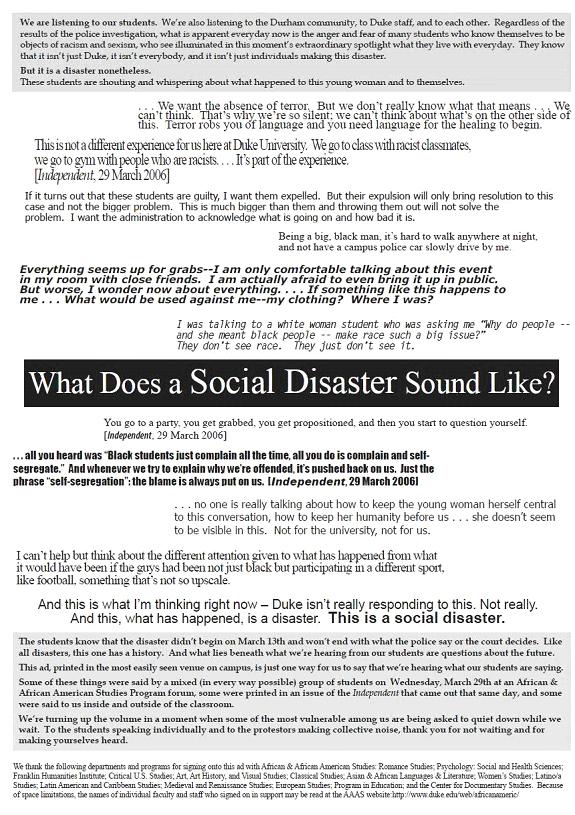
Strandberg recalls events of spring 2006, when “a boiling tsunami of faculty rage” culminated in the Group of 88’s ad; he now deems it “a mistake to launch this ad into so supercharged an atmosphere.” Strandberg partially excuses the Group of 88 on grounds that they were relying on Mike Nifong’s good faith. But that rationalization, he notes, can’t apply to the “clarifying” statement—when, after Nifong’s case had imploded, almost all of the Group chose to “republish their earlier statement, as though no second thoughts were necessary.” The “clarifying” statement, in fact, not only reaffirmed the Group of 88 ad. It also maintained that in spring 2006, they had wanted to thank protesters whose stated motivations were fighting “discrimination and violence,” motivations that the “potbanger” protesters with their “castrate” banner had claimed, and affirmed that the signatories would never apologize for their actions, as, indeed, they have not.

Strandberg concludes in the following manner: “Someone else paid for that exercise of free speech, namely the phantom students who might have become real Dukies with the help of that hundred million dollars. I believe in free speech as much as anyone, but I do hope we will all consider who pays for it if and when some similar situation again arises.”

This is a welcome, if belated, criticism of the Group’s extremism and its effects. It’s hard to know how much covering for the faculty—as opposed to covering for former SANE nurse-in-training Tara Levicy or ensuring that Richard Brodhead, Larry Moneta, and other senior administrators would never be cross-examined—accounted for Duke’s decision to settle. But given that the settlement explicitly shielded the faculty from individual lawsuits, it’s clear that protecting extremists in the ranks played some role in Duke’s legal strategy.

Other sections of Strandberg’s op-ed, however, are a little odd. Strandberg incorrectly suggests that payments to the falsely accused lacrosse players were $20 million each. (Bernie Reeves of Raleigh Metro, who Strandberg doesn’t cite, long ago reported the total settlement was in the neighborhood of $18 million, a figure I have no reason to dispute.) Strandberg argues that even half the actual amount, however, would have been too high, since “innocent men who have spent 15 to 20 or more years actually in prison have received less than a million.” Is Strandberg suggesting that Duke administrators or faculty or employees behaved maliciously in helping to send other “innocent men” to prison for 15 years? If not, the comparison makes little sense. Payments in such cases revolve not merely around the actual innocence of the accused, but around the misconduct of the state or other parties.

Was any settlement necessary? According to Strandberg, no. The university should have “quietly let the legal system do its work.” Why didn’t Duke take this course? As he notes a couple of sentences later, “there was too much talk from faculty and administrators of an inflammatory and legally liable nature.” In other words: Duke faculty and administrators were legally liable, and the university elected to pay rather than fight. That doesn’t seem like an unreasonable calculation.

A final oddity from Strandberg: he goes out of his way to say that he doesn’t “blame our President.” His grounds for such an evaluation? He recalls Brodhead “saying on television as the media were going hysterical, ‘The three captains tell me they are innocent.’” (Strandberg evidently doesn’t recall Brodhead saying about Seligmann and Finnerty that whatever they did was bad enough, or the President’s guilt-presuming letter to the Duke community in April 2006.) That said, Strandberg correctly recalls that no faculty publicly stood up for the presumption of innocence in spring 2006, though women’s lacrosse coach Kirsten Kimel did so.

All that said, and despite Strandberg’s very strange accounting of the nature of the legal harms faced by the three falsely accused players, it’s good to see someone point out that the Group of 88’s conduct had consequences.

Tuesday, January 14, 2014

Diversity, Inclusiveness, and Karla Holloway

A major theme of the blog has been the lack of academic accountability. Dozens of Duke professors rushed to judgment in the most public way possible, ignoring the academy’s traditional commitment to due process, as well as, simply, fundamental principles of fairness. Several of these professors, over the duration of the case, appeared to violate Duke policies. Yet there never was any indication that Duke disciplined, in any way, even one of its rogue professors. (Contrast their fate with that of Mike Pressler.) And, as the subsequent careers of Group of 88’ers Houston Baker (hired by Vanderbilt) and Grant Farred (hired and promoted by Cornell) demonstrated, it wasn’t simply Duke that had no interest in accountability.

In government or the corporate world, a scandal such as the faculty’s response to the lacrosse case almost certainly would have triggered some sort of inquiry. Such an inquiry would have addressed, among other matters, hiring policies. In the context of Duke, the question is obvious: did the obsession with “diversity,” a characteristic of Group of 88’er William Chafe’s tenure as provost (which ended in 2004) result in the hiring of an increasingly groupthink-oriented faculty, whose rush to judgment on the lacrosse case illustrated a broader closed-mindedness on issues of race, class, and gender? And did the faculty’s record in the lacrosse case suggest that Duke should think twice about its personnel priorities?

These were, of course, questions that Duke didn’t want to address, since doing so would have alienated powerful constituencies on campus. (Recall the fate of Larry Summers at Harvard.) Instead, the university has doubled down on its hiring patterns: if the lacrosse case occurred today, the Group of 88 would probably be the Group of 100. (Such a hypothetical statement probably would also contain a throwaway line about due process, to deflect criticism.)

The latest indication of hiring trends is an announcement from Duke that the Faculty Council that its meeting this week will be devoted to what a Duke press release terms a “discussion” about “diversity” in faculty hiring. Needless to say, neither intellectual nor pedagogical diversity appear to be on the agenda.

Four faculty members have been invited to “make short opening remarks to start the conversation,” under the heading of “diversity andinclusiveness” at Duke. The first professor listed? Group of 88 extremist Karla Holloway (who was back in the news this week defending her extremism on another front, championing the ASA’s anti-Israel boycott). Holloway will be followed by Kerry Haynie, who close followers of the case might recall as the professor who illustrated his conception of “inclusiveness” by sending a wildly intemperate, threatening e-mail to Steve Baldwin, the first Duke professor to speak up about the lacrosse players’ treatment by their university.

By this stage, no one should be surprised that the Group of 88 and their allies continue to be influential voices on personnel policy a Duke. Accountability, it seems, will never arrive in Durham. 

Tuesday, January 07, 2014

Harris-Perry, Race, & the Group's Legacy

In one respect, the lacrosse case was extraordinarily unusual: actions of campus extremists don’t often get much attention outside of campus walls. The national media doesn’t cover higher-ed ideological or pedagogical issues all that much; and when it does (as in the recent controversy over Title IX and sexual assault policies), it often covers the issue poorly. The behavior of the Duke faculty in the lacrosse case attracted so much attention largely for accidental reasons: the case itself was a media firestorm, and then the Group of 88’s inability or unwillingness to apologize for what they did seemed unjust.

Yet on the rare occasions when the world of higher-ed ideas does seep into the public consciousness, the result is an almost stupefied horror. The best recent example (about which I’ve written over at Minding theCampus) came when the American Studies Association formally endorsed a boycott of Israeli institutions of higher education—a flagrant violation of academic freedom that the ASA justified, in Orwellian language, as the protection of academic freedom. (The other rationale: according to the ASA president, describing the organization’s penchant for boycotts that allegedly promote human rights, “one has to start somewhere.”) 

The ASA move earned widespread rebuke from editorial boards, politicians, and more than 100 college presidents—the people at universities whose jobs depend on dealing with the public, and therefore are particularly sensitive about their schools looking like hotbeds of out-of-touch extremism.

The Group of 88 statement, and the ASA anti-Israel resolution, exemplify the pernicious effects of groupthink—the phenomenon best described by Mark Bauerlein in which the position regarding commonly-held beliefs shifts toward the most extreme perspective, because of a lack of dissenting viewpoints on campus.

Since academics of the anti-Israel or race/class/gender types have little influence outside campus (they have, of course, enormous influence on campus), their actions get noticed only by their colleagues or their school’s administrators. And since tenured and tenure-track jobs are so precious in today’s academy, very few groupthink-type academics leave the academy to take non-academic positions. Their ideas, it seems, are hermetically sealed on campus.

One of the very few exceptions to this pattern, however, is Melissa Harris-Perry, the MSNBC host who has been much in the news lately. Harris-Perry holds a Ph.D., from Duke, where she studied under William Chafe and Wahneema Lubiano, and is listed as a full-time faculty member in Tulane’s Political Science Department. As I’ve noted previously, Harris-Perry has a very close relationship with several members of the Group of 88 (Karla Holloway actually appeared on her MSNBC broadcast), and offered a full-throated (and almost comically misleading) defense of the Group of 88 in a 2011 book. The book, indeed, faithfully reflects the extreme views on issues of race, class, and gender prevalent on campus but largely absent anyplace else.

But not on Harris-Perry’s TV program. The host recently did a segment on the Romneys, in which she, and two guests, mocked a Romney family photo that contained the entire Romney family, including a child of color adopted by one of the Romney sons and his wife.

It’s possible to imagine a segment on Romney and family values that would comport to the public policy focus that ostensibly characterizes Harris-Perry’s program. (For instance: Romney values the importance of marriage and family personally, but campaigned on a platform to annul, via constitutional amendment, around 100,000 marriages nationally, and leave kids in those families without married parents.) But Harris-Perry wasn’t interested in content.

The segment triggered widespread condemnation—as much for its sneering tone as for its content. (National Review claimed, in a report denied by MSNBC, that the network had instituted new editorial checks on Harris-Perry’s scripts.) Harris-Perry subsequently apologized via twitter, accompanied oddly by a hashtag, followed by a tearful apology on her program. But she demonstrated no problem at all with the content during the broadcast itself. The apology, therefore, seemed more than a little forced.

The backlash against the Harris-Perry segment reflects the media’s (and the public’s) predictable horror at getting a first-hand taste how issues of race are too often viewed behind campus walls.

As for one of Harris-Perry’s mentors on the issue of race in America? Here’s Wahneema Lubiano, offering her insights while speaking a few months back at Duke's "National Dialogue on Race Day":


If you can work your way through the jargon, the basic Lubiano argument is that racism is inherent in the capitalist system, and that referencing black-on-black crime is racist.

While Harris-Perry remains a moderate by comparison, the Harris-Perry/Romney vignette, like the far more substantial Group of 88 statement and ASA resolution, should provide a tip-off to journalists that they might want to pay a little more attention to just how extreme campus discourse in some quarters has become.

Tuesday, December 17, 2013

Updates

A couple of notes:

(1) For those interested, I have a long piece at Minding the Campus examining the overall decline of due process involving campus allegations of sexual assault—and asking why colleges are so reluctant to treat rape what it is: a crime. In short, a combination of pressure from the Office for Civil Rights, a general indifference to due process by some administrators, and an aggressive attempt by campus ideologues to introduce a system that makes rape convictions easier explain the development.

(Update: I also have a shorter MTC piece on poor coverage of procedure in the media, including some Group of 88-like tweets from a Journalism professor.)

(2) An interesting item a few weeks ago from the Supreme Court. The Court declined to hear the appeal of a case called Martin v. Blessing, where the issues included what Justice Alito termed the “highly unusual” practice of a New York district court judge, Harold Baer, of setting racial and gender quotas for attorneys in class action cases. (Baer, it seems, would fit right in with the Group of 88.) The Court chose not to hear the appeal, but Alito penned an interesting opinion strongly condemning Baer’s practice, what Scotusblog’s Tom Goldstein described as “a warning shot that some anomalous practices should be stopped without the Court ever having to get involved.

Alito’s opinion was interesting for one other reason. The justice commented that, to the best of his knowledge, Baer was the only federal judge who demanded that law firms in class action cases before his court employ racial and gender quotas in “The uniqueness of this practice,” Alito wrote, “weighs against review by this Court, but the meaning of the Court’s denial of the petition should not be misunderstood.”

We’ll likely never know why the Supreme Court declined to hear the appeal of the 4th Circuit’s ruling to let Durham off the hook in the lacrosse civil suit. But it’s worth noting that Alito’s observation would seem to apply to the facts of the lacrosse case as well—it’s extremely rare, almost unprecedented, in recent years to have a prosecutor usurp control of a police investigation (with the cooperation of police higher-ups) and then manufacture evidence to obtain indictments, which were critical for his short-term political goals. Perhaps the Court simply concluded that since we weren’t likely to see a Mike Nifong again anytime soon, the “uniqueness” of the lacrosse case’s facts weighed against review.

That said, the denial left in place the deeply flawed 4th Circuit ruling, holding that at least in the circuit, no federal civil rights violation occurs when a prosecutor conspires with police to frame innocent people, provided that the police are candid in discussions with the prosecutor that no real inculpatory evidence exists—and the prosecutor obtains a grand jury indictment, even if the police mislead the grand jury about the nature of the evidence.

[Update, Fri., 9.47am: Those wishing a chuckle can examine the ravings of pro-Nifong crank Sidney Harr (whose Justice for Nifong committee roster includes convicted murderer Crystal Mangum). Harr and the Duke attorneys can battle it out between them.]

Hat tip: J.R.

Friday, December 13, 2013

Accountability

The post below reflects on the almost utter lack of media accountability regarding those who got the lacrosse case wrong. Selena Roberts is Exhibit A for the pattern--a figure who rushed to judgment and then has offered wildly misleading accounts of what she had written, apparently believing that readers can't read for themselves what she wrote in 2006.

A lack of accountability has been a major theme in the academic world, as well. The Group of 88 ad violated Duke procedures; the public statements of several Group members (plus Peter Wood) seemed to violate Duke's Faculty Handbook and Student Bulletin. Yet to the best of my knowledge, there never was any discipline against a Group member.

Perhaps one reason for this lack of accountability is that discipline would have needed to come from a deeply compromised figure himself, Richard Brodhead. The lacrosse case probably finished any chance of another university hiring Brodhead as president, but otherwise the man who reacted to the first two arrests by asserting of his students that whatever they did was bad enough has seen his career flourish.

The latest: The Carnegie Corporation recently conferred upon Brodhead an Academic Leadership Award (there were four recipients), designating him among the "exceptional leaders in higher education." Imagine if one fact in the lacrosse case had been reversed: that to prevail in the 2006 primary, Mike Nifong had needed white votes rather than black votes, and therefore had manufactured evidence against black Duke students, and then-President Brodhead, as he did in the lacrosse case, had joined the rush to judgment against his innocent students.

Does anyone believe that such a record would not have permanently (and appropriately) disqualified Brodhead from future prestigious academic leadership awards?

In American Thinker, Bernie Reeves has an excellent column on this issue, and takes to task a forget-the-past editorial hailing Brodhead from the N&O.

Friday, December 06, 2013

Selena Roberts: The Serial Misleader

The case involving Florida State quarterback Jameis Winston is probably the highest-profile sexual assault claim involving an elite college athlete since the lacrosse case. But the facts of the two cases have almost nothing in common.
  • The claim in the Winston case was one of acquaintance rape, his DNA was found on the accuser, and as soon as the DNA findings became public, his attorney admitted that Winston had sexual contact with the accuser. The lacrosse players’ attorneys, on the other hand, consistently denied any sexual contact—and no DNA links between them and false accuser Crystal Mangum ever were established.
  • In Tallahassee, the local police seemed to bend over backwards to accommodate Winston; in Durham, the local police (ranging from the DPD leaders, who turned the case over to Mike Nifong, ranging down to ex-Sgt. Mark Gottlieb) seemed to bend over backwards to frame the lacrosse players.
  • In Tallahassee, the college administration stood firmly behind Winston; in Durham, the reverse was true.
  • In the Winston case, the media coverage was generally accurate and avoided a rush to judgment; in the lacrosse case, the reverse held true--especially on the pages of the New York Times.
  • And, of course, there was no equivalent to the Group of 88 in Tallahassee.
Given these enormous differences, it would be a reach to draw much of a connection between the two cases. But Selena Roberts has never let anything like facts (or common sense) stand in her way. She embarrassed herself earlier this year in odd ruminations about Auburn. After disparaging the concept in her coverage of Duke, she suddenly purported to discover the importance of due process in Auburn—only to see several of the current and former players she had (allegedly) quoted claim that they didn’t tell her what she claimed they did, and only to see her main source, whom she had presented as almost certainly innocent, plead guilty to the crime.

So now, she’s back to doing what she does best—leveling a character assault against the lacrosse players, while whitewashing her own commentary from the period before the arrests. As part of a critique about the police response in the Winston case, Roberts reached back to Durham:

“In 2006, pitched against a political backdrop of elections, District Attorney Michael Nifong aggressively pursued rape charges against lacrosse players and falsified statements about evidence. The case against the players was dismissed and Nifong was disbarred. Nifong let himself be swept into a public tinder box of scenes from the party, including porn-style pictures taken on phones of an exotic dancer -- accuser Crystal Mangum -- and a disturbing email post depicting the skinning of strippers in an ‘American Psycho’ reference. This was in addition to irrefutable accounts of racial slurs and sodomy jokes at the party and past misdemeanors involving the team.

“As I noted in two opinion pieces for The New York Times, a no-crime, no-foul approach wasn't the only answer to the Duke scandal although it was the most popular one by the lacrosse team supporters. Folks can still inspect and debate a dehumanizing culture even though what happened at Duke didn't rise to a criminal case. I wrote in March 2007: ‘No one would want an innocent Duke player wronged or ruined by false charges -- and that may have occurred on Nifong's watch -- but the alleged crime and the culture are mutually exclusive. Some readers argue no one would have known about the lacrosse team's misogyny bash last year if not for the initial rape charges by the hired dancer. True, but that’s how we often discover what goes on behind the curtains: by a botched break-in, through a door left ajar.’”

It’s curious that Roberts writes that she penned “two opinion pieces for The New York Times.” Actually, she wrote three. Two of her columns, as she noted, focused on attacking the players’ character. Those columns came in April 2006—after, contrary to widespread expectations, it was revealed that there were no DNA matches between Mangum and the lacrosse players, strongly suggesting that her story, as described, could not have occurred—and in March 2007, after Nifong’s case had utterly collapsed.

But a character-only approach wasn’t Roberts’ initial take. I wonder, therefore, why Roberts didn’t ask “folks” to review the first column she wrote on the case, published in late March 2006. Indeed, I wonder why she didn’t even mention that column. That’s the item in which she—based solely on what Nifong and Mangum were saying—unequivocally asserted that “something happened March 13” that “threatens to belie [the players’] social standing as human beings.” She compared the players’ behavior to that “of drug dealers and gang members engaged in an anti-snitch campaign.” She praised the “heartening” protests of the potbangers—people, it’s worth remembering, who carried signs reading “Castrate” and “Measure for Measure.” She falsely stated that none of the players “have come forward to reveal an eyewitness account.” She falsely contended that a “court document” described the accuser as “the victim of a hate crime.” She noted that the accuser was “reportedly treated at a hospital for vaginal and anal injuries consistent with sexual assault and rape.”

This sort of writing didn’t exactly feature a recognition that “the alleged crime and the culture are mutually exclusive.” It did precisely the opposite, by analyzing the lacrosse players’ character (in what turned out to be a wildly misleading fashion) solely for the purpose of trying to explain why the players had not turned in their teammates who had committed the rape. Comparing college students to drug dealers or gang members doesn’t scream a respect for presumption of innocence. Does Roberts believe that no one who reads her work has access to Lexis-Nexis or Proquest? Why, then, would Roberts attempt to mislead about the thesis of her columns?

While Roberts has “folks” assuming the worst about the lacrosse players’ character (all of them, in Roberts’ world, appear to be judged solely on a portrayal of the party that some didn’t even attend and the overwhelming majority didn’t plan, with no discussion of whether the party was in any way typical of tasteless spring break activities by many college students, and a convenient use of the plural to describe events at the party), examine how Roberts describes the criminal case.

Most important, Roberts still can’t bring herself to label the lacrosse players as innocent. (“The case against the players was dismissed.”) So does she believe there was some evidence to substantiate the charges? If not, why the reluctance to identify the falsely accused players as AG Roy Cooper did, as actually innocent?

As for Nifong, he almost comes across as a good guy—“swept into a public tinder box” (he had no choice!) as he “aggressively pursued rape charges” (what’s wrong with that?). So what did Nifong do wrong? Roberts can only bring herself to devote four words: the disgraced DA “falsified statements about evidence.” Actually, he concealed evidence. And he ordered police to violate their own procedures to produce inculpatory evidence. And he violated myriad ethical procedures. And he lied, in court, to a judge. But including such offenses would have distracted from Roberts’ agenda.

After all, some lacrosse players (like hundreds of other Duke students, thanks to a then-secret agreement between Duke and Durham) had “misdemeanors.”

Monday, November 25, 2013

Mangum, Murder, and the Los Angeles Times

The 2nd-degree murder conviction of Crystal Mangum has, understandably, brought the lacrosse case back into the news; if Mangum hadn’t falsely accused three people of raping her, and if the local prosecutor hadn’t violated all sorts of rules to keep her story alive, and if dozens of Duke faculty hadn’t published an ad that among other things vouched for Mangum’s credibility, it’s unlikely many people outside the Triangle would care much about Mangum’s latest brush with the law, even if this time she managed to kill Reginald Daye.

For the most part, reports on Mangum’s conviction responsibly recapitulated lacrosse case events, given space limitations.

Perhaps the best positioning of the case came from Georgia Parke in the Duke Chronicle: “Mangum previously gained notoriety after accusing three 2006 Duke lacrosse players of raping and kidnapping her. The players were eventually found innocent and Mangum's lawyer and former Durham District Attorney Mike Nifong was disbarred for perjury and violating professional conduct.

Even the normally biased Herald-Sun chose a wholly neutral, appropriately short, and accurate summary: Mangum drew national headlines in 2006 when she falsely accused three members of the Duke University lacrosse team of raping her at a party near East Campus.

The BBC strayed a little closer to the politically correct approach: eight of the article’s fourteen paragraphs dealt not with Mangum’s killing of Reginald Daye but instead with the lacrosse case. And some of that description wasn’t accurate; the BBC claimed that Mike Nifong “resigned following an ethics trial investigating whether he had broken rules of professional conduct in the case.” Of course, the ethics proceeding did more than investigate—it found Nifong guilty on 27 of 32 counts, and disbarred him.

Nonetheless, the BBC also conceded that the initial assumptions about “race, class and gender elements . . . were turned upside down [except among the Group of 88] when all charges against the three students were dropped by North Carolina’s attorney general, who cited significant inconsistencies between the evidence and various accounts given by Mangum.”

Then, almost as a counterbalance to this overall record of fairness, there’s Soumya Karlamangla of the Los Angeles Times. Karlamangla, a Cal-Berkeley graduate, came to the Times after serving as a web producer intern and a health reporter intern for papers in San Francisco and Portland—and as an “editorial intern” for The Nation. Nation editorial interns, needless to say, tend not to be card-carrying members of the Federalist Society.

In what purported to be a straight news article, Karlamangla devoted 12 of her 15 paragraphs to the lacrosse case; Daye got one mention. And she framed the article in a manner that suggested a desire to relitigate the collapse of the race/class/gender narrative and even, to some extent, the facts of the case. Her overall portrayal of the case read as if it came from a Group of 88 press release: “The case captured the nation’s attention, exposing racial and socioeconomic divides not just at the elite university, but across the country.”

The race angle: Mangum “enrolled at the historically black North Carolina Central University, and the three men accused were white and attended a prestigious private university that was not integrated until the 1960s.”

The class angle: “While Duke typically attracts students more familiar to schools in the Northeast, its Southern home in Durham is made up of mostly blue-collar workers. As cited frequently by the media during the court proceedings, the yearly tuition at Duke at the time was about $43,000, while the 2000 census put the the [sic: did anyone edit this article?!] median household income in Durham at $41,160.”

Meanwhile, Karlamangla’s description of the actual events of the lacrosse case leaned heavily on the give-and-take of court filings or defendants’ statements, rather than on neutral inquiries such as the AG’s investigation or Nifong’s ethics proceedings. Indeed, while she could find space in her 15 paragraphs for Durham’s median household income 13 years before the murder conviction that sparked the publication of the article, Karlamangla couldn’t bring herself to mention that the State Bar conducted an ethics inquiry into Nifong’s conduct and found him guilty of 27 of 32 counts. The piece merely mentioned that Nifong was disbarred without explaining how or why.

Karlamangla then presented events of the case with action verbs (emphasis added below) all but designed to invite the reader to doubt: “The defense claimed” Nifong ordered a procedurally improper photo array. (Did he?, a reader might wonder.) “The Duke players maintained they were innocent.” (Were they?, a reader might ask.) While Karlamangla quoted from AG Cooper’s press conference, she pointedly did not include Cooper’s statement that the players were innocent—easily the most newsworthy item from his remarks. But the L.A. Times reporter found space to pass along that even as evidence of her lies accumulated, Mangum “insisted some sort of sexual assault had taken place.”

If Karlamangla wants to publish an op-ed in The Nation defending the framing of the case by the Group of 88 and itsallies, she’s obviously free to do so. But the L.A. Times should be embarrassed for allowing her item to run as a news article. 

Sunday, November 17, 2013

Updates from Durham

[Update: Mangum was found guilty of 2nd-degree murder, and sentenced to a minimum of 170 months (14.2 years) in prison.

The Chronicle reports that Mangum's attorney asserted that his client's disastrous decision to testify in her own defense (see below) came against his advice.

The paper has no comment from any member of the Group of 88, nor have I seen any comments elsewhere on the web from any Group members. Presumably few if any of the Group continue to find Mangum credible, but it's worth reiterating that all except Arlie Petters have not in any way distanced themselves from their 2006 statement.]

Mangum has taken the stand in her own defense, and WRAL has the video. Cross-examination starts at the 46.30 mark.

Mangum's basic argument: she's telling the truth; and various police officers, neighbors, friends were all lying; and videos and photos that don't corroborate her version of events are for inexplicable reasons all inaccurate.

Recall: this is the person to which, in different ways, Mike Nifong and the Group of 88 attached their public reputations. Recall: this is the person whose allegations the Group of 88 deemed credible, to the extent they were willing to publicly affirm that something "happened" to her, based solely on her version of events, as presented by police and Samiha Khanna.

--------------------------------------------------------------------------

The oft-delayed murder trial of Crystal Mangum is underway in Durham. (WRAL has been live-streaming the proceedings.) Testimony in the first two days has featured evidence of Mangum trying to mislead police about her name—Marcella Mangum was the preferred choice—and (as she did in the lacrosse case after police were called to Kim Roberts’ car) her going limp when handcuffed by police.

A ruling by the judge presiding over the case that prosecutors could introduce evidence of Mangum’s previous arrest—in which she allegedly tried to get a knife to stab her then-boyfriend, Milton Walker—makes a conviction likely. But, then again, this is Durham.

As expected, the Supreme Court declined to hear the appeal filed by Bob Ekstrand on behalf of his three clients. This decision was all but certain once the Court declined to hear the appeal from the falsely accused players.

Limited claims against ex-officers Gottlieb and Himan (from the falsely accused players) and against Duke (from the three former players represented by Ekstrand) are the only remaining matters of civil litigation arising from members of the 2006 team.

There is, however, one potential civil suit that could expose items related to the case. The Herald-Sun has reported that Ekstrand, who’s representing former DPD Sgt. John Shelton (who’s now working for the Durham Co. sheriff’s office), has threatened a suit against Durham for its mistreatment of Shelton.

Ekstrand alleges that the DPD retaliated against Shelton because Shelton—apparently alone among Durham police officers—from the start doubted the veracity of Mangum’s tall tales in the lacrosse case. In another department, Shelton’s prescience would be grounds for praise. But, then again, this is Durham.

Monday, October 28, 2013

Accountability and Pre-Exising Biases

The other day, I came across an item in my Twitter feed from Salon’s Soraya Chemaly. The article, entitled 5 Ways Sexual Assault Is Really About Entitlement, contained this remarkable assertion about due process and false accusations: “the likelihood of being falsely accused of rape are [sic] no different from that of being falsely accused of any other crime. And women are far more likely to be raped than men are to be falsely accused. The insistence on treating the two as equally prevalent issues is ….an entitlement.”

This sort of extreme victims’ rights rhetoric was associated in the early 1990s with the far right, and is almost never (and for very good reason) seen coming from mainstream liberals, much less from an activist publication such as Salon. Imagine the (appropriate) outrage if a left-of-center publication published something along the lines of the following: “The likelihood of being falsely accused of robbery in urban areas is no different from that of being falsely accused of any other crime. And accusers are far more likely to be robbed than urban African-Americans are to be falsely accused.”

The piece focused, however, on the college environment. Regarding male Division I athletes, Chemaly wrote, with an embedded link, that “while male student athletes make up 3.3% of the U.S. college population, they are responsible for 19% percent of sexual assaults and 37% of domestic violence cases on college campuses.” Note that the sentence was delivered in the present tense (“make,” “are”).

It turns out, however, that Chemaly misrepresented her source, a 2012 Dartmouth Law Journal article by Edward Sansone. Here’s how Sansone described the study [my emphases added]: “A study of sexual assaults at thirty major Division I universities over a three-year period in the early 1990’s came to the conclusion that male student-athletes, compared to the rest of the male population, are responsible for a significantly higher percentage of sexual assaults reported to judicial affairs on the campuses of Division I universities. The survey found that while male student-athletes make up only 3.3 percent of the college population at the surveyed institutions, they were responsible for 19 percent of sexual assault cases and 37 percent of domestic violence cases.”

Chemaly basically copied Sansone’s second sentence (without including quotation marks), but adjusted it in two ways. She changed Sansone’s “were” to “are,” and changed Sansone’s “college population at the surveyed institutions” to “U.S. college population.” Copying word-for-word might have been dismissed as incidental plagiarism, perhaps forgivable because Chemaly included a link. But Chemaly—a self-described “activist and writer of feministy things”—didn’t simply copy Sansone’s words. Instead, she copied most of them but then altered a few of them to make it appear that the survey was current (instead of 20 years old) and comprehensive (instead of only 30 institutions). That sort of behavior is unethical.

What of the survey that Sansone cited? Given that his piece (which calls for using Title IX to crack down on what he sees as disproportionate sexual misconduct by male student-athletes) appeared in a law journal article rather than in Salon, it might be assumed that higher editorial standards would apply. Yet Sansone’s sole source for his claim is an organization called the National Coalition Against Violent Athletes. The group’s website contains the following line, which formed the basis of Sansone’s claim: “A 3 year study shows that while male student-athletes comprise 3.3% of the population, they represent 19% of sexual assault perpetrators and 35% of domestic violence perpetrators.” Yet the website doesn’t contain the actual (20-year-old) study itself. And the group’s assertion that the highly-regarded Northeastern University Center for the Study of Sport and Society “refused to publish these statistics” doesn’t exactly provide reassurance about the quality of the data.

To review: a one-sentence summary of a study on an activist group’s website was then picked up in a law journal article (whose author, at least according to his footnotes, does not appear to have examined the study itself). The law journal article’s item was then picked up by Salon, which altered its meaning to make it seem as if the study was new rather than 20 years old.

Sansone’s article, it turns out, had another item directly connecting to the topic of this blog. Here’s his lede sentence—opening the article’s second paragraph after a first-paragraph vignette. “The dark secret that many male college athletes carry is that they are one of the main perpetrators of domestic violence and sexual assault on college campuses.”

For this extraordinary claim, Sansone (in an article published out of an Ivy League college) cited a grand total of one source, a 2006 article by Jake Tapper and AudreyTaylor. (While Tapper is now a reliable barometer of conventional wisdom in Washington, he worked at Salon before moving on to ABC.) Here’s how Tapper and Taylor opened their piece, entitled “Is Jock Culture a Training Ground for Crime?”:
A year before Duke University’s lacrosse team became the center of scandal, administrators and the school's athletic director were warned that the players had demonstrated "boorish" behavior.
According to news reports, 15 of the team’s 47 players have court records for drunken and disorderly behavior. [The ABC duo was writing before “news reports” revealed the Duke-Durham agreement to maximize charges against all Duke students who engaged in underage drinking or the type of disorderly behavior that likely wouldn’t result in an arrest of an NCCU student.] Two were arrested today on charges of raping and kidnapping a 27-year-old woman at an off-campus party.
The alleged incident may be part of a larger problem, experts said, of athletes whose attitude includes a sense of entitlement that manifests itself in crude and even lawless behavior.
Tapper and Taylor then went on to cite . . . the very same study used by Sansone and misrepresented by Chemaly.

But, of course, the “alleged incident” that Tapper and Taylor speculated “may be part of a larger problem” never occurred. Yet rather than Crystal Mangum’s false charges and Mike Nifong’s unethical behavior discrediting Tapper and Taylor’s article, Sansone had no problem citing it—and citing it for his law journal article’s key claim—as if Tapper and Taylor’s piece provided some sort of special insight. And the journal’s editors had no problem in clearing the article and the citation.

How can a crime that never happened be used to demonstrate a “larger problem” whose relevance to the case would make sense only if the crime had actually occurred? For true believers, it seems, there’s no reason to come to grips with how the initial rush to judgment in the lacrosse case requires some reconsideration of the broader assumptions about due process in campus sexual assault cases embedded in both the Sansone and the Chemaly items.

Friday, October 11, 2013

Reflections on the Supreme Court Move

As I noted Monday, the Supreme Court has declined to hear the falsely accused players’ appeal of the 4th circuit’s dismissal of most of their case. On the one hand, the decision wasn’t surprising: (1) the Court doesn’t take many appeals; and (2) the politics of this appeal were particularly difficult, since judicial liberals tend to be more favorably inclined to civil rights claims—but as Judge Gregory demonstrated at the 4thCircuit, it appears that at least some judicial liberals are extremely hostile to this particular group’s civil rights claims.

On the other hand, however, the decision was extremely disappointing and at least a little bit surprising, in two respects. First, it’s not as if the Court is overflowing with critical cases this term—its first week of the session featured two cases (Madigan and Burt) that never should have reached the Court in the first place.

Second, it’s worth reiterating the breathtaking precedent that the Court allowed to stand. From here on out in the 4th Circuit, there’s no federal cause of action against a town or city when the municipality’s police department: (a) turns over a police investigation to a local prosecutor; and (b) stands aside as that prosecutor and police officers manufacture evidence with which to indict innocent people for a crime that never occurred—provided that (a) the police are perfectly candid with their co-conspirator (the prosecutor) that there’s no evidence on which to base the indictment; and (b) a grand jury returns indictments, even if, as occurred in the lacrosse case, the indictment resulted from misleading or outright false testimony from one of the police officers.

The dismissal means that a host of questions are likely to remain permanently unanswered. That list includes the following:

(1) Who in the police department (or city government) allowed Mike Nifong to assume personal command of the police investigation?

(2) What precise interactions occurred between the Durham and Duke police departments?

(3) What precise interactions occurred between Nifong, the DPD, and former SANE-nurse-in-training Tara Levicy? (Levicy, by the way, is currently working in my home state of Maine, where she notes her particular interest in “women’s health.”)

(4) Who gave Cpl. David Addison the information that he used for his fact-free, race-baiting March 2006 public statements? Why was he not subsequently disciplined for his statement?

(5) Who in the DPD made the decision to involve Sgt. Gottlieb in the investigation?

(6) Why was Sgt. Shelton removed from any involvement in the investigation?

(7) Did any backchannel discussions occur between Durham authorities and the Duke administration?

Monday, October 07, 2013

Supreme Court Update

Scotusblog reports that the Supreme Court announced this morning that it would not hear the appeal in the falsely accused players' case. I'll have some more thoughts later today.

Friday, September 13, 2013

Supreme Court News

Attorneys for the three falsely accused players have filed their reply to the City of Durham’s brief, the final stage before the Supreme Court will decide whether to hear the appeal.

A brief reminder on how we got here: a three-judge panel of the 4th Circuit essentially sided with Durham, dismissing all but one state claim on the grounds that the police were honest with Mike Nifong (acting, at the time, in his improper capacity as supervisor of the pre-indictment police investigation) about the evidentiary weaknesses in Crystal Mangum’s wild allegations; and a grand jury (acting, in the case of Sgt. Gottlieb’stestimony, on an erroneous recapitulation of the facts) returned indictments, breaking the chain between the police misconduct and the arrests.

The falsely accused players appealed to the Supreme Court, citing three lines of argument. First, their brief noted that several other circuits had held that civil liability ensued for pre-indictment police misconduct, even when a prosecutor secures an indictment; and that the Supreme Court, in oral arguments for a case ultimately settled on other grounds (Pottawamie County), appeared to agree. Second, the petition suggested that the 4th Circuit had strengthened a circuit split on the question of whether police officers fabricating evidence during an investigation violates the Constitution. Finally, the players’ filing noted that even on its own terms (that an indictment wipes clear the city’s federal liability for everything that occurs before) the 4th Circuit’s ruling made no sense, given that the improper conduct by city employees (the harassment of Elmostafa, Sgt. Gottlieb’s magical “notes”) came after indictments occurred.

Durham countered by reiterating its traditional line of argument, which was previously summarized by Judge Beaty: that “no provision of the Constitution has been violated, and that no redressable claim can be stated, when government officials intentionally fabricate evidence to frame innocent citizens, even if the evidence is used to indict and arrest those citizens without probable cause.”

The players’ reply opens with this wonderful line: “In a brief in opposition that is long on invective—and, for that matter, just plain long—[Durham] respondents seek to hold petitioners to an impossible burden.” The Durham argument amounts to a suggestion that because the Supreme Court has never before considered a case precisely like the lacrosse case (was there such a case?), the Court should allow the 4th Circuit decision to stand. But the Supreme Court often hears cases that involve previously-unseen facts; the issue, as the reply brief correctly notes, is whether this case illustrates a split between the federal circuits on an important issue. And Durham never really argued otherwise.

The reply brief makes three central points:

First, the brief dismisses Durham’s efforts to distinguish its conduct from cases in other circuits where governmental agents were held liable for federal violations. The city had claimed that all of these cases differed from the lacrosse case because in each of them, police had not fully shared information with the prosecutor, but had instead misled or withheld evidence from the prosecutor, which the Durham Police did not do. But the players’ reply brief observes that the circuits whose opinions are in question (the 2nd and 6th) did not, in fact, make such a hard and fast distinction, and certainly did not suggest that facts like the lacrosse case—in which police conspired with a prosecutor acting as their de facto supervisor to produce evidence to frame innocent people for a crime that never occurred—should be shielded from constitutional claims. Indeed, the brief notes that one case on which Durham relied (Wray v. City of New York) actually appears to back the players’ position, not Durham’s, on this point.

Second, the brief reasons that the arguments in Durham’s filing “do not pass the smell test” regarding the city’s attempts to differentiate its behavior from earlier cases in which federal courts had found that “the fabrication of evidence at the investigation stage, standing alone, gives rise to a constitutional violation.” For instance, the brief observes, the City had tried to distinguish its behavior from a 1st Circuit case, Limone v. Condon, on grounds that the plaintiff in Limone was falsely imprisoned using fabricated evidence, while the lacrosse players were only falsely arrested, detained, and would have gone to trial but for a 9-8 decision by the State Bar to bring charges against Nifong. Yet the case that Durham believes helps in cause in fact says that “if any concept is fundamental to our American system of justice, it is that those charged with upholding the law are prohibited from deliberately fabricating evidence and framing individuals for crimes they did not commit.” Durham thinks that Limone helps its cause?

Finally, the brief cleverly uses its rebuttal of Durham on this point to remind the Court that the behavior of the lacrosse case was, in a way, more egregious than the cases cited by either side. It’s true, the brief notes, that most of the cases involving constitutional claims based on police misconduct involved the police behaving improperly toward the prosecutor. But that’s because, in each of these cases, the prosecutor wasn’t himself involved in a conspiracy with the police to fabricate sufficient evidence to secure indictments. It’s not as if any circuit other than the 4th Circuit has held that this sort of record should be shielded from constitutional challenge as long as the prosecutor managed to fool a grand jury into returning an indictment. For instance, the brief points to a 5th Circuit case, Hand v. Gary, to explain that “a prosecutor’s intervening action ‘remain(s) tainted by the malicious actions of the government officials’ either if the officials ‘join in malicious prosecution by prosecutors’ or if the officials’ malice ‘results in an improperly motivated prosecution without probable cause.’”

The Court does not accept many cert grants. But if the justices decline to hear this case, and thereby allow the 4th Circuit ruling to stand, they’ll be saying that a victim of a police-prosecutor conspiracy to create evidence to indict the victim without merit has no federal constitutional claim in six states. That would be a terrifying precedent.

Tuesday, August 27, 2013

Litigation Matters

[Update, Friday, 1.34pm: According to WTVD-11, the latest Mangum lawyer has withdrawn from her case, citing a conflict of interest. Note, by the way, the radically different (and more accurate) way WTVD summarizes the case than that offered by the comically biased Herald-Sun. Two mentions that the Mangum allegations were false, and no bizarre insinuation that charges were dismissed because of national media coverage.]

[Update, Tues., 4.04pm: Mark Anthony "thugniggaintellectual" Neal brings news that Group of 88 leader Wahneema Lubiano--or, in his words, the "brilliant" Wahneema Lubiano--now has a twitter account.]

A few updates on litigation matters.

The City of Durham has filed its response with the Supreme Court, urging the Court not to hear the appeal filed by attorneys for the falsely accused players. The basic argument was the same that the city adopted (successfully) before the 4th Circuit—that as long as Durham police officers didn’t withhold information from Mike Nifong, and as long as a grand jury came back with an indictment, even if that indictment was based on (in the case of Sgt. Gottlieb) inaccurate testimony about Crystal Mangum’s myriad stories, it doesn’t violate the Constitution for a city to: (1) allow an elected prosecutor to supervise an ongoing, pre-indictment police investigation; (2) then have its police officers work with that elected prosecutor to manufacture evidence implicating innocent people in a crime that never occurred. As long as the police didn’t lie and the grand jury indicted, according to Durham, there was nothing actionable in how the city behaved.

The City of Durham: civil liberties capital of America.

On matters related to civil liberties, I have a piece up at Minding the Campus on the remarkable (and deeply disturbing) reaction of UNC administrators to the recently-passed law boosting accused students' legal rights. (Jane Stancill also obtained some jaw-dropping quotes at the N&O.) As often is the case, defenders of the academic status quo essentially prove the critics' case.

The false accuser, meanwhile, was back in the news—the Herald-Sun reports that her latest attorney, Scott Holmes, is seeking to recuse himself from the case, citing a conflict of interest. The precise nature of that conflict was left very murky by Holmes; he pointed to a colleague whose client was in an “adverse position” to Mangum.

Perhaps the most interesting aspect of the H-S article came in its description of Mangum’s role in the lacrosse case: “Mangum is the woman who accused Duke lacrosse players of raping her after they hired her to strip at their party. After national media coverage about the case, the charges against the lacrosse players were dismissed.”

A casual reader wouldn’t know: (a) that the lacrosse players were declared innocent, and Mangum’s allegations were false; and (b) that the declaration resulted not from “national media coverage” but from an attorney general’s investigation.

At least the distinguishing of the “national media,” while ignoring the excellent work of the N&O and the Chronicle, makes clear that the Herald-Sun‘s coverage played no role in bringing about the exoneration.

Speaking of Mangum, John Tucker from the Independent did a long article on the false accuser’s stoutest defender, Justice for Nifong Committee chairperson (and, at this point, sole member?) Sidney Harr. (The cover art, oddly, portrays Harr as a superman carrying Lady Justice.) While Harr is one of the strangest people to appear in the case, I doubt that before this article appeared anyone realized just how strange Harr actually is. To quote from Tucker’s piece, which brought to the fore a host of previously unknown items about Harr, at least in the Triangle:
Despite Harr’s reputation as a public gadfly and Nifong’s biggest supporter, most people know little about the man and his motivations. It is not well-known that after going broke in California, he bounced around with his wife, leaving a trail of sensational lawsuits marked by paranoia. Between 1985 and 1997, Harr was a party to at least 27 lawsuits in California, Arizona and Ohio. He sought hundreds of millions of dollars in compensation for civil rights violations, employment discrimination and fraud.
“He confidently moved from city to city wrecking people’s lives and careers,” said Dwight James, a physician who runs a practice in Porterville, Calif.

It might be suggested that a man who spent years “wrecking people’s lives and careers” is exactly the sort of character Mike Nifong deserves as chairperson of his exoneration committee.

Tucker also managed to obtain a rare comment from the long-silent Wahneema Lubiano, architect of the Group of 88 proclamation—which falsely claimed official endorsement from five academic departments—that something “happened” to Crystal Mangum. To the best of my knowledge, Lubiano’s last interview with a mainstream journalist about anything related to the case was a highly sympathetic one from ESPN, after which reporter John Pessah nonetheless concluded, with extraordinarily vivid imagery, that his subject, Lubiano, “knew some would see the [Group of 88] ad as a stake through the collective heart of the lacrosse team—but drove the stake anyway.

Tucker chatted with Lubiano about “issues such as race, class and privilege—ideas never fully reckoned with during the lacrosse chaos.” Not really: it’s hard to argue that these issues—addressed non-stop by the Duke faculty—were never fully reckoned with in the lacrosse case, unless the argument is that those who so badly misjudged the case were never held accountable.

In any event, according to Tucker, here’s the new Lubiano take on the person whose version of events she once uncritically accepted:
Mangum symbolizes a host of uncomfortable ideas, like mental illness and social order, according to Wahneema Lubiano, the associate chairwoman of Duke University’s Department of African & African American Studies. “And frankly we should be uncomfortable,” she said, “but the discomfort should take a different form than collectively rolling our eyes.”
I’d agree with Lubiano that we should be uncomfortable—uncomfortable about Duke faculty members who disregarded their obligations under the Faculty Handbook and then refused to take responsibility for their actions. (By the way: during the case itself, neither Lubiano nor any other member of the Group of 88 ever publicly suggested, or even hinted at, the fact that Mangum was mentally ill.)

Finally, an odd item from the article:
As is his longstanding media policy, Nifong declined to comment for this story. He and Harr have met only a handful of times, but there are parallels between them. Both men tried to take on Duke University, and lost. Both were rebuked by the State Bar. Both declared bankruptcy. Both staked their identities on fighting injustice.
As portrayed by Tucker, Harr comes across as delusional, an almost sad character: it’s entirely possible that he sees himself as a champion of justice, and that he actually believes that Richard Brodhead’s Duke was actually part of a conspiracy to victimize, rather than lionize, Crystal Mangum.

But Nifong—a man who broke myriad ethics rules and tried to manufacture evidence to imprison innocent people, all in an effort to advance his political career—cannot possibly be portrayed as someone who staked his identity on “fighting injustice.” Moreover, Nifong never took on “Duke University.” He took on Duke students, a big difference. Duke University, by contrast, was one of his biggest allies. It employed his star witness (former SANE-nurse-in-training Tara Levicy). Its president repeatedly took actions that communicated to the world a belief in the players’ likely guilt (such as cancelling the Georgetown game while the players were on the field, or publicly remarking that whatever Seligmann and Finnerty did was “bad enough). And, of course, for the critical first weeks of the case, the public voice of Duke’s faculty was the rush-to-judgment sentiment of Wahneema Lubiano and her 87 pedagogical allies.

I nonetheless hope people read the Tucker piece. In a case filled with bizarre characters, Harr might well be the most bizarre—which is saying something.

Friday, August 16, 2013

An Update from St. Joe's

Over at Minding the Campus, I’ve analyzed two federal lawsuits filed by male students found culpable of sexual assault after college procedures (at St. Joe’s and Vassar) that failed to provide much, if any, due process. Today is the deadline for the defendants in the first suit, filed by Brian Harris against St. Joe’s and his accuser, Lindsay Horst. Horst’s attorney, Daniel Rucket, filed a reply yesterday urging dismissal of all claims in Harris’ lawsuit. (You can read the filing here; I’ll be analyzing the St. Joe’s reply when it comes in, at Minding the Campus.)

Rucket does not deny that Harris’ complaint accurately described the (wildly tilted) judicial “process” that St. Joe’s employs, which is “based on guidance from the United States Department of Education, Office for Civil Rights (‘OCR’).” (This guidance, of course, came from the 2011 “Dear Colleague” letter, which asserted that federal law requires universities to change their procedures in various ways to make it easier to find students culpable of committing sexual assault.) Rucket concedes that St. Joe’s policies prohibited Harris, like all accused students, from having an attorney represent him at the disciplinary hearing, or attend the hearing in any way. And Rucket observes that, as Harris’ complaint noted, St. Joe’s has structured a procedure in which“[c]ivil or criminal rules of procedure and evidence do not apply,” while allowing the school to consider hearsay.

But according to Rucket’s filing, these are all unobjectionable things, beyond the scope of the federal courts to review. It’s quite remarkable to see a private lawyer—much less a “Pennsylvania Super Lawyer,” as Rucket’s website notes he has been every year since 2010—celebrating the fairness of a process in which the accused is denied the right to counsel.

Intriguingly, seeking to protect Horst against a claim of defamation, Rucket subsequently claims that in Pennsylvania “quasi-judicial proceedings . . . include school administrative hearings and statements made that lead to such hearings.” In other words: the St. Joe’s disciplinary tribunal should be viewed as “quasi-judicial,” even though it denies accused students the right to counsel, doesn’t guarantee them the right to cross-examine their accuser, doesn’t follow civil or criminal rules or procedure, and allows hearsay.

Rucket argues that Harris has no legal claim to challenge the judgments made by St. Joe’s, no matter how unfair the university’s procedures. “Harris is attempting improperly to relitigate the finding of the [St. Joe’s tribunal] that Harris sexually assaulted Jane Doe, in Federal Court, which is not allowed.” Why? In part, because “there is a presumption of fairness in administrative proceedings which favors administrators.” Moreover, according to Rucket, federal courts should respect an assertion in the St. Joe’s handbook that “[s]ubsequent reviewers shall not determine anew whether there was a Community Standards violation.” How convenient as a way to shield any university from challenges to potentially unconstitutional behavior.

This line of argument, if upheld by the court, would render beyond judicial review the assault on due process for all college students accused of sexual assault, and Rucket asserts as much. At least with regard to students at private colleges, he claims that as “Harris’ guilt for the sexual assault has therefore been conclusively and finally decided by SJU at the [disciplinary] hearing,” a federal jury “cannot reconsider or alter that decision.” The power this line of interpretation gives to college disciplinary processes is extraordinary: once a private college brands a student a rapist, no matter how unfair the process the college utilizes, the student can never challenge the finding, as long as the college followed whatever unfair procedures it utilizes in sexual assault cases.

Absurdly, Rucket claims that the power he gives to the St. Joe’s process to avoid court challenge is equal opportunity: If, he notes, St. Joe’s had found that Horst hadn’t been sexually assaulted, and she had then filed a “lawsuit against Harris and SJU, Harris certainly would be making this exact same argument, that the findings of the [disciplinary tribunal] cannot be relitigated.” First: this claim will certainly come as news to the anti-due process “activists” glowingly profiled in the New York Times and Inside Higher Ed’s Allie Grasgreen, who have urged federal intervention to effectively relitigate a variety of campus decisions they opposed. Second: as Rucket well knows, even if Harris had been cleared by St. Joe’s, Horst still could have filed a criminal complaint with the police. Harris then could have been tried and, if convicted, sued.

In any event, the filing notes, even without the specific wording in the St. Joe’s handbook, Harris would have no case. Before choosing to attend St. Joe’s, Harris knew (or should have known) the university’s procedures for handling sexual assaults. Courts, Rucket suggests, can’t now intervene. (Oddly, the only two cases that Rucket cites to bolster his point come from Pennsylvania state courts; he doesn’t explain why these decisions should be treated as precedential in a federal lawsuit.) If Harris didn’t want to subject himself to the anti-due process approach used in his case, he shouldn’t have matriculated at St. Joe’s. But given that the “Dear Colleague” letter applies to virtually every university in the country, under Rucket’s viewpoint, the only realistic choice for a male student who wants to ensure that he has due process if accused of sexual assault would be not to attend college at all.

Finally, Rucket challenges Harris’ claim that he lacked an opportunity to cross-examine Horst, but, in any case, deems the matter irrelevant—in part because St. Joe’s doesn’t promise such a right and in part because the “Dear Colleague” letter “strongly” discourages granting such a right. To the best of my knowledge, this is the first time perhaps the most objectionable aspect of the “Dear Colleague” letter—its urging schools to set up procedures that deny an accused student the right to confront his accuser—has been cited, positively, in a legal filing.

Beyond legal arguments, the filing also provides Horst’s version of the evening in question, in which she alleges that she was assaulted while incapacitated. Rucket’s writings, however, corroborate several points from Harris’ filing, chiefly that:
  • Horst asked Harris to come to her dorm room and spend the night;
  • After the alleged assault (which Harris maintains was consensual intercourse), Horst left her room to go to the bathroom, but then returned to her room voluntarily, where she and Harris then spent the night;
  • Horst did not seek a medical examination after the incident;
  • Horst did not report the incident to police.
The filing describes Horst as “obviously intoxicated” on the evening in question. But since she didn’t go to the police or seek a medical exam, there’s no way to verify this claim.

Rucket does challenge the version of events presented in Harris’ complaint in one significant way. While he concedes that Horst invited Harris to come to her room for “cuddling” and to spend the night, according to the filing, this invitation had no sexual connotation.

Two final notes: (1) This is not the lacrosse case, in which overwhelming and unimpeachable evidence of actual innocence existed. Instead, the Harris case is an excellent demonstration of how due process-unfriendly college procedures—coupled with the newly-mandated preponderance-of-evidence (50.01%) standard—all but ensure that college structures can’t discover the truth in close or even somewhat close cases. And in a campus environment that’s overwhelmingly favorable ideologically to accusers, this is a dangerous thing.

(2) In his brief, Rucket asserts that Harris “was found guilty of (1) sexual assault.” [emphasis in original] Technically, colleges and universities can’t find anyone “guilty of sexual assault”: only the criminal justice process can do so. But in the real world, that’s a distinction that’s easily elided, since the stigma of being branded a rapist comes just as easily from a college process as from a jury verdict. That Horst’s own attorney—in a legal filing, no less—conflates the result of the St. Joe’s disciplinary process with that of a criminal trial illustrates why universities, when they consider issues that also qualify as criminal matters, need to provide due process to accused students. And if federal courts are the only mechanism for forcing universities to do so, then so be it.

Tuesday, August 13, 2013

Brodhead, Colbert, and Questions

Richard Brodhead will be appearing Thursday night on Comedy Central’s Colbert Report. Let’s set aside the obvious: why would a group that wants to promote increased public support for the humanities select as its spokesperson a figure best known outside the academy for this disastrous appearance on 60 Minutes?

Instead, since Brodhead himself has said that he sees the interview as “a good chance to show off Duke,” perhaps Colbert could find the time to ask him why, in his first public appearance after their arrest, he said that even if Reade Seligmann and Collin Finnerty were innocent, whatever they did was “bad enough.” Does he continue to believe what he told the Durham Chamber of Commerce in April 2006, and if not, why did he never retract or apologize for his remarks?

Some other items that remain unanswered:

(1) Why specifically did Brodhead and the Duke Board of Trustees demand Mike Pressler’s resignation in early April 2006? What did they expect the public reaction to their move to be? Did they recognize at the time that the forced resignation would likely be interpreted as a sign of the players’ likely guilt?

(2) When did Brodhead and the trustees first learn of the conduct of former SANE-nurse-in-training Tara Levicy? After so learning, what steps did the Duke leadership take to ensure that Levicy would not affect any additional sexual assault cases?

(3) What steps, if any, did the Duke administration take against either Wahneema Lubiano or the African-American Studies Department for their decision to improperly use Duke funds to pay for an ad denouncing the school’s students, and for their falsely claiming that numerous Duke departments officially endorsed the ad? If, as is widely believed, the university took no disciplinary steps on the matter, should Duke professors interpret this inaction as an implicit statement that Lubiano and her department really didn’t do anything wrong?

(4) Why didn’t Duke administrators reveal to the Coleman Committee the university’s then-secret arrangement with the city for Duke students—and only Duke students—to be prosecuted to the maximum for alcohol-related offenses?

(5) Does the university continue to stand by the Bowen/Chambers report as the best analysis for how the administration should have handled the case? If so, how can the university explain the millions of dollars in settlements and legal fees for administrators’ conduct that Bowen and Chambers ignored? If not, why did the university never elect to commission a Freeh Report-style white paper for Duke?

Somehow, I doubt any of these questions will get asked. And in the unlikely event they were asked, I can all but guarantee they would generate a non-responsive reply.

Monday, August 05, 2013

Litigation Issues

As a reader of TheShadow University shortly after it was published, I understood well the due process difficulties in campus judicial systems. But until the lacrosse case, I simply assumed that because sexual assault is a crime, such matters were handled by police, not by a campus judiciary. In any event, how campuses handled sexual assault complaints couldn’t be more troubling than the manner in which they handled other allegations.

That, obviously, isn’t the case. One of the most troubling counterfactuals of the lacrosse case is to wonder what might have occurred if Crystal Mangum had simultaneously filed a complaint through the Duke campus judicial process. If—and it’s not entirely clear—she had standing to have done so, there’s little doubt that a finding of guilty would have occurred. Procedurally, the accused students would have lacked the right to attorneys, been unable to access the critical DNA evidence, and would have faced severe evidentiary and time restrictions in presenting their case. Ideologically, the accused students would have been operating in an environment heavily influenced by the Group of 88 and their race/class/gender agenda. For a less explosive example, consider the case of Caleb Warner, a former University of North Dakota student whose school found him guilty of sexual assault—even as the local police filed charges against his accuser for filing a false police report.

(As an aside, note that the police saying the accuser was lying wasn’t enough for the AP to identify the accuser, since “AP’s policy is not to identify alleged sexual assault victims,” even those the police have formally concluded made a false allegation.)

The basic unfairness of campus sexual assault procedures was intensified by the 2011 “Dear Colleague” letter, about which I’ve written extensively at Minding the Campus, which dramatically lowered the burden of proof in campus sexual assault cases.

In the last two months, however, two students convicted under their school’s wildly biased procedures filed suits in federal court. One lawsuit targeted Vassar College, which handles sexual assault claims through an “Interpersonal Violence Panel” whose procedures the college refuses to make publicly available. The second suit targeted St. Joseph’s University, after a process that appeared to ignore exculpatory text messages sent from the accuser to the student she accused. You can read my Vassar post here, and my St. Joe’s post here.

In the aftermath of the “Dear Colleague” letter, and with administrators responsive to their school’s version of the Group of 88, it’s all but inconceivable to imagine many, or any, residential colleges restoring due process on their own. In the end, only intervention by federal courts—as occurred a generation ago with speech codes—will bring a measure of due process to how campuses handle allegations of sexual assaults.

-------------------

Former NCCU chancellor Julius Chambers recently passed away. The most comprehensive obituary came in the Charlotte Observer, which recounted his myriad contributions to the causes of civil rights and due process over the course of his career.

Obituaries, obviously, tend to stress the positive in a career, and it’s hard to find any positive in Chambers’ conduct in the lacrosse case, where he teamed with William Bowen to pen a whitewash report that supposedly represented a critical analysis of how the administration responded to the case. Yet the report didn’t even address the issues that ultimately would cost Duke millions of dollars in legal fees and settlements, largely because Bowen and Chambers operated under an ill-concealed assumptions that the rape allegations were likely true. The Observer didn’t reference Chambers’ conduct in the lacrosse case, which contradicted his career-long support for civil rights and due process.

-----------

The Supreme Court has requested a formal response from Durham to the longshot appeal in the McFadyen case. While this move means the appeal hasn’t been  rejected out of hand, the question doesn’t seem to be the type that’s likely to generate interest from the Court.

Wednesday, July 24, 2013

The Perils of Political Correctness

Two items showing the continuing failure in the academic world to learn the lessons of the lacrosse case.

The first comes from the Chesterfield (VA) Observer, which ran an article on the status of African-Americans in the sport of lacrosse. The Observer interviewed Jay Coakley, professor emeritus of sociology and sport at the University of Colorado-Colorado Springs. According to the Observer:

In the aftermath of the 2006 Duke lacrosse rape scandal, Coakley was invited to speak to a national lacrosse convention in Philadelphia. His message – that the sport desperately needed diversity – wasn’t well received. “When I gave my presentation, probably about 100 white men walked out,” Coakley recalled.

He offered up slides of photos culled from college websites, which showed a preponderance of white men playing the game. “I was accused on local talk radio of pushing political correctness and not understanding what lacrosse is all about,” he said.

The address to which Coakley referred occurred at the 2007 US Lacrosse convention, which was held January 12-14 in Philadelphia. It’s worth noting the context: by this point, disciplinary charges had been announced against Mike Nifong; Crystal Mangum’s story had been changed to claim that no actual rape had occurred; and even Richard Brodhead (though not the Group of 88) had been moved to denounce Nifong. In short, the version of events to which so many politically correct figures on campus had attached themselves had been revealed as an utter fraud. Yet Coakley’s remarks appear to have ignored the jarring transformation of the case between March 2006 and January 2007; he spoke, instead, as if all events were as commonly understood in early April 2006.

Since there was no record of Coakley’s remarks online, I e-mailed him. He graciously summarized his main points, which—to put it mildly—were stronger than the Observer article entailed. That wasn’t too surprising, since it was all but impossible to imagine that a banal call for more racial diversity in lacrosse could have triggered the mass walkout that he alleged.

A few items: (1) Ignoring any of the new developments between early April 2006 and January 2007, Coakley linked the case to a call that (paraphrased) the “sport desperately needed diversity” because it had (paraphrased) “a preponderance of white men playing the game.” (Whites were, of course, a preponderance of all college-aged men in January 2007.) Even if some sort of racial balancing in college men’s lacrosse was or is desirable, how, precisely, could this goal be linked to the Duke lacrosse case in a way that would reflect well on Coakley?

It’s true that, if the accused students were African-American rather than white, the lacrosse case would have differed. Neither Nifong nor the Group of 88 would have had any reason to have exploited the case, and therefore it likely would have never moved forward or received much campus or media attention. But suggesting that a sport having more black athletes minimizes the possibility of a local prosecutor or a school’s faculty engaging in race-baiting behavior doesn’t strike me as a  . . . progressive . . . argument.

Coakley seems to be insinuating, instead, that if more African-Americans were on the 2006 lacrosse team, the team would have treated the strippers more sensitively. That strikes me as a highly implausible conclusion.

In general, his view of events seemed then, and still seems, frozen in time, as if no additional facts about what occurred at the party came out after early April 2006. He suggested to me that racial epithets were directed at false accuser Crystal Mangum (there’s no evidence of this, since Mangum was passed out during the racially charged argument between Kim Roberts and a lacrosse player that concluded the evening) and that other lacrosse players somehow should have intervened to stop the exchange between Roberts and their teammate. But it’s not clear how they could have done so, since all accounts of the evening suggested that Roberts then immediately called the police claiming a “hate crime,” and then drove off, while the captains told the remaining handful of players to go home. Coakley’s comment about intervention only makes sense if he believes that racial epithets occurred during the party itself—yet the only figures connected to the case to ever have made such a claim were Mangum and Mike Nifong. That he still seems to view the duo as credible speaks volumes as to the biases he brings to the case.

(2) In his e-mail to me, Coakley linked his criticism of the lacrosse team in part to the hiring of strippers—an act that I, too, find distasteful. Yet it’s hard to see any connection between his critical comments about the team’s (or, more generally, lacrosse’s) racial makeup and the hiring of strippers. After all, a few weeks before the party, the majority African-American basketball team had hired strippers for a team party.

More broadly, his basic approach in the 2007 talk—on which he doubled down in his Observer interview—suggests that the hiring of the strippers, and Coakley's seemingly inaccurate view of the development of the party, was such a grave character flaw that it overcomes all that we subsequently learned about members of the lacrosse team, whether in the Coleman Committee report, or in their post-case behavior in the 2006-7 academic year. Much like the Group of 88, it’s as if, for Coakley, the team’s character is frozen in time, as of early April 2006, and nothing that came after was allowed to disturb the preconceived ideological notions that he brought to the case.

(3) In his interview with the Observer, Coakley said that he “was accused on local talk radio of pushing political correctness.” (Coakley didn’t cite which local talk radio leveled the accusation against him; it’s intriguing that he’s evidently a talk-radio listener.) In the event, at least based on what he shared with the Observer and later with me, the accusation seems to be a valid one.

It’s unclear how many people share Coakley’s perspective; in society as a whole, it’s almost certainly a minority, and perhaps a small minority indeed. On campus, however, his politically correct approach is very much mainstream—as we saw, yet again, in a recent event at Duke.

Of all the campuses in the country, it would seem as if Duke—whose students were the victims of the highest-profile rape hoax in modern American history—would bend over backwards to protect due process in sexual assault cases. The reverse was true: in 2009, the university implemented a new sexual assault definition, in which students could be found guilty of rape on the following criteria: “Real or perceived power differentials between individuals may create an unintentional atmosphere of coercion.” Why a student could be deemed a rapist based on unintentional actions that any accuser happened to perceive Duke never said, and amidst an outcry from alumni and from national groups, especially FIRE, Duke quietly dropped the new criteria in 2010.

But otherwise, a due process-unfriendly sexual assault policy remained in place—until earlier this month, when Duke announced an adjustment. Students found guilty by the university now will face a presumed penalty of expulsion. Remarked Larry Moneta to the Herald-Sun, “This is not like the measles; there’s no vaccine . . . This is a very complicated issue that is not unique to us that just requires persistence and a multi-varied approach.” Moneta did not mention the importance of due process for sexual assault allegations.

Students properly deemed rapists certainly should be expelled. Actually, of course, they should be sent to jail—but university activists tend to strongly oppose the idea of allowing the criminal justice system, rather than university bureaucracies, to address allegations of sexual assault.

In the event, the heightening of the punishment has to shine the spotlight on the procedures the university employs, since the error resulting from a procedurally flawed decision is now so much greater. Duke’s policy is for a university administrator or a hired outside investigator to examine the allegations. The investigation is almost guaranteed to be slipshod: “Allegations of sexual misconduct will be investigated in a thorough and timely manner, typically within 15 business days of receipt of a complaint.” (Imagine if the police had such a requirement, amidst a bureaucracy that’s strongly predisposed, for ideological reasons, to believe all allegations of sexual assault, as is the case at Duke and many other universities.) The accused student doesn’t have the right to be represented by outside counsel, only a “member of the university community,” and even the role of this advocate is severely restricted: “He/she may only confer quietly or through notes with the complainant and may not address the panel.” And a finding of guilt occurs at the lowest possible threshold—a preponderance of evidence, or 50.01 percent.

In explaining the new penalties, Moneta didn’t reference the lacrosse case, or explain why a campus that witnessed such an extraordinary violation of due process wouldn’t be vigilant about due process on such matters in the future. But Bob Ashley’s Herald-Sun filled the void. In an unsigned editorial celebrating Duke’s action (there’s a surprise!!), the H-S reflected in the following manner: “One legitimate debate fueled by the infamously false rape allegations against Duke lacrosse players in 2006 concerned the overall culture of gender relations on Duke and other campuses.” It’s easy to see how “legitimately false rape allegations” might have triggered a debate about why so many on Duke faculty members were willing to rush to judgment against three of the university’s male students. But somehow I doubt that’s the sort of “legitimate debate” about “gender relations” on the Duke campus that Ashley had in mind.


Beyond the rare admission from Ashley that the charges his paper so consistently framed as true were actually false, it’s as if for the H-S editor, much like Professor Coakley, events in time are frozen as of April 2006.