Saturday, September 17, 2011

Cline the Dissembler

In an interview with the H-S, Duke Law’s Kathryn Bradley correctly noted that Tracey Cline’s holding a “town hall”/political rally wasn’t in and of itself an ethical violation, given that she planned to discuss trials that had already ended. That said, the peculiar nature of Cline’s decision was unavoidable: “Duke’s Bradley questioned whether Cline was speaking as Tracey Cline, the elected district attorney of Durham, or if she was speaking as Tracey Cline, who didn’t like what was written about her . . . During the meeting, Cline seemed to indicate it was both.”

Just because something might not be unethical doesn’t mean it makes any sense.

Moreover, Cline obtained little but some more embarrassment from her decision to escalate the fight with the N&O. A DIW reader who went to the “town hall” reported the following breakdown of attendees:

  • 8 odd members of the media
  • 7 members of the office of the public defender
  • 3 ada's (all arrived late, one left early)
  • 3 young ladies (purpose of attendance unknown)
  • 2 members of the sheriff's office (both arrived late)
  • 1 police officer
  • 1 minister (a supporter who tipped out after praising her)

If Cline anticipated a swelling of grassroots support, her plan backfired.

Moreover, in an event designed to discredit the “Twisted Truth” series, Cline twisted the truth. She charged that the N&O had misrepresented the record by reporting that she never testified before the jury in the Frankie Washington trial. But, as Joe Neff pointed out, the court records showed that the N&O, not Cline, was correct.

So the embattled DA misrepresented the truth even at her own gathering.

Cline’s handling of the N&O series—which revealed a prosecutor who has only a loose relationship with the truth—seems to have robbed her of whatever credibility she retained, a potentially fatal blow for any prosecutor.

Put yourself, for instance, in the position of a judge handling the appeal of Angel Richardson. In this case, Cline admitted wrongdoing. She violated the Brady rules by failing to turn over, until the trial already had started, police notes that indicated someone else had claimed to have committed the murder. Cline (who, like her predecessor Mike Nifong, boasted of her policy of turning all files, not merely exculpatory ones, over to the defense) claimed that the error was inadvertent, and subsequently defended her decision in court filings.

That document prompted a blistering response from Anne Petersen, Richardson’s attorney, in a filing yesterday posted by the N&O. Petersen termed as “ludicrous” and “inane” Cline’s claim that she should be absolved of her responsibility of handing over the exculpatory evidence on grounds that the defense team could have obtained this information on its own. (By running a classified ad in the H-S, perhaps?) Petersen accused Cline of having “misrepresented the record” (where have we heard that before?) in an attempt to minimize the significance of the DA’s non-disclosure. And Petersen dismissed Cline’s almost comical point that her non-disclosure was irrelevant on grounds that “overwhelming” evidence existed against Richardson. This “Cline Doctrine” (which amounts to saying that Brady doesn’t apply when the prosecutor has decided that she has strong evidence against the accused) would be a far more extreme restriction on criminal defendants’ civil liberties than anything the Supreme Court has promulgated since the Court’s shift to the right in 2005.

Normally, a defense attorney describing a prosecutor’s arguments with such strong terms as “inane” might cause a judge to suspect that the argument is overheated. But Durham isn’t a normal situation, and given Cline’s behavior (including her town-hall appearance), a description of her as misleading the court or offering ludicrous arguments seems perfectly reasonable.

And that situation applied even before this morning’s extraordinary item from the N&O’s John Drescher, in which Judge Orlando Hudson told the N&O that—despite Cline’s protestations to the contrary—he held her “responsible” for her misrepresentations in the Derrick Allen case.

It’s hard to dispute Drescher’s conclusions: “Durham District Attorney Tracey Cline has a problem with facts . . . in communicating in broad strokes, she pays little attention to detail, as if it doesn't matter. She has her story, and she's sticking to it, the facts be damned . . . Cline says she would never lie in court. Let's give her the benefit of the doubt and say her memory has failed her from time to time, as it apparently did Wednesday night . . . But in the end, she's the district attorney for Durham. She is an officer of the court. She is responsible for what she says. The facts matter, regardless of how fast Tracey Cline speeds past them."

And, it goes without saying, Cline continues to deflect comment on whether she will release the 2007 conversation with Michael Biesecker, in which she offered her opinion on the strength of the evidence in the lacrosse case.

Sunday, September 11, 2011

Tracey Cline's Philosophy of Justice (Updated)

[Update II, Thursday, 9.56pm: The behavior of Cline at her "town hall"/campaign rally was bizarre even by her usual standards. First, doors to the courthouse were locked when the event began at 5.30pm, because Cline appears not to have informed the sheriff deputies who handle security at the building about her plans.

Second, at least according to reports in both the H-S and N&O, Cline appears to have ranted against the N&O series without offering any new lines of defense, beyond those that already had been deemed bankrupt in the N&O series.

Third, she did make one specific claim of error against the N&O--only to be proved wrong by the relevant court transcript. Reports Joe Neff,

Cline criticized the Sept. 4 story that focused on her handling of the case of Frankie Washington.

"The story says I testified in front of a jury? Never happened."

The trial transcript indicates otherwise. The jury was called into the courtroom, Cline took the stand, testified and stepped down.

The jury was later dismissed.

Finally, and by this point unsurprisingly, Cline did not comment on what she said about the lacrosse case in her 2007 interview with Michael Biesecker. She did not respond to an e-mail from me asking for her rationale in not bringing up the interview at her . . . truth-seeking . . . event.]

[Update, Tuesday, 11.18pm: In her e-mail exchanges with the N&O, Tracey Cline demanded that the paper send reporter Andrew Curliss and various other figures to what she described as a "town hall" (actually, as she outlined it, more like a Cline political rally) to defend the paper's work. The paper's editors "respectfully" declined Cline's idea, but indicated a willingness to engage, and suggested instead that Cline and Curliss both appear on a neutral forum, such as WUNC. Cline indicated no interest in such an option, nor did she respond to the paper's repeated requests to comment on her 2007 remarks about the lacrosse case to the N&O's Michael Biesecker.

What, then, appeared in Sunday's Herald-Sun? The advertisement below.

The ad doesn't mention that the N&O already declined a "town hall" request, just as Cline appears to have declined the N&O's offer to appear on WUNC. Nor does the ad give any indication that Cline even communicated this new, date-specific "offer" to the N&O. The ad contains no indication of its funding source. Did Cline pay for it out of her own pocket? And what must the State Bar think of this bizarre move? A prosecutor holding "town hall" meetings to criticize a series that indicted her by using her own words doesn't strike me as terribly temperate behavior.]

A problem with prosecutors misleading the court and the public comes in the difficulty of keeping the “revised” story straight. In the lacrosse case, Mike Nifong experienced this problem when he discussed why he didn’t turn over all the DNA evidence to the defense. By the end of the affair, he had offered nearly a dozen (sometimes mutually contradictory) explanations.

It nonetheless was pretty surprising to see that Tracey Cline could not proceed even six minutes before offering contradictory statements on whether she advised Nifong about the case. And these contradictions didn’t even take into account whatever she told to the N&O’s Michael Biesecker in 2007; a 2008 statement from Durham attorney (and DA candidate) Keith Bishop that Nifong and Cline had met with a client of his to discuss the case; and a 2008 note from a figure inside the DA’s office, that Nifong “utilized a small inner circle of advisers, known informally around the office as his “Cabinet,’” which included Cline, and which “met at least weekly for approximately one hour prior to the regular staff meeting of all ADAs and staff. They advised Nifong on sensitive matters and undertook the most sensitive duties in the office. The laborious process of copying, reviewing, and organizing the voluminous discovery in the lacrosse case was not outsourced due to confidentiality concerns; instead it was performed by and under the supervision of, these most trusted advisers of Mr. Nifong.”

--------

Lacrosse matters comprised only around three percent of the July 28 interview between Cline and N&O journalists. The N&O’s series speaks for itself, and didn’t depend in any way on material gleaned from the Cline interview. But the discussion, which lasted more than two hours and which was posted at Cline’s request, provided an extraordinarily revealing look into Cline’s approach to her job and her general philosophy.

Cline stated that she tells all her prosecutors that at all stages before a case goes to trial, they need to step back and look at the facts, lest they miss anything that might contradict their theory of the case. Yet, at other points in the interview, Cline made perfectly clear that this strategy does not guide her approach to handling cases. Speaking of the prosecutor in the second person, Cline implied that “true justice” was “trying every case where you know the defendant is guilty beyond a reasonable doubt.” [emphasis added]

Most prosecutors would seem to focus on cases with strong evidence of guilt, such as confessions, good eyewitnesses, DNA matches, or other compelling “evidence” to ensure a guilty verdict. And when these elements don’t exist, a good prosecutor might want to ask some hard questions about the quality of the case or whether the police arrested the right person (or, in the case of a sexual assault claim, whether a crime even occurred). But not Cline. “Courage,” to her, comes in trying other cases, “cases that do justice to the community and the victim.” [emphasis added]

In short, Cline seems to see herself as essentially a victims’ rights advocate, but one armed with the powers of the prosecutor. If she believes the victim—regardless of whether any objective evidence exists to sustain this belief—the case should go to the jury. During the lacrosse case, it had been widely rumored that Cline had instituted this policy for sexual assault cases; now, it appears, her belief-even-without-corroborating-evidence philosophy applies to all cases in Durham County.

Cline, by the way, curiously denied that her approach constitutes a philosophy. Rather, she said, “it’s the way it should be.” Take a listen:

Perhaps reflecting this philosophy of bringing cases to juries that in fact never should have been tried, the N&O uncovered data suggesting that in 2010, only 30 percent of Durham County’s felony trials ended in convictions on the felony charge; and over the past five years, Durham County had the lowest rate of convictions of North Carolina’s 10 largest counties. The N&O’s Andrew Curliss explained the paper’s methodology to Cline, noted that the figures came from the relevant statewide agency, and asked her an obvious question: was she aware of the plunging percentages in convictions? Incredibly, this data appeared to be news to the DA. But Cline’s first response was to deny the N&O’s figures (without citing any of her own). Here’s the clip:

One problem with Cline’s true-believer approach—once the prosecutor has decided, for whatever reason, that the defendant is guilty, the case must go forward, evidence be damned—is that it invariably leads to a shading of evidence, even on minor matters, to confirm the preconceived belief. Consider this brief excerpt regarding the Yearwood case (allegation of a man trying to sexually assault a 12-year-old girl, only to have the mother allegedly walk in)—but in which no DNA evidence match existed to the defendant.

The N&O has posted the transcript of the 911 call (the mother talks to the 911 operator and in the background to her daughter). But Cline believes that the mother also was talking with the alleged perpetrator in the background—a description of events that would corroborate the theory of the case that the mother walked in on the sexual assault, with the startled perpetrator continuing to lurk. Take a listen:

The N&O also has posted an excerpt of the police interview with Yearwood, in which he admitted that he was present at the house (looking for yard work) but passionately denied having done anything inappropriate with the girl. When the police arrested him, Yearwood was drunk and belligerent. But at a pre-trial conference, Cline told the judge that Yearwood was so drunk he could scarcely give a coherent statement—at best a highly misleading statement, at worst a lie.*

When asked about this behavior by Curliss, Cline simply reiterated that Yearwood was drunk (which no one had denied—the issue was whether he was so drunk as to not have been able to give a statement) before hilariously claiming that the N&O excerpt constituted not a “statement” but a “conversation” with police—as if the judge ever would have suspected that Cline was drawing such a highly technical distinction. This clip lasts a few minutes, but is quite interesting:

This is the case, by the way, in which Cline gave highly misleading statements about the nature of the DNA evidence, which contained no matches to the alleged perpetrator. Pressed by Curliss on these statements in the interview, she didn’t see that she had done anything questionable.

Cline’s true-believer approach was also on display when she discussed the Frankie Washington case (lack of a speedy trial, in which a plausible alternative suspect existed) with N&O journalists. Washington didn’t match the description initially given of the suspect. He was identified not through a lineup but instead by driving him in a police car and having the victims look at him from 20 feet away. The N&O reporters asked Cline whether this was a good ID tactic. She appeared unable to process the question, however, and, Perry-esque, simply stated that the tactic was legal:

With this highly dubious ID as her most significant evidence, Cline went to trial. And even through—as observed in the N&O series—it’s at the very least reasonable to believe that someone else, a convicted criminal, committed the crime, Cline has refused to send the available evidence for DNA testing. She reasoned that she knew that Washington was guilty. Evidence that might contradict that belief seems most undesirable, as is clear in this clip (which lasts a few minutes):

In some ways, however, the most depressing portion of the interview came in this brief excerpt, when Cline outlined the standard to which she (and her prosecutors) should be held. Always telling the truth? Upholding basic ethical guidelines? Following regular procedures? Not exactly—take a listen:

Perhaps this item will provide her re-election slogan: “Tracey Cline: Doing the Best She Can.”

*--corrected, regarding pre-trial rather than in-trial statement

Friday, September 09, 2011

Cline on Nifong & Lacrosse Case: “I Think I May Have Generally Given Him Suggestions"

The N&O has released audio of a lengthy (more than two hours) discussion between DA Tracey Cline and N&O journalists. Virtually the entire interview dealt with the ethical breaches revealed in the “Twisted Truth” series. But for 5 minutes, 32 seconds, the two discussed the lacrosse case. Here’s the audio excerpt:

Four particularly striking items from the interview.

First: As you’ll see if you listen to the above, Cline is very, very careful about what she says. After N&O reporter Andrew Curliss initially brought up the topic, she almost snarled, biting out, “What do you mean, my role in the Duke lacrosse [case]?” She then repeatedly paused (a couple of times for a significant period), cut herself off, and retreated to generalities.

Second: Contradicting both the DNA evidence and the attorney general’s findings, Cline described the case as “acquaintance rape situation.” In an acquaintance rape claim, of course, both sides acknowledge that sexual contact occurred, and the only question at play is a matter of consent.

Third: While Cline consistently refused to give a direct opinion on Crystal Mangum’s various tall tales, Curliss noted (correctly) that her description of a prosecutor’s role—a willingness to try hard cases despite a lack of evidence, as long as the prosecutor believes in the “victim”—is almost identical to how Nifong described his motivation in the lacrosse case. Curliss then noticed that Cline was smiling, and asked her why. She coyly responded, “I’m just smiling.”

Fourth: Further confirming her reputation for slipperiness with the truth, Cline managed to offer differing descriptions about three aspects of her role in the case—again, in less than six minutes. The contradictions:

Whether She Had Any Involvement in the Case

Cline claimed that she never talked to Nifong about why he took the case, even though, as the chief sexual assault prosecutor for the county, the case normally would have been assigned to her. Cline further claimed that the case simply “didn’t come to my desk.”

But earlier in the interview, she conceded that the case “was originally going to be mine,” and that, originally, the case did come to her desk. She admitted that she had been the prime mover behind the ethically dubious NTO (which operated under the premise that even lacrosse players for whom the state had no evidence were even in Durham that evening could be required to give DNA).

Whether She Discussed the Case with Nifong

When asked directly about whether she spoke to Nifong regarding the case, Cline confessed, “I think I may have generally given him suggestions,” although she refused to reveal the content of those discussions. But then, less than a minute later and after a lengthy pause, she seemed to deny that she had spoken to Nifong about the case: “If he had asked my opinion, I would have given it to him.”

Whether She Would Have Tried the Case with Nifong

At the start of the discussion, Cline seemed to concede that she would have served as second chair at trial, recalling that “Mike had asked me if the case went to trial if I would help him, because he hadn’t tried a case in a long time.” But then, less than two minutes later, she denied that she would have served as second chair, telling Curliss, “I don’t think so.” She offered no explanation for why this was so, or who would have served as second chair in the trial if she had not done so.

A critical point: this interview occurred on the 28th of July. According to the e-mail stream released by the N&O, at the time of this discussion, Curliss hadn’t uncovered the tape of a 2007 exchange between Cline and the N&O’s Michael Biesecker, in which Cline apparently commented on the lacrosse case. What did she say? Would her 2007 remarks contradict what she told the N&O reporters in 2011? And why has she refused to respond to at least five requests (two from the N&O and three from me) to release the tape?

Thursday, September 08, 2011

The Cline Files

As a follow-up to its series explicating ethical breaches by Durham DA Tracey Cline (which I analyzed here), the N&O has released a treasure-trove of primary sources—e-mail exchanges, an extended audio clip—between its journalists and Cline. As in the lacrosse case, the N&O deserves kudos for its willingness to place copious source material (in the case of this series, court reports, legal briefings and arguments, and police reports) on-line, so readers can test the series' accuracy.

For those who have followed the lacrosse case, by far the most significant item from the 59 pages of e-mails is the following:

Although she would have served as second chair to Mike Nifong had the lacrosse case ever made it to trial, Cline has never made a public statement about the evidence in the case. This audio excerpt, therefore, has the potential to be a bombshell. Cline ignored two requests from the N&O regarding discussing the clip. And she has failed to respond to three e-mails from me asking if she planned to authorize the clip’s release, and, if not, what she told N&O reporter Michael Biesecker in 2007.

For residents of Durham County, the entire e-mail thread is significant. The e-mails reinforce—rather than undercut—the N&O’s portrayal of a prosecutor who, at best, places winning above factual accuracy to such an extent that she (1, below) repeatedly, and publicly, misrepresents key pieces of evidence. The e-mails also show a chief prosecutor who has (2, below) difficulty with basic spelling and grammatical rules; and who seems (3, below) unable to engage with data that contradicts her pre-conceived viewpoints.

In the e-mails, Cline repeatedly told the N&O that she had an attorney—but she just as repeatedly refused to divulge the attorney’s name. If, in fact, this unnamed attorney counseled her to release these e-mails, she should sue for malpractice.

T. Cline, Esq., Paragon of Ethics (Cont'd.)

At Tracey Cline’s demand—and despite a caution from N&O reporter Andrew Curliss that she might want to reconsider, given their content—the N&O released its reporters’ and editors’ e-mail exchanges with the Durham County “minister of justice.” Far more important than the strange spelling and grammatical errors common in the elected DA's writings, the e-mails reinforce, rather than rebut, the N&O’s portrayal of a prosecutor who too frequently bends the truth to advance her case.

Consider, for instance, these two troubling examples from the e-mail exchanges. First, Cline misrepresents physical evidence:

Curliss responds:

And then Cline misrepresents DNA evidence:

Again, Curliss has to set the record straight, in the process revealing a troubling "evolution" of Cline's public statements:

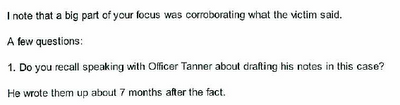
By the way, the e-mails also feature this Gottlieb-esque development from the DPD, as seen in this Curliss e-mail to Cline, about a DPD officer penning way-after-the-fact notes:
In Durham, it appears, some things never change.

Tracey Cline: Durham's Rick Perry? (Cont'd.)

Tracey Cline is the chief prosecutor for Durham County. Her job requires—among other things—a degree of intellectual facility. Chief prosecutors must write briefs, and think quickly on their feet in developing and articulating oral arguments.

Starting this spring, Cline stated that she would only communicate in writing with N&O reporter Andrew Curliss. And so e-mails flew back and forth between Cline and Curliss, as well as other N&O journalists and editors. In response to the “Twisted Truth” series, Cline demanded that the N&O make public all of these e-mails. Curliss tried to give her an out, noting that the e-mails featured her making factually erroneous statements. But Cline insisted.

Below are some excerpts from the e-mails. Everyone has typos in e-mails. But Cline repeatedly makes basic spelling mistakes—such as:


Cline also favors wild run-on sentences—the sort of writing that I often see from poorly-prepared freshmen, but would never expect from a chief prosecutor:


And I have absolutely no idea what Cline meant in this sentence:
Cline also tends to play the victim card—even as she noted in her interview with the N&O that she didn’t want to suggest she was a victim:


Politico recently ran a column with the blunt headline, “Is Rick Perry Dumb?” The e-mails suggest that Durham’s current DA is in Rick Perry’s intellectual league.

Tracey Cline: Durham's Rick Perry?

One of the most extraordinary videos of a politician I have ever seen was this interview of Gov. Rick Perry.

Asked a simple question, Perry not merely was unable to provide a coherent response, but he couldn’t intellectually engage with (or even process) data that contradicted his pre-ordained belief. It was almost as if Perry thought the interviewer was speaking Hebrew.

Listening to Cline’s July 2011 discussion with N&O journalists reminded me of the Perry interview. Cline’s chief complaint—which she also expressed several times in e-mails to the N&O—involved a claim that in March 2011 articles about the Derrick Allen case, the N&O hadn’t revealed that the state had turned over bench notes regarding SBI testing to the defense.

This complaint would have been serious, if true. But not only had N&O articles mentioned the fact twice, N&O staffers read to Cline, during their meeting, the relevant sections from the paper’s stories. Much like Perry in the abstinence clip, Cline reacted as if her interviewers were speaking a foreign language (except for when she said she had no complaint about Judge Orlando Hudson making the same alleged error of which she was accusing the N&O). She repeatedly pressed the N&O reporters and editors to see her point of view. They confessed they were unable to do so—and understandably, since Cline’s “view” was incomprehensible. Here’s the section of the interview:

Based on this . . . reasoning . . . Cline concluded that the “Twisted Truth” series had done her a grave “injustice.” She penned a rambling e-mail demanding that the N&O send reporter Andrew Curliss, plus the paper’s editors, to a Cline-arranged “town hall,” at which she would invite “the victims in the crimes of alleged misconduct,” representatives from the DPD, and local politicians. (In other words, she planned to arrange a Cline political rally.) The N&O editors declined, but expressed a willingness to have Curliss appear alongside her in a neutral forum, such as a moderated discussion by the WUNC public radio station. Cline didn’t indicate any interest in such an option.

Sunday, September 04, 2011

T. Cline, Esq., Paragon of Ethics (Cont'd.)

[Update, Tuesday, 5.11am: The third and final part of the series portrays a "minister of justice" who routinely flouts not merely the Supreme Court's Brady requirement (which mandates that all exculpatory evidence be turned over to the defense) but also North Carolina's open file discovery law (which mandates that all material be turned over to the defense). As with the first two parts of the series, Cline blames everyone else (the police, unnamed people in her office, procedures in her office that she claims to have changed, poor cooperation in one case with the FBI) for her failure to uphold legal ethics.

Viewing the articles through a lens most favorable to Cline, the series portrays a prosecutor who sees her role not as a "minister of justice" but as the representative of victims of crime, and who believes that her sole role as elected D.A. is to obtain convictions, by whatever means necessary. Through a more realistic lens, the series shows Cline to be fundamentally unethical, a prosecutor who believes that the rules don't apply to her.

One final note, on the similarities and differences between Nifong and Cline. Anyone who followed the lacrosse case will recognize the similarities--the willingness to mislead judges, bizarre rationalizations of negative DNA evidence, withholding exculpatory evidence while simultaneously (and sanctimoniously) proclaiming in public about having turned over all files.

But there's a very significant difference, as well. Cline, in this series, comes across as someone whose basic goal is to win at all costs, while breaking myriad rules in the processs. But there's no indication that she ever interfered in a pre-indictment police investigation--her rule-breaking always appears to have begun after indictments occurred--or that she has exploited a case for immediate political gain, as Nifong did. So there's something of a difference in motive, even as both chief prosecutors exhibited fundamentally and deeply unethical approaches to their position.]

[Update, Monday, 11.07am: The second part of the series should send chills to anyone who followed the lacrosse case. The case involved a claim of sexual assault against David Yearwood, in which then-ADA Cline misrepresented DNA findings to the court and withheld evidence from the defense attorney, all while she was claiming to go above and beyond the legal requirements by providing "open-file" discovery. Sound familiar?

A couple of passages to capture the flavor of Andrew Curliss' exposé, which I recommend in its entirety: "Cline told a judge that 'contact was insufficient' to capture Yearwood's DNA. She said the tests couldn't determine whether saliva found in the child's vaginal area belonged to the girl or to Yearwood. But the crime lab's work was clear about Yearwood: No forensic evidence, such as hair or fluids, connected him to the alleged crime, according to interviews and SBI records."

More: "Cline said she believes that she spoke accurately but that she relied in some instances on information that was available to her but is not in any record."

And a Nifongesque touch: "Long-settled law in the United States requires that defendants receive information the state gathers if it could be favorable to the defendant or if it would undermine, or impeach, a witness. Cline said in hearings during the Yearwood case that she went beyond that, giving 'open file' access. But records Yearwood's lawyers have not previously seen have recently emerged. The SBI's lab report and notes, as provided to Yearwood for his trial, are 12 pages. The SBI says its file is 71 pages. Investigators scraped Yearwood's fingernails, but he has no reports about testing on them. In one hearing, Cline said the police had dusted for fingerprints in the home, mentioning as many as 20 prints. But she said they couldn't be evaluated because they weren't 'workable.' No reports about fingerprinting were provided to Yearwood."

Tracey Cline was going to be Nifong's second chair if the lacrosse case had gone to trial. It's quite clear, based on the above, that she would have had no problems with his unethical handling of the case. The question now is how much she advised him, in private conversations, to follow his unethical course.]

The voters of Durham County elect a district attorney with a record of public, ethically-dubious behavior. Now possessed of more power than ever before, the “minister of justice” only intensifies the unethical conduct.

The two sentences above could apply to either of the last two district attorneys elected in Durham. Mike Nifong is, fortunately, disbarred, and can’t harm people anymore. Tracey Cline is, alas, still dispensing her brand of “justice” in the Triangle.

A blockbuster story, by Andrew Curliss, in today’s N&O shows Cline to be, at best, utterly indifferent to legal ethics; at worst, she is someone determined to break the rules on a consistent basis in order to win in court. The article’s thesis: “In her quest to convict those accused of serious crimes, Cline has misstated facts to judges in other cases, a News & Observer investigation shows. She has not provided evidence favorable to defendants, as is required under the U.S. Constitution, state law and ethics rules that govern lawyers. . . . Cline's conduct is under scrutiny for similar behavior in at least five cases other than Washington's that are in various stages of the courts, according to documents and interviews.

Today's article focuses on the Court of Appeals dismissing the conviction of Frankie Washington, on 6th amendment grounds. (That’s extraordinary in and of itself—though technically all defendants have a right to a speedy trial, the courts almost never enforce those rights.) The article shows that, in handling the case, then-ADA Cline was at best negligent and at worst lied outright on the witness stand (Washington’s attorney had called her to testify to ask why it took so long for the case to trial). Cline tried Washington on a procedurally dubious eyewitness ID, without forensic evidence, and without looking seriously into evidence that another man, a convicted criminal named Lawrence Hawes, actually committed the crimes.

Even now, almost incredibly, Cline refuses to ask the SBI lab to compare the DNA evidence in the case to Hawes’ profile, which they have on file. Why? "It was clear to me that Frankie Washington was the person who did it."There was never any doubt in my mind that he committed the offense."

Evidently, Tracey Cline “knows” the truth, evidence be damned. Does that sound familiar? But what more could be expected from a "minister of justice" who invited Mike Nifong to her inauguration?

Curliss also interviewed several jurors from the case, all of whom didn’t know the charges had been dismissed. They recalled that when deliberations had begun, considerable disagreement had existed, but that they had eventually based their decision to convict largely on the basis of eyewitness ID. Yet the police had never even included Washington as part of a lineup—instead, two witnesses, sitting in the back of a police car, got a look at Washington from a distance of 20 feet. Incredibly, Cline seemed to have no problem with sending someone to jail based on such police conduct: "Frankie Washington has very smooth skin around his eyes, extremely, very distinctive eyes," she said. "It was clearly a legal show-up."

The State Court of Appeals, more reasonably, wrote, "We are troubled by the Durham Police Department's use of a highly suggestive show-up procedure to identify defendant as the perpetrator of this crime."

The Court of Appeals opinion overturning Washington’s conviction is brutal in its description of the DPD’s behavior and Cline’s indifference to legal norms: “The circumstances of this case are unprecedented,” the court wrote, in that “even with more than four-and-one-half years of time to prepare its case, the State failed to completely analyze the evidence as ordered.”

More important, “the record contains overwhelming evidence that the actual reason for the delay in this case was not a neutral factor, but rather, was repeated neglect and underutilization of court resources on the part of the Durham County District Attorney’s Office.” Evidence was “not submitted to the SBI lab for analysis until 4 August 2005, which was more than three years after these items were collected.”

“The record reveals that during the prosecution, the State was given notice of evidence tending to establish the guilt of another person already in custody, yet the State failed to request that the SBI make appropriate comparisons of the evidence to this person.”

The opinion noted the Court’s concern with “the fact that the victims in this case were permitted to participate in several in-court identifications nearly five years after the date of the crime.”

And then the opinion zeroed in on Cline: “At trial, Assistant District Attorney Cline testified that it can take ‘years’ for the SBI to fully test an item. This assertion, however, is simply unsupported by the evidence of record.” Cline’s stunning response to the Court? “In an interview, Cline did not recall[!!] her testimony at the trial."

In a series of interviews and e-mails with Curtiss, Cline offered varying explanations/excuses for her behavior. “I would not sit in a courtroom and lie. I wouldn't," she said. "That is not who I am. And anybody that knows me will tell you that.” That a person who invites to her inauguration the only DA in Durham's history convicted of lying to the court, and who then cut the salaries of the people in her office most associated with championing legal ethics, can claim to be a truth-teller to the core is almost laughable.

On another occasion, Cline seemed to blame the system, almost as if violations of constitutional rights are inevitable and unavoidable, and a prosecutor doesn't have any independent role in upholding ethics: “Every day we go to court - or in every jurisdiction in North Carolina, South Carolina, probably all the 50 states - there's evidence that's thrown out because of constitutional violations. There's confessions that are thrown out. There's evidence that's suppressed. Everything. This happens every day because of a violation of someone's constitutional rights. And, to be sure, sometimes the guilty people go free."

A few broader points:

(1) Events in Durham since 2006 are Example A of the dangers of elected district attorneys. Based on the results of the 2006, 2008, and 2012 elections, a majority of Durham voters are indifferent to electing chief prosecutors who are, in turn, at best indifferent to adhering to basic legal ethics. The result is almost predictable—a D.A.’s office run by people who can’t tell the truth will invariably trample on defendants’ rights.

(2) Washington’s fate—and the fates of the other defendants who have suffered from Cline’s unethical behavior (and that of the DPD)—brings into relief the folly of how groups like the NAACP and supposed progressives such as Irving Joyner and Diane Catotti approached the lacrosse case and its aftermath. Rather than realize that it was likely that the behavior of Nifong (and Cline) and the DPD likely had threatened the rights of other defendants, they chose to function as Nifong apologists—thereby losing the chance to push for a full-scale review of how the DPD and the prosecutors associated with the lacrosse case had behaved in other cases.

(3) Will the State Bar inquire into Cline’s behavior?

Friday, September 02, 2011

Reminders

A few items from the last week serve as reminders of the lacrosse case.

First, a teaser from yesterday’s N&O front page, highlighting an article to appear Sunday (that I’ll blog) on Mike Nifong’s ethically-challenged successor, Tracey Cline.

Second, college football fans might have read about the arrests of two of LSU players (including the starting quarterback) for assault. LSU’s current athletic director is former Duke AD Joe Alleva—who demonstrated a rather uneven record in the lacrosse case: he shifted from initial public support for the lacrosse players to sudden silence, even as faculty members starting publicly going after student-athletes. All the while, he remained on the job despite being involved in a boating accident that resulted in alcohol-related charges against his son, before moving onto LSU at a higher salary.

Alleva’s comment on the football players’ travails? According to the Times-Picayune, “For his part, Alleva said the current problems facing the football team are "frustrating," but added that he understands how to handle delicate off-the-field issues from his experience around an alleged 2006 Duke lacrosse rape case that sparked controversy during his time as athletic director at the school.

“There's a lot of similarities in this situation," said Alleva, who has been at LSU since 2007. "I think it's always disappointing when student-athletes don't behave the way they're expected to."

A “lot of similarities” exist between the situations? Really? In the LSU case, no one appears to be denying that a fight occurred and that people were injured, though the players’ attorney has stated that his clients are innocent. (The lawyer has been careful not to deny that the players participated in a fight.) In the Duke case, on the other hand, the players’ attorneys consistently said that no crime occurred, and no physical evidence existed of any injury.

In the LSU case, the prosecutor and police appear to have behaved ethically—and, indeed, seem to have bent over backwards to ensure cooperation with the players. In the Duke case, on the other hand, both the prosecutor and the police cast legal ethics aside in an attempt to obtain convictions.

In the LSU case, there’s no evidence of race/class/gender-oriented faculty exploiting the situation to advance their pedagogical agendas (perhaps because one of the accused is a non-wealthy African-American, albeit one who owns no fewer than 49 pairs of shoes). In the Duke case, on the other hand, activist professors aggressively exploited the case, initially relying solely on the version of events presented by Mike Nifong—though most, in the 2007 clarifying statement, reaffirmed their rush to judgment even after Nifong’s case imploded.

In the LSU case, the accused players appear to have acted well outside the norm for LSU students (most LSU students, it would seem, don’t engage in bar fights). In the Duke case, on the other hand, the lacrosse players—along with hundreds of other Duke students, and thousands of students nationally—attended a tasteless spring break party; and—along with nearly 20 Duke groups over the course of the 2005-6 academic year, including some athletic parties—hired strippers.

Well, one similarity exists between LSU and Duke: Joe Alleva was the AD in both situations.

-----------------

And finally, consider this item from Cara Buckley in the New York Times, on the aftermath of the DSK dismissal of charges: “Experts said rape crisis centers usually see a drop in reported cases in the aftermath of high-profile sexual assault cases, especially those in which the prosecution failed, like the case against Duke University lacrosse players.”

Nifong clearly “failed,” but this doesn’t appear to have been Buckley’s meaning about “the prosecution.” In the lacrosse case, of course, Crystal Mangum's varying allegations were thoroughly investigated by the North Carolina attorney general's office. The special prosecutors' investigation used medical, DNA, and electronic evidence--as well as numerous interviews with Mangum, the two men euphemistically termed her "drivers," and lacrosse players who attended the party--to determine that the people Mangum accused were actually innocent, and that no physical contact of any kind between her and the accused could have occurred. Mangum, they concluded in a public report, had either lied or had come to believe her claims (which included, in their final version, an assertion of the rape occurring while she was suspended in mid-air) because of her serious, and longstanding, mental problems.

This process, obviously, was not the "prosecution" having "failed," given that the prosecutor's job is to achieve justice, not to obtain a conviction. Buckley—or her interviewees in the “victim’s rights” movement, whose viewpoint the article reflected—appear actually to maintain that any high-profile sexual assault claim, no matter how flimsy, that doesn’t yield a conviction, by hook or by crook, leads to diminished reports of sexual assault.

On another front, I invite readers to answer this SAT-style question: which of the following is NOT like the other?

a.) The DSK case, in which all sides admitted that sexual contact occurred, and in which a reasonable person could conclude that a sexual assault likely took place;

b.) A recent case involving two ex-NYPD officers, which yielded conviction on minor charges and in which the officer’s defense against rape was the highly implausible contention that he lay down in bed with a drunk woman to whose apartment he had been called but didn’t sexually assault her;

c.) The William Kennedy Smith case, in which all sides admitted that sexual contact occurred, and in which a reasonable person could (though I’d argue shouldn’t) conclude that a sexual assault likely took place;

d.) The Duke lacrosse case, in which no sexual contact of any kind occurred, and in which a state investigation was able to conclusively conclude that each of the accuser’s myriad tales was false.

I suspect that most test-takers would respond “d.” Yet Buckley’s article, reflecting the viewpoints of victims’ rights advocates, lumped the four cases together. And so either (a) given the disparity between press coverage of Mangum’s initial charges and of the players’ exoneration, many people, including potential rape victims, recall the event as initially portrayed, a likely sexual assault (thus implying continuing harm to the falsely accused players’ reputations); or (b) Buckley, whose article contained no quotes from any defense attorneys, buried the lede—that victims’ rights groups, for their own reasons, choose to link the lacrosse case with cases in which some doubt about guilt is actually plausible, in a manner that almost would have to raise suspicions that something must have happened in Durham.

On the latter point, in sentiments recalled the extremism of former SANE-nurse-in-training Tara Levicy, Buckley reports, "None of the women’s advocates interviewed expressed doubt in Ms. Diallo’s claim that she was assaulted." Ideological blinders work wonders.

The latter two items testify to the lasting reputational damage to the falsely accused players caused by the unethical actions of Nifong, the DPD, and figures such Levicy and Dr. Brian Meehan.

Monday, August 22, 2011

Durham & NYC

[Update, Tuesday, 3.45pm: On the Atlantic site, Andrew Cohen praises Vance's decision. His conclusion: "No one ever said the criminal justice system is pretty, or perfect, or capable of always delivering a narrative that has a clear beginning, middle, and end. There is no legal right to a happy ending -- or even a dispositive one. The leavening truth here is that the Constitution worked pretty much the way it is supposed to work in these circumstances. Under the Supreme Court's precedent in Brady v. Maryland, prosecutors have a duty to share with defense attorneys any exculpatory evidence they find. This the prosecutors did, to their eternal credit. Moreover, a district attorney has an ethical obligation not to try a case he or she doesn't believe can be won. This, too, the district attorney considered."

Cohen had a far different take, however, on the lacrosse case, writing in June 2006 that discussion about Mike Nifong's procedural misconduct meant that, in the media, “there is no balanced coverage in the Duke case. There is just one defense-themed story after another.” The lacrosse players, he claimed in apparent ignorance of the first month of the case, benefited from “race and money and access to the media.” And when the victims of a rush to judgment were college students rather than the former IMF head, Cohen's interpretation of legal ethics went as follows: “We haven’t seen all of the evidence, haven’t examined all of the testimony; haven’t had the privilege of seeing the case unfold at trial the way it is supposed to.”]

As I’ve noted previously, there were significant differences between the lacrosse case and the allegations against French politician Dominique Straus-Kahn: in the DSK case some type of sexual contact occurred; and even his version of events reflected poorly on the former IMF head's character.

It turned out, however, that the most significant difference between the two cases involved the office of district attorney. With the exception of an ill-timed public statement early in the case, Manhattan DA Cyrus Vance, Jr., followed both ethical guidelines and normal investigative procedures. Mike Nifong, of course, did not. A few items from the dismissal motion filed by Vance’s office:

Prosecutor’s Duty

Vance's office spelled it out in the dismissal motion:


Nifong, by contrast, spoke of false accuser Crystal Mangum as “my victim,” and as late as Dec. 2006 ignored basic ethics and described his role as purely a gatekeeper: “If she says, yes, it’s them, or one or two of them, I have an obligation to put that to a jury.” These comments came several weeks after what was perhaps his most chilling remark of the entire case, when he claimed that not the evidence nor even his beliefs but instead divisions within the community sufficed as a cause to bring the case to trial.

Continuing the Investigation

Consider these passages from the motion, describing the Manhattan DA office’s continuing investigation:

This investigation included a critical analysis of the medical evidence:

Nifong, by contrast, preferred willful ignorance; he claimed that, until his case imploded with the Dec. 2006 Meehan hearing, neither he nor anyone from his office asked Mangum anything about the case. And neither he nor his office appear to have challenged the ever-changing testimony of former SANE-in-training Tara Levicy.

If Vance and Nifong differed, some elements of the political and intellectual community evident in Durham carried over into New York.

Sunday's New York Times reported that "Bill Perkins, a state senator from Harlem, who like Mr. Vance, is a Democrat, stood alongside black and female leaders and urged Mr. Vance to press forward with the case . . . Mr. Perkins and others framed the case as a possible instance of a powerful white man getting off for something he did to a poor immigrant woman. . . . Councilwoman [Letitia] James said that if the case was dismissed over credibility issues,'it would have a chilling effect on all rape victims, and it would send a message to all rape victims that unless you are a perfect rape victim, you should not even bother to come forward.'"

There’s little reason to believe that James or Perkins will suffer any political repercussions for their indifference to due process; but if they do, they could discuss survival strategies with one of the most vociferous apologists for the DPD’s procedural shenanigans, City Councilor Diane Catotti, who remains in office, and seems likely to win re-election this fall.

Alas, the Durham Democrats have removed from their website the 2006 photograph of a beaming Catotti standing by her endorsed candidate for her city’s minister of justice, Mike Nifong. But even without the photo, based on her record in the lacrosse case, those who presume guilt in sexual assault cases and are indifferent to procedural misconduct by authorities have no better friend than Catotti.

Wednesday, August 17, 2011

Durham "Justice"

An explosive story in today's N&O, suggesting that the familiar patterns--concealment of evidence, lax ethics in the police and prosecutor's office--remain firmly in place in Durham. In this case, the behavior had a deeply unfortunate consequence: for the second time in nine months, a murder charge was dismissed on procedural grounds. Judge Orlando Hudson found "that the state and/or its agents have destroyed the evidence," violating the terms of the Brady decision.

Read the entire story, by J. Andrew Curliss, here.

A few noteworthy items:

--Durham County's "minister of justice," the ethically-challenged Tracey Cline, declined to comment, or offer any explanation to the public as to how her office has repeatedly run afoul of basic procedural guidelines.

--Hudson has promised "a very interesting order" outlining his findings.

--Cline couldn't even manage to get the small lies correct, as seen in this vignette regarding the victim's sister, Latifah White. From Curliss' article:
White had been testifying while wearing sunglasses, an accommodation allowed because Cline said she was legally blind. But in the midst of her testimony, the sister told the judge she was removing her glasses.

"Dorman is looking at me," [the supposedly blind White] said. She removed the glasses and stared at Dorman from the witness box.
Can anyone really be surprised that DA Cline isn't overseeing an ethically pristine office?

Thursday, August 11, 2011

Moneta & Holloway

The contemporary academic majority worships the trinity of race, class, and gender. Class is clearly the third wheel—unsurprisingly given that most tenured professors are well-off financially and secure in employment, and therefore don’t have a personal connection to the preferred ideological viewpoints on the issue.

The competition for primacy between race and gender, however, is less clear-cut. In a matter like the lacrosse case, where the preferred viewpoint on class, race, and gender all dictated a rush to embrace false accuser Crystal Mangum’s wild claims, the result—as we all saw with the Group of 88’s activities—can be vicious. But the rape of Katie Rouse, a white Duke student, by a local black man was met with utter silence from the Group. As I noted at the time, they seemed desperate to avoid making a politically difficult choice.
One Duke administrator, on the other hand, seemed positively eager to demonstrate that when push comes to shove, race trumps even gender. Larry Moneta responded to the attack on Rouse by issuing a statement casting blame on the victim. As he informed a local TV station, according to Liestoppers,"The situation was “part of the reality of collegiate life and of experimentation and some of the consequences of students not necessarily always being in the right place at the right time. This happens around the country. Duke is no different in that respect.”* 

Rouse has filed a federal lawsuit against Duke, claiming that the administration’s actions created for her a hostile educational environment. She took a leave from Duke shortly after the attack, and eventually left the university altogether, though under disputed circumstances. The initial complaint, filed by Bob Ekstrand, and Duke’s response go over the events of the case, but the two documents feature several notable items:

(1) Ekstrand claims that Duke administration never sanctioned the (African-American) fraternity at whose event Rouse was sexually assaulted.

(2) Both sides concede that Duke’s Stephen Bryan e-mailed senior administrators after Rouse was attacked—and highlighted the race of her attacker. In its response, Duke declines to explain what motivated Bryan.

(3) Ekstrand’s complaint alleges—and Duke’s response doesn’t seem to dispute—that Duke maneuvered (a cynical person might say manipulated) its internal procedures in fall 2007 to get Rouse out of the university. Then-dean Diane McKay (who’s now at Princeton) met with Rouse at the time to discuss Rouse’s desire to take some time off, and encouraged Rouse to write an e-mail stating a desire to transfer. Duke then took this e-mail as an indication that Rouse had voluntarily withdrawn from the university, rather than (as Rouse seems to have intended) a desire for additional voluntary leave as she recovered from the rape.

(4) Ekstrand tries to claim that university administrators had a legal obligation to follow the student handbook—a losing argument in light of Judge Beaty’s unfortunate decision in Carrington. Duke makes clear the documents have no legal weight at all, instead asserting “that Duke University published and made available its Undergraduate Student Bulletin and its Community Standards publications.” The bulletin, in short, isn’t worth the paper upon which it’s printed.

(5) Duke claims that deciding in Rouse’s favor would constitute a “denial of due process”(!) to defendants such as Moneta.

(6) One item in Duke’s response raised eyebrows: “Defendants admit that Crystal Mangum is an African-American Durham woman who falsely accused Duke lacrosse team members of rape.” [emphasis added] This admission appears to contradict a key element from the filings of former Duke attorney Jamie Gorelick, whose departure as the university’s lead counsel in the civil suits continues to lack credible explanation. Gorelick’s filings, it’s worth remembering, strongly implied that the judgment of former SANE nurse-in-training Tara Levicy was correct, and the findings of the AG’s report were wrong.
Duke, therefore, is simultaneously claiming that Mangum’s claims were false and that Levicy’s “medical” findings that corroborated Mangum’s rape claim were true.
-------------

During the lacrosse case, English professor (and a Duke. law faculty member who lacks a J.D.) Karla Holloway demonstrated an . . . unusual . . . conception of ethics in the legal arena. Abandoning the academy’s traditional fealty to presumption of innocence, she signed a statement affirming that something “happened” to false accuser Mangum. She then publicly criticized the Duke women’s lacrosse players who did stand up for presumption of innocence. And, after Mike Nifong’s case imploded, she penned a mass e-mail passing along wild sixth-hand gossip designed to make the falsely accused players look bad.
And yet the NIH has invited this same Karla Holloway to participate in a forum on . . . ethics.

Was Larry Moneta unavailable?

*--This section quoted from a Bob Ekstrand filing that he subsequently withdrew; I have modified the post for accuracy.

Friday, August 05, 2011

Tuesday, August 02, 2011

Legal Filings

In perhaps the least surprising legal development of the case, a unanimous three-judge panel from the North Carolina Court of Appeals affirmed a lower court's judgment that DNA Security had cause to fire former lab director Brian Meehan.

The court's description of Meehan's activity was blunt. Though his lab's tests indicated not one but two vital findings: "(1) there was no match between any of the specimens provided by the lacrosse players and the alleged victim; and (2) the alleged victim had recent sexual contact with multiple men who were not among the specimens provided," Meehan's "report obscured findings that exculpated the charged players." By using "opaque" language "instead of explicitly stating both conclusions," Meehan produced a report that "obscured the actual test results"--not even mentioning the critical second finding, and mixing in the first finding with additional irrelevant details.

The appeals court found that Meehan had no grounds to dispute his dismissal for just cause, given that he had, under oath, "explicitly stated that he knowingly violated his company's protocol and procedures." Meehan's dubious conduct, in turn, directly harmed his company's bottom line, since "DSI's business model depended on the reliability of the scientific research and its reports used by courts or law enforcement personnel for determining the probable guilt or likely innocence of those being tested." The contract between DSI and Meehan stated that the lab director could be fired for misconduct, and Meehan's behavior fit the bill: "Plaintiff's misconduct involves intentionally obscuring evidence and submitting an incomplete report in a court of law when clear explanation of the test results would have exculpated individuals wrongly charged."

The opinion also quotes at length from Brad Bannon's brutal examination of Meehan at the Dec. 15, 2006 hearing, and includes the following classic Meehan rationalization of his report: "I don't have a legal justification for it or a reason, okay."

-----------

In a partial setback to the three falsely accused players, Judge Beaty declined to certify their appeal of one aspect of his March ruling, namely his finding that as the City could not have delegated its policymaking authority to Nifong, the claims against Nifong in his “official capacity” are claims against the State (forbidden by the 11th amendment), not the City, and therefore "the City cannot be liable under § 1983 for 'official capacity' claims against Defendant Nifong or for alleged conduct by Nifong as a 'policymaker.’" In other words, Beaty found in a bit of torturous reasoning, Nifong had no lawful authority to take over personal command of the police investigation, and even though the city allowed him to do so, no legal claims can be filed against the city for its improper behavior.

Yet Beaty's ruling was something of a mixed bag on this point. He noted that: (1) the players would have an opportunity to appeal this aspect of his decision after the trial; (2) civil rights claims against the city continue to go forward on other grounds; and (3) perhaps most importantly, repeating an item from his March ruling, "the City is still responsible for its own policies that result in Constitutional violations by City employees, even if the City employees were acting in coordination with or at the direction of Nifong." In other words: unless the city can establish that its police officers refused to follow Nifong's unconstitutional orders (which, at least in the case of Sgt. Gottlieb, clearly was not the case), Durham is still on the hook.

---------------

Beaty's ruling also took note of a lengthy filing by Durham to the 4th Circuit, in which the "defendants have attempted to raise additional issues on appeal, beyond the limited denial of qualified immunity." (In a debatable ruling in June, Beaty delayed discovery for the city defendants while this appeal goes forward.) That filing, as reported in the H-S, featured little more than the city's fantastical interpretation of the case, in which city officials did nothing much wrong and the case was handled pretty well.

Also, in the only-in-Durham world: the head of Durham's Department of Social Services director was fired, in part--according to the H-S--because she did not vigorously contest a judge's decision to award temporary custody of two of false accuser/accused murderer Crystal Mangum's children to their biological father.

Remarkable.